Disappointing Accubond performance?

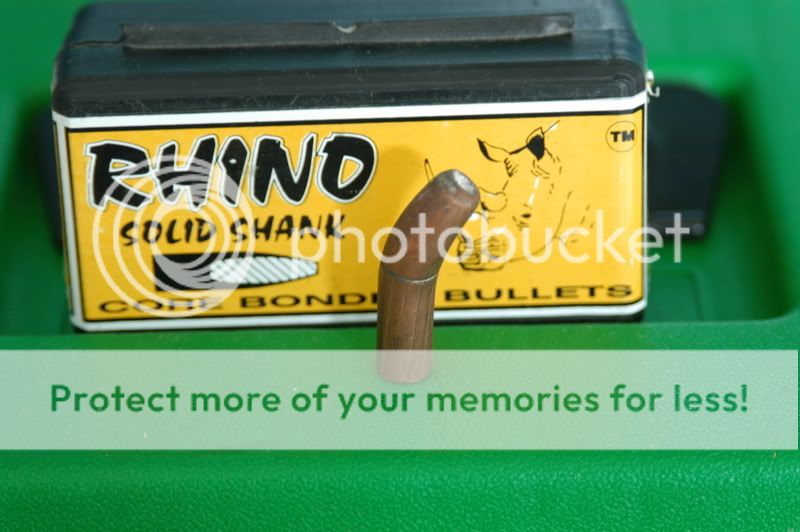
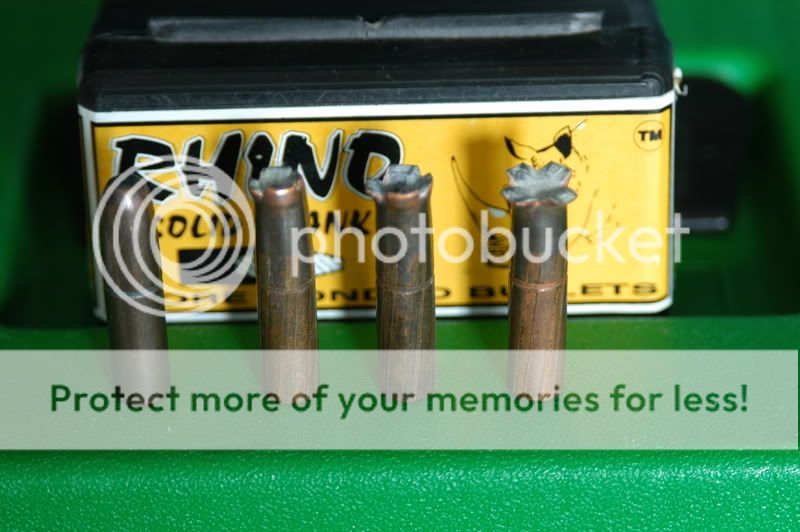
Don't know about Africa so much, I just hunt and shoot in a very small patch of saskatchewan, but when I test bullets as well as on game the pure copper bullets tend to over penetrate leaving animals to wander around wondering what happened. This only works well when the bullet is very wide and flat to begin with and little or no expansion occurs. For me, the key is a good hit in the vitals and plenty of expansion, though not so much as to inhibit penetration. If the animal is much thicker then our deer, moose, or bear, results with the overhyped (read:well advertised copper) bullets may be better. My first experience with this was when I fired some X-bullets into a barrel of frozen meat and bones that I test bullets with before I bait my bears. Some bullets expanded a bit, some bent, and some didn't expand at all, the ones that didn't expand penetrated the most. I got the bullets for free, thankfully I didn't spend money on them.

Ben, I am sure you are a nice guy. And sometimes you say some reasonably wise things. But your choice of test medium and opinions on certain well proven products created through your test often leave me with a lot to be desired. I would bet dollars to donuts lead and cup and core bullets will and have performed similarly in that medium. How many frozen animals have you shot in a barrel lately?
 
My experience has been that bullets need a wet medium to promote expansion and provide an indication of wound volume and the potential path of penetration. Consider the fiollowing pictures . . .

High Density Wet Medium (wet drill mud)
DSC_0008.jpg


Dry Medium, (across the grain of an old dry timber)
DSC_0011.jpg


Wet Medium, insufficient density (a hard snow drift)
DSC_0009-1.jpg
 
Don't know about Africa so much, I just hunt and shoot in a very small patch of saskatchewan, but when I test bullets as well as on game the pure copper bullets tend to over penetrate leaving animals to wander around wondering what happened.

I have heard of a few of the early X bulllets not expanding, but in my own experiences, the TSX/MRX/TTSX have always expanded well, and provided very quick kills. I have seen many more instances of deer running short distances after being shot with Partitions than with the newer Barnes bullets.
 
I have had limited but very good experience with the Accubond. I took a bull elk at 350 yds. with a .375 cal 260 gr. Accubond with an MV of about 2650fps. The first shot went through both lungs and out the other side. This tipped the bull over after three short steps. He was on the ground struggling as he bled out so I ended his struggle with a final shot to the neck. The second bullet travelled 3/4 of the length of the neck, clipped the spine and came to rest near the back of the skull. It retained a little over 80% IIRC. Upon field dressing, the chest cavity was mush and there was virtually no blood shot meat up the neck. Near perfect performance from my point of view.

I have heard stories similar to the OPs from higher velocity impacts, so maybe something akin to the TSX would be better for shorter shots at the higher MVs.???

P1040336.jpg
 
Contrary to what many people think, close range high velocity impacts often don't pass through with modern controled expansion bullets. Expansion is rapid and violent at high speeds and the bullets slows very quickly. I once shot a kudu at about 20 feet with a 338 and a 225 grain TSX and it didn't pass through. I wasn't surprised. The Accubond is a tough bullet. Most of my kills with it from my 270WSM have been pass throughs, other than the real close up or real long stuff.
 
Quartered away moving shot on moose at 150-200 yards with Accubonds. Tipped over with a shot through the lungs with a 140 grain 7mm-08. Bullet picked out of the opposite side hide... And what's wrong with Accubonds?
 
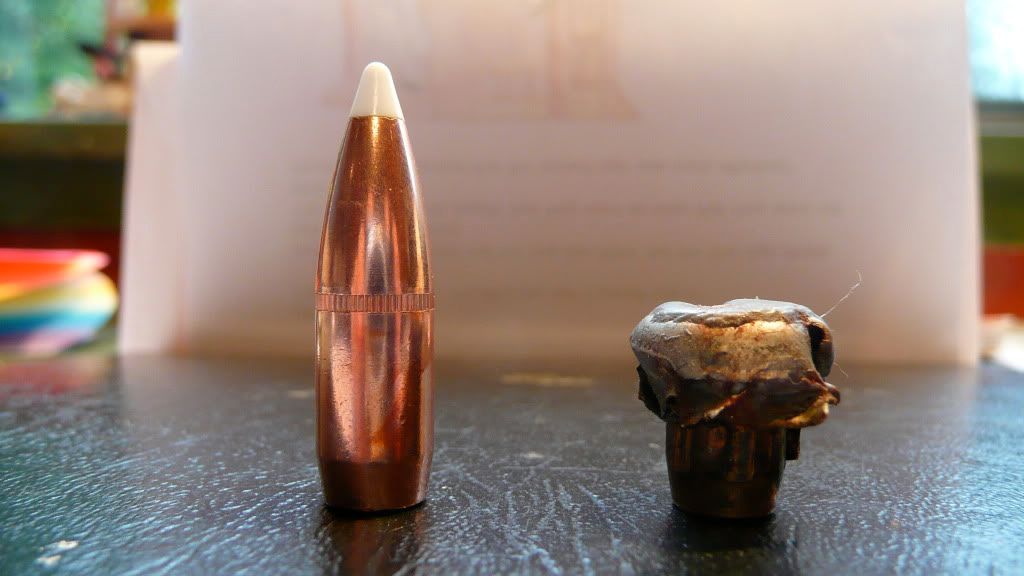
This is what caused the pancaking 3100fps and impact @ 60yds. I'm not sure you would have seen any better performance with a traditional lead bullet.

IMHO I want the bullets to leave all their energy in side the deer not a pass threw but that's just me.

That would mean that the energy is being wasted on the bullet fragmenting and deformance in stead of being delivered to the animal. The kenetic energy that follows the bullet is as damaging or more than the bullet itself. A Barnes bullet that has 100% weight retention is delivering all its energy on the target and will penetrate through with little effort yet open instantly on as little as a grape.
 
That would mean that the energy is being wasted on the bullet fragmenting and deformance in stead of being delivered to the animal. The kenetic energy that follows the bullet is as damaging or more than the bullet itself. A Barnes bullet that has 100% weight retention is delivering all its energy on the target and will penetrate through with little effort yet open instantly on as little as a grape.

Huh?

That makes no sense at all. How can kinetic energy "follow" a bullet?
 
I send 225 grain .338 cal Accubonds out at 3150 fps out of my .338 Ultra Mag. I have dropped a fair amount of game with them from whitetails to moose and elk. I have only ever recovered one of them and that was from a 43" bull moose. It looked like the perfect mushroom. They have always left a very large wound channel and exitted. Scary accurate too.
 
That would mean that the energy is being wasted on the bullet fragmenting and deformance in stead of being delivered to the animal. The kenetic energy that follows the bullet is as damaging or more than the bullet itself. A Barnes bullet that has 100% weight retention is delivering all its energy on the target and will penetrate through with little effort yet open instantly on as little as a grape.

Open up on a grape? That is fantastic, penetrate through with little effort? Deliver all it's energy? Truly a "wonder bullet"!!!
 
i think thats what they do, my swift sciroccos do the same , hit a deer @3200fps @ 25yds with 150gr and no exit wound,yet hit one at 200yds and it tore a huge hole out other side,

you cant have the slippery BC without losing somewhere else, partitions wont be as flat but would work way better on close high vel shots

once you get to 30-06 velocities both the partitions an abonds should behave more similar
 
That would mean that the energy is being wasted on the bullet fragmenting and deformance in stead of being delivered to the animal. The kenetic energy that follows the bullet is as damaging or more than the bullet itself. A Barnes bullet that has 100% weight retention is delivering all its energy on the target and will penetrate through with little effort yet open instantly on as little as a grape.

I have come to grudgingly admire the performance of TSX bullets even though I think they're a built backwards. Howevere, I believe your understanding of ballistic wounding in tissue is flawed. I suggest you read "WHAT'S WRONG WITH THE WOUND BALLISTICS LITERATURE, AND WHY" by Dr. Martin Fackler. Fackler is the preeminent expert on wound ballistics and the treatment of gunshot injuries and in his opinion, "A projectile crushes the tissue it strikes during penetration, and it may impel the surrounding tissue outward (centrifugally) away from the missile path. Tissue crush is responsible for what is commonly called the permanent cavity and tissue stretch is responsible for the so-called temporary cavity. These are the sole wounding mechanisms."
 
I suggest you read "WHAT'S WRONG WITH THE WOUND BALLISTICS LITERATURE, AND WHY" by Dr. Martin Fackler. Fackler is the preeminent expert on wound ballistics and the treatment of gunshot injuries and in his opinion, "A projectile crushes the tissue it strikes during penetration, and it may impel the surrounding tissue outward (centrifugally) away from the missile path. Tissue crush is responsible for what is commonly called the permanent cavity and tissue stretch is responsible for the so-called temporary cavity. These are the sole wounding mechanisms."

One of the links on the site I posted is Fackler's research.

http://rkba.org/research/fackler/wrong.html
 
I have come to grudgingly admire the performance of TSX bullets even though I think they're a built backwards. Howevere, I believe your understanding of ballistic wounding in tissue is flawed. I suggest you read "WHAT'S WRONG WITH THE WOUND BALLISTICS LITERATURE, AND WHY" by Dr. Martin Fackler. Fackler is the preeminent expert on wound ballistics and the treatment of gunshot injuries and in his opinion, "A projectile crushes the tissue it strikes during penetration, and it may impel the surrounding tissue outward (centrifugally) away from the missile path. Tissue crush is responsible for what is commonly called the permanent cavity and tissue stretch is responsible for the so-called temporary cavity. These are the sole wounding mechanisms."

Give this man a prize! Very well explained. Energy dump or transfer is nothing but a persistent myth. All that energy can be converted to is heat from friction. It's as you explain, the mass moving through the tissue that kills.
 
My bull elk this year was killed with a .30 cal 180gr accubond bullet. The shot was 320 yards (paced out). Bullet left the muzzle at 3080 fps [chronied]. It was a quartering away shot that entered just behind the near shoulder and was found under the hide in front of the opposite shoulder. It weighed 119 gr after I washed it [66% retention]. I was pleased.

Last year I killed a WT buck with a .284 cal 140 gr Federal Fusion bullet that left the muzzle at 3150 fps. The shot was only 150 yards, and I hit it higher than I wanted to, in the top of the lungs just under the spine. There must have been some shock or something to the spine, because it dropped instantly and couldn't get up. When I walked to it, it was still breathing, but only it's head and neck could move. I slit it's throat and let it die. Upon autopsy there was just a small hole on each side of the rib cage just below the spine. The bullet didn't expand at all, and I was lucky the deer died as quickly as it did.

This year I killed 2 WT's and saw another 3 killed, and also a mulie doe. Those 6 deer were all killed with .270's shooting 130 gr Sierra Game Kings. All were quick kills, and the SGK's did just as I had come to expect from them. They fly true, and expand reliably on game. The closest one was at 80 yards, and the furthest one was over 300 yards.


From what I've seen [not just from these stories, but from 20 years of hunting], using a bonded core bullet on a deer is less reliable than a cup-and-core like a SGK. I also see no need to use a magnum for deer, and any do-able shot on a deer [read: standing braodside within 400 yards] is easily done with a 270 or a 280, if you're practiced. These are what I prefer to hunt deer with, and to me are the ideal recipe for where I hunt.

The magnums {to me} belong on the 'elk and larger' type hunts. And the bonded core bullets belong there as well. The Accubond I used this year performed great, and I'll use it again next season.

But I wouldn't use the 300 magnum with 180 gr accubond on a whitetail. There's no need, and I'd be afraid the bullet wouldn't expand enough, and I'm surprised to hear about it pancaking.
 
Deer are usually targets of opportunity. Usually we're looking for moose or elk; hence the bigger-than-necessary guns, and loads. Plus, some of my hunting partners aren't gun nuts, so, when they're buying a gun, they buy it to hunt the biggest game that we'll be after because they're only looking to buy one gun (!!).

Otherwise, I agree. When it's just deer on the card, I usually pack my 7mm08; I just can't think of a more ideal deer cartridge.
 
This year I shot a small calf moose with my .338 Federal with 225 Hornaday Interbonds at an approx. 2450-2500 fps. I shot it in the throat first, then in the shoulder joint as it tried getting up to run for some nasty terrain. My plan was to smash through the shoulder joint and into the lungs, breaking his leg and demo'ing the vitals. The Interbond blew apart on the joint. It didnt touch the vitals.

TTSX's for me from now on.
 
Back
Top Bottom