To Flintlock or Not?

Suka

CGN Ultra frequent flyer
Rating - 100%
65   0   0
Looking for some advice. I will be doing some muzzleloader hunting next year. I may even do the whole season m/l. We currently have a Safari Arms and a JB Mountain Rifle, both in .54 percussion. A few yrs ago I hunted with the safari arms during regular rifle season.

I enjoy shooting them both, but the idea of a flintlock has always interested me. I have never shot one though, and hesitate to spend 600 on a new Lyman great plains to find out it's not my cup of tea, since lets face it, a used flinter isn't the easiest resell. Plus, I'm not a fan of the double/set trigger.

I know I blew it, there was one on the ee ahwile ago at a good price, I hesitated. (no icon for kicking yourself in the ass)

Since both wife and son also hunt, I'm not interested in selling one of our percussions to fund a flinter.

I'm sure I would enjoy a flintlock, but while I enjoy a good challenge, I lose interest in something that's a constant pain in the butt. How common are misfires, and how much do you have to #### around with the flints?

Any suggestions on both wether I should get a flintlock, and also a good reliable make in the lyman price range that's single trigger?
thanks.
 
You have lots of time before next hunting season to talk to flint-gun shooters and hopefully try before you buy. Contact the Alberta Black Powder Assoc. and try to attend a shoot where you can see good shooters use them and ask questions. That will greatly shorten your learning curve. With a good lock and some attention to detail, misfires can be quite rare. I actually find flinters easier to clean than percussion because of the shorter ignition channel in flint barrels.
 
a good flintlock is not that bad with a good flint and a well tuned lock(i dont think lyman tunes there locks i do know traditions does not)

you need to use real BP like goex BP no pyrodex,777,goex clear shot
 
Definitely a good idea to contact your local black powder shooters. If you come to one of their shoots chances are you will get a chance to shoot a flinter to see if its your thing. Chances are it is if you are already into traditional percussion guns. As said earlier you have a lot of time till next season. You might run into someone who has a good gun for sale at your local group too.

Cheers, Steve.
 
A good flintlock goes click boom. IMHO the height of perfection is a 20 or 16 gauge smooth bore that will let you hunt through every season on the calendar.

If you are worried about resale do not buy a new lyman buy a used one or better yet get a used custom gun.

Flintlocks are an awful lot of fun and represent 100s of years of development. A flintlock patterned after an 1800s mdl is the equivalent of a cartridge arm from 2200 A.D
 
I am not convinced that you have the patience for a flintlock. A good lock does not go click boom it goes boom almost instantly --- enough so that you cannot tell the difference from a percussion gun. While the Lyman is a good gun, I would not class their lock as top of the line and I suspect the whole gun is made in Italy and stamped with their name.

I am also not convinced that you would gain much by shooting a flintlock before buying one since you already appear to have some experience with percussion guns. Even though a good lock is very reliable there is also a learning curve in making them so. I strongly prefer english knapped flints and would not consider reknapping them to resharpen them a difficult task. The agate flints can be knapped sharp again but not nearly as easily as the english flints. For knapping I use a 3/16 diameter brass drift and strike it with my short starter (which is mallet shaped). Final thought is that use 3F Goex both for the main charge and for priming

About 80% of my muzzle loading shooting is with a flintlock and using a Siler lock and I think that I fire about 1000 shots per year with them

A final thought is that it is much easier to clear a dry ball with a percussion lock (there is them that has and them that is going to)

cheers mooncoon
 
Good flintlocks are a hoot to shoot.
I find them as fast as a cap, or faster with a bit of care. A sharp flint and a good sparking frizzen are very reliable. Just remember to clean the touch hole between shots. Real Black powder ignites very fast and easy. I use 4F in the pan, it is faster than 3F in the pan.Don't over fill the pan with primer. A bit is all it needs.
You can change the trigger from a set to a single in 2 minutes if you don't like set triggers.
My Deerstalker from Lyman had a bad frizzen that would not spark I replaced the lock with a L&R and it showers sparks. Lyman replaced the frizzen and I had no warranty and now that lock showers sparks too.
I realy like the Hawken from TC, it's lock is a good sparker too. Typicaly I can get 60 to 70 shots from a flint before knapping the edge or changing it.
You can get good deals from people with a flinter because it won't spark for them. A new Frizzen for 20 bucks and a sharp flint set properly is all you need to fix it. Sometimes all you need to do is remove gun oil from the frizzen face.

Pete
 
First off, I don't own a flintlock, but have shot different versions, and intend on getting at least one (which will undoubtedly multiply) in the future.

My only mention would be that in poor weather, or very very very damp weather any fine powder in the pan might get a bit wet/fussy. I've only seen it once, and it was cold and very damp.... we were high enough up that fog and low cloud was rolling through the range and leaving water droplets on everything... in those conditions, flinters can get fussy unless they're sealed up tight.

Personally, if you're looking for a challenge, I'd get one. They're more elegant than a lot of cap locks and in some ways better (smoothbores are lighter, which is a preference for me, as they're more common in flinters than cap locks in my limited experience).
 
First off, I don't own a flintlock, but have shot different versions, and intend on getting at least one (which will undoubtedly multiply) in the future.

My only mention would be that in poor weather, or very very very damp weather any fine powder in the pan might get a bit wet/fussy. I've only seen it once, and it was cold and very damp.... we were high enough up that fog and low cloud was rolling through the range and leaving water droplets on everything... in those conditions, flinters can get fussy unless they're sealed up tight.

Personally, if you're looking for a challenge, I'd get one. They're more elegant than a lot of cap locks and in some ways better (smoothbores are lighter, which is a preference for me, as they're more common in flinters than cap locks in my limited experience).

if you have a well tuned lock theres no need for fine powder(4f) you can use 2f in a well tuned lock and a well make lock the pan to frizzen fit will be good enough to keep water out of it also a leather cover helps
 
My only mention would be that in poor weather, or very very very damp weather any fine powder in the pan might get a bit wet/fussy.

They're more elegant than a lot of cap locks and in some ways better (smoothbores are lighter, .

Part of the trick is to keep a strip of cloth tied to your possibles bag and use that to dry the pan and particularly the bottom of the pan cover. A wet pan cover will foul any powder it touches. In rain you need some sort of cover both to keep the water out of the pan and prime under.

My present principle gun is both swamped and tapered and while it is slightly heavier than a smoothbore, it is not a lot heavier. I definitely find a one inch barrel to be fairly heavy for packing around or for holding steady

cheers mooncoon
 
It's all in the quality of the rifle and especially the flint. An old friend (www.clarkindustries.on.ca) makes rifles that will fire every time.

Another old friend (sadly passed away) was a professional flint knapper. Any rifle he had fired every time. He came to my farm one time and we shot his Dixie .45 Pennsylvania rifle all afternoon without a misfire.

At many Rendezvous I have attended the flintlock shooters would hold up the fun because of no sparks at all or the Flash-in-the-pan. One guy got 1 shot off all afternoon! He was using a good quality Thompson/Center Hawken.

At the last Rendezvous I attended this year another friend used Jim Shockley's Gold Powder as his main charge with FFFFg for priming in his Traditions .50 cal Pennsylvania rifle. He only had one misfire.

Good luck with your flintlock - I think you'll enjoy it.
 
I had 2 lyman great plains in .54, one percussion, and one flintlock. The only thing I have to warn you about them is the weight. These are very very heavy guns for hunting. As far as misfires, if you keep the flashole clean, and your powder dry you shouldn't have a problem, or atleast I never did. The other added bonus is you skip out on registering, and its not classed as a firearm. I did a little hunting with my lyman flintlock, the delay between the flash and the fire is no worse than the snap of a bow and the flight of the arrow.
If you buy one I hope you enjoy yours as much as I did mine.
 
An old friend (www.clarkindustries.on.ca) makes rifles that will fire every time.

Just got off the phone with Mr clark. He is tooling up to produce fowlers in the new year. Nice fellow to talk with and obviously knowledgable as heck. Said he cast his first lock in 1970! Not sure but I can't imagine there are many builders out there that start the build process with his own lost wax castings!
His other shop business is plane props I am thinking he understands accuracy.

I am gonna send in an order for a couple of his locks seems like a better long term investment then DOW 30 stocks.
 
I knew John way back, when he was first starting up. The dies for his "Clark" lock were beautiful! We were making do with epoxy dies for our waxes, his were machined aluminum. He was, and is, an outstanding craftsman. Haven't been in his shop for years, really should make a point of dropping in.
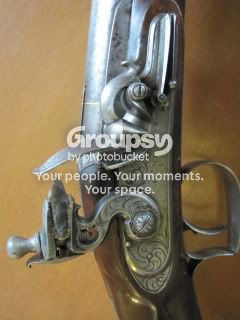
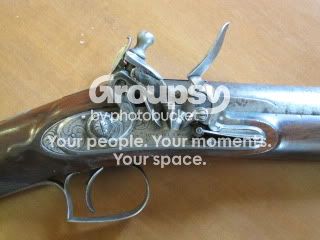
I've posted these before, but speaking of "waterproof" locks, here are photos of a "London Best" lock with all the bells and whistles from 1822.
If you look carefully, you can see that there is a loop surrounding the vent. This is part of the lockplate. The frizzen is fitted against this, rather than being up against the barrel. The loop is tight against the barrel, but is stationary, of course. The pan and frizzen are arranged to shed moisture. Lock has all the friction reducing features, inside and outside. Patent breech, platinum vent. Springs are firm, action is very snappy.
003-1.jpg

001-1.jpg
 
cast locks are nice but forged locks are even better and a forged lock get even nicer if its made from wrought iron of corse a well made forged lock is about 10 times a well tuned cast and cut steel parts lock

ive been playing with my new forge i just got a book that tells you how to forge a lock this book was touched by the master lock maker him self jim chambers (thats who i bought it off of )
 
Back
Top Bottom