












































You are using an out of date browser. It may not display this or other websites correctly.
You should upgrade or use an alternative browser.
You should upgrade or use an alternative browser.
To Flintlock or Not?
- Thread starter Suka
- Start date
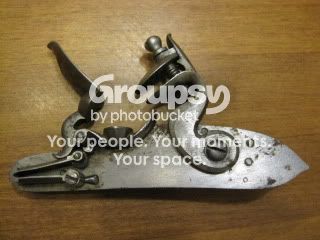
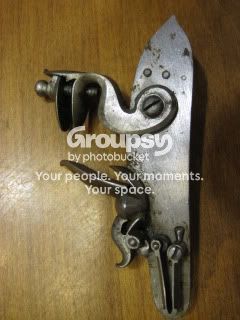
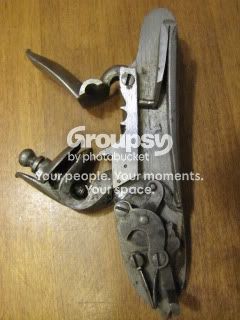
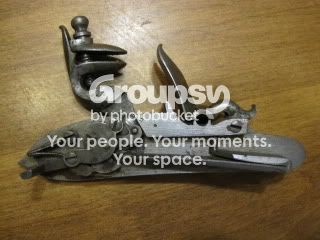
Here is a cute little left hand pistol sized lock. It is an unused, unfinished, untuned antique original. Even though it is petite, it is sprung in such a manner that it can fit against a musket barrel. This one has a semi-waterproof pan.
- Location
- windsor,ontario
Please explain in detail how a forged lock is ten times better than a cast and cut one.
You reference to wrought iron is particularly interesting.
its just more appealing to the eye thay look alot better and if done right it can be better on wear and you can forge your frizzen out of high carbon steel
it cost alot more because it takes more time to finish one VS cast and cut
and theres things you cant do with cast like wrougth iron and like im going to do for my double when i get to it damascus (my barrels are twist damascus im going to do twist pattern damascus lock parts butt plate and trigger guard)
John Clark, mentioned above, was having his frizzens cast using 52-100 steel when I knew him. Nigh on 40 years ago. That is high carbon steel with a vengance.
Given equal degrees of finishing, there is no difference in the appearance of forged and precision cast parts.
Wear is determined by alloy and heat treatment, not by how things are made.
Wrought iron is dead soft unless case hardened, and is of little use in a lock, except perhaps for the plate, which is basically just a chassis for the working parts. Incidentally, where are you getting your wrought iron?
Modern casting techniques permit the use of sophisticated steel alloys.
Which lockparts are you going to pattern weld?
PLEASE show us some pictures of your work.
Given equal degrees of finishing, there is no difference in the appearance of forged and precision cast parts.
Wear is determined by alloy and heat treatment, not by how things are made.
Wrought iron is dead soft unless case hardened, and is of little use in a lock, except perhaps for the plate, which is basically just a chassis for the working parts. Incidentally, where are you getting your wrought iron?
Modern casting techniques permit the use of sophisticated steel alloys.
Which lockparts are you going to pattern weld?
PLEASE show us some pictures of your work.
- Location
- windsor,ontario
John Clark, mentioned above, was having his frizzens cast using 52-100 steel when I knew him. Nigh on 40 years ago. That is high carbon steel with a vengance.
Given equal degrees of finishing, there is no difference in the appearance of forged and precision cast parts.
Wear is determined by alloy and heat treatment, not by how things are made.
Wrought iron is dead soft unless case hardened, and is of little use in a lock, except perhaps for the plate, which is basically just a chassis for the working parts. Incidentally, where are you getting your wrought iron?
Modern casting techniques permit the use of sophisticated steel alloys.
Which lockparts are you going to pattern weld?
PLEASE show us some pictures of your work.
the plate for sure and the pan maybe the hammer i will not be making the locks untill spring comes
wrough iron locks have the hammer and lock plate made from wrought iron for the most part the rest is made with high carbon

there is a fellow on the ALR who makes locks from wrought iron and completely by hand. Even his screws are made with a screw plate rather than a modern die and the threaded holes start out with a hand made somewhat D bit style of drill followed by a tapered square reamer. He makes every part himself literally and does a superlative job of it. He normally sells completed guns but estimated the cost to buy a lock only would be about $1000 That is a lot more than I would chose to pay for a good lock. Another fellow on the ALR makes complete locks which are extremely good and makes the parts some from castings and some from scratch. His locks are $300 and I think he only makes a small number of types or patterns. At least some of you have probably heard of him ---Bob Roller
cheers mooncoon
cheers mooncoon
the plate for sure and the pan maybe the hammer i will not be making the locks untill spring comes
How about posting some photos of guns / locks that you have made.
cheers mooncoon
I don't want to put myself too far back in line but while on the topic of Mr Clark his prices for his lancaster rifle kit and long rifle kit are crazy cheap for what he offers. Anyone thinking on a build would do well to check his web site. for 800 bucks all that is left to do are the idiot proof fun parts. full inletting, vented, lugs, pin holes drilled etc etc. Oh yeah and Canadian Maple wood.
I for one am gonna buy up a few of his complete locks and lock kits while we are still lucky enough to have a chance at them. Made in Canada! and they are engraved J Clark Toronto. How cool is that.
Tiraq that south paw pistol lock has me green with envy. Any idea where it was made? Sure would look some nice on a scaled 40 cal fowler. Let me know when you are having your yard sale. LOL
I for one am gonna buy up a few of his complete locks and lock kits while we are still lucky enough to have a chance at them. Made in Canada! and they are engraved J Clark Toronto. How cool is that.
Tiraq that south paw pistol lock has me green with envy. Any idea where it was made? Sure would look some nice on a scaled 40 cal fowler. Let me know when you are having your yard sale. LOL
It is entirely unmarked. I am assuming that it is English in origin. I've owned it perhaps 40 years; I know that I had it before 1974. You can see the chisel marks from when the pan basin was opened out. David - you would not believe the stuff I have acquired over the years. At least I have a very large yard for the sale.
Wrought iron... True wrought iron is a pretty rare item now-a-days. According to one of my blacksmithing texts, the last producer was in Sweden, and this was some years ago. At that time, about the easiest source for wrought iron was old salvage material, particularly old wheel tires. Forge welding mild steel is a different kettle of fish than welding traditional wrought iron.
Some welded barrels are just iron, others are welded up from iron and steel, to produce the patterns.
Some of the pattern welding being done by knifemakers these days is remarkable.
I do the machining needed by an 80+ year old blacksmith who lives about 20 miles from me. He has a large supply of proper forge coal, and has offered me all I need. Of course, a lot of smithing is done these days with gas forges. I have two blowers, one cranked and one driven by an electric motor. Always used gas before I moved, but I now have a good spot to build a coal forge near my shop. My forging experience is limited to blades and springs. I've never tried a pattern welded blade.
What I do need is to find an iron foundry that would pour a couple of small castings for me, to restore a Michael Mater, Chippawa CW target pistol.
So, camerl2009, please show us examples of any pattern welded items you have made.
Wrought iron... True wrought iron is a pretty rare item now-a-days. According to one of my blacksmithing texts, the last producer was in Sweden, and this was some years ago. At that time, about the easiest source for wrought iron was old salvage material, particularly old wheel tires. Forge welding mild steel is a different kettle of fish than welding traditional wrought iron.
Some welded barrels are just iron, others are welded up from iron and steel, to produce the patterns.
Some of the pattern welding being done by knifemakers these days is remarkable.
I do the machining needed by an 80+ year old blacksmith who lives about 20 miles from me. He has a large supply of proper forge coal, and has offered me all I need. Of course, a lot of smithing is done these days with gas forges. I have two blowers, one cranked and one driven by an electric motor. Always used gas before I moved, but I now have a good spot to build a coal forge near my shop. My forging experience is limited to blades and springs. I've never tried a pattern welded blade.
What I do need is to find an iron foundry that would pour a couple of small castings for me, to restore a Michael Mater, Chippawa CW target pistol.
So, camerl2009, please show us examples of any pattern welded items you have made.

I don't want to put myself too far back in line but while on the topic of Mr Clark his prices for his lancaster rifle kit and long rifle kit are crazy cheap for what he offers. Anyone thinking on a build would do well to check his web site. for 800 bucks all that is left to do are the idiot proof fun parts. full inletting, vented, lugs, pin holes drilled etc etc. Oh yeah and Canadian Maple wood.
I for one am gonna buy up a few of his complete locks and lock kits while we are still lucky enough to have a chance at them. Made in Canada! and they are engraved J Clark Toronto. How cool is that.
Tiraq that south paw pistol lock has me green with envy. Any idea where it was made? Sure would look some nice on a scaled 40 cal fowler. Let me know when you are having your yard sale. LOL
I like them, but I'm not ready to call it crazy cheap.
the fellow on ALR gets his wrought iron from salvage material including wagon wheel rims. There was one fellow on ALR who owned a wrought iron framed greenhouse (a big one) that he is dismantling and intends to sell the iron. I know of several hundred pounds of wrought iron which is in Departure Bay just a few hundred yards from the ferry terminal but you would need to be fast and have a 60 foot boat with a good winch and strong boom to get it (plus dive). 30 or more years ago I was one of several divers who recovered an anchor from a square rigger there and left an unknown amount of roughly 1 1/2" chain on the bottom.
cheers mooncoon
cheers mooncoon
crazy cheap:
yeah 800 is alot of money but when you compare to what else is available it is excellent value. I have a soft spot for quality.
$800 is not bad at all. but I saw $1200.
Am I wrong?
the fellow on ALR gets his wrought iron from salvage material including wagon wheel rims. There was one fellow on ALR who owned a wrought iron framed greenhouse (a big one) that he is dismantling and intends to sell the iron. I know of several hundred pounds of wrought iron which is in Departure Bay just a few hundred yards from the ferry terminal but you would need to be fast and have a 60 foot boat with a good winch and strong boom to get it (plus dive). 30 or more years ago I was one of several divers who recovered an anchor from a square rigger there and left an unknown amount of roughly 1 1/2" chain on the bottom.
cheers mooncoon
I have a smallish wrought iron stair railing I'm getting ready to change out for oak.
- Location
- windsor,ontario
I have a smallish wrought iron stair railing I'm getting ready to change out for oak.

I'll give it to someone that wants it.
I would rather buy the parts already manufactured by those that know how.

Somebody's going to be happy 
Just curious though - any idea on the age of said staircase? True wrought iron hasn't been used or produced in much quantity for quite a while now and has been replaced with mild steel. It's pretty much a "potayto potahto" kind of discussion, but older wrought iron does have some unique traits that you can't find in modern produced metals. I've never found a project that I particularly would have preferred wrought iron over something else, but it's nonetheless different and historically accurate.
haha - I definitely have a hard time spending $800 on a flinter that isn't assembled, but only because I'm cheap.... you can see the quality in these guns.... I quite like the lancaster but it's even more expensive!!!
Just curious though - any idea on the age of said staircase? True wrought iron hasn't been used or produced in much quantity for quite a while now and has been replaced with mild steel. It's pretty much a "potayto potahto" kind of discussion, but older wrought iron does have some unique traits that you can't find in modern produced metals. I've never found a project that I particularly would have preferred wrought iron over something else, but it's nonetheless different and historically accurate.
crazy cheap:
yeah 800 is alot of money but when you compare to what else is available it is excellent value. I have a soft spot for quality. These things never seem like much till the day they are no longer available.
haha - I definitely have a hard time spending $800 on a flinter that isn't assembled, but only because I'm cheap.... you can see the quality in these guns.... I quite like the lancaster but it's even more expensive!!!
I have a smallish wrought iron stair railing I'm getting ready to change out for oak.
It would have to be at least 100 years old and probably 130 years plus to be true wrought iron. Today people call mild steel bent in twirly ques wrought iron.
I think tiny amounts of wrought iron were produced up to about 1920 but I also think that by perhaps 1880 most of the production had ceased. The bessemer process came out in 1854 producing homogenous controlled carbon iron and that would spelled the beginning of the end.
If you file and draw filed a piece smooth and bright then rubbed with copper sulphate you should see lines or perhaps blotches in true wrought iron. In the case of the anchor chain that I mentioned above, rusting left ridges much like a wood grain in the metal.
cheers mooncoon
Not sure how well this photo will turn out; Photobucket seems to have morphed yet again. Anyway, what I hope can be seen in the photo is the barrel of a gun that was made between and which has elongate blotches of light and dark of high and low carbon areas. A longitudial weld line looks very similar but in the case of wrought iron, the blotching goes all the way around the barrel. By the 1850s wrought iron appears to have been run through rollers a few times and the pattern has become fine longitudinal lines fairly close together
cheers mooncoon

cheers mooncoon
$800 is not bad at all. but I saw $1200.
Am I wrong?
we were both wrong:
from clark industries web site
This rifle is also available in kit form with a fully shaped and inletted stock, barrel installed, and ramrod hole drilled. A full size measured drawing is included with several articles on gun building written for Rendezvous and Longrifles Magazine in the 1980's.
With Hard Maple stock - Price: $750.00 CDN (inludes Parcel Post)
ORDER# CLR-001
Yep that is 'crazy cheap' but not as cheap as Hwally LOL. Wally go take a look at what he is offering even for you it should sit well (BTW I have a lot of respect for you and for your frugal nature). For the same money you could pay shipping/duty from the USA for a DOM tubing barrel, sketchy partial inletting, a gamblers breech job and a hundred dollar lock.
It really is the best deal out there.






















