












































You are using an out of date browser. It may not display this or other websites correctly.
You should upgrade or use an alternative browser.
You should upgrade or use an alternative browser.
Sako brass very hard
- Thread starter mbogo3
- Start date

I have once fired .222 Sako brass from the 50's and after first reloading the cases split?They are in an orange and blue box..........Harold
Try annealing them and give it another go.

BattleRife
CGN Ultra frequent flyer
- Location
- of No Fixed Address
Most likely they have picked up a corrodent that has induced stress-cracking. Annealing will reduce the stress and eliminate the problem, but it wouldn't hurt to thoroughly wash and tumble them, too.
Please provide a reference that agrees that 70-30 brass will age harden in anything short of a million years.
They have age-hardened. Anneal them.
Please provide a reference that agrees that 70-30 brass will age harden in anything short of a million years.
BR;
I have had quite a few rounds of old factory non corrosive amunition split in the necks without being fired, still new in the box. That's all the proof I've needed that bullet tension may split brass as it gets old. If it's not getting harder and brittle the alternate would be it wasn't properly annealed in the first place. Corrosion can play a part but I doubt it's the case in the instances I've witnessed. I suppose you doubt that it will work harden from repeated sizing too? That can occur in much less than your conjectured million years.
I have had quite a few rounds of old factory non corrosive amunition split in the necks without being fired, still new in the box. That's all the proof I've needed that bullet tension may split brass as it gets old. If it's not getting harder and brittle the alternate would be it wasn't properly annealed in the first place. Corrosion can play a part but I doubt it's the case in the instances I've witnessed. I suppose you doubt that it will work harden from repeated sizing too? That can occur in much less than your conjectured million years.
Battle Rife: My apologies. I don't have a reference that directly states age hardening. What I do have is an old Lyman manual that refers to season cracking. I haven't referred to it for many years. I'm afraid with the passage of time I assumed they meant the same. They don't. Season cracking in necks and shoulders over long periods of time is caused by internal stresses in the brass where cracks originate from under bullet tension or from early resizing. You are probably correct that unfired brass does not harden solely from it's age. Modern factory annealing methods have pretty much eliminated this it seems because later manuals make no reference to it that I could find.

BattleRife
CGN Ultra frequent flyer
- Location
- of No Fixed Address
What I do have is an old Lyman manual that refers to season cracking. I haven't referred to it for many years. I'm afraid with the passage of time I assumed they meant the same. They don't. Season cracking in necks and shoulders over long periods of time is caused by internal stresses in the brass where cracks originate from under bullet tension or from early resizing.
If you Google or Wikipedia "season cracking" you will find that it is an obsolescent term for the mechanism that is now known as stress-corrosion cracking. Stress-corrosion cracking was what I meant to type when I wrote "stress-cracking", but my mind got ahead of my fingers. A corrodent is required, stress alone will never cause brass to crack by itself. Ammonia, nitrate and mercury compounds are all notorious at cracking brass. The case will not necessarily look corroded, it simply cracks as the corrosion is focussed entirely at the crack tip. Microstructurally, the crack cleaves through the brass grains or separates them from each other, leaving a very brittle looking fracture, but if you do an impact test on the material it is not brittle. It looks like this:
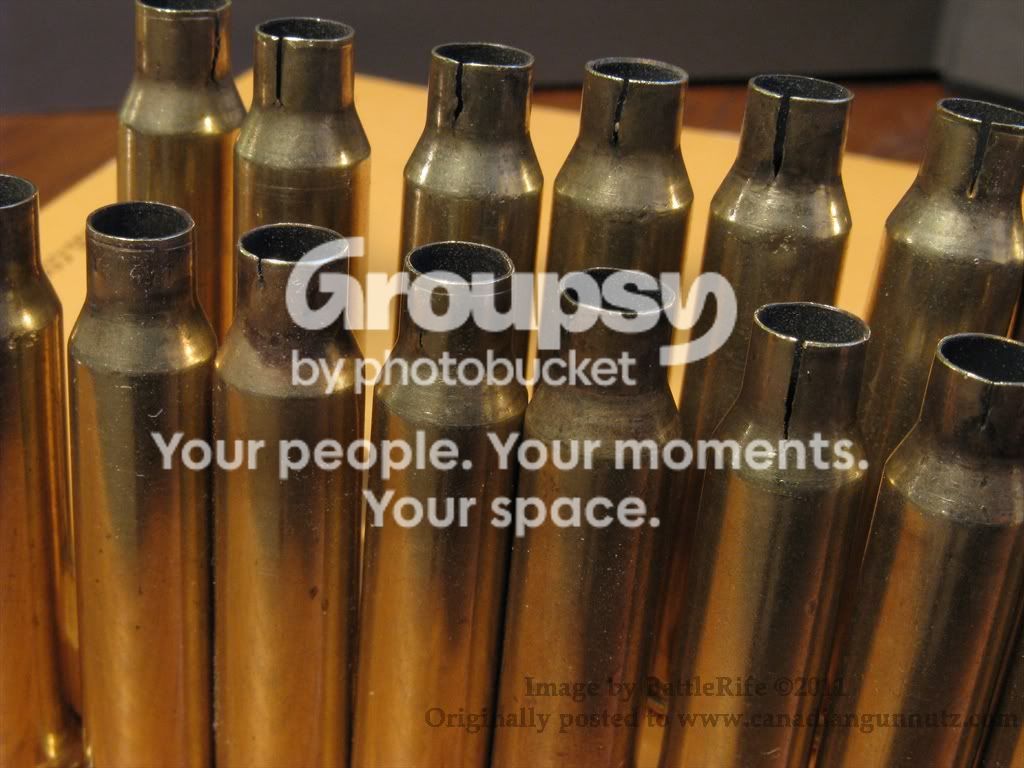



And funny you would bring it up, but it so happens that I do not believe in work hardening, at least as a common failure mechanism in brass cartridge cases. Lots of tests have shown rifle cases will take dozens of loadings in a short period without cracking, but if I load them then store them, sometimes they fail in as few as 3 loadings. I have looked at the metallurgical condition of enough of my failed cases (and cases that were fired a dozen times without failing) to convince myself that if they failed in less than 20 cycles, they didn't fail by work hardening. Some people get that kind of life, but apparently something in my basement or my reloading/shooting routine is contaminating my brass.

Some people get that kind of life, but apparently something in my basement or my reloading/shooting routine is contaminating my brass.
I remember reading an article by Rick Jamison early in his career (yeah, I'm that old
 ) in which he made a similar assertion -- that brass cases don't work-harden or age-harden, but generally fail by means of contamination/corrosion, and often simply through airborne means. There's probably an argument here to not clean firearms (with those wonderful ammonia-based solvents we tend to use) in the same room in which ammo is stored...
Battle Rife: I'm glad I went looking for references as we may all get an education here. I'm sure there are a lot of reloaders without the specific technical knowledge required to sort the wheat from the chaff. So, if 20 or so relaoding manuals describe a specific failure over many years of publication we assume they know what they are talking about. Perhaps they were simplifying their explanations.
My gun cleaning area is separate from my reloading area but only by a different room. I don't use much ammonia based cleaner as most of my shooting is with smokeless cast bullet loads and I don't tumble cases and use cleaners for that purpose. That is not to say a contamination can't/doesn't occur but the odds are reduced. But I do use the usual range of solvents and thinners for other shop work and they do get around. I have recently read that some primers still contain corrosive properties in minute quantities despite being described as non-corrosive. Might not take much if conditions in a case make it vulnerable.
The new in the box splits I mentioned were a specific brand of ammunition. Also, most neck failures I get from actual usage are mainly of the same manufacture and I anneal any of those cases that can't be readily replaced with new cases. The annealed cases then seem to last indefinitely.
Have you noted anything specific related to manufacturer as regards case splitting? I am not mentioning a name as it may just be co-incidental and related to the volume of that makers brass I have used over the past 60 years.
I also recall the Jamison article and he was quite broadly verbally criticized for it among reloaders if memory is correct. It flew in the face of what others believed and had read from what were believed to be reliable sources. He may have known more than was commonly accepted.
The granular makeup of the picture that shows complete separation appears different from the splits. Was that a lower case separation? Excellent pictures by the way.
My gun cleaning area is separate from my reloading area but only by a different room. I don't use much ammonia based cleaner as most of my shooting is with smokeless cast bullet loads and I don't tumble cases and use cleaners for that purpose. That is not to say a contamination can't/doesn't occur but the odds are reduced. But I do use the usual range of solvents and thinners for other shop work and they do get around. I have recently read that some primers still contain corrosive properties in minute quantities despite being described as non-corrosive. Might not take much if conditions in a case make it vulnerable.
The new in the box splits I mentioned were a specific brand of ammunition. Also, most neck failures I get from actual usage are mainly of the same manufacture and I anneal any of those cases that can't be readily replaced with new cases. The annealed cases then seem to last indefinitely.
Have you noted anything specific related to manufacturer as regards case splitting? I am not mentioning a name as it may just be co-incidental and related to the volume of that makers brass I have used over the past 60 years.
I also recall the Jamison article and he was quite broadly verbally criticized for it among reloaders if memory is correct. It flew in the face of what others believed and had read from what were believed to be reliable sources. He may have known more than was commonly accepted.
The granular makeup of the picture that shows complete separation appears different from the splits. Was that a lower case separation? Excellent pictures by the way.






















