Besides not wanting to get shot with anything ,most hunters who actually shoot things will tell you, your hypothesis that a centre fire 22 will outperform a 308 is staggeringly wrong. As a very straight forward example it is illegal in SK to shoot a whitetail with a 223 and no one in their right mind would shoot anything bigger with a 223
I can understand why you wouldn't want to hunt with .223. There just isn't enough energy in the projectile to knock down an animal that will basically sprint several kilometres until it bleeds out.
That said, I think anatomically, human beings differ significantly from ungulates. I don't believe we as a species have the capability to run great distances, especially when injured, the way a deer/elk/moose can/will.
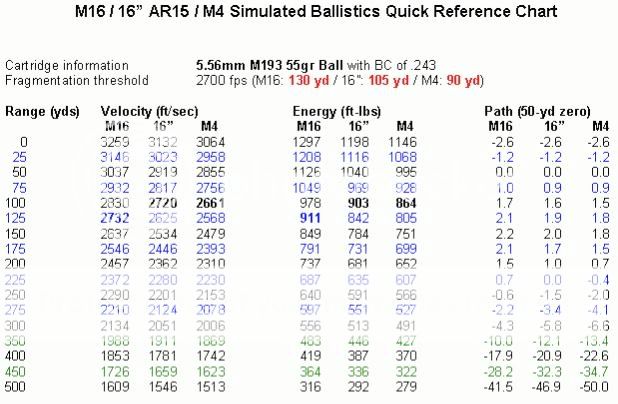
The interesting thing though, is that for this reason, applications where shooting other humans (military and law enforcement), .223 I think has an undeserved reputation. I think the real interesting thing about it is that by design, when impacting tissue over 2600 fps, the bullet will yaw and fragment - even with FMJ bullets. From the OP, it sounds as if over 2000 fps, the bullet will yaw. Under 2000 fps, it basically is a .22 - and pencils through soft tissue.
If you look at the ballistic chart for M193, you can see it reaches that point at about 300 yards.
This in itself might be where much of the bad rep 5.56 has developed. Ironically, from World War II up until the first Gulf War, most fire fights were more or less between uniformed, professional militarys or organizations who generally had a logistical infrastructure set up to tend to wounded soldiers/fighters. Similarly, every conflict in that period (and arguably even still today) fire fights occur around 200-300 yards (see wikipedia article on Assault Rifles)
http://en.wikipedia.org/wiki/Assault_rifle
Combat experience during the World Wars had shown that most infantry combat took place at 200-300 meters distance and that the winner of any given firefight would most likely be the one with the highest rate of fire. The rifle cartridges of the day were therefore unnecessarily powerful, producing recoil and report in exchange for marginal benefit. The lower power of the intermediate cartridge meant that each soldier could fire more bullets faster and/or with less recoil and its lighter weight allowed more ammunition to be carried.
Given that, it's apparent that the .223/5.56 as a military service, standard issue was much better designed around this philosophy. At close ranges, the 5.56 does significantly more damage AND is lighter than 7.62x39. This allows soldiers to be better able to severely wound their opponents resulting in the logistical burden to the opposing side of having to tend to the wounded during a fight, as opposed to collecting their dead afterwards.
Interestingly (also from Wikipedia) on 7.62x39:
http://en.wikipedia.org/wiki/7.62x39mm
M43
Although the new cartridge represented a great leap forward from previous designs, the initial bullet design was flawed. The complete solidity of the M43 projectile causes its only drawback—it is very stable, even while traversing tissue. It begins to yaw only after traversing nearly 26 cm (10 in) of tissue.[9] This greatly reduces the wounding effectiveness of the projectile against humans. These wounds were comparable to that of a small handgun round using non-expanding bullets. Unless the round struck something vital, the wound was usually non-fatal, small and quick to heal.
[edit]M67
In the 1960s Yugoslavia experimented with new bullet designs to produce a round with a superior wounding profile, speed, and accuracy to the M43. The M67 projectile is shorter and flatter-based than the M43. This is mainly due to the deletion of the mild steel insert. This has the side effect of shifting the center of gravity rearward in comparison to the M43. This allows the projectile to destabilize nearly 17 cm (6.7 in)[9] earlier in tissue. This causes a pair of large stretch cavities at a depth likely to cause effective wound trauma. When the temporary stretch cavity intersects with the skin at the exit area, a larger exit wound will result, which takes longer to heal. Additionally, when the stretch cavity intersects a stiff organ like the liver, it will cause damage to that organ.
The wounding potential of M67 is mostly limited to the small permanent wound channel the bullet itself makes.[9] The real damage of the M67 occurs when it yaws.[9] Meanwhile a fragmenting round (like the 5.56×45mm NATO) might cause massive tissue trauma and blood loss (and thus rapid incapacitation) on a lung or abdominal hit, the M67 has a greater chance of merely wounding the target.[citation needed] However, the 5.56×45mm will only reliably fragment in close ranges below 125 metres (410 feet).[citation needed]
Many contemporary Russian-made 7.62×39 cartridges, such as those sold under the brand names Wolf Ammunition and Golden Tiger, feature a modified M67 bullet with an airspace cast into the nose, or similar ballistic-enhancing tip design (e.g. 8m3), which improves fragmentation and/or tumbling tendencies.
It's interesting to note that most of the milsurp 7.62x39 stuff you find on the Canadian market today is M43. I guess it's generally not as desired for combat purposes versus the M67 (although I'm sure lots of M43 is still seen on the frontlines of most conflicts in the world today).
Don't get me wrong, I wouldn't want to be shot with anything either - but if you think about it, getting a straight through and through shot through the thigh, without contacting bone. Under 300 yards, I think it would do much less damage being shot with a 7.62x39 FMJ than a 5.56 FMJ. Past 300 yards, I'd be willing to bet a similar hit from a 7.62x39 FMJ would do much more damage than a 5.56.
That said, against a motorized force or in an area with lots of cover and concealment, 5.56 has a significant draw back of poor penetration and an unstable flight path, resulting in an unpredictable point of impact if the bullet hits anything before it's intended target. In that circumstance, I can envision 7.62x39 having a significant advantage over 5.56. This I think was one of the reasons NATO went towards SS109 - the 62 gn FMJ with a steel penetrator - to give the bullet more stability and penetration - although it looks as if this came as a trade off to a significantly decreased yaw in soft tissue.