Why you do not want to get shot with an M16...Warning: Disturbing photograph linked

I wonder what (if any) measurable difference there is on bullet tumbling/fragmentation with the various twist rates out there. The Phillipine example was with an M16-A1 , which have 1 x 12" twists. How would the 55 gr fmj perform with the newer 1 x 7" twist? The same? Less? More? Theoretically, you'd think the 1 x 7" would be less lethal due to over-stabilization of the 55 grainers....or are they more likely to blow apart?

There seems to be alot of ballistic info out there with the ss 109 type (and heavier) bullets with the newer/current twists, but not so much on the 55 grainers in the faster twists. Surely, there are still millions of these rounds still in military inventories, be interesting to know how these older rounds perform.
 
Last edited:
I don't quite follow???

The Norinco guns we get over here are pretty shotty. However, to my understanding Norinco itself makes almost everything the Chinese military uses. Some things they manufacture may be of inferior quality, like the NORINCO AR's we get, but I don't think judging everything they make by the firearms we get over here is fair considering the Chinese military trusts them to make so much stuff

Norinco, is a Chinese aerospace and defense company that manufactures vehicles (trucks, cars and motorcycles), machinery, optical-electronic products, oil field equipment, chemicals, light industrial products, explosives and blast materials, civil and military firearms and ammunition, etc. Norinco is also involved in domestic civil construction projects.


Norinco is also known outside of China for its high-tech defense products, some of which are adaptations of Soviet equipment. Norinco produces precision strike systems, amphibious assault weapons and equipment, long-range suppression weapon systems, anti-aircraft & anti-missile systems, information & night vision products, high-effect destruction systems, fuel air bombs, anti-terrorism and anti-riot equipment and small arms.

Odd - the 3 Norinco AR's I've owned while having a little rough around the edges full functioned (and continue to function) extremely well.

If you value form, I'd concede the Norks are inferior. If you value function, I'd say the Norks are more than adequate.

You also have to remember that there also are also many civilian markets out there that Norinco supplies guns AND ammo to other than Canada. Australia, the Philipinnes, India come to mind quite readily. Especially as some of the less developed nations become more prosperous, Nork's market share in these growing markets will pretty much guarantee the quality of their products will substantially improve (as they already have over the past 6 years).

Likewise, I think it would be foolish to discount China's ability to manufacture quality armaments given that in all probability, a global war could break out in the future and more than likely, the nations Canada will be fighting will probably be using nothing but Chinese made weapons. Much in the same way American arms during World War II were generally "inferior" to German arms, the fact that the Americans could mass produce significantly more than the Germans was the reason they won the war. I wouldn't expect things to be any different the next time there is a major war.

I agree with you though about not judging foreign Nork ammo. Manufacturing ammunition is probably one of the easiest things in the world to do - I can see no reason to think that the Chinese wouldn't be very good at doing so. After all - they supply ammo to pretty much every nation the US is opposed to with the specific intent of allowing their allies the ability to use captured American/NATO weapons.
 
to my understanding Norinco itself makes almost everything the Chinese military uses. Some things they manufacture may be of inferior quality, like the NORINCO AR's we get, Norinco is also known outside of China for its high-tech defense products, some of which are adaptations of Soviet equipment. Norinco produces precision strike systems, amphibious assault weapons and equipment, long-range suppression weapon systems, anti-aircraft & anti-missile systems, information & night vision products, high-effect destruction systems, fuel air bombs, anti-terrorism and anti-riot equipment and small arms.[/I]

My understanding is that Norinco doesn't manufacture much, if anything. I believe that Norinco is a distributor who represents numerous Chinese manufacturers who build to spec. I could be wrong on this as my sources are suspect but I have been led to believe that 3 Norinco AR's purchased a few months apart could quite possibly have been made by 3 different companies or parts thereof.
 
Amazed how quickly this became a Norc thread.

Yeah - my apologies for derailing it.

Lots of crazy stuff seems to happen in the Philippines, and by my observation, it seems Norinco is quite popular over there too.

I think a lot of LE's and military units over there use Norinco's and that SAM clones them (kind of ironic - the Filipinos clone the Chinese Clone of the American M16/M4 platform).

Case in point:

[youtube]KBJO_zXuHVQ[/youtube]

It's kind of interesting reading their forum - it seems Philippino gun nuts are pretty formal and respectful in their discourse with one another.

To the original point, it's not inconceivable that the injures in the original thread were inflicted with a Norinco.

Either way - it's pretty disingenuous to slag any gun or brand of ammo - they all can cause catastrophic injury, as was the original intention of this thread.
 
I keep pondering that for modern military applications since it's inception and acceptance as the NATO standard, it sounds like 5.56 is extremely devastating within 100 yards, given the amount of damage it does on account that it both yaws AND fragments. Conversely, the M43 7.62x39 round (the stuff all of us stockpile) doesn't tend to yaw or fragment at close range, tends to pencil through human tissue

Nonsense.

There were pics of of a guy shot through the leg with an ak47 in offtopics not too long ago and I assure you that western mindset reassurances that one of the most widely used and feared assault rifles in the world is practically non-lethal is borderline self-imposed brainwashing.

A quick google search brings me to the Amercian Academy of orthopaedic surgeons.

Ak47 gunshot wound to the leg.

http://www.jaaos.org/content/14/10/S52/F2.expansion
exit.jpg


Yah I can see your small entry wound. Look INSIDE that hole and tell me thats a small wound. The tissue in that pan is simply DEAD and had to be removed.
 
Nonsense.

There were pics of of a guy shot through the leg with an ak47 in offtopics not too long ago and I assure you that western mindset reassurances that one of the most widely used and feared assault rifles in the world is practically non-lethal is borderline self-imposed brainwashing.

I never said it was non-lethal, I meant to say that at close range, through soft tissue, the M43 round doesn't tend to yaw. Maybe that's one of the reason so much of it is so abundant, so cheap for us civilians here in Canada. I'm sure any hit with any calibre of ammunition to bone tissue would cause catastrophic wounds - but you have to consider that anatomically, our skeleton makes up a very small portion of our entire mass.

I don't know, but I'd be willing to guess that on the frontlines of most of the conflict zones of the world, M67 is the preferred 7.62x39 load out, given that it was purposefully designed to yaw.

For us it doesn't matter - we'll never shoot at anything but cardboard and, maybe steel, but it's still interesting to know the history and science behind the various calibres of ammo we shoot.

I think it's interesting especially, with .223/5.56. In the military, a lot of the troops in my unit would deride our issued C7, mocking it as just an overpowered .22. While that is technically true - as an engineer and hobbyist history buff - the science and history behind the 5.56 is utterly fascinating and partially repudiates that assertion.

I wrote this in another forum, but I think it is related:

Besides not wanting to get shot with anything ,most hunters who actually shoot things will tell you, your hypothesis that a centre fire 22 will outperform a 308 is staggeringly wrong. As a very straight forward example it is illegal in SK to shoot a whitetail with a 223 and no one in their right mind would shoot anything bigger with a 223

I can understand why you wouldn't want to hunt with .223. There just isn't enough energy in the projectile to knock down an animal that will basically sprint several kilometres until it bleeds out.

That said, I think anatomically, human beings differ significantly from ungulates. I don't believe we as a species have the capability to run great distances, especially when injured, the way a deer/elk/moose can/will.

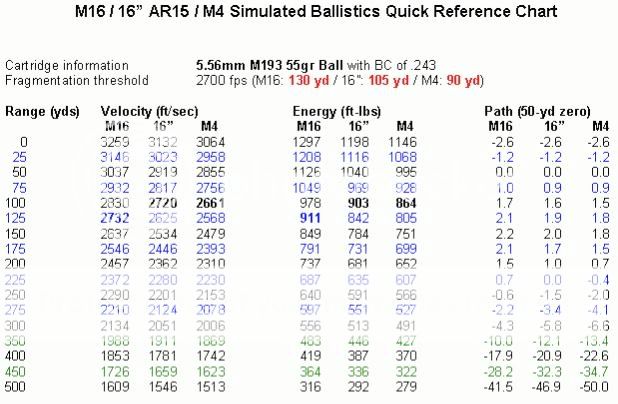
The interesting thing though, is that for this reason, applications where shooting other humans (military and law enforcement), .223 I think has an undeserved reputation. I think the real interesting thing about it is that by design, when impacting tissue over 2600 fps, the bullet will yaw and fragment - even with FMJ bullets. From the OP, it sounds as if over 2000 fps, the bullet will yaw. Under 2000 fps, it basically is a .22 - and pencils through soft tissue.

If you look at the ballistic chart for M193, you can see it reaches that point at about 300 yards.

M193ballisticchart2.jpg


This in itself might be where much of the bad rep 5.56 has developed. Ironically, from World War II up until the first Gulf War, most fire fights were more or less between uniformed, professional militarys or organizations who generally had a logistical infrastructure set up to tend to wounded soldiers/fighters. Similarly, every conflict in that period (and arguably even still today) fire fights occur around 200-300 yards (see wikipedia article on Assault Rifles)

http://en.wikipedia.org/wiki/Assault_rifle

Combat experience during the World Wars had shown that most infantry combat took place at 200-300 meters distance and that the winner of any given firefight would most likely be the one with the highest rate of fire. The rifle cartridges of the day were therefore unnecessarily powerful, producing recoil and report in exchange for marginal benefit. The lower power of the intermediate cartridge meant that each soldier could fire more bullets faster and/or with less recoil and its lighter weight allowed more ammunition to be carried.

Given that, it's apparent that the .223/5.56 as a military service, standard issue was much better designed around this philosophy. At close ranges, the 5.56 does significantly more damage AND is lighter than 7.62x39. This allows soldiers to be better able to severely wound their opponents resulting in the logistical burden to the opposing side of having to tend to the wounded during a fight, as opposed to collecting their dead afterwards.

Interestingly (also from Wikipedia) on 7.62x39:

http://en.wikipedia.org/wiki/7.62x39mm

M43
Although the new cartridge represented a great leap forward from previous designs, the initial bullet design was flawed. The complete solidity of the M43 projectile causes its only drawback—it is very stable, even while traversing tissue. It begins to yaw only after traversing nearly 26 cm (10 in) of tissue.[9] This greatly reduces the wounding effectiveness of the projectile against humans. These wounds were comparable to that of a small handgun round using non-expanding bullets. Unless the round struck something vital, the wound was usually non-fatal, small and quick to heal.

[edit]M67
In the 1960s Yugoslavia experimented with new bullet designs to produce a round with a superior wounding profile, speed, and accuracy to the M43. The M67 projectile is shorter and flatter-based than the M43. This is mainly due to the deletion of the mild steel insert. This has the side effect of shifting the center of gravity rearward in comparison to the M43. This allows the projectile to destabilize nearly 17 cm (6.7 in)[9] earlier in tissue. This causes a pair of large stretch cavities at a depth likely to cause effective wound trauma. When the temporary stretch cavity intersects with the skin at the exit area, a larger exit wound will result, which takes longer to heal. Additionally, when the stretch cavity intersects a stiff organ like the liver, it will cause damage to that organ.

The wounding potential of M67 is mostly limited to the small permanent wound channel the bullet itself makes.[9] The real damage of the M67 occurs when it yaws.[9] Meanwhile a fragmenting round (like the 5.56Ă—45mm NATO) might cause massive tissue trauma and blood loss (and thus rapid incapacitation) on a lung or abdominal hit, the M67 has a greater chance of merely wounding the target.[citation needed] However, the 5.56Ă—45mm will only reliably fragment in close ranges below 125 metres (410 feet).[citation needed]

Many contemporary Russian-made 7.62Ă—39 cartridges, such as those sold under the brand names Wolf Ammunition and Golden Tiger, feature a modified M67 bullet with an airspace cast into the nose, or similar ballistic-enhancing tip design (e.g. 8m3), which improves fragmentation and/or tumbling tendencies.

It's interesting to note that most of the milsurp 7.62x39 stuff you find on the Canadian market today is M43. I guess it's generally not as desired for combat purposes versus the M67 (although I'm sure lots of M43 is still seen on the frontlines of most conflicts in the world today).

Don't get me wrong, I wouldn't want to be shot with anything either - but if you think about it, getting a straight through and through shot through the thigh, without contacting bone. Under 300 yards, I think it would do much less damage being shot with a 7.62x39 FMJ than a 5.56 FMJ. Past 300 yards, I'd be willing to bet a similar hit from a 7.62x39 FMJ would do much more damage than a 5.56.

That said, against a motorized force or in an area with lots of cover and concealment, 5.56 has a significant draw back of poor penetration and an unstable flight path, resulting in an unpredictable point of impact if the bullet hits anything before it's intended target. In that circumstance, I can envision 7.62x39 having a significant advantage over 5.56. This I think was one of the reasons NATO went towards SS109 - the 62 gn FMJ with a steel penetrator - to give the bullet more stability and penetration - although it looks as if this came as a trade off to a significantly decreased yaw in soft tissue.

 
I agree with everything, 556 is a fine round WITHIN its effective range depending on bullet choice, then it has more likelyhood of doing less damage than a typical 7.62x39 since it will icepick without the significant damage that the latter does regardless of fragmentation or yawing.

Other than that, the 556 designed to wound is a MYTH. Always has been. A persistent myth spread by internet warriors.

Again, a quick google search will clear this up.

"""5.56 designed to wound myth""
 
Anyone seriously interested in reading about the apparent drawbacks of 5.56 should read this.

"Increasing Small Arms Lethality In Afghanistan-Taking Back The Infantry Half Kilometer"

http://www.dtic.mil/cgi-bin/GetTRDoc?AD=ADA512331&Location=U2&doc=GetTRDoc.pdf

Bear in mind it's about 60-70 pages (A small book) but it explains a lot about why 5.56 has the rep it does, and challenges several points as well. It educated me quite a bit, and I was glad to read it. Even if it took over an hour!

Also, as a side note, the thread got sidetracked onto norinco because I made the mistake of mentioning the Norc M193 that I am awaiting arrival of. I had no idea just mentioning the word Norinco would start such a debate. I should've just said "Chinese M193" it would have made it way easier. My mistake!


 
I agree with everything, 556 is a fine round WITHIN its effective range depending on bullet choice, then it has more likelyhood of doing less damage than a typical 7.62x39 since it will icepick without the significant damage that the latter does regardless of fragmentation or yawing.

Other than that, the 556 designed to wound is a MYTH. Always has been. A persistent myth spread by internet warriors.

Again, a quick google search will clear this up.

"""5.56 designed to wound myth""

I think you're right. I don't think "wound" is an accurate description of what 5.56 was designed to do. I think "incapacitate" is more accurate. Really, any gunshot will result in a wound - the question is, how effective will that wound be at taking down it's intended target. I don't know, but it sounds as if a straight lung shot from an M43 7.62x39 round at 50 yards would cause a sucking chest wound, but still let a victim survive at least a few minutes, capable of pulling a trigger (or detonating a suicide vest), whereas an M193 5.56 round placed on the same spot, at the same distance would completely shred the lungs and probably cause complete incapacitation within seconds (I'm no expert on the subject, however).

Thinking from a hunters perspective - one of the reasons I'd assume why it's generally prohibited in most places to hunt with non-expanding ammunition is because FMJ ammunition tends to be less effective at incapacitating it's intended target since the likelihood, as you say that it will "icepick" is higher. Probably not coincidentally, I think this is also much safer for anything behind the intended target as well.

If you apply that principle to military adoption - IIRC, the Hague convention prohibits the use of expanding ammunition that would otherwise be very effective at incapacitating it's target, but it sounds as if Armalite/Remington found a work around in the design of the .223, since the round is not designed to expand - but rather both fragment AND yaw. So while it is completely in compliance with international law, it completely violates the spirit of the law (I love things like that).
 
All firearms are designed to wound. Unless it is a specialised target firearm, which will wound, but not the intended function.
It seems silly to suggest that military firearms are designed not to wound.
Fackler insisted that Vietnam 7.62x39 didn't tumble in muscle, but this may not apply to other kinds of 7.62x39.
 
I think you misunderstand what they mean by wound. By wound they mean "hurt but not kill."

All firearms are designed to wound. Unless it is a specialised target firearm, which will wound, but not the intended function.
It seems silly to suggest that military firearms are designed not to wound.
 
I think you misunderstand what they mean by wound. By wound they mean "hurt but not kill."
No, wounds can be fatal or non- fatal.
The fatality of a wound depends more on anatomy and treatment than chambering.

SIWARD Had he his hurts before?
ROSS Ay, on the front.
SIWARD Why then, God's soldier be he! Had I as many sons as I have hairs, I would not wish them to a fairer death. And so, his knell is knoll'd
.

Macbeth: Act 5, Scene 8
 
Anyone seriously interested in reading about the apparent drawbacks of 5.56 should read this.

"Increasing Small Arms Lethality In Afghanistan-Taking Back The Infantry Half Kilometer"

http://www.dtic.mil/cgi-bin/GetTRDoc?AD=ADA512331&Location=U2&doc=GetTRDoc.pdf

Bear in mind it's about 60-70 pages (A small book) but it explains a lot about why 5.56 has the rep it does, and challenges several points as well. It educated me quite a bit, and I was glad to read it. Even if it took over an hour!

Also, as a side note, the thread got sidetracked onto norinco because I made the mistake of mentioning the Norc M193 that I am awaiting arrival of. I had no idea just mentioning the word Norinco would start such a debate. I should've just said "Chinese M193" it would have made it way easier. My mistake!

It's not your fault - I tend to derail things as well.

I have a crate of Nork M193 and it chrono'd very consistently out of my CQA and my bodies NEA15 10.5". IIRC, I had it dialled in at 3200fps +/- 10fps or so. IIRC, my buddy had it at about 3000 fps.

He had some problems though with primers popping out - even getting one wedged in the trigger assembly (not pretty). I hadn't had any problems in mine though, so I don't know if it was the gun or the ammo (hopefully that doesn't derail further in another direction).

Thanks for the link though, I'll check it out at home.

What's somewhat amusing though, is just from the title of that article "Taking Back The Infantry Half Kilometer," am I to assume one of the prevailing themes behind the weakness of 5.56 is it's long range limitations (at or past 500 yards)? From the abstract, it looks as if that is the case.

It's kind of funny - it reminds me of a quote I read in Max Brooks "World War Z":

"the army equips itself with tools perfect for the last war they fought."

It seems that this may very well be true :)
 
When you say "The fatality of a wound depends more on anatomy and treatment than chambering."

Do you mean, Anatomy = Shot Placement
Close enough. 50 BMG is not designed to kill from a big toe wound. And someone's granny killed huge things with 22LR.
Military firearms and ammo are designed to make holes. In heads and big toes.
Had the wound (Yes, it is a wound) in the photo been in the cranium, the prognosis would be different.
 
Close enough. 50 BMG is not designed to kill from a big toe wound. And someone's granny killed huge things with 22LR.
Military firearms are designed to make holes.

Your way of going about explaining yourself is a little confusing, but I do understand and agree with what your saying. All firearms, other than specifically designed target/competition guns, are designed to "Wound". Shot placement and medical attention are going to make the biggest difference as to whether or not the "wound" in question is fatal.

I think you misunderstand what they mean by wound. By wound they mean "hurt but not kill."
No, wounds can be fatal or non- fatal.
The fatality of a wound depends more on anatomy and treatment than chambering.
I do think you misunderstood the guy though. What i think he meant was that there is a common misconception that 5.56 was designed to "Severely Wound" an enemy and be less likely to inflict a fatal wound. The idea behind this was that it would take 2-3 guys to carry the wounded man from the field, hence removing anywhere from 2-3 enemy from the battle, albeit only temporarily. I also think this is a complete myth created LONG before the internet, and agree that 5.56 like any other military round is designed quite simply "to incapacitate the enemy" either instantly or as quickly as possible, regardless of shot placement.
 
Last edited:
Steve - that article you posted is brilliant.

Any and every AR owner should read it.

Thanks, I wish I wrote it!!

It's not just for AR owners either, I think anyone who shoots .223/5.56 on a regular basis should read it. It's one of the best articles I have ever read surrounding this topic. I just wish the ARMY brass would listen to guys like this, and make the changes that are clearly necessary to increase our forces effectiveness by a wide margin.
 
I disagree that that's FMJ Ball. I've shot beavers and yotes and myriad other animals with ball. It's in and out. Hydrostatic shock is minimal with FMJ. That's the point and why it's used, to minimize trauma. That was the point of countries agreeing to ball ammo use.

As well, typically police do not use ball. Police ammo is generally high fragmentation, high shock ammo designed to incapacitate and stop the threat right now. That's what I see here. I'm gonna depart from the agreed consensus and believe the reporting party got it wrong or got fed a line by the police to contain public discourse. Like when the "evil Black Talon" ammo got taken off the market because of public outcry because this, in these pictures, was what it was designed to do.

My thoughts. Agree or not but its what I see.
 
Back
Top Bottom