Can you identify this antique (?) firearm

OccasionallyOnTarget

CGN frequent flyer
Rating - 100%
13   0   0
Location
Burnaby, BC
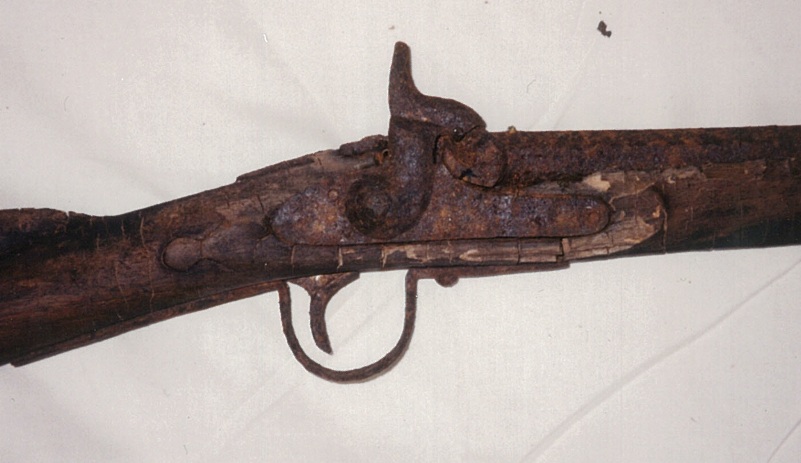
I found this in the remote forests of northern BC in 1992. Looks to be some kind of flintlock muzzle-loader. It's rusted and has some rot on it, but still a pretty cool find:

NEK2q.jpg


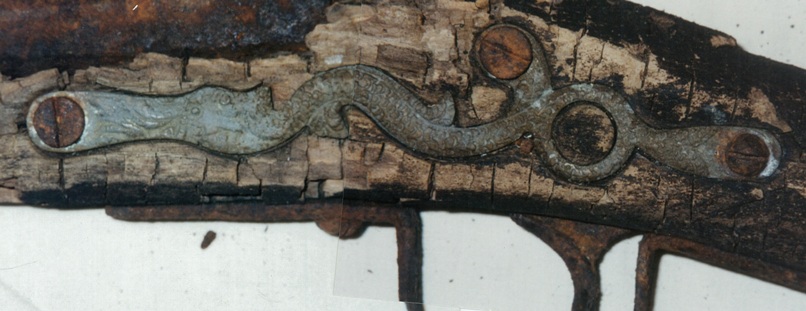
Here are close-ups of both sides:

4TAh9.jpg

v0jG1.jpg
 
Last edited:
What a lucky find! Looks to be a trade gun as sold all over the north in the 1800's. The serpent on the left side and the oversize trigger-guard are the tell-tale. Careful cleaning and gentle work may make this a reasonablly valuable piece-at least from an historical standpoint as well as monetary. What area did you find it in? Cheers, bill
 
I found it about 75 miles north of Hazelton, BC. in the rafters of a collapsed cabin along the Telegraph Trail near the Skeena River. The cabin was not one of the main ones, but may have been one of the "refuge" cabins used by hunters, trappers, and prospectors. There was almost nothing left of the cabin and if I had not found the gun it probably would have rotted completely away by now. I have kept it dry but otherwise have not done anything with it.

Here's a little blurb on the trail:


Yukon Telegraph Trail

Description

The Yukon Telegraph Trail extends through British Columbia from Ashcroft in the south to Atlin in the north. The portion of the trail located in the Regional District of Kitimat-Stikine is approximately 500 kilometres long, extending from Moricetown near Hazelton to the village of Telegraph Creek. The trail, overgrown in places, contains the remains of telegraph cabins, wire, and other artifacts related to the construction of the Dominion Telegraph Line.

The historic place consists of the length and width of the trail route from Moricetown to Telegraph Creek.

Heritage Values

Almost 3,000 kilometres in length, the Yukon Telegraph line linked Dawson City to southern Canada. The line branched north from the Canadian Pacific Railway telegraph line at Ashcroft; along much of its length was a trail used for servicing the line. Within the Kitimat-Stikine region, the Yukon Telegraph Trail is valued for its historical association with the Collins Overland and Yukon Telegraph lines, its role in communications and transportation, its scientific association with the changes in communications technology, its cultural association with First Nations, telegraph operators and others, its current use by guide outfitters, its potential as a recreational resource, and its location within the pristine natural environment of the Kitimat-Stikine region.

The 500 kilometre portion of the Yukon Telegraph Trail that extends from Moricetown to Telegraph Creek is valued as a physical reminder of the history of the Yukon Telegraph line. Begun during the Yukon Gold Rush and constructed between 1897 and 1901 by the Dominion Government Telegraph Service, the trail along with the Teslin trail was promoted as an All-Canadian Route to the Yukon gold fields. The trail is also valued for the critical role it played in maintaining communications and opening up settlement in the remote Kitimat-Stikine region. The trail highlights the transportation challenges in the region, as pack trains were the only possible means for transporting goods along the line.

There are cultural, social and architectural values associated with the Yukon Telegraph Trail through the lives of the men who patrolled the trail and maintained the line. Along the line each main log cabin housed two men. North of Hazelton the main cabins were numbered 1 to 9 followed by 2 or 3 other named cabins leading to Telegraph Creek. Smaller ‘refuge’ cabins were located between them for use as emergency shelters. These log cabins are an integral, physical part of the Telegraph Trail’s heritage value. Their presence represents the technical system of the telegraph that relied on human labour to keep it functioning, as well as the dedication of the workers, whose lives were both pragmatic and storied. While enduring extreme weather and harsh living conditions, the men played music, tended wilderness vegetable gardens and maintained traplines.

Cultural value is also found where the trail passes through First Nations traditional territory, where it was traditionally used as part of a network of trails for travel, trapping and the transport of goods such as oolichan grease from the coast. Also important is the trail’s relationship to the village of Telegraph Creek, named for the Collins Overland Telegraph, that attempted to construct a telegraph line through the region in 1866. The use of the trail by many diverse people over time including First Nations, prospectors, trappers, packers and outlaws, adds to its social and cultural significance. All of these people left their traces and their stories along the Yukon Telegraph Trail.

The Yukon Telegraph Trail is valued for its direct association with the Telegraph Line and its scientific and engineering feats, which included the physical construction of the trail and telegraph line through difficult terrain, developments in communications technology of the time, and the physical presence of a continuous wire through the wilderness.

Although the telegraph line was abandoned in 1936 with the advent of radio communication, the historical value of the line and trail is reflected in many place names associated with the telegraph survey, construction and operation, including Telegraph Creek, Bob Quinn Lake, Durham Creek and Burrage Creek. The trail is significant as a historic recreational trail, for its pristine and aesthetic environment, as the subject of ongoing historical research, and for its power to evoke a sense of nostalgia for the pioneering construction of early telegraph routes in B.C.

 
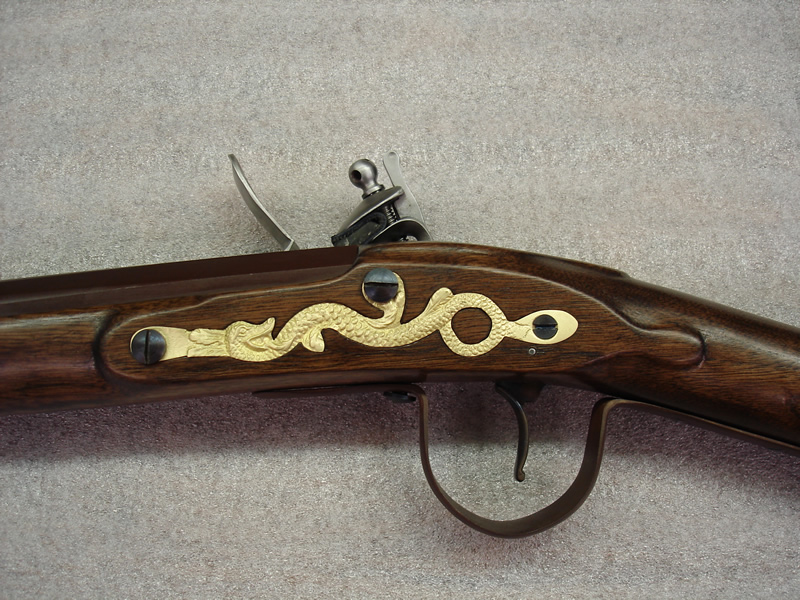
Note the difference in the serpents, caplock vs flintlock. The boss for the rear lock screw is in a different position. The lock is basically an Enfield rifled musket type. In all propbability the gun would have been made by either Barnett or Parker Field.
 
Note the difference in the serpents, caplock vs flintlock. The boss for the rear lock screw is in a different position. The lock is basically an Enfield rifled musket type. In all propbability the gun would have been made by either Barnett or Parker Field.

or by some poor boy with parts of a few muskets this was common near the late 1800's for "trade" guns to be made from left over parts
 
I wonder if the thing is still loaded Very nice find nice bit O history to hang on the wall
 
or by some poor boy with parts of a few muskets this was common near the late 1800's for "trade" guns to be made from left over parts

No, that is a standard late pattern percussion Hudson Bay gun. Barnett and Parker Field were the primary manufacturers during that period. It is not an assembly cobbled together from parts of a few muskets by some poor boy.
Trade guns were standardized products, manufactured to a specific pattern.

It might be loaded, but it is very unlikely that the charge would be live. I did unload a Barnett some 40 years ago. It was loaded as a shotgun, wadded with newspaper, #5 shot. I steamed the paper wadding, flattened it out so I could read it. The shooter had torn off the top corner of the page. The Free Press (London, ON), Nov. 13, 1924. This was a standard pattern Barnett percussion gun, 1884; very unusual in that it was 12ga, not the standard 24ga. We sold it to Charley Hanson, Museum of the Fur Trade, Chadron, NE. It was the only 12ga trade gun he had ever seen. At the time, we were manufacturing reproduction Trade Guns; Charley loaned us a brand new W. Chance lock, that we used to have our dies for investment casting made.
 
Beautiful, I've hiked / worked many many kilometers in that same forest and on parts of that same trail. Poked around in my fair share of the old cabins HOPING to find something like that...part of my job at times (one of my hats anyway) has been to relocate the old grease trails (there are many)and other historic trails and record the sites along the way.

Found a LOT of traps, old snowshoes (handmade ones), teapots, lard buckets (for making tea), pieces of stoves, plates, etc etc etc...and etc and even a rifle stock once. But nothing so complete.

Nice work
 
That is a very nice find. We have so little real old gun history in the Canadian west (no old battle fields ) to speak of. Those old trade guns are priceless in my mind, wish you could just click on it,s profile and listen to the story. Hope you don't mind there "On Target" but I have a story much like yours, I really like the old what I call trade guns, I have a number of old front stuffers that somebody traded for. :) LOL . The one I am going to tell the story on is not an actual prized Barnett trade gun like you have but is from an unknown maker, very crude sort of a copy of a plains rifle ?, found in an old caved in trappers dugout or shack in the Cypress Hills by my Uncle when he homesteaded in the early 1900's . Found near Chimney Coulee which had been the site of a Hudson Bay trading post, Metis camp and where Sitting Bull came after the battle of the Little bighorn. I have never attempted to take it apart or clean, just a little oil to slow down it's rusting process. It is smooth bore about 58 or closer to 60 cal. Anyways here are some pics . Please comment all you like. To me these are the real old west Canadian antique guns. Hope you enjoy.

Overall length-- 46 inches

404717587.jpg


Note Hudson Bay brass whatchmalcallets in the stock.

404718381.jpg


Quite a patch box but the crudest I've ever seen

404717590.jpg


Cheek piece! :)

404717589.jpg


Lots of brass, could maybe sell it scrap value :confused:

404717588.jpg


Hows that for a bore off center, poor Native North Americans, and you think Indian Residential Schools were a bad deal !

404717594.jpg
 
Last edited:
I really would like some comments on the old gun I posted pics of. I hoped someone that is into old guns of the fur trade and Canadian west would have some ideas on maker etc. I only know where it came from in the early 1900,s. At the time my Uncle found it there were few white men in the Cypress Hills. When I was a kid , now thats some time ago :rolleyes: I used to sneak it out of my Uncles gun room and carry it around pretending I was Kit Carson or somebody. :) I know Tiriag says quote: Trade guns were standardized products. and antiqueguy says quote: trade guns in the late 1800,s were made from left over parts. I do beg to differ a little with both, all in fun. This gun was not all made with left over parts, no well know mfg I know of used parts that crude. The barrel for example was not a Remington or Nelson Lewis LOL. It was not a white buffalo hunters gun or a US Calvery gun that might of come up with sitting Bull. It was a trade gun so to speak. Crudley made, with lots of brass to apeal to a Native North American customer in the 1800,s. It is only valuable to me, it will never leave the family and I am not asking for comments saying nice find etc. Just would appreciate all comments on maker or who might of been the trader etc. good or bad. We have so little real Canadian west antique gun history everything is from the wonderful US. Oh yea I forgot we have cooeys and lee enfields LOL. like-- Occasionally on targets-- find it is our antique black powder history. Cheers John
 
Indian Trade gun, Northwest gun, the smoothbore guns with the serpent sideplate were more or less standardized products made for the trading companies - Northwest Company, HBC, American Fur Company, et al. They were commercial products manufactured by a number of contractors, usually in Birmingham, occasionally in Belgium. AFC contracted with Leman in PA for some.
There were also rifles made for the Indian trade. The big companies ordered rifles made to their standard design. Leman made quite a number for the US traders. In British North America, smoothbore guns were much more popular. The trade was also more structured, the HBC essentially having a monopoly through the mid and latter 19th century.
I don't know if your gun was made specifically for a fur trading company or not, or if it is an example of a rather primitive gunsmith made/remade piece. Bet that forend plate covers either damage or a ramrod hole gone astray. The guns made for the US trading companies were far less standardized than the ones purchased by the HBC. It is entirely possible that the gun came north with Sitting Bull's people.


In US museums there are guns known to have been used by Plains Indians during that period. Some are NW guns, others are Leman rifles, there are odds and ends as well, including breechloaders.
 
The further info on area would lead one to suspect it was sold out of the HBC post of Ft St, James sometime after 1845 when percussion guns were getting more acceptance. Trade guns as flinters were still being made and sold into the 1890,s along with the percussion pieces. Had an old friend who found an octagonal !890 Winchester in similar fallen cabin many years ago. It used to be common to find odd ammo as well as hunters would leave one round behind when they left just in case the next passerby would need it. Think that tradition has died out now, unfortunately. Barrel length should be 40" but they could be shorter depending on buyers need and whether or not they were worked on later.
 
Later trade gun barrels were 2 1/2, 3 and 3 1/2 feet. 3' probably the most common.
Apart from the changing market, one of the reasons that flint guns disappeared was that Birmingham was running out of workers who could make the locks.
I think that the percussion guns with Enfield rifled musket style locks were using up parts left over from the intense production of locks for the Enfield rifles widely sold to the Union and the Confederacy. Hundreds of thousands of these rifled muskets were made for export. Very similar to, but not necessarily made to the same standards as ones made for the British government.
The serpent sideplate guns were being displaced by conventional sporting muzzleloaders - the Imperial series - and rapidly by cartridge guns.
I have heard that there were still trade guns in the HBC warehouse in Winnipeg in 1930.
 
Back
Top Bottom