Ran into something similar a number of years ago. Cases were headstamped "F N 50" but otherwise it was unmarked. The stuff was HOT. Bullet was 184 grains and had a VERY pronounced boat-tail to it. Charge was some kind of COOPPAL flake powder. Later, ran into more of the stuff, but 1969 manufacture, including some Tracers (pinky-violet tip, very chic and utterly trend-setting, sweetie, terribly artsy). The stuff all used a small (.217") Berdan primer, so was not reloadable unless you had a source for the things. The 1950 came in brown-paper boxs of 20, the 1969 in brown-cardboard boxes of 100, very light construction. I sent one of the 20-round empty boxes to Peter Labbett and it's in his book!
By Mark VII or 7 and Mark VIII or 8, with or without a Z, is meant the type of BALL ammunition in .303" calibre. These were the LAST 2 types of Ball ammo issued for the .303; there were 6 previous Marks of .303 Ball ammo with smokeless and 2 with Black Powder before the Mark VII was adopted in 1910. It had a 174-grain composite 3-piece pointed FMJ bullet backed up by enough Cordite MDT 5-2 to give it a velocity of 2440 ft/sec. A Z in the designation indicated NO Cordite but instead a charge of NC powder very much like 4895 to give the same velocity. The bullet was impact-unstable. This was the standard rifle cartridge for over a century, still being made today.
Mark VIII or 8, Z or not, was developed in the inter-war years and manufactured ONLY for machine-gun use. The velocity was 110 ft/sec higher and the bullet the same weight but with a distinctive rebated boat-tail which gave an advantage to MGs in both range and overhead-fire applications. Being that it was a British development and completely obsolete by US standards, it is interesting to note that it is actually .57 of 1% more powerful than its US long-range replacement, the 7.62x51NATO M-118 Ball round.
Or perhaps we are being lied to. Again.
BALL ammunition (ammunition for shooting at targets or humans) had no LETTER designation, although the various Specials, a whole list of them, did have Letter designations, nearly always found in the cartridge headstamp. Tracers have letter-mark G, Armour-piercing have letter-mark W, Proof have letter-mark Q, Incendiary have letter-mark B, Blank have letter-mark L and so forth. In addition, most are also marked with the MARK of that letter-group which they are. There are 2 Marks of AP, for example: WI and WII, 6 Marks of Incendiary marked B1 through BVII although there is no BV, things like that. Add on the Powder code and you get headstamps like BIVZ: Armour-piercing Tracer Incendiary designed for torching the armoured gas-tanks on the ME-109 and loaded with Neonite powder instead of Cordite. Got it?
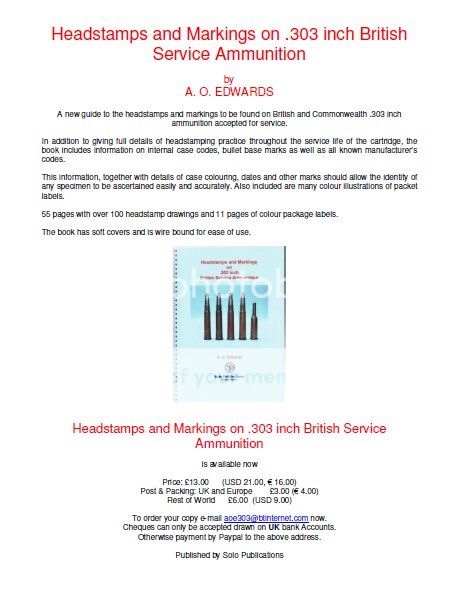
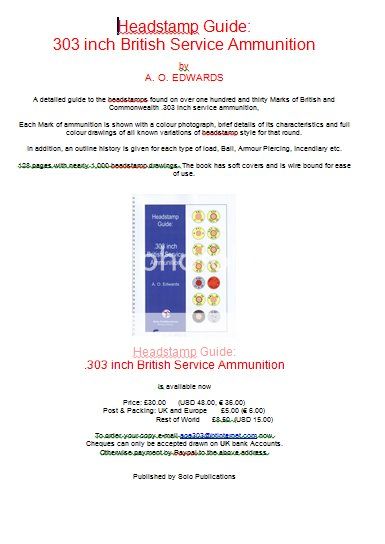
The whole thing is a fascinating study, being that there are more than 3600 known varieties of the .303 military cartridge. The late Major Peter Labbett wrote the most complete study that will ever be done, ".303 Inch", which was (unfortunately) printed in such a small number that it became a "rare book" before most book dealers even knew it existed. Copies today sell for stunning amounts of money..... on the very rare occasion that one hits the market at all.
Hope this helps.