.303 ammo question

Mr.4x4

CGN frequent flyer
Rating - 100%
6   0   0
Location
Alberta
I have an opportunity to buy some .303 Brit ammo.
It's 20 round packs wrapped in brown paper, looks older with blue typing on a white piece of paper on the front that says 303 machine gun bren

It doesn't say the gr or year but am thinking its going to be a bit hot for the Lee Enfield

Guy wants $9 / 20 rounds

Thoughts ?
 
I'm not sure about the Bren rds, but $9 for 20rds of .303 is a pretty good deal. I'm always happy when I can get surplus .303 for under $.50 a rnd. Enfields have a very strong action, but I'd wait to hear from one of the enfield experts before firing any out of yours.
Cheers
 
Machine gun ammunition was loaded with single base powder and not cordite, it would be the same as Mk.8z ammo. Pull a bullet and see if it is a rebated boat tail.

303ammo.jpg


Mk8z.jpg
 
I'm curious to know what VII and VIII mean. I also have some Bren ammo, not going to shoot it, just for collecting, but I'd just like to know what the physical difference is for my own knowledge.
 
the Bren mags were re filled from the squads rifle chargers. Ammo from one worked in the other. The Mk.8Z was primarily for the Vickers gun. There was a Mk.VIIZ for machine gun use, too. Just a Mk.VII loaded with nitrocellulose instead of cordite. Easier on the barrel than cordite loads.
 
I believe that modern .303 made by General Dynamics in Quebec (IVI) for the Canadian Rangers is Mk. VIII Z, vice being Mk. VII Z. They have also made 303 soft point for the Rangers.

Mark VII Z was made in Canada by Dominion Industries in (I think in Brownsburg, Quebec) 1943, 1944 and 1945 as well probably as other years. It is boxer primed and so reloadable if you can find it. The WW2 stuff I have seen that was made by DA (Dominion Arsenals) was Berdan primed at least until 1943.

Your observations mat be different.
 
I believe that modern .303 made by General Dynamics in Quebec (IVI) for the Canadian Rangers is Mk. VIII Z, vice being Mk. VII Z. They have also made 303 soft point for the Rangers.

Mark VII Z was made in Canada by Dominion Industries in (I think in Brownsburg, Quebec) 1943, 1944 and 1945 as well probably as other years. It is boxer primed and so reloadable if you can find it. The WW2 stuff I have seen that was made by DA (Dominion Arsenals) was Berdan primed at least until 1943.

Your observations mat be different.

thats the new stuff before mk 8 ball was mg only this newer stuff is more along the lines of mk 7 ball

id not shoot any of this ammo anyway not as common as some think if its wraped id leave it wraped
 
Ran into something similar a number of years ago. Cases were headstamped "F N 50" but otherwise it was unmarked. The stuff was HOT. Bullet was 184 grains and had a VERY pronounced boat-tail to it. Charge was some kind of COOPPAL flake powder. Later, ran into more of the stuff, but 1969 manufacture, including some Tracers (pinky-violet tip, very chic and utterly trend-setting, sweetie, terribly artsy). The stuff all used a small (.217") Berdan primer, so was not reloadable unless you had a source for the things. The 1950 came in brown-paper boxs of 20, the 1969 in brown-cardboard boxes of 100, very light construction. I sent one of the 20-round empty boxes to Peter Labbett and it's in his book!

By Mark VII or 7 and Mark VIII or 8, with or without a Z, is meant the type of BALL ammunition in .303" calibre. These were the LAST 2 types of Ball ammo issued for the .303; there were 6 previous Marks of .303 Ball ammo with smokeless and 2 with Black Powder before the Mark VII was adopted in 1910. It had a 174-grain composite 3-piece pointed FMJ bullet backed up by enough Cordite MDT 5-2 to give it a velocity of 2440 ft/sec. A Z in the designation indicated NO Cordite but instead a charge of NC powder very much like 4895 to give the same velocity. The bullet was impact-unstable. This was the standard rifle cartridge for over a century, still being made today.

Mark VIII or 8, Z or not, was developed in the inter-war years and manufactured ONLY for machine-gun use. The velocity was 110 ft/sec higher and the bullet the same weight but with a distinctive rebated boat-tail which gave an advantage to MGs in both range and overhead-fire applications. Being that it was a British development and completely obsolete by US standards, it is interesting to note that it is actually .57 of 1% more powerful than its US long-range replacement, the 7.62x51NATO M-118 Ball round.
Or perhaps we are being lied to. Again.

BALL ammunition (ammunition for shooting at targets or humans) had no LETTER designation, although the various Specials, a whole list of them, did have Letter designations, nearly always found in the cartridge headstamp. Tracers have letter-mark G, Armour-piercing have letter-mark W, Proof have letter-mark Q, Incendiary have letter-mark B, Blank have letter-mark L and so forth. In addition, most are also marked with the MARK of that letter-group which they are. There are 2 Marks of AP, for example: WI and WII, 6 Marks of Incendiary marked B1 through BVII although there is no BV, things like that. Add on the Powder code and you get headstamps like BIVZ: Armour-piercing Tracer Incendiary designed for torching the armoured gas-tanks on the ME-109 and loaded with Neonite powder instead of Cordite. Got it?

The whole thing is a fascinating study, being that there are more than 3600 known varieties of the .303 military cartridge. The late Major Peter Labbett wrote the most complete study that will ever be done, ".303 Inch", which was (unfortunately) printed in such a small number that it became a "rare book" before most book dealers even knew it existed. Copies today sell for stunning amounts of money..... on the very rare occasion that one hits the market at all.

Hope this helps.

 
Sorry Smellie, but I have to take issue with you on a number of your statements about .303 inch ammunition. Whilst the broad thrust of your post is right in principal, some of your detail is wrong.

For example, there are four marks of armour piercing, Mark VIIS with steel tip insert, Mark VIIF with solid bronze envelope, Mark VIIP with narrow AP core and the widely issued Mark VIIW, later changed to W.I. There is no W mMark II.

There are seven marks of incendiary, B Marks I to VII. The B Mark V did exist, was approved but was never issued. Add to these the Brock incendiary and then the two marks of Pomeroy and three marks of explosive.

You quote the BIVz as an armour piercing tracer incendiary. There is nothing AP about the BIVz, it is a phosphorus filled Buckingham style incendiary, sometimes called a smoke tracer by Kynoch.

Finally, what was the basis for your calculation that there are 3600 known varieties of .303 inch cartridge? Are you including dates? I reckon there are 135 distinct marks, although I am happy to argue that number as some were local expedients never formally approved.

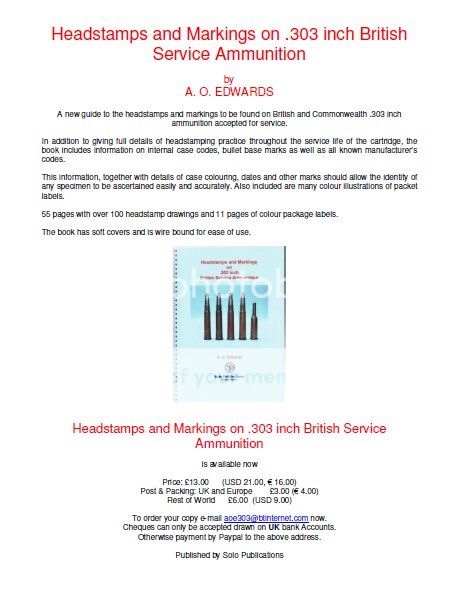
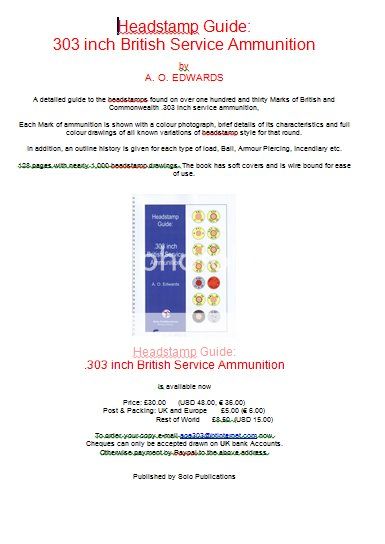
Peter and Freddy's book ".303 inch" is indeed a superb volume, but is as you say hard to find and expensive. My two volumes, one on identification and the other on all known (to me) headstamps are available. PM me for details.

Regards
TonyE

AD1jpg_zpsf65c1a0f.jpg


Ad2jpg_zps20bbe665.jpg
 
Hi, Tony E!

If you will reread my post, you will find that I was talking about letter-codes at the time I mentioned the various Marks of ammunition. There were several Marks of many of the letter-codes, but not all. I have a couple of the Mark VIIP but it was superceded by the Mark VIIW which became the W Mark I in the post-1927 period. I count this as a single variety of the W and a single variety of the VIIW and a single variety of the VIIP, for a total of 3 different markings. Likewise there was the original VIIB from the Great War which became the B Mark I which I count as the first of the "family" of B-coded rounds, the earliest type being, as marked, a variant of the Mark VII. I know about the B Mark V, but the fact that it was never issued sort of removes any great quantity of the things from what you will pick up at Canadian gun shows. As far as issued ammo goes, there were the 6 Marks, headstamped from I through VII with V "missing".

My authority for the description of the B IV as an APIT is in a personal letter from Major Labbett, stored with my small library. I have not taken one apart to section for the good reason that the things are illegal in this Free Country and so I no longer have any. He also is the source of my stab at the number of varieties; he told me that he had 1800 in his own collection (I have less than 200 myself) and that Mr. Woodend possessed double that number. I assumed, perhaps incorrectly, that he meant varieties rather than cartridges; I count the RG Mark 8Z of 1955 as a single cartridge when, in fact, I have 252 of them: 2 singles and 250 in a belt, sealed away like a mummy in its coffin.

Sorry for the goof on the W variety; there was only the one for the .303. I was confusing it with something else; it was 4 in the morning and I was trying to work fast. No excuse, I know; I hate passing out duff information, but the majority of my library has been moved to a new location. Looking after a ton or so of military books can be an awful chore at times; I am not looking forward to moving again.

I am aware of your series of books on the .303" round and wanted to purchase a set, so I have PM'd you on two occasions regarding this. You do not, however, seem to return e-mails or PMs, I find, and, without a title or an ISBN, it can be difficult to find a Publisher.

With the information now posted, I can source a set through rather a co-operative bookseller I know.

Thanks for setting me straight on the WI.
 
Fair enough on the AP, I understand what you meant now. I think we can cordialy agree to disagree on the incendiaries, as my take is that although not issued the B Mark V was approved and made and examples still exist.

With regards to numbers, Peter Labbett's total included date variations. I was very familiar with both Peter's and Herb Woodend's collections. I may have mentioned that after Peter died his collection was sold for the estate but I inherited his document and drawing archive including his collection catalogue and importantly all the breakdown data he had amassed. Similarly when his co-author Freddy Mead died I inherited the originals of all the drawings for the .303 inch book. I don't collect dates so my collection is relatively small, just over 1,000 .303 inch variations.

I am sorry about the problems of reaching me about the books, I don't know why that should be. PM me again or send an e-mail and i will make sure things happen. Again my apologies.

All the best,
TonyE
 
MkVIIIz was certainly intended for machine guns because of the extra range it provided, BUT it was also authorized for sniper rifles. SO, in effect, using it in a Enfield is OK
Oh by the way, the Z stands for flake powder rather than cordite.
 
When the Canadian Army needed more .303 ammunition for the Northern Rangers in the early 1980s, they let a contract to IVI. IVI said they would have difficulty making Mk 7 bullets but could produce Mk 8 bullets with no difficulty because they had recently made some for Sri Lanka. We went with the Mk 8 bullets. The only thing they asked us was whether or not we planned to shoot it in machine guns because they wanted to use the thinner brass casings of the sort they used for sales to hunters. Machine guns beat up the casings a lot in feeding and extracting. We took the thin brass and, since no one in Canada used cordite anymore, we used NC propellant to make Mk 8Z catridges.

I do not believe there is any reason to worry about firing either Mk 7 or Mk 8 bullets in a LE rifle. The only real difference is their ballistic properties. The boat-tailed Mk 8 bullets will fly better at long range after they have lost most of their velocity and are sub-sonic. Other than that, I doubt there is mouch difference.
 
When the Canadian Army needed more .303 ammunition for the Northern Rangers in the early 1980s, they let a contract to IVI. IVI said they would have difficulty making Mk 7 bullets but could produce Mk 8 bullets with no difficulty because they had recently made some for Sri Lanka. We went with the Mk 8 bullets. The only thing they asked us was whether or not we planned to shoot it in machine guns because they wanted to use the thinner brass casings of the sort they used for sales to hunters. Machine guns beat up the casings a lot in feeding and extracting. We took the thin brass and, since no one in Canada used cordite anymore, we used NC propellant to make Mk 8Z catridges.

I do not believe there is any reason to worry about firing either Mk 7 or Mk 8 bullets in a LE rifle. The only real difference is their ballistic properties. The boat-tailed Mk 8 bullets will fly better at long range after they have lost most of their velocity and are sub-sonic. Other than that, I doubt there is mouch difference.

you do know there is mk8 ammo only ment for MG's

id not want to fire .303 surplus anymore anyway its not like we a talking about stuff we can get by the truck load .303 surplus is not a easy thing to come by anymore
 
you do know there is mk8 ammo only ment for MG's

id not want to fire .303 surplus anymore anyway its not like we a talking about stuff we can get by the truck load .303 surplus is not a easy thing to come by anymore

Mark 8 or 8z is indeed intended for Vickers machine guns, but not ONLY for MGs. Mark 8/8z is authorised fro use in L-Es and Brens when less flash is required. e.g. night patrols. See Pamphlet 11, Small Arms Ammunition.

Actually there was very little Mark 8 cordite loaded ammo made. It was virtually all Mark 8z,

Regards
TonyE
 
Here's some pictures I took of the FN Bren ammo and packaging that I have. It has none of the markings that are talked about here, and if I didn't still have the top of the box, I'd have absolutely no idea what type of .303 it was. The label on the box is in rough shape, but you can clearly see BREN, everything else is a little harder to make out.

P3261054_zps8a6a5da6.jpg


P3261052_zps73e1b21d.jpg


P3261053_zpsd4b396da.jpg


P3261051_zps962c8897.jpg


Now here's the hundred dollar question, what ill effects would come from firing this (or any other bren/mg .303) in a Lee Enfield. (not that I'm going to be shooting it!)
 
Mark VIII or 8, Z or not, was developed in the inter-war years and manufactured ONLY for machine-gun use. The velocity was 110 ft/sec higher and the bullet the same weight but with a distinctive rebated boat-tail which gave an advantage to MGs in both range and overhead-fire applications. Being that it was a British development and completely obsolete by US standards, it is interesting to note that it is actually .57 of 1% more powerful than its US long-range replacement, the 7.62x51NATO M-118 Ball round.

So if I read this correctly, MkVIII and 7.62X51 are basically equivalent in power, and they rechambered or built new #4's in 7.62. Could one assume then the is really no reason why w can't run MkVIII in L.E.?
 
Back
Top Bottom