Fastest Piston Engine Fighter of World War 2

"http://en.wikipedia.org/wiki/Republic_P-47_Thunderbolt
When fitted with a GE CH-5 turbosupercharger, the XP-47J achieved a top speed of 505 mph (440 kn, 813 km/h) in level flight in August 1944, making it one of the fastest piston engine fighters ever built.

Apparently the allies didn't really have a requirement for that kind of speed, the Germans were so heavily outnumbered by that time that it didn't matter what speed piston engine fighters could reach.
 
Do335 specs

General characteristics

Crew: 1, pilot
Length: 45 ft 5 in (13.85 m)
Wingspan: 45 ft 1 in (13.8 m)
Height: 15 ft (4.55 m)
Wing area: 592 ft² (55 m²)
Empty weight: 11,484 lb (5,210 kg)
Max takeoff weight: 19,500 lb (8,590 kg)
Powerplant: 2× Daimler-Benz DB 603A 12-cylinder inverted engines, 1,287 kW, 1,726 hp (1,750 PS) each

Performance

Maximum speed: 474 mph (765 km/h)
Combat radius: 721 mi (1,160 km (half load))
Service ceiling: 37,400 ft (11,400 m)

Armament

1 × 30 mm (1.18 in) MK 103 cannon (as forward engine-mounted Motorkanone)
2 × 20 mm MG 151/20 cowl-mount, synchronized autocannons
Up to 1,000 kg (2,200 lb) bombload


Sounds like it fitts in the same roll as a P3x lightning or a Mosquito. Heavy fighter/night fighter/fighter bomber.
 
So they would have to fight identically to US fighters fighting zero's in the pacific?

Also identicaly the same basic doctrine of all the fighter/bombers in europe including the p47, p38, tempest, typhoon, mosquito etc etc......using dives and speed to hit and run targets, since they could not turn with the 109 or 190's...

If manouverability was a sole factor in dogfights, biplanes would have won the skies of ww2, as they could outturn any piston fighter.


They are pretty much useless for maneuvering. Cessna re-did this design years later with a split tail. It wouldn't last a turning fight with any decent fighter of the time.
 
So they would have to fight identically to US fighters fighting zero's in the pacific?

Also identicaly the same basic doctrine of all the fighter/bombers in europe including the p47, p38, tempest, typhoon, mosquito etc etc......using dives and speed to hit and run targets, since they could not turn with the 109 or 190's...

If manouverability was a sole factor in dogfights, biplanes would have won the skies of ww2, as they could outturn any piston fighter.

Not as cut and dry as that. The P47 P38 etc. Could turn relative to the other aircraft just not nearly as well. This particular one would be lucky to turn at all. Speed would be its only advantage. This airplane wouldn't even be able to do a rolling scissors or a weave. They would be akin to a Mig 21 zoom and boom.
 
Was at Sudbury airport to pick up my son and daughter-in-law last Fri. There were four Cessena 210's (the push-pull model) parked there at a corporate terminal. Not sure what they were used for. One of my friends used to be a half owner of one. I was told that the original rationale was that single engine certified pilots could be certified to fly them as they didn't have the nasty tendencies of conventional twin-engine designs if one engine failed. Apparently the FAA didn't see it that way.

Not a 210 Centurion. It's a Cessna 337 Skymaster. The militarized version was the O-2. Still needed a specific multi rating but yes, it is easier to handle with an engine out as there's no asymmetric thrust to contend with and therefore no VMCG/VMCA to worry about. Much easier on the thigh muscles too if you're a longish way from an airport.

It had its problems though as the aft engine was difficult to cool.

Also, many folks would start just the forward engine with the intention of taxiing to the post with the aft shut down in an effort to save on gas. Lots of them would forget to start the aft engine in spite of a checklist, and attempt takeoff with only one engine. You can imagine the consequences. The best way to do that (if you're that cheap) was to start the aft engine and taxi out. Hard to forget the forward engine if the front prop blade is just sitting there, staring you in the face.
 
That would be the Cessna 0-2 Skymaster which the USAF used as a FAC aircraft in Vietnam. It was a good choice for this role.

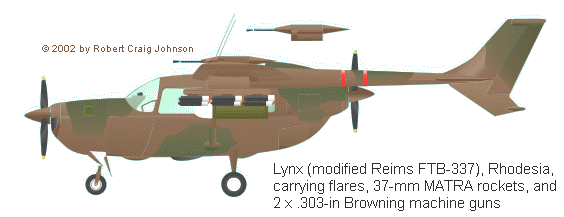
The Rhodesian Air Force also used the 337 (of which the O-2 was a military version) as the Lynx. Theirs were built in France by Reims Avaiation.

cessna337lynx.gif
 
Seems the Do-335 would be good for intruder missions to drop a bomb and run or photo recce. A single aircraft doing such missions were hard to catch as the intercepting aircraft had to takeoff and climb to an intercept altitude and coordinate. A fast aircraft trying to avoid combat makes this intercept a very tricky thing. hence the reason that photo recce aircraft were rarely armed. Straightline speed was their defense.
 
Ahhh, the ol' 337 "Bug Masher", or as we called it, the "Suck me Blow me". Were hell on the avionics. They had a terrible problem with EMI from the plug wires. They all needed to be shielded.

Auggie D.
 
Just reviewed Eric Browns post war notes on the 335, his note agrees with most the comments here about dog fighting. It was a massive airplane designed to kill bombers, he felt had it made it into full service it would have done so fairly well. Better at night than day but still effective during the day. You really need to see a person beside to get a feel for how big it was.
 
Back
Top Bottom