Ffp

might be fast but has a lot of room for error "tuning via magnification" is sloppy at best. , where as FFP and knowing you trajectory is the fast and accurate.

caustic, that statement right there tells me you obviously have zero experience with a well designed sfp scope and ballistic reticle and you are arguing for no other reason than justify your ffp scope. I own both ffp and sfp scopes and both systems work great and both systems have their advantages in certain situations. For me I like the speed of the ballistic reticle in an sfp scope in big game application. I appreciate that you think you don't but spreading misinformation isn't doing anyone here any good. Until you have considerable experience with an sfp scope I'd suggest you limit your comments on their function because it's obvious you don't have the experience to back them up.
 
yes you do need to know you trajectory for that days conditions.

what do you do for your setup when the temp and air density changes?

How much shooting have you done to 600 yards caustic...by that statement there I'd say not much. As I've explained already to you, I can easily compensate for a drastic temperature or elevation change with a slight magnification adjustment but in a hunting situation at 500-600 yards, the temperature changes I'm going to experience during hunting season aren't likely to make a hill of beans difference.
 
How much shooting have you done to 600 yards caustic...by that statement there I'd say not much. As I've explained already to you, I can easily compensate for a drastic temperature or elevation change with a slight magnification adjustment but in a hunting situation at 500-600 yards, the temperature changes I'm going to experience during hunting season aren't likely to make a hill of beans difference.

disagree , here is the mindset difference i only use one gun for long range target and hunting.

i've experienced 1 mil change in my load from temp change -10 to -35 in one day . That amount to change is definitely a hill of beans to contend with as i always want to hit where i'm aiming and not roughly in the area. @600 m that's over 60cm or 20.58" too much for my liking .
 
Last edited:
disagree , here is the mindset difference i only use one gun for long range target and hunting.

i've experienced 1 mil change in my load from temp change -10 to -35 in one day . That amount to change is definitely a hill of beans to contend with as i always want to hit where i'm aiming and not roughly in the area. @600 m that's over 60cm or 20.58" too much for my liking .

What in the world are you shooting that changes POI by over 20 inches at 600 yards with a 25 degree temperature change? I'm thinking you might want to rerun those numbers.
 
What in the world are you shooting that changes POI by over 20 inches at 600 yards with a 25 degree temperature change? I'm thinking you might want to rerun those numbers.

1 mil = 3.6" or so @ 100y

3.6" x 6 = 21.5 "

I didn't own a kestrel weather meter so actual temp at the shooting location that day was is unknown , TV stated it was -35C but who knows. that was the change from morning to evening. can't recall the wind of the day though may have played a factor.
 
Last edited:
1 mil = 3.6" or so @ 100y

3.6" x 6 = 21.5 "

Ya but what are you shooting to see that kind of drop? That's about 1000% more than I'd see with my rifle. If your powder is that temperature sensitive perhaps the scope is the least of your worries.
 
I'd take a guess that caustics 3.6" difference at 100 yards was more of a loading or marksmanship error than anything else. Also would not a POI temperature shift affect both a FFP and SFP scope equally or does the FFP some how compensate for this?
 
I'd take a guess that caustics 3.6" difference at 100 yards was more of a loading or marksmanship error than anything else. Also would not a POI temperature shift affect both a FFP and SFP scope equally or does the FFP some how compensate for this?

Both could be manually adjusted to compensate but neither would do it automatically but with my rifle and my load, the shift in POI with a 25 degree temperature drop at 600 yards would be insignificant in a hunting application. If one was really worried about the couple inch difference one could easily adjust their POA slightly to compensate with either an sfp or ffp scope and not worry about making any mechanical adjustments.
 
Last edited:
one big flaw in the 'just set the magnification and go' theory is that the magnification dial was never meant to be set accurately. if you need to be on 15.3x you have to estimate that. given the often mushy style of setting magnification and no positive clicks like you have on your turrets you are guessing at best. in a FFP scope (whichever the reticle) 1 MOA/MRAD is always the same. there is almost no need to guess. the only time that it MIGHT be needed is if you need partial holdoffs. however, in this case it would be idential to BCD reticles without the added inaccuracy of having to worry about what you set the magnification to. as far as i am concerned the debate as to which is more accurate is obvious based on these facts alone. if you care about having the most accurate scope possible you go with FFP. if you are willing to sacrifice some accuracy (for personal ease of use) depending on what you prefer then a SFP BCD reticle is an acceptable choice. in the event that you are shooting over short ranges the difference will be pretty much inconsequential, but there will be a difference nevertheless. the true difference will show when you are at longer ranges.
 
Accuracy is a pretty relative term under actual field hunting conditions......the SFP BDC is a hunting reticle no question but under actual field hunting conditions I'd say it's every bit as accurate as a turret...and way faster. Off the bench...no doubt the win goes to the turret. A lot of this stuff sounds good on paper and in theory and makes good internet banter but in the field with crosshairs on an elk at 600 yards, it really doesn't mean squat. If you've used a quality BDC reticle in a SFP scope, you'd realize how off base your comments actually are in the field. Most people never have the opportunity to ever learn the abilities of their gear on live animals at longer ranges....at least not in any quantity.

If they aren't for you that's fair enough but to insinuate that they are not sufficiently accurate is just plain ludicrous.....lots of proof in the pudding out there. Some of you are basically calling bdc users unethical. It's two systems that both work well with each having their benefits and disadvantages.....and both can be used very effectively in a hunting situation.
 
Last edited:
I really don't see a couple of hundred dollar advantage to a FFP scope. I don't use my scope to range anything, got ranging bino's for that and I mostly use the turret in MOA for range adjustment. If I'm shooting at any distance, I normally have plenty of time to take a minute or so to adjust my zoom setting or crank up the turret. FFP to me, is really more of a tactical scope. Not saying there is anything wrong with them, just saying that to ME, I don't see the advantage.
On my SFP scopes with range hash marks on them (non-target turret) I normally shoot at the indexed power setting and know the POI at the hash mark....instead of being 100, 200, 300, 400 etc yards at each mark it might be 100, 200, 275, 350, 440, 540 etc....works for me!
Also there isn't really any reason a FFP scope should cost more than a SFP scope....I don't think there is any increased cost to build one.
 
Accuracy is a pretty relative term under actual field hunting conditions......the SFP BDC is a hunting reticle no question but under actual field hunting conditions I'd say it's every bit as accurate as a turret
accuracy is not a relative term. it is something which is quantifiable. your statement is incorrect. saying that -5*C is cold is relative (what you are saying). saying that -4*C is warmer than -5*C is factual and quantifiable (which is what i am saying).

Off the bench...no doubt the win goes to the turret. A lot of this stuff sounds good on paper and in theory and makes good internet banter but in the field with crosshairs on an elk at 600 yards, it really doesn't mean squat.
whether or not the extra accuracy is appreciable in a given application is perfectly subjective and you are well within reason to make that claim. i agree with you. however, you just admitted that FFP is more accurate than SFP, thus proving my point and therefore disproving yours.

If they aren't for you that's fair enough but to insinuate that they are not sufficiently accurate is just plain ludicrous.
once again, i did not say that SFP is not sufficiently accurate. under the majority of conditions it is. i stated that FFP is more accurate in a quantifiable sense. your statement is an opinion. mine is a fact. please recognize the difference.

Some of you are basically calling bdc users unethical. It's two systems that both work well with each having their benefits and disadvantages.....and both can be used very effectively in a hunting situation.
I for one have not. i agree with many of your opinions. at no point have i ever said you are wrong to use one. i simply stated facts. in fact i specifically agreed with you in that "It's two systems that both work well with each having their benefits and disadvantages"

Also there isn't really any reason a FFP scope should cost more than a SFP scope....I don't think there is any increased cost to build one.
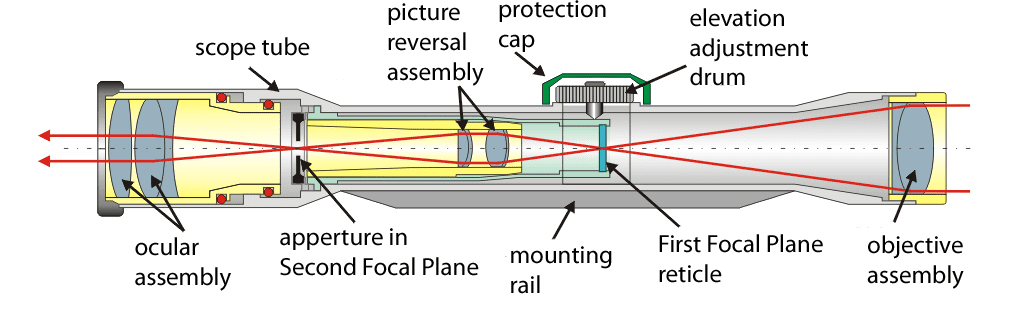
there are. first of all EVERY rifle scope has both a first and second focal plane. the second focal plane is fixed in location and the first is what moves when you adjust focus, parallax, turn your turrets, etc. because of this there is more money spent on the FFP lense than the SFP lense (regardless of where the reticle is placed). now for the reasons for the price difference:
- because one very common use is for indexing the reticle is generally much more accurate and consistent than SFP counterparts. this generally has more to do with overall scope build quality than price though. a $1500 SFP reticle will be just as accurate as a $1500 FFP reticle. however, at lower prices (sub $500) you rarely see FFP scopes because of this reason. an inconsistent FFP scope is much less useful than a SFP one.
- from an optical point of view it is much easier to mount a reticle to a SFP lens than a FFP lens because of optical distortion. the FFP lense creates more distortion than a SFP lense does. because in a FFP scope the lense is mounted right to the lens which creates more distortion it will be much more noticeable. as a result in a FFP scope the actual FFP lense is usually more expensive by necessity.
- a SFP scope is indexed and calibrated for one specific magnification such that a 1MOA adjustment on the turrets is the same as a 1MOA holdover on the reticle. although through its magnification range the two values will remain close there will be a difference (however slight). given that manufacturers make no claims as to the accuracy at any magnifications other than the indexed one this will never be an issue for them. the inherent inaccuracy of 'setting your magnification to 12.7x' will be more than the difference between the turrets and reticle. however, with a FFP scope the turrets and reticle must match throughout the magnification range. this requires tighter tolerances to build around. once again this is mostly at the lower end of the scope spectrum. once you are above $1k for a scope it isnt an issue.

those are the main differences in the cost to build. they perfectly explain why there arent many FFP scopes for $500. however, at higher prices in my opinion the difference in price is mostly contrived. there might still be some small differences in production cost but nothing to warrant a $200-$300 difference as you have in some cases.

i have attached a simplified image to illustrate.

Telescopic_sight_internals.png
 
whether or not the extra accuracy is appreciable in a given application is perfectly subjective and you are well within reason to make that claim. i agree with you. however, you just admitted that FFP is more accurate than SFP, thus proving my point and therefore disproving yours.

I didn't just admit that...I've said it several times if you've been following along and I disproved nothing as that was not my point. My point is that the slight edge in accuracy offered by the turrets is not appreciable in a hunting situation, not sub 600 anyhow. It sounds good on the internet though.
 
I'll be up front, I haven't read all of the previous 95 comments, but here's my two cents. I have a Mark 4 with the TMR reticle at it is FFP. With my particular caliber the mil hash marks correspond to very useful holdover points, they are close enough to increments of 50 or 100 yards to be used as such. For example 2.0 mils of drop will put me dead on at 400 yards with my 100 yard zero. If I ranged a target/animal to be 400 yards and didn't want to dial the correction, I can use the 2 mil hash mark regardless of what power I'm on. No worrying about correct powers or conversion factors.
 
oh, another thing i didnt meantion which is very important to you hunters out there is not losing your sight picture. even if you do memorize what magnification you should be on for whichever range you need to look at the dial when you need to adjust it. during this time you will lose your sight picture and possibly the shot. as 1ShotKing said, with FFP you dont need to change anything at all. no losing your sight picture and no extra time to take that shot. this just occured to me because i have never thought of a ballistic reticle on a FFP scope (no idea why.... kinda slow i guess) because all of my experience and what i look for are MIL-whatever reticles. i think we have a winner for easiest to use scopes for hunting: FFP ballistic reticles


 
oh, another thing i didnt meantion which is very important to you hunters out there is not losing your sight picture. even if you do memorize what magnification you should be on for whichever range you need to look at the dial when you need to adjust it.

If it's far enough away that you require secondary hashmarks, you usually have time to adjust your magnification....lol I suspect you might lose sight picture turning the turret as well. This has been entertaining if nothing else. I had no idea there were so many hunters out there that could not handle a task as simple as turning a magnification ring....truly interesting and frightening all at the same time.
 
If it's far enough away that you require secondary hashmarks, you usually have time to adjust your magnification....lol I suspect you might lose sight picture turning the turret as well. This has been entertaining if nothing else. I had no idea there were so many hunters out there that could not handle a task as simple as turning a magnification ring....truly interesting and frightening all at the same time.

why would you need to turn the turrets at all. if we are taking ranged up to 600m as you have said that you dont need to turn turrets at the slightest. just hold for wind and drop using your reticle regardless of which magnification you are in. if you need to change your sight picture without removing your face from the scope turn the dial until you are comfortable without a care in the world for what the magnification is set to. if you have a FFP ballistic reticle there would be no need to remember magnifications, what you need to set your turrets to (because for common shots, which is what we are talking about here, they are all there), no need to lose sight of the animal once you acquire it the first time. you arent stuck at a magnification which doesnt give you an ideal sight picture either. this takes everything positive you have said about SFP ballistic reticles and removes the need for the need to do your computer calculations at all. one disadvantage would be that you cant really range on those reticles but strictly adhering to the ease of use argument which you have been using it is the best option.

also you seem to be under the impression that 'we' are attacking you for using a SFP scope. 'we' arent. the differences between the two have been pointed out throughout this topic. you are the person who is making boarderline insulting comments about individuals when you make statements such as " I had no idea there were so many hunters out there that could not handle a task as simple as turning a magnification ring....truly interesting and frightening all at the same time."

TLDR: reviewing the pros and cons to each option i cant think of a better choice than a FFP ballistic reticle for the 'as easy to use as possible 100-ish to 600-ish yard accurate-ish' scenario you have concocted.
 
I stand corrected...sfp ballistic reticles are definitely too complicated for some.....it does require a degree of hand eye coordination to turn the magnification ring, you need to be able to remember the direction your target was in and some bullets drop 20 inches in cold weather. All others should have no issues. This has been entertaining but I'm done!
 
Back
Top Bottom