9mm seating depth and unsafe pressures?

Trinimon

CGN Ultra frequent flyer
Rating - 100%
128   0   0
Location
Onterrible
Hi folks, I normally buy factory cast or FMJ pills for reloading but got a great deal on some homemade cast 9mm from a local guy. They are RNFP and weigh in at 132gr. Kinda odd weight bullet and tough finding load data for it so I have to do some averaging for a safe test load from a few reloading manuals and personal recipes.

I did up a few with the following specs:

Bullet: Lead RNFP 132gr
Powder: 2.9gr Titegroup
COAL: 1.055"
Velocity: 870fps avg (a bit slow for 9mm)

Looks like I can bump up the powder weight a little more to be around the 950-1000fps range.

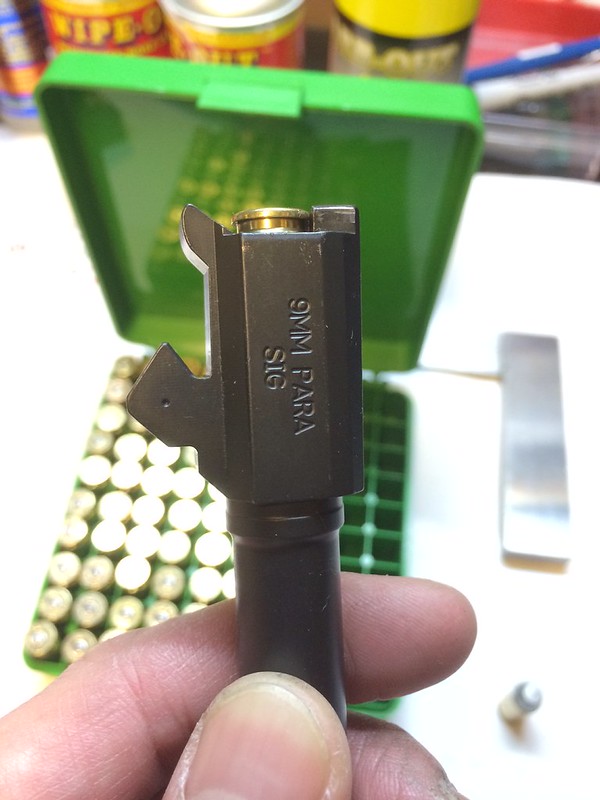
Here's where I need some help. These feed reliably in my Beretta 92FS and Sig226 barrels easily. I did the drop test in each barrel to see if the ammo would fall out easily and they do. They headspace perfectly.
11295229395_a1925df2ed_c.jpg


Now when I try this test on my Glock's LoneWolf barrel, the bullet hits the lands and does not allow the entire ammo to sit safely in the breech. Sorry, forgot to take a pic.

The only way to get the ammo to sit in the LoneWolf barrel is to seat the bullets down to 1.005". I'm guessing the OGIVE on the RNFP is longer than your regular RN.

So my question is, is it safe to reseat the bullets to 1.005" from 1.055" without any overpressure issues seeing that TiteGroup is a fast powder already. Will 0.05" make a big increase in pressure to be unsafe? I know I'm pretty close to SAAMI minimum spec for 9mm at that new OAL.

Thanks!
 
DRG sells a 135gr hard cast lead Round Nose bullet that I find works better than the 125 gr. I load 3.3 to 3.8 gr of Titegroup, depending on the gun.

Your powder charge is so mild I am surprised it would cycle your pistol.

I suggest you load both lengths, and mark the boxes as to which gun the ammo is intended for. That's what i do. One gun likes 3.1gr and the rest prefer 3.5.

I suggest you make test ammo at 3.1, 3.3 and 3.5 in both lengths and see what groups the best.
 
do you have pictures of the cast boolits? i have a 135gr RNFP mold from NOE and i seat them to 1.090". Although now that i just measured the bullet, seating them as deep as you suggest seats them past the driving band. but i shoot these out of my stock glock barrel, leading isn't an issue for me, i size them to .357 or .358 depending on which bullet.

Regardless of what i said above, looking on hodgdon's website for a 130gr RN bullet the minimum load is 3.5gr, so i would feel comfortable seating them deeper.
 
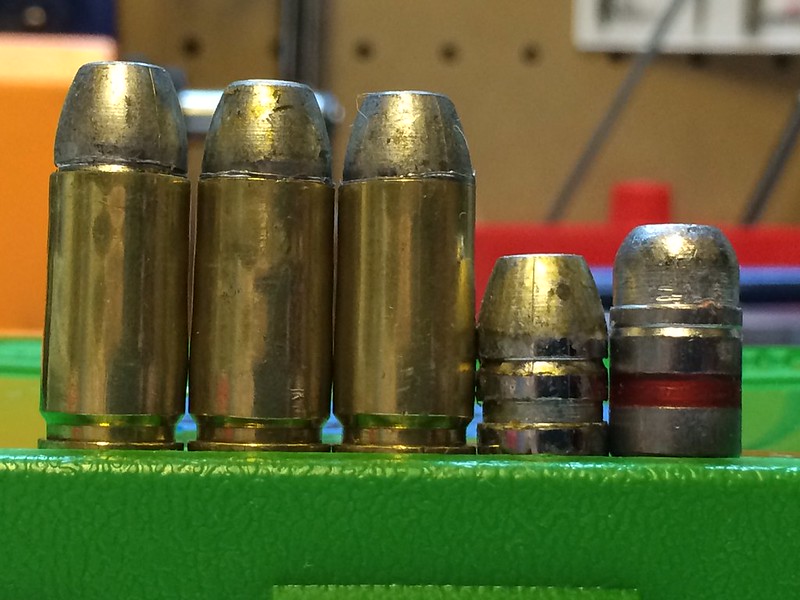
Here's an overall pic of the ammo/pills.
Left to right - 1.055", 1.010", 1.005", 132gr RNFP, DRG 158gr RNFP for my 357Mag.
11300738124_f4a4c23753_c.jpg


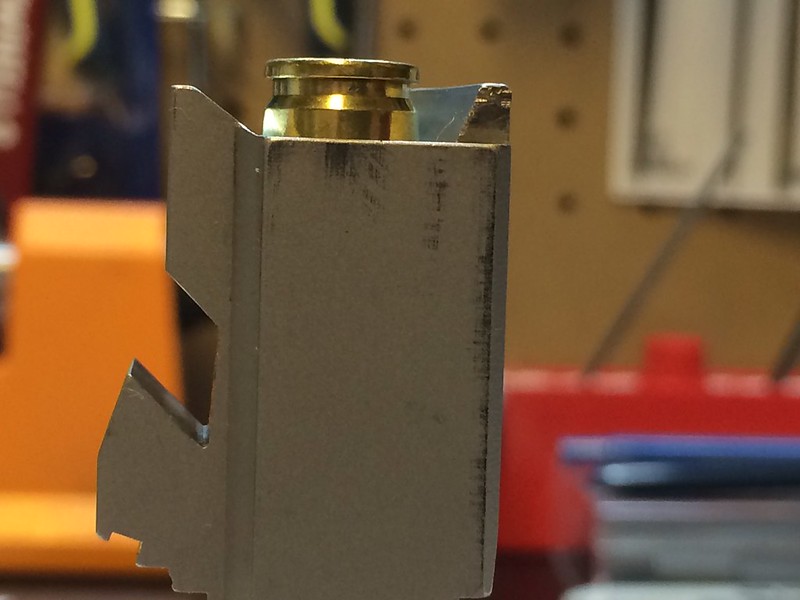
Here's the 1.055" ammo seated in my LoneWolf barrel. Same ammo fitted in my Sig226 above.
11300772983_597546751f_c.jpg


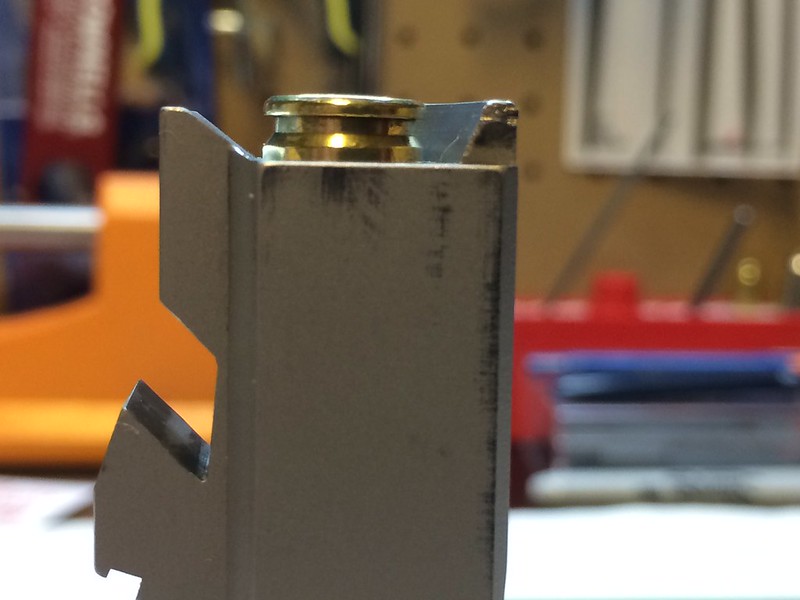
Here's 1.010" in the LoneWolf barrel. It is JUST making contact with the lands.
11300671805_fcff2b6aa6_c.jpg


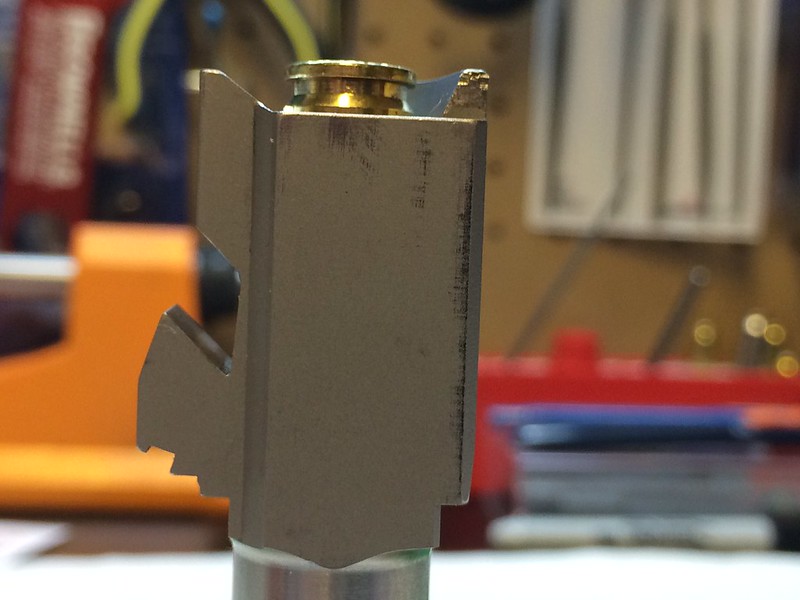
Here's 1.005" in the LoneWolf barrel. It falls out cleanly.
11300672845_2a11c56945_c.jpg
 
In small capacity, straight wall cartridges, the pressures increase exponentially with even tiny decreases in case volume (under the base of the bullet). A few years ago, I did a number of scenarios using QuickLoad software, and the increases in pressures were beyond anything I could have imagined. As in DOUBLE or TRIPLE for a 0.1" to 0.15" decrease in OAL.

Small changes can be very substantial for the 9mm cartridge. Especially with long bullets. Remember it's not the OAL, but how far the base of the bullet goes down into the case. Meaning a long bullet with the same OAL as a shorter bullet will leave less volume in the case.

From my post a few years ago. http://www.canadiangunnutz.com/forum/showthread.php/320822-Bullets-pushed-in-!!

Just to see, I ran QuickLoad using a 125gr FMJ with max pressure load of Titegroup that generated 34,000 psi at 1.12" OAL

At 0.98" OAL the calculated pressure was 94,000 psi

Using a 115gr bullet the pressure only increased to 79,000 psi


Regardless of what i said above, looking on hodgdon's website for a 130gr RN bullet the minimum load is 3.5gr, so i would feel comfortable seating them deeper.

Not good advice at all.


EDIT:

Another thread. A bit long running, but one member did some tests and went from a sceptic to a believer.

http://www.canadiangunnutz.com/forum/showthread.php/322686-How-to-Safely-Discharge-Primer
 
Last edited:
In small capacity, straight wall cartridges, the pressures increase exponentially with even tiny decreases in case volume (under the base of the bullet). A few years ago, I did a number of scenarios using QuickLoad software, and the increases in pressures were beyond anything I could have imagined. As in DOUBLE or TRIPLE for a 0.1" to 0.15" decrease in OAL.

Small changes can be very substantial for the 9mm cartridge. Especially with long bullets. Remember it's not the OAL, but how far the base of the bullet goes down into the case. Meaning a long bullet with the same OAL as a shorter bullet will leave less volume in the case.

From my post a few years ago. http://www.canadiangunnutz.com/forum/showthread.php/320822-Bullets-pushed-in-!!

Just to see, I ran QuickLoad using a 125gr FMJ with max pressure load of Titegroup that generated 34,000 psi at 1.12" OAL

At 0.98" OAL the calculated pressure was 94,000 psi

Using a 115gr bullet the pressure only increased to 79,000 psi


Not good advice at all.

WOW, that's quite a spike. Do you recall the powder weight?
 
WOW, that's quite a spike. Do you recall the powder weight?

No, I intentionally didn't mention it. But it would have been a max load with whatever length bullet was used. Even if QuickLoad is off by a good percentage, it still shows the magnitude of a seemingly small change in OAL.

That's why I've (re) posted this, it surprised a LOT of people, including me.


A clip from the second thread posted above. This time using a light published load as a starting point. Note the pressures are increases, not total. A heavier, longer bullet would increase pressures quicker.

The example that you used about pushing back a bullet from 1.125 OAL to 1.100 OAL. I ran a simulation using a 9mm with 125gr FMJ bullet, Titegroup powder and makes IPSC Minor. Pressure was well below SAAMI average max for 9MM.

Pushing the bullet back to 1.100" OAL increases pressure by 5,000 psi.
Pushing the bullet back to 1.050" OAL increases pressure by 19,000 psi
Pushing the bullet back to 1.000" OAL increases pressure by 55,000 psi

SAAMI pressure for 9mm is 35,000 psi.

Going from 1.125" to 1.00" is only 1/8 inch. Yes, 1/8" is very noticeable. This is only one example, and it uses a modest load. Different combinations and slightly heavier loads can boost the pressure MUCH more quickly.
 
Last edited:
Maybe it's the photo but the cartridges in the centre and on the right (1.010" and 1.005" seem to have some lead shaving going on. You might want to to try expanding the case mouths a bit more.
 
Now when I try this test on my Glock's LoneWolf barrel, the bullet hits the lands and does not allow the entire ammo to sit safely in the breech. Sorry, forgot to take a pic.

The only way to get the ammo to sit in the LoneWolf barrel is to seat the bullets down to 1.005". I'm guessing the OGIVE on the RNFP is longer than your regular RN.

So my question is, is it safe to reseat the bullets to 1.005" from 1.055" without any overpressure issues seeing that TiteGroup is a fast powder already. Will 0.05" make a big increase in pressure to be unsafe? I know I'm pretty close to SAAMI minimum spec for 9mm at that new OAL.

Take a minute and think about what you are measuring when you measure COAL.

................. take your time, we will wait ................

OK, now did you figure it out?

The COAL measurement is to the tip of the bullet. Did you happen to notice that a RN and FP are very different shaped bullets and thus will use a totally different COAL in order to have the ogive in the same place lengthwise? COAL is the most useless measurement ever devised because it is totally dependant on the shape of the bullet nose.

To answer your second question. It is highly unlikely that .050" of seating depth will make any difference in case pressure. Even if it does, the gun won't blow up. In the event of excessive pressure there are two things that will generally happen. The first is the primer will be seriously flattened and the primer pocket will stretch and possibly allow the primer to just fall out. This can be annoying but not dangerous.

At really excessive pressures the back end of the case may begin to bulge. Keep in mind that this is not dangerous as it still takes a fair bit more pressure for the case to split. Even if the case does split, the gun won't blow up. There is a ton of safety margin in modern guns.
 
"The first is the primer will be seriously flattened and the primer pocket will stretch and possibly allow the primer to just fall out. This can be annoying but not dangerous."

I disagree on this. I have seen a number of serious Kabooms that were preceded by one, two or several blown primers. A blown primer is God's way of saying STOP SHOOTING!

A blown primer is not, in itself, dangerous, but what is causing the primer to blow might be very dangerous. (wrong bullet, wrong powder charge, wrong powder, etc.)
 
Take a minute and think about what you are measuring when you measure COAL.

................. take your time, we will wait ................

OK, now did you figure it out?

The COAL measurement is to the tip of the bullet. Did you happen to notice that a RN and FP are very different shaped bullets and thus will use a totally different COAL in order to have the ogive in the same place lengthwise? COAL is the most useless measurement ever devised because it is totally dependant on the shape of the bullet nose.

To answer your second question. It is highly unlikely that .050" of seating depth will make any difference in case pressure. Even if it does, the gun won't blow up. In the event of excessive pressure there are two things that will generally happen. The first is the primer will be seriously flattened and the primer pocket will stretch and possibly allow the primer to just fall out. This can be annoying but not dangerous.

At really excessive pressures the back end of the case may begin to bulge. Keep in mind that this is not dangerous as it still takes a fair bit more pressure for the case to split. Even if the case does split, the gun won't blow up. There is a ton of safety margin in modern guns.

Thanks Suputin. I'm aware of the bullet shape differences of a RN and RNFP. I did not reference anywhere in my request to a RN bullet for OAL measurements. I did consult my Lyman and Hornady manual for FP projectiles and based my measurements on their min OAL in comparison to what I'm currently seating at in order to accommodate the short leade in the LoneWolf barrel. Agreed, OAL is a bit of a misinterpretation and maybe they should go by OGIVE measurement instead.

Now on another site, one person picked up right away that the bullets were made from a Lee 359-125RF mould and that it was sized down to 0.356" with an average weight of 132gr and known issues of this pill with tighter LoneWolf and CZ barrels.
 
Thanks Suputin. I'm aware of the bullet shape differences of a RN and RNFP. I did not reference anywhere in my request to a RN bullet for OAL measurements. I did consult my Lyman and Hornady manual for FP projectiles and based my measurements on their min OAL in comparison to what I'm currently seating at in order to accommodate the short leade in the LoneWolf barrel. Agreed, OAL is a bit of a misinterpretation and maybe they should go by OGIVE measurement instead.

Now on another site, one person picked up right away that the bullets were made from a Lee 359-125RF mould and that it was sized down to 0.356" with an average weight of 132gr and known issues of this pill with tighter LoneWolf and CZ barrels.

that makes alot of sense, i tried using a 110gr mold that drops at .359 and i size them to .357 or .358. but i have to seat them really deep to work in my glock barrel.

2013-12-10174301_zps086bd002.jpg

left is the 135gr bullet i was talking about before.
 
To answer your second question. It is highly unlikely that .050" of seating depth will make any difference in case pressure. Even if it does, the gun won't blow up. In the event of excessive pressure there are two things that will generally happen. The first is the primer will be seriously flattened and the primer pocket will stretch and possibly allow the primer to just fall out. This can be annoying but not dangerous.

At really excessive pressures the back end of the case may begin to bulge. Keep in mind that this is not dangerous as it still takes a fair bit more pressure for the case to split. Even if the case does split, the gun won't blow up. There is a ton of safety margin in modern guns.

In terms of pressures, what matters is how far the base of the bullet is into the case and the remaining volume.

As for the 0.050", it depends on where you start. If using a long and heavy bullet and seated deeply, it means that the volume in the case under the base is already very small. Even the slightest reduction in volume is a large percentage of remaining capacity. If charges are near max, it can easily push pressure well above proof load pressure. Pistol cartridges don't show pressure signs nearly as well as rifle cartridges. By the time most pistol cartridges are showing pressure signs, it usually means the pressure is excessive.

As for safety margins. Running above design pressure doesn't automatically mean a kaboom, but it does mean the margin of safe is substantially reduced. Sort of like paracord. Breaking strength of 550 lbs so can easily support an average person, in theory. Would you feel comfortable using one strand as a sling lifting you over a canyon?

(I know you are aware of the above, just commenting for everyone)
 
Back
Top Bottom