Sometimes yes.Isn’t the 10/22 known as the least accurate production semi 22lr that requires replacing almost everything on the gun to make them shoot good?













































You are using an out of date browser. It may not display this or other websites correctly.
You should upgrade or use an alternative browser.
You should upgrade or use an alternative browser.
.22 Cheap / inexpensive squirrel plinker
- Thread starter tiho74
- Start date

The body of scientific evidence do not indicate that longer barrels are more accurate. Conversely, shorter barrels often have better stiffness and are more accurate than long barrels. Furthermore, velocity loss in going from a 20" to 13" barrel is minimal. About 3 to 6% for standard velocity subsonic ammo.I would suggest the Scorpio EM332A with the 20" barrel is a better option if accuracy is of importance. They are both well made for sure and the 13" 332X is certainly handy and the bolt handle is a major upgrade, but mine would struggle to get better than 1" 5-shot groups at 50yds, even with decent ammo. The 20" would do much better, even with CCI standard. Being Chinese rifles, that may vary by example. But good suggestion.


That is all very true, I was just referring to the examples of both the JW15s (24" and 13") and Scorpios (20" and 13") that I have owned. In both cases the longer barrels were considerably more accurate than the 13" versions.The body of scientific evidence do not indicate that longer barrels are more accurate. Conversely, shorter barrels often have better stiffness and are more accurate than long barrels. Furthermore, velocity loss in going from a 20" to 13" barrel is minimal. About 3 to 6% for standard velocity subsonic ammo.
IMO a shorter barrel would tend to cause more POI variance even if shot from a 'normal' stable rest. The short distance to the muzzle likely would exaggerate Any slight movement during the actual trigger pull. That is part of the reason for 'light triggers'. If a gun was fired from a more 'absolutely stable' rest like a Ransom this 'variance' could be more controlled and comparisons of barrel length could be defined.
When testing ammo I use a Primos 'Group Therapy' one-piece rest and snug the rifle on with styrofoam pieces holding the butt in place. My CZ-VMTR has a ca-5-oz trigger and I can get a better idea of the ammo's relative consistency (barring fliers). PS - The 180-yd berm in this pic has been re-built and now is ca 4-meters taller per NB reqs in 2025.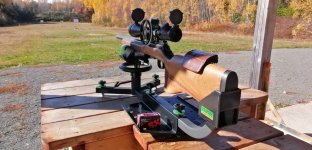
When testing ammo I use a Primos 'Group Therapy' one-piece rest and snug the rifle on with styrofoam pieces holding the butt in place. My CZ-VMTR has a ca-5-oz trigger and I can get a better idea of the ammo's relative consistency (barring fliers). PS - The 180-yd berm in this pic has been re-built and now is ca 4-meters taller per NB reqs in 2025.
- Location
- Northeastern Ontario
Longer barrels are universally preferred by shooters looking for the best accuracy possible. In serious rimfire benchrest competition shooters invariably use barrels that are about 24 - 26 inches in length. This is the length that is most responsive to the use of barrel tuners. RFBR shooters use tuners to help wring out improvements in accuracy from ammo that is already very good. Short barrels are less responsive to tuners and so are never seen in serious BR shooting.The body of scientific evidence do not indicate that longer barrels are more accurate. Conversely, shorter barrels often have better stiffness and are more accurate than long barrels.
Another reason longer barrels may be preferred over shorter ones is related to inertia. Heavier rifles are easier to "keep on target" than lighter ones. This is true in rimfire benchrest, ISSF (Olympic style), and rimfire PRS shooting.
In ISSF (Olympic style) shooting, longer barrels have the advantage of giving a longer sight radius which is important when shooting with aperture sights. It helps also with rifles having iron sights.
Not sure about that. I've shot a couple of 10-22 rifles with scopes on them . they did minute of Groundhog or pigeon and cherry tomato's no problem. and if you watch the shows from Alaska about surviving in the bush a lot of them are using 10-22 rifles for food - survival. very reliable too.Isn’t the 10/22 known as the least accurate production semi 22lr that requires replacing almost everything on the gun to make them shoot good?
IMO those $400-ish 10/22s don't 'fit the bill' for 'Cheap, inexpensive squirrel plinker'. Definitely not 'cheap' and even more questionable is 'inexpensive'. Semi would be a Sav-64 and Bolt would be the MKII or a Scorpio; $200-ish is both Cheap and Inexpensive.
In my experience one out of five standard Ruger 10/22 can have an exceptional factory barrel and it’s a ‘keeper’. An aftermarket Green Mountain barrel swap-out and Boyds stock can do wonders for accuracy. Most factory HB Ruger 10/22 target rifles are tack drivers. And if you really want to take it to another level spend a few extra dollars on a Volquartsen 10/22 with a stainless steel receiver and stainless steel Walther Lothar barrel. They might not quite keep up with my German target rifles, or my Vudoo,,Sakos, Coopers and Kimbers but the headshot gophers don’t know the difference. Having a good accurate rimfire puts more fun into whatever sport you are involved in.
Savage Mk2 bolts are no longer $200 unless buying used.
Bass pro has them listed starting at $399.99, and most retailers from a quick google have them around $360-$400 at least.
If I were to throw in my 2 cents, the Norinco NR15 might fit the bill for inexpensive, cheap squirrel plinker.
Gotenda has the 24" barrel NR15 for $209 + 500 rounds. That's about a $150 rifle, + $50 of ammo that comes with 2 magazines.
I put together a short review in the NR15A thread
But it goes bang, trigger pull is decent (no creep, just 0 weight take up and break and not heavy), magazines relatively inexpensive, $30.
Accuracy is meh, I compared it to a CZ 457 varmint but the grouping isn't bad, just not the best. But for $150 it's good.
Bass pro has them listed starting at $399.99, and most retailers from a quick google have them around $360-$400 at least.
If I were to throw in my 2 cents, the Norinco NR15 might fit the bill for inexpensive, cheap squirrel plinker.
Gotenda has the 24" barrel NR15 for $209 + 500 rounds. That's about a $150 rifle, + $50 of ammo that comes with 2 magazines.
I put together a short review in the NR15A thread
But it goes bang, trigger pull is decent (no creep, just 0 weight take up and break and not heavy), magazines relatively inexpensive, $30.
Accuracy is meh, I compared it to a CZ 457 varmint but the grouping isn't bad, just not the best. But for $150 it's good.
^ Yes, I hadn't looked for prices for a while. Those NR15s are good 'cheap guns', as are the Scorpio in the same price range. The Sav B-22 I bought 5-6 years ago for $300 is now in the mid-$5s, and the Sav-64 I bought 10 years ago for $150 is now $280-ish. I'm saving so much I think I need to buy some more . . .
Longer barrels are universally preferred by shooters looking for the best accuracy possible. In serious rimfire benchrest competition shooters invariably use barrels that are about 24 - 26 inches in length. This is the length that is most responsive to the use of barrel tuners. RFBR shooters use tuners to help wring out improvements in accuracy from ammo that is already very good. Short barrels are less responsive to tuners and so are never seen in serious BR shooting.
Another reason longer barrels may be preferred over shorter ones is related to inertia. Heavier rifles are easier to "keep on target" than lighter ones. This is true in rimfire benchrest, ISSF (Olympic style), and rimfire PRS shooting.
In ISSF (Olympic style) shooting, longer barrels have the advantage of giving a longer sight radius which is important when shooting with aperture sights. It helps also with rifles having iron sights.
The body of scientific evidence do not indicate that longer barrels are more accurate. Conversely, shorter barrels often have better stiffness and are more accurate than long barrels. Furthermore, velocity loss in going from a 20" to 13" barrel is minimal. About 3 to 6% for standard velocity subsonic ammo.
A short barrel will vibrate a a higher frequency than a long barrel; which may be why tuners don't work so well. One would also expect it to be a bit stiffer. I wonder if anyone has ever done any testing to determine optimum lenght to diameter ratio? I would call it "aspect ratio". A one inch barrel 20" long would be 20:1 or .05, 3/4" x 20 would be 0.0375, 3/4" x 12 would be 0.0625.IMO a shorter barrel would tend to cause more POI variance even if shot from a 'normal' stable rest. The short distance to the muzzle likely would exaggerate Any slight movement during the actual trigger pull. That is part of the reason for 'light triggers'. If a gun was fired from a more 'absolutely stable' rest like a Ransom this 'variance' could be more controlled and comparisons of barrel length could be defined.
When testing ammo I use a Primos 'Group Therapy' one-piece rest and snug the rifle on with styrofoam pieces holding the butt in place. My CZ-VMTR has a ca-5-oz trigger and I can get a better idea of the ammo's relative consistency (barring fliers). PS - The 180-yd berm in this pic has been re-built and now is ca 4-meters taller per NB reqs in 2025.View attachment 1131021
A light but shorter barrel would have the highest aspect ration, and therefore should be less prone to barrel whip when fired. Not long ago, gun makers we putting pads in stockes to try to stabalize whip. I had a Brno 4, it had a very heavy barrel, a pad in the stock, and an adustable spring loaded tuning screw. I don't think it made much difference, but it was interesting to see that there was that much work and experimentation to overcome the same issues we duscuss today. I think the Brno had a .9" diameter and was about 26" long. 0.0346.
How's that for a rabbit hole?





















