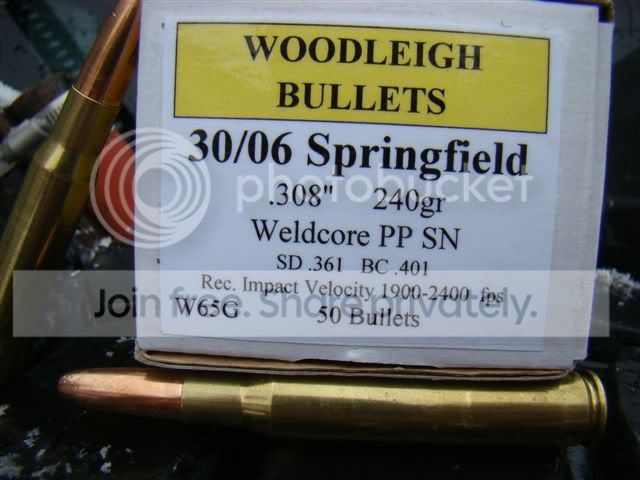
30-06 240gr

jameskw

Regular
Rating - 100%
27   0   0
Location
Vancouver
Would these 240gr bullets for the 30-06 really have enough velocity without a free bore?
http://www.shop.tradeexcanada.com/content/w65g-woodleigh-bullets-30-06-springfield
Seems like they would take up too much powder room? Anyone have experience with them?
 
I don't have experience with that bullet, however I have played with many many loads and reloads for 30.06. Its my opinion as most math points to, you do not gain too much in 30.06 when you exceed 180grains bullet weight. More weight gives more initial punch but overall energy and velocity is down in flight. The peak performance for energy of 30.06 is about 180grains. For short distances, a 240 grain bullet will whollop pretty good on impact, but for anything over a hundred yards or so, the dynamics of your flight and energy completely drop to worthlessness.


I used to hunt with 220gr homeloads. The performance of the round disintegrates at about the same distance as you can throw a baseball. went back to 180s, nothing beats them.
 
I personally have never loaded anything past a 180gr bullet. The 180gr bullet has enough punch to drop all North American big game species. Including grizzly bears. The only bullet that I have seen bigger run through the 06' is the 200gr bullet. Like I have said a 180gr Nosler Part will drop grizzly bears. IMO the 180gr bullet is the 06's perfect match similar to the 168gr bullet is the perfect match to the .308 Win.
Just out of curiousity what would you be hunting that would need the 240gr bullet? If you wanted to throw that much lead then maybe jump up in calibre to say the 375HH mag or 300 Win mag.
Just my opinion.
 
I recently inherited all my grandpas firearm stuff, had a box of these. All i have is a 30-06. would it work? Figure I might as well give it a try. but the bullet is very long with respect to the casing.

"sunray A 240 will be too long. Not made for the .30-06 either. "

it says 30-06 right on the box? shouldnt it work?
 
Could you come up with a load? Sure.

Would it take more bullets than you've got to get it right? Probably.

I suspect they were bought for a .300 H&H Magnum or something - some of the bigger .30s can use bullets that heavy to advantage. Trade 'em off for a box of something more useful.

On the other hand, we're gun nutz, right? We do it because it's possible.
 
Why not use them? IMR shows loads right up to 250 grains for the aught 6. Whole lotta short range whoopa$$. The great thing about this cartridge is the versatility, more than any other caliber that I have reloaded for.

Cam
 
I've shot commercial 240 and 250 grain cartridges. I don't recall the brand names. I thought I still had some but when looked, there were only six boxes of winchester 220s. The loads work, but you are so far beyond the bullets peak velocity/mass ratio that the energy is falling backwards. The bullet becomes so heavy that the speed drops so much, that at no point do you have any ballistic advantages over a 180gr in speed or energy. For very close shots, its hits harder, but there are more disadvantages the that bullet than is worth having. To make further comparisons for close range nastiness, its close to half of the energy of a 12 gauge 1oz (430gr) slug.


I loaded and hunted for a few years with 200+ grain 30.06 bullets, its my opinion that you have much more to lose than you have to gain. The 180 grain 30.06 bullet is the peak performance, it goes downhill on either side of that bullet weight.
 
I tweaked the numbers and decided the best long range .30 caliber bullet for use in the .308 or the .30/06 was the 210 gr. While the 220s and 240s have equal reach, their lower muzzle velocity provides no advantage that I could detect. At long range, the 210 beats the 180 by a considerable margin.
 
here is a quick comparison from Federals ballistic site comparing energy of 180gr to 220 gr:


muzzle 100 200 300 400


180gr 2900 2400 2000 1600 1300

220gr 2800 2100 1600 1300 900


I don't have any specs for 210gr, but this clearly shows no advantages over 180gr. I used Federals site for fast rounded off numbers

w ww.federalpremium.com/default.aspx
 
I don't have experience with that bullet, however I have played with many many loads and reloads for 30.06. Its my opinion as most math points to, you do not gain too much in 30.06 when you exceed 180grains bullet weight. More weight gives more initial punch but overall energy and velocity is down in flight. The peak performance for energy of 30.06 is about 180grains. For short distances, a 240 grain bullet will whollop pretty good on impact, but for anything over a hundred yards or so, the dynamics of your flight and energy completely drop to worthlessness.


I used to hunt with 220gr homeloads. The performance of the round disintegrates at about the same distance as you can throw a baseball. went back to 180s, nothing beats them.


Very knowledgeable.
 
I guess I wasn't fully awake when I first replied to this topic as I had 240 gr MKs in mind. :redface:

I load the 240 gr Woodleigh in the .30/06 for use as a close range bear load. My wife's .30/06 with it's 1:12 twist doesn't stabilize that particular bullet, so I load her's with 180 gr TSXs. When we look at terminal ballistics, we must look beyond the numbers on a ballistics table and consider the design and construction of that particular bullet. The .308/240 Woodleigh is a bonded bullet with a pure lead core and a solid shank and jacket made from pure copper, made thin enough to expand at .30/06 velocities. This provides us with a bullet with a very long expandable nose section which can potentially expand to a greater diameter than comparable cup and core traditional bullets, particularly those lighter than 220 grs, and I have recovered some expanded to .75", which is exceptional for a .30 caliber bullet. The purpose of this bullet was so that Australians could use .30 caliber rifles on their buffalo. A buffalo provides a very dense target, which also plays a role in the amount of bullet upset. Naturally once velocity bleeds off with range, the degree of expansion is rapidly reduced, and beyond 75 or 100 yards I doubt you would see much difference between it and a 180 as pointed out by Fiddler.

But up close, the combination of a large expanded frontal area combined with sufficient momentum to ensure deep penetration, will result in a wound volume out all out of proportion to a .30 caliber bullet.

DSC08355.jpg
 
I tweaked the numbers and decided the best long range .30 caliber bullet for use in the .308 or the .30/06 was the 210 gr. While the 220s and 240s have equal reach, their lower muzzle velocity provides no advantage that I could detect. At long range, the 210 beats the 180 by a considerable margin.

Boomer that's because there are some topnotch 210 grain .308 bullets made, but there are not (yet) similarly topnotch 220, 230 or 240 grain .308 match bullets made. It is only a matter of time before someone like Berger gets around to this, and when they do their 230 or 240 grain bullet will outperform the 210-class bullets.
 
Boomer that's because there are some topnotch 210 grain .308 bullets made, but there are not (yet) similarly topnotch 220, 230 or 240 grain .308 match bullets made. It is only a matter of time before someone like Berger gets around to this, and when they do their 230 or 240 grain bullet will outperform the 210-class bullets.


There are always gonna be exceptions to the general rule, but heres the thing with heavy weight 30.06: Its not popular and technology and the market has not come up with much yet, however promising it may be. The longer bullets do have expansion qualities over shorter bullets, but they diminish when the velocity drops. I cannot stress enough, the difference of punching paper to dropping a large animal.


25 years ago, we didn't have ballistic calculators, internet, or modern bullets. Perhaps modern bullets existed, but I didn't have them, as a teenager or young adult. We used to shoot into wet bundles of newspapers. It wasn't rocket science, but we could poke a rod into the bullet hole and measure how far it went. The 220s and 240s made a bigger hole, but not any deeper than 180s. At 100 yards, the 220s hole got small with little expansion and less penetration, where the 180's still had a good hole and maintained depth. At 200 yards, the 220s were out of steam, had significant drop in trajectory, and substandard penetration, where the 180s were losing some penetration, but still pretty good.


Here is another point that I'll argue. Its not the actual ballistics of a 210 or heavier bullet that I dispute, its the method of comparison. When I make my comparisons, I'm using factory specs in relation to other factory specs. Here is my point: I can minimum load a 180 and max load a 220, and show you that ballistic-wise the 220 is better. Conversely, I can max load a 180gr and compare to a min load 220gr and extend my findings as originally posted to further support my argument. Further to this, I compared soft points to soft points, not one technology to another. Again stressing, modern technology bullets do not work well at lower velocities.


Having all that said; max loads, min loads, max weight, min weight, ect. says a lot about ballistics, yet speaks nothing of accuracy. Its great to preach speed and energy, but if it shoots a 40 inch group at 100 yards, what good is it? Further question: if you think you have a good hunting load, shoot it into a wet bundle of newspaper at 50 yards, 100, 200 and 300 yards, and see for yourself the difference of punching a paper target or having actual killing energy.

 
"My wife's .30/06 with it's 1:12 twist doesn't stabilize that particular bullet"

hmm I dont know what my twist is. What happens if it cant stabilize? Just less accuracy?
Thanks for all the feedback! Learning lots AND getting an answer is great!
I'm definately going to load them up just to play either way. So you dont need a free bore?

 
"My wife's .30/06 with it's 1:12 twist doesn't stabilize that particular bullet"

hmm I dont know what my twist is. What happens if it cant stabilize? Just less accuracy?

Thanks for all the feedback! Learning lots AND getting an answer is great!
I'm definately going to load them up just to play either way. So you dont need a free bore?

You'll see that the bullet holes in your target are elongated, possibly even full keyholes from the bullet impacting in an extreme yaw. The greater the yaw at the moment of impact, the less effective the bullet wound will be on a live target as straight line penetration is lost, and the expanded portion of the bullet will be off center, further reducing straight line penetration.

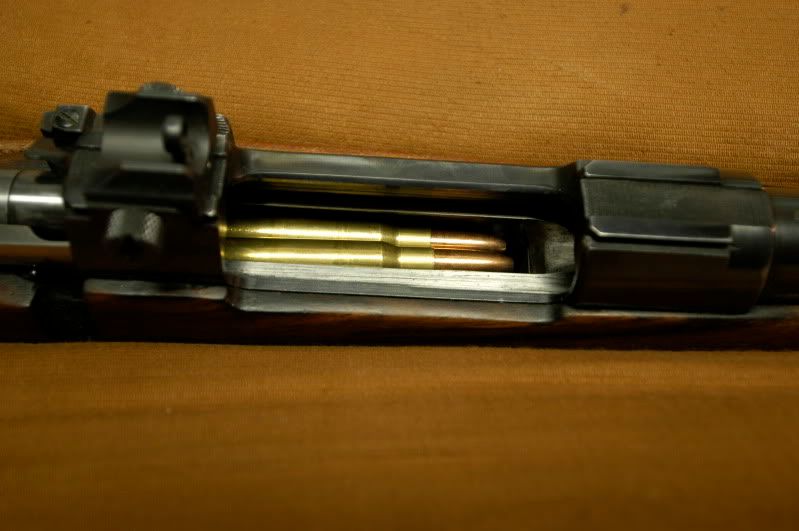
As to the question of free bore, my .30/06 has a factory chamber, the lead was not lengthened, but the bullet must be seated short enough to cycle through the magazine.

DSC_0008-3.jpg
 
Last edited:
Boomer that's because there are some topnotch 210 grain .308 bullets made, but there are not (yet) similarly topnotch 220, 230 or 240 grain .308 match bullets made. It is only a matter of time before someone like Berger gets around to this, and when they do their 230 or 240 grain bullet will outperform the 210-class bullets.

That does suggest that the 210 gr is the longest VLD that Berger has determined to be practical. What is interesting though is that Bryan Litz rates the 210 MK ahead of the 220, yet both bullets share the same profile. I've shot Bergers and like them, but thus far I've managed to miss the 210 MKs, as I have both 200s and 220s. I've also have some 210 Matrix on the way, and I expect them to be every bit as good as the Bergers. My target rifle needs a "go to" bullet, and I expected that to be a heavy MK, but it might well end up being the 210 Matrix.

I've been ignoring this rifle for far too long and it has come to the point that either I start shooting it or sell it, and it is unlikely that I would ever get my money out of it, so I guess I'm shooting it. Note to self . . . when building a custom target rifle, start with a bare action, rather than an overpriced complete rifle that needs all of its components upgraded.
 
If your bullets don't stabilize there is nothing subtle about it at all. I shot a 6.5x55 that put the bullets through the paper *completely* sideways at 40 yards. And I tried shooting Hornady 68 grain match bullets out of a 1-14" twist .22-250; I was shooting at 125 yards and out of ten shots not a single one hit my 2' wide by 4' high target, the bullet splashes indicated a group about ten feet in diameter.

@fiddler you make a number of good practical points about bullets for hunting use, which is almost certainly what the original poster had in mind (after all these are hunting bullets he found). Most of my comments were a bit off topic in that they were oriented toward heavier target bullets.

@Boomer it's not that good bullets heavier than 210 grains are not practical it's just that the bullet companies haven't gotten to it yet. Ballistically it is a no-brainer; bigger longer heavier pointier is better. Longer bullets tend to be more and more of a manufacturing problem to make well, the principal issue is drawing a long jacket and maintaining uniform wall thickness. I am quite sure that we'll see 230-250 grain class high performance .308 target bullets be introduced over the next few years; as for Berger, once they have gotten their .338 target bullet well established I would start the clock on this project...
 
If your bullets don't stabilize there is nothing subtle about it at all. I shot a 6.5x55 that put the bullets through the paper *completely* sideways at 40 yards. And I tried shooting Hornady 68 grain match bullets out of a 1-14" twist .22-250; I was shooting at 125 yards and out of ten shots not a single one hit my 2' wide by 4' high target, the bullet splashes indicated a group about ten feet in diameter.

That can be the case, or the yaw may be slight, where the bullet holes are only slightly elongated. I've experienced slight yaw on impact with several bullets, the .308/240 Woodleigh in my wife's 1:12 Husky, the .243/107 MK in my 1:10 Lilja, and a .224/53 gr TSX in a 1:14 Savage .22-250. Certainly there was a loss of accuracy in each case, but not that would take the bullet impacts off an 8.5"X11" target at 100. But I did experience the same dismal results as you when I loaded heavy bullets in an otherwise accurate 1:14 .222 M-700, re-barreling to a fast twist solved that particular issue.

But from the standpoint of a big game bullet, if a bullet is slightly unstable, but retains enough accuracy to hit it's target, the bullet will yaw to a greater extent when it impacts a dense target as opposed to a paper target on a cardboard or plywood backing. Almost all bullets yaw slightly on impact with game, but their spin induced stability corrects this as the bullet drives into the target. This can be demonstrated by shooting identical game bullets at the same velocity, one from a slow twist barrel and another from a fast twist barrel into a target made up of a dense medium like wet phone books or wet drill mud. The bullet with the faster spin, bull all else being equal, will penetrate deeper, in some case quite a bit deeper, because it recovers from precession (yaw) more quickly, and the shank of the bullet does not become the leading edge. If you recall seeing early pictures of solids recovered from African big game, you might recall that the bases of some were flattened on one side. That is what happens to a bullet that badly preccesses within a dense target and cannot recover.
 
Back
Top Bottom