Rick:
Your work is educational and beneficial. I will file and disseminate to those interested.
Thanks and Regards,
Peter
I should have mentioned that if any of your group are reloading in attempts to replicate the original Mk VII round with the settings of the service sights... well, good luck with that. Many, many including myself have tried to do that, and so far there is not a bullet currently available that matches the ballistic profile of the Mk VII ball round.
With No. 4 rifles another confounding factor is the military data for zeroing the rifles. They were to be zeroed at 300 yards with FIXED bayonet. I doubt anybody is going to shoot with fixed bayonets at the range. Yes, if you served in the infantry, zeroing with bayonets fixed at 300 yards will jar what's left of your military mind.
Reading Reynold's book on the Lee Enfield, it would seem to have resulted from War Office testing of the new rifles finding that the rifles produced their best grouping at any range if the bayonet was fixed rather than not mounted. But that's another quirk outside of reloading that will mess up anyone attempting to replicate Mk VII ballistics with reloads and the original service sights.
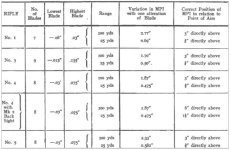
To add further confusion, there's about a 2.5 MOA difference in height above point of aim between UK/Commonwealth zeroing specifications and the Canadian specifications in the last pam with zeroing instructions, the 1945 "Shoot To Live". (available for download as a .pdf online - entertaining war era reading, and definitely not politically correct).
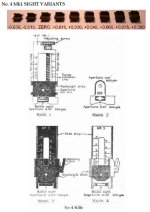
From memory, the POI differences between different height sight blades on the No. 4 Mk 1 is 1.8" at 100 yards and 2.7" with the SMLE.
One last thing on the sights themselves: the No. 4 sights cannot be trusted to be correctly manufactured as far as the two different apertures being correctly in the same vertical and horizontal axis. The majority are, but there are a few who aren't. While doing SAI/RSO taskings to support some of the Ranger groups, I had several point this out to me that they had discovered by themselves. Generally, it is a windage error, but it can be quite significant.
Most competing with the rifle in matches are not going to be using the battle aperture anyways; they will be zeroing and competing with the smaller aperture. But it is a potential wartime manufacturing flaw that can really mess you up if you do use both.
(I imagine it was a lot more problematic to the boys using the rifle in WWII and Korea, with such a defective sight being used in battle... I haven't read anything from any of the pams and other material during the war years that indicates they confirmed the zero was correct with both sight apertures before the troops took the rifles into battle)
The ballistic differences between Mk VII military ball and commercial bullets today will not be all that much of a consideration unless you get into shooting at longer ranges. Range comparisons between zeroed Mk VII ball to Hornady and Sierra reloads at the same muzzle velocities, significant differences in POA=POI don't show up until you're out around 500 - 600 yards.
If you're not engaged in shooting at distances like that, simply find the load combination that produces the best grouping and then pick your sight setting you will use with it. Then adjust elevation by changing and dressing down the front sight until you have the POA=POI at the range you desire.
The vintage matches you are setting up are pretty cool for those with Lee Enfields who want to do some competitive shooting with them. There's a few Brits/Australians/New Zealanders over on the Milsurp forum that are still doing that who could be a good resource. I don't check in here much anymore, so if you have other thoughts or questions you think I might be able to help your group with, just drop me a line:
OldAirborneDog@ProtonMail.ch