.308, bumping the shoulders and headspace

MartyK2500

CGN Ultra frequent flyer
Rating - 100%
278   0   0
Location
Quebec
Hi CGN
Still new to .308 reloading, coming along well but have this new headache.

Locally, i have a friend who has reloaded the caliber for a while, giving me advice.
I also double check with what's on the web and it makes sense.
We are not using the same tools, so i may have some of my tools that are off and need to shop.

I have recently learned, it seems, that instead of using a collet neck sizing die, i should use a full lenght resizing die, and only bump the shoulders back 2 thous.

So my fired cartridges measure exactly 1.630" in headspace. Once a fired cartridge has been fired in my bolt rifle, i put it back in my full lenght resize die. I get close to zero resistance, as in too easy to pull lever, and my brass comes back out of the press at 1.630" headspace. My shellholder is touching the die, so no more slack for me to bump shoulders back.

As a test i took some once fired AR10/auto brass. They measure around 1.639" in headspace,and give quite a bit of resistance on the full lenght resize die. Once resized they measure 1.630".

Either somethings wrong in my tooling, or i have missed a point and am not looking at the right measurments. Here is my current tooling.

Lee single stage press,shell holder, and full lenght resize die
RCBS precision MIC (yes using propper adapter, tripled check instructions, Ogive adapter would fully close on either brass when no bullet is seated)
Forster headspace gauge, 1.630x.308, i used to make sure RCBS precision MIC was giving good measurments
 
There will always be varying opinions but a bunch of competition shooters would argue that the Lee collet neck die is very good. Coupled with a Bump die, it allows you complete control about sizing for the bullet and chamber. It is best approach outside of a custom everything rifle.

Certainly works for me....

With your current rifle, is the fired brass at 1.630" stiff to rechamber? Or does it go in like normal?

What many do not understand, FL dies vary (like all dies offered). Saying use a FL sizing die is like saying, just choose any Size 10 shoe... I am sure you know the same size shoe by one company may not fit the same as from another company. The same applies to sizing dies... SAAMI allows a range of sizing tolerance to still be 'in spec'.

SO, if your case is stiff to chamber and the FL sizing die is offering no resistance nor sizing anything, pull out the body die, set for your appropriate bump and have at it. Or shave off the bottom of the FL die or change shell holders until you reach the dimensions of YOUR rifle.

Yes, it is possible that you may need to shortern a die to actually reach the case to size. Yes, shellholders can vary from manf to manf... even from the same brand but made over different years.

You aren't going nuts... trust the measurements you have and adjust your tooling to make things fit for you.

Chambers vary, dies vary, opinions vary....

Jerry

PS.. I have a Ruger predator in 6.5 CM with a chamber that is overly generous. If I FL sized the brass, it would likely split the next firing... certainly the 2nd firing due to massive change in headspace dimensions (chamber vs die). Without context, making blanket statements can get someone in a heap of headaches.
 
Thanks for taking the time to write up a detailled reply Jerry

If i FL resize, i end up with 1.630'', same headspace as before i resized.
Being new to rifles, i don't know how easy a bolt should close. I know the 10TR has a generous long bolt handle, and i do have to give it some amount (not exagerrated) of torque to close the bolt. Chamber is clean, rifle is now 200 rounds in.
I have had several sub-moa 5 shot groups, even first time out, with factory crappy(accu)stock and no load development, rifle seems to shoot good.

I did not know the existence of a bump die, i will look into it soon, matched with my Lee collet neck die it looks like a very good combo.
If i modify (shorten) FL die and/or shellplate, i could get the brass deeper in the die, makes sense.

Am i aiming for my brass to be headspaced at 1.628''? Would that be in line with what they call a 2 thou shoulder bump on a 1.630'' chamber?
Thanks again Jerry.
 
Compare the resistance of bolt closing...

nothing in the rifle, lube the back of the bolt lugs... just cycle and get a feel for what the rifle does on its own.

Chamber the fired cases... note how much more resistance there is and WHERE it is. Having a hint of resistance just before full close is just fine.

Having resistance any more then 1/4 from full close is too tight. Bump the die 1 thou, check... if still resistance, bump another thou and so forth. At some point, the brass will go from just a hint of resistance just before closing to 1 more thou, no resistance.

For a field, rapid feed rifle, I would add that extra thou so there is no resistance.

But you can now play with whatever headspace setting you prefer for function, and accuracy.

Jerry
 
Using my 1911 modification knowledge, i shaved the shellplate rather than the die
Always take away material from the lowest value $$ part

I can now headspace empty shells under 1.630", and get resistance in press.
Cycling the bolt empty a few times, and now with empties of different headspacings,
i found the 2 thou bump to be a very happy medium.

Thanks again for the help, that shoulder bumping die is on my future to buy list so i can make use of my collet neck sizing die
 
when I am adjusting dies for a particular rifle, I remove the ejector from the bolt, to get a better feel for the resistance when closing the bolt. removing the ejector can be a pain, but well worth it in my opinion.
 
No beer cans around here, but plenty of tonic water cans ;)
Problem was solved, ground 4 thou off the top of shellholder, and now have a bit of leeway to bump shoulders.
Shaving a 4-5$ part is parfectly fine! No shims to worry about falling out etc...
 
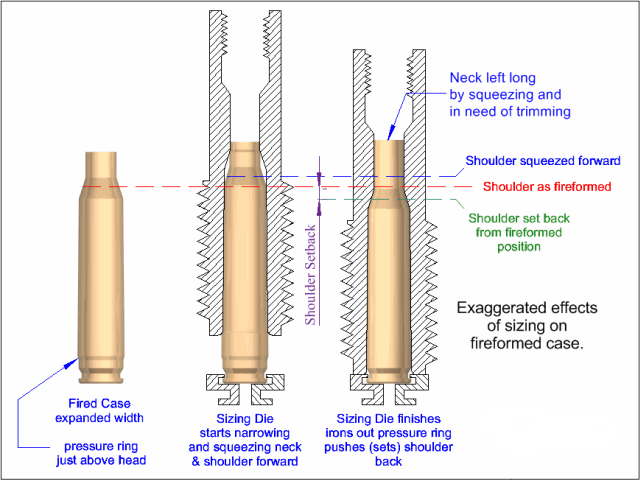
Chambers and dies vary in diameter and headspace length, and looking at the image below when full length resizing you need to push the shoulder back below the red dotted line.
This is .001 to .002 on a bolt action and .003 to .006 on a semi-auto. Also the case diameter for a semi-auto should be .003 to .005 smaller after sizing than its fired diameter for reliable extraction.
All these figures are ball park figures depending on your chamber and dies and the finished case.

Example I have a standard Lee full length .223 die that will reduce the case diameter "MORE" than my RCBS small base die. And this same Lee die if it contacts the shell holder will push the shoulder back .009 shorter than a GO gauge.

And this is where having gauges to accurately measure your cases is a good thing to have in our plus and minus manufacturing world.

wm05ArY.gif


And a small base die reduces the case diameter and shoulder setback .002 to .003 more than a standard die. And because this die is smaller in diameter the case shoulder is moved further forward when squeezed smaller in diameter (resized). And this die is also shorter in headspace length to push the shoulder back further. Also using a small base die will cause the cases to be trimmed more often.
 
I am reading lots and lots of good info on lee collet die, seems to make neck tension quite uniform.

What shoulder bumping die should it be combined with? With a shoulder bumping die, will the brass body buldge with time and become hard to chamber?
 
Chambers and dies vary in diameter and headspace length, and looking at the image below when full length resizing you need to push the shoulder back below the red dotted line.
This is .001 to .002 on a bolt action and .003 to .006 on a semi-auto. Also the case diameter for a semi-auto should be .003 to .005 smaller after sizing than its fired diameter for reliable extraction.
All these figures are ball park figures depending on your chamber and dies and the finished case.

Example I have a standard Lee full length .223 die that will reduce the case diameter "MORE" than my RCBS small base die. And this same Lee die if it contacts the shell holder will push the shoulder back .009 shorter than a GO gauge.

And this is where having gauges to accurately measure your cases is a good thing to have in our plus and minus manufacturing world.

...

And a small base die reduces the case diameter and shoulder setback .002 to .003 more than a standard die. And because this die is smaller in diameter the case shoulder is moved further forward when squeezed smaller in diameter (resized). And this die is also shorter in headspace length to push the shoulder back further. Also using a small base die will cause the cases to be trimmed more often.
Big Ed, Thanks for that great explanation. I have two questions from your post:
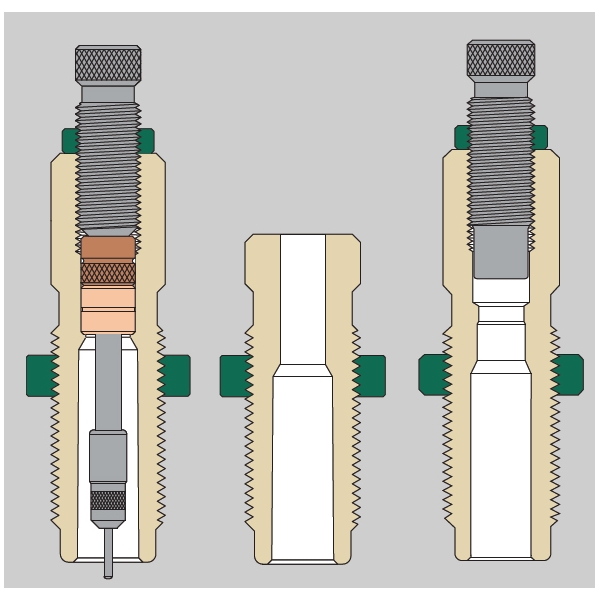
1. Do you have a similar picture but instead of a FL die, showing a body die? I am still trying to understand what they look like inside.
2. Is the "small base die" you refer to, the same thing as a "body die"?
Thanks!
 
I am reading lots and lots of good info on lee collet die, seems to make neck tension quite uniform.

What shoulder bumping die should it be combined with? With a shoulder bumping die, will the brass body buldge with time and become hard to chamber?

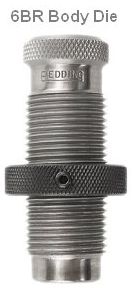
Since Jerry hasn't chimed in yet, I'll tell you what he told me, haha. The Redding body die works great in conjunction with the Lee collet neck die.
 
Big Ed, Thanks for that great explanation. I have two questions from your post:
1. Do you have a similar picture but instead of a FL die, showing a body die? I am still trying to understand what they look like inside.
2. Is the "small base die" you refer to, the same thing as a "body die"?
Thanks!

A small base die is a full length die that reduces the case to minimum SAAMI dimensions. The small base die will reduce the body diameter .002 to .003 more and push the shoulder back .002 to .003 more than a standard FL die. You normally associate small base dies with tight chambers or semi-autos rifles. The smaller case diameter allows more brass springback from the chamber walls for reliable extraction.

I use small base dies because I buy bulk once fired military Lake City brass and size the cases once with a small base die to make sure they will chamber and eject. Meaning this brass was fired in larger military chambers and needs to be brought back to minimum SAAMI dimensions. Some of these cases were fired in much larger machine gun chambers and brass spring back can be a problem if a small base die is not used.

"BUT" chambers and dies vary in size and nothing is written in stone. Example I have a Lee .223 full length die that will reduce the case diameter "MORE" than my .223 small base die.

Read the link below and see how much variation there is in the neck diameter of the dies.

Are Your Sizing Dies Overworking Your Rifle Brass?
http://www.massreloading.com/dies_overworking_brass.html

Below on the left is a Redding bushing neck sizing die, in the center is a body die that does not touch the case neck, and on the right a seating die.

15516.jpg


reddingbodydiex150.jpg
 
Last edited:
Hi guys,

This is an old post, but it is the closest I found about my question...!

Here it is:

When I first full length sized my brass (for my 243, and my 300WSM), I gave the brass a dimension inside SAAMI specs. This is necessary smaller than any chamber well cut.

When I shoot , and measure the brass before/after, I notice a difference of only 0,002 if my memory is good. (Measured it a long time ago...). I then decided I would always FL, and never bother to bump or neck size. This way I would repeat 100% the same dimensions EVERYTIME.

now I have some second thoughts... if my cartridges were placed in a loose chamber, how long would they be? Would they grow a lot? What I mean is: does the 0,002 represent my chamber measure, or it can be larger and my brass just did not 100% fire form?

Is there a chance I never let them form to my chamber?? Or with that 60,000 PSI it is sure it goes perfectly against the chamber all around...

Thanks!
 
If you are shooting full power loads, or close to it, you can assume the brass has formed to the chamber. When shooting minimum loads, it is possible to not have the brass fully form. You can see this by looking at the neck and shoulder, there will be a layer of black soot on the outside of the case.
 
Back
Top Bottom