.45Colt (LC) Reloaded Too Long

Re3iever

Regular
Rating - 100%
41   0   0
Location
Newfoundland
I recently purchased a conversion cylinder for my 1858 Remington New Model Army Revolver which allows me to shoot .45lc (Cowboy Loads).

Part of the deal was a substantial quantity of reloaded ammo most of it fits and fires just fine but one batch is slightly longer than the rest and won't allow the cylinder to revolve. Basically the shells in question are ~42.2mm long whereas the ones that work are ~40.2mm long.

Is there a safe way for me to trim the lead bullet by 2.0mm? See picture attached, the one on the left is the "long" one.

Thanks, Retreever
View attachment 270048
 
I have never heard of trimming bullets. However, I cannot help but notice that the case on the left appears to be bulged, which would indicate an oversize bullet (diameter wise). That could result in a pressure issue, once you fire the ammo, depending on the hardness of the lead alloy. I suspect that whoever loaded these cartridges may have used oversize bullets. There also appears to be no roll crimp.

Assuming the bullets are safe ti fire in that gun, your other solution is to seat the bullets deeper and to crimp over the shoulder of the bullet.
 
'58 Conversion, one of these is on my bucket list for sure.

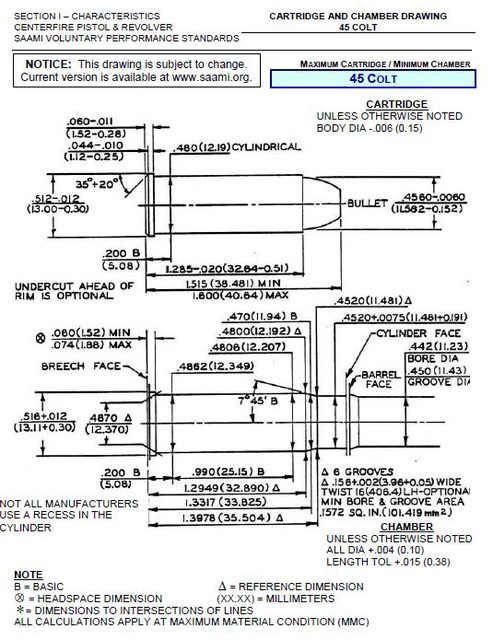
A conversion cylinder has the limitation of not being able to accommodate overly long ammunition, as you've experienced. There is only so much room, no more. The 45 Colt or 45 Long Colt as it is often called, has a SAAMI max of 40.64 mm Max. Most ammunition, and most cast bullets are designed around that maximum length.

Cutting the lead safely could be accomplished with a flush cut nipper, however, that would not be my first choice solution.

Thanks for the pictures, the first shell ( the too long one ) is not crimped, not a good sign. To me the lack of crimp and over length could indicate a reloading issue.

Before I shoot someone else's reloads I like to confirm the charge. In other words remove the bullet and weigh the powder, and visually identify the powder if possible. If after doing this to one of the cartridges, and finding that the charge was not excessive, I'd seat the other bullets deeper, and crimp over the bullets shoulder, IOW, seat it deeper. Hopefully that would shorten it sufficiently. Visually, it may not. I'm not familiar with that cast bullet, may be a 200 gr H&G 68, an uncommon shape for 45 LC, more of a 45 ACP bullet. I'm guessing here. If it is a H&G 68, it does not have a crimping grove, is meant to crimp over the shoulder. It is a 200 gr bullet.

I'm a handloader, knocking apart ammo, salvaging the components, and re-assembling; all part of the game.

In an 1858 conversion my ammo choice would utilize a lighter bullet, in the 200 gr range, cast a bit on the soft side, with a starting charge to keep the pressure down. This would keep the recoil and pressure down to ensure the gun pieces last a long time.

Have fun with your new toy.

Caveat; my Cowboy gun experience is with 38/357 and 44 Spl/Mag. BTW, if used in a rifle, I don't like the over the shoulder crimp. In a handgun, the bullet tends to slip forward, in a lever rifle the bullet tends to get pushed into the case.
 
The bullet on the left looks like a typical 200 grain SWC for .45 Auto, such as an H&G #68. Assuming an appropriate powder charge, seat those bullets deeper and crimp over the shoulder.

Best practice would be to pull apart all of those rounds, charge the cases with a known amount/type of powder, and seat the bullets correctly.
 
Just put them in your press and seat them a little deeper. I've run 45 loads through the sizer when they ended up too fat for a Kirst cylinder. a very MILD roll crimp to smooth the case edge is all I ever used. I don't like to feel the case mouth with my finger. My crimps weren't to "crimp" but to smooth feeding.

* a couple of thoughts here...
smokeless powder, yes?
shake the case, is there free space?
 
Last edited:
I agree with tjhaile above and the bullet on the left was made for the .45 ACP and far to long for a .45 Colt cylinder. Even if you seat it deep enough there will be no bullet left to crimp.
 
I agree with tjhaile above and the bullet on the left was made for the .45 ACP and far to long for a .45 Colt cylinder. Even if you seat it deep enough there will be no bullet left to crimp.

The only online information I found was that the H&G 68 had a distance of .335 from the shoulder to the nose. That's what lead me to conclude it may work, 1.275 + 0.335 = 1.610", (<42mm), and add a bit deeper for the crimp, may be possible to get it under 1.600", (40.64mm). It will be close.

I hope you don't have a case of those to deal with.
 
I could tell you straight off the top of my head that max OAL in 45 Colt is 1.6". That calibre isn't meant to be measured in millimetres!

If I found some of my own loads slightly long I might just give them another push in the seating die, but if it's third-party reloads of unknown provenance then the first sign of a problem is half-past time to pull the rounds apart and start over.
 
I agree with tjhaile above and the bullet on the left was made for the .45 ACP and far to long for a .45 Colt cylinder. Even if you seat it deep enough there will be no bullet left to crimp.

.... unless you taper crimp as per a .45 ACP rd. But - it is the wrong bullet for the application as pointed out already.
 
When I first started shooting CAS a number of years ago I picked up 10,000 of these. They were fine in my 1894 Marlin and my old model Vaqueros but if I crimped them in the grove they were to long for my new model vaqueros. I simply seated the bullet flush with the top of the shoulder with just enough roll crimp to remove the flair. Those rounds only got used in the revolvers while those I crimped in the crimp grove were used in the rifle. Once I used them all up I switched to a Round Nose Flat Point bullet for everything.

My powder load in the 45 Colts at that time was 7.1gr of 231 with a 200 gr bullet so while not a heavy load by any stretch of the imagination it certainly wasn't a powder puff load either. I currently run a 200 gr RNFP with 5.8 gr of Trail Boss and a firm roll crimp. 5.5 gr works well and is very accurate but 5.8 is a much cleaner load to shoot.
 
Last edited:
I could tell you straight off the top of my head that max OAL in 45 Colt is 1.6". That calibre isn't meant to be measured in millimetres!

If I found some of my own loads slightly long I might just give them another push in the seating die, but if it's third-party reloads of unknown provenance then the first sign of a problem is half-past time to pull the rounds apart and start over.

I feel the same way, about inches, but in Canada we went metric beginning in 1970, courtesy of the Sr. Trudeau. We are fortunate that most of our reloading manuals have been allowed to remain in Imperial. If you look at Ladebok, it is mostly metric, with some Imperial. The original poster listed his measurements in Metric, and out of respect for that poster, I gave the mm measurements as well. As odd as it looks, Metric is a legitimate standard of measurement. Personally I prefer a system I can understand, based on the weight of a single grain of barley, and a yard is the distance from the nose to the tip of the outstretched arm of Henry VIII. SAAMI; sees fit to have both Metric and Imperial units, something lacking in the CIP publications, all Metric.

DM2B3N4l.jpg


Nitro
 
Last edited:
Colt never made any so-called "long Colt" cartridges. Colt never made any so-called "45 short colt" cartridges either. Plus Colt never, ever roll marked any SAA revolvers with the so-called "long colt or LC" designation.

The 1873 Colt 1st, 2nd, & 3rd generation Single Action Army (SAA) revolvers are .45Colt.
That being said, (whew!) just re-adjust your seating die & seat the loaded bullets deeper.
 
I wanted to thank all of you who replied to my question - I am not a reloader (as of yet) and don't have the equipment to, as some suggested, "seat the loaded bullets deeper".

That said I do have ~90 of these rounds and the guy I got them from shoots at the same range as I do so I can find out the loading details i.e. powder amount etc. I'll ask him about "re-seating" them for me. He loaded these rounds originally for his 1858 Remington New Model Army.

Thanks Again
 
I can't think of a practical way to trim a bullet. But from the pictures I'd guess there is no crimp at all, so you should be able to just push the bullet in a bit more with your seating die. Try it on one, if it works do them all. That's about the only option you have, and maybe the guy you got them from can reseat them if you don't have a press.

Tthe other thing to remember is that shooting someone else's reloads is not a recommended practise.
 
Colt never made any so-called "long Colt" cartridges. Colt never made any so-called "45 short colt" cartridges either. Plus Colt never, ever roll marked any SAA revolvers with the so-called "long colt or LC" designation.

The 1873 Colt 1st, 2nd, & 3rd generation Single Action Army (SAA) revolvers are .45Colt.
That being said, (whew!) just re-adjust your seating die & seat the loaded bullets deeper.


While that is entirely true, the "long and short" nomenclature was used to differentiate between the .45 Colt and 45 Schofield cartridges but has remained in use even after the Schofield became obsolete.

Code:
https://www.ammoland.com/2016/09/45-colt-vs-45-long-colt/#axzz5myimndps
 
Last edited:
While that is entirely true, the "long and short" nomenclature was used to differentiate between the .45 Colt and 45 Schofield cartridges but has remained in use even after the Schofield became obsolete.

Code:
https://www.ammoland.com/2016/09/45-colt-vs-45-long-colt/#axzz5myimndps

That is fact. For a few years the US Army used 2 revolvers concurrently: Colt SAA (.45 Colt) and S&W (.45 S&W, aka .45 Schofield).

This caused them grief. The "short" 45 S&W cartridge could be used interchangeably in both revolvers, but the .45 "Long" Colt could not be used in the S&W revolvers. More than once the Army found themselves in a position where fighting men were issued ammo that they could not use in their weapons. Eventually they dropped the 45 Colt cartridge and standardized on the 45 S&W cartridge to fix these supply stream issues.

That's about the Long and Short of it.
 
Last edited:
That is fact. For a few years the US Army used 2 revolvers concurrently: Colt SAA (.45 Colt) and S&W (.45 S&W, aka .45 Schofield).

This caused them grief. The "short" 45 S&W cartridge could be used interchangeably in both revolvers, but the .45 "Long" Colt could not be used in the S&W revolvers. More than once the Army found themselves in a position where fighting men were issued ammo that they could not use in their weapons. Eventually they dropped the 45 Colt cartridge and standardized on the 45 S&W cartridge to fix these supply stream issues.

That's about the Long and Short of it.

Ain't it funny what a fella learns bringing old iron back to life as a hobby.

My hand loading career started because I needed obsolete ammo for the irons I was fixing, and that led to reloading modern rifle cartridges for hunting.

Funny thing, most of my enjoyment with antique revolvers came from making them work again. Once I built the parts and made ammo and proved an old iron worthy, I lost interest. Turns out shooting them was the least of it. The satisfaction came from the resurrection.
 
Hey bubba - using a vise ?? This is dum.

The only safe way is to take a kinetic hammer and take apart those loads. Then start fresh. Check the brass and trim as per min specs. Choose a powder and charge that are within limits of your gun. AND never use somebody else reload... adjust oal then - BUT that bullet seem a .45 acp SWC- H&G 68 style normaly 200 grains - not really suitable for 45 colt. They were made for 1911 semi auto in the early days of IPSC.. nothing to do with cowboy shooting...There is no crimp groove and you must use a taper crimp on those. Myself I would dissemble them and use a proper bullet.
 
Last edited:
Back
Top Bottom