.50-60 Peabody rifle ... centerfire conversion?

GrantR

CGN frequent flyer
Rating - 100%
13   0   0
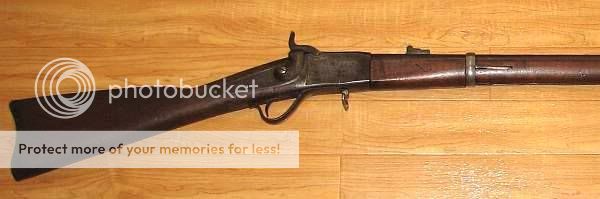
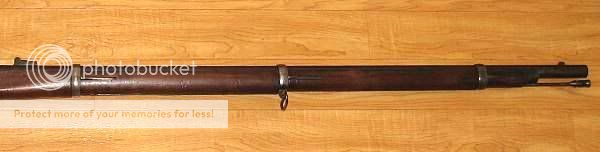
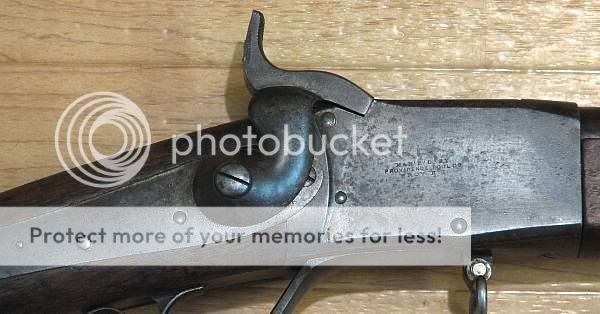
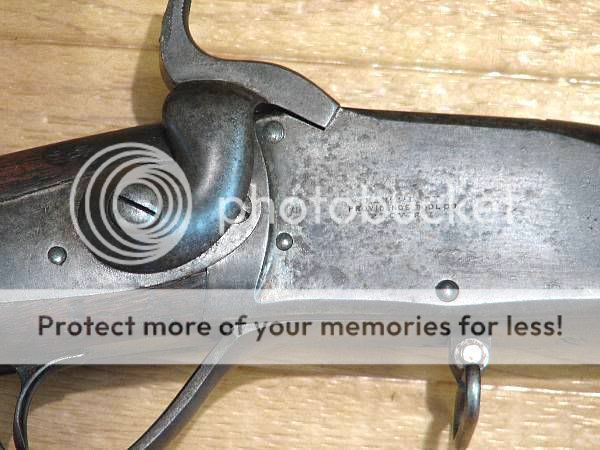
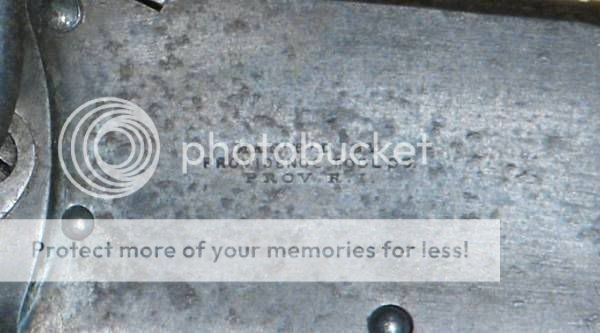
I have just committed to purchasing one of 3000 .50-60 rimfire Peabody rifles which were purchased by Canada in 1866 - and so marked, with the appropriate "CM" (Canada Militia) stamp on the buttstock.

pea2.jpg


pea1.jpg


pea4a.jpg


I want to try to convert the rifle to centerfire, by modifying a replacement breechblock and striker already ordered from Dixie Gun Works following the procedure which people have reported on the SwissRifles.com forum. Can anyone who has performed such a conversion ofer any tips, or steer me to any more resources for the project? Also, does anyone have any pointers on making suitable centerfire cartridge cases? (It is my belief that .50-70 cases will be suitable.)
 
Last edited:
Is this the one from the John Denner? Very nice piece :cool:
Of course, it is none of my business what you do with your property, but wouldn't doing a conversion on this fairly rare gun ruin its collectable and historic value? Or maybe its reversable?
I just don't want anyone to accuse you of being a bubba :p
Sorry I can't offer any advice on the conversion, I just happened to notice the rifle on Denners site and was admiring it (wish I had the $$ :redface: )
 
Last edited:
Dear GrantR,

Contact Mooncoon, he will have an idea of what's involved. He made five reuseable brass casings for a 58 cal rimfire. The base of each casing has an off-centre hole to insert a 27 cal. ramset cartridge to use as ignition. It works great and the firearm is still an unaltered original!

SW
 
Yes, this is the one from John Denner, which I've been eyeballing for quite some time ....

Not to worry - the "conversion" will not alter the gun or its original parts in any way. What is involved is to use another breechblock and striker (available from Dixie Gun Works for a mere $15.00 and $10.00 respectively (they must have scored a warehouse full of old parts, I presume.) I understand that these breechblocks work in all of the various different models of Peabody with relatively little fitting - as the receiver and block specs remained quite standard.

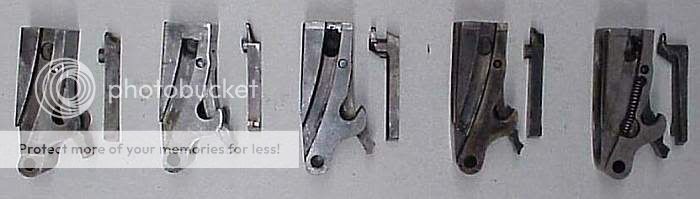
To show the similarity, here are breechblocks and strikers from 5 different Peabody models - any apparent differences are really only the result of the different angle each block is from the camera lens. The four on the left are all rimfire configurations, while the one on the right is centerfire. The Canadian model breechblock is on the far left. The striker rides in the groove machined along the side of the block. When struck on its back end by the external hammer it transmits that force to the rear of the cartridge to fire it. Note that the centerfire version has a deeper recess into the block behind the breechface (at top on all the blocks in the picture) with a firing pin which extends farther out from the striker. That pin rides in a firing pin channel drilled through the center of the breechblock face - i.e. to stike a primer in the center of the cartridge base, rather than the rim of the case.

brblk-all5b.jpg


The conversion is performed entirely on the "extra" breechblock and striker obtained for that purpose, and the rifle's original rimfire block and striker can simply be replaced at any time - the entire block/striker assembly is held in place by a stout pin through the receiver - just like the block of a Martini-Henry, which is in fact a direct descendant of the Peabody action.

Here are links to the conversion discussions (with pictures) on the Swiss Rifle forums [Edit - 12 Nov 2009 - and elsewhere] in case you are interested. They are discussing the same conversion process on M1867 Swiss Peabody rifles, which were chambered in .41 rimfire (a bottlenecked cartridge which has a similar base diameter to the .50-60 Peabody ...

http://theswissriflesdotcommessageboard.yuku.com/topic/1695/t/Peabody-Conversion-and-Range-Report.html

http://p090.ezboard.com/fcollectorguns35625frm26.showMessage?topicID=8.topic

http://britishmilitariaforums.yuku.com/forum/viewtopic/id/6668

http://britishmilitariaforums.yuku.com/topic/1924

http://britishmilitariaforums.yuku.com/reply/27160#reply-27160
 
Last edited:
I think there are two options; leave it rimfire and make cases out of solid brass or convert it to center fire. If converting, I think the first question is the configuration of the existing firing pin; some guns have an offset rimfire pin on a centered body and that would simply involve making a pin with a central firing portion and bushing the breach face. With a large case like the 50 - 60 I think it is much more likely that the whole pin is offset and you are probably looking at a lot of work to change it.
Seems a lot easier to me, to simply make the cases from solid stock and use ramset shells for primers. It looks like the bullet is .502 diameter which means you could drill the cases with a 1/2" drill or perhaps 1 size down then clean the hole up with a 1/2" endmill. Also looks like you would be remodeling a smaller caliber Lee mold to cast a .502 bullet.

cheers mooncoon
 
I guess you were posting while i was writing :>) I still suspect that you are looking at making centerfire cases from solid stock. Not all that hard; I made a few velodog shells a few weeks ago and they seem to work OK.

cheers mooncoon
 
Peabody can be fired using Dixie 56-50 Spencer cases which use a .22" RF as a primer. Canadian Militia used 56-50 ammo in their Peabodys even though they were chambered for 50-60 RF.
 
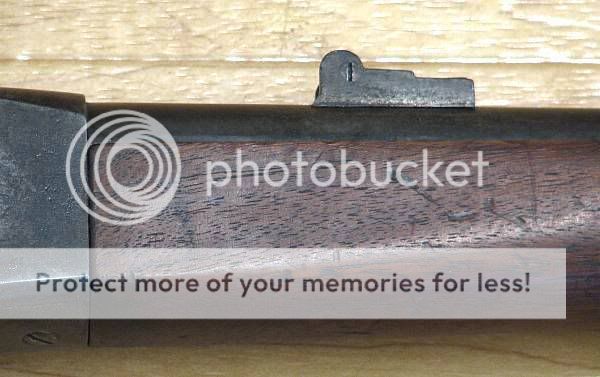
My Peabody rifle arrived last week, though I've only now gotten around to taking a few photos to supplement those obtained from the vendor's website which I posted initially ...

peabody01.jpg


peabody02.jpg


peabody03.jpg


peabody04.jpg


peabody05a.jpg


peabody06.jpg


peabody07.jpg
 
Last edited:
before buying any shells, I would suggest taking a chamber cast including the first 1" or two of the bore. If you don't have any cerrosafe, parafin wax will do. It is not unusual for early chambers and bores to be a bit different from the published dimensions.
I had a look in Nonte's "Handloader's Guide" and he recommended making shells from 500 NE , I think. Would probably be cheaper to make them from solid stock if you have access to a small lathe. Probably use 5/8" brass and settle for a slightly small rim.
the reason that I used Hilti (Ramset) blanks in Steppenwolf's gun is that they are a little more available than .22 blanks and about the same price.
You can make a mold for the gun from a surplus Lee mold and bore it out. Drill a hole in the blocks opposite the pins that secure the handles (and smaller than the pins) and you can drive the pins out to remove the handdles.

cheers mooncoon
 
Well, folks, another "piece of the puzzle" appears to have fallen into place in my hope for a practical centerfire conversion setup for my .50-60 Peabody! :D

One of the local black powder fellows, whom I've known for decades, has a .50-70 Rolling Block ... I asked him if he could spare one or two old cartridge cases so I could explore how suitable they'd be for conversion to ".50-60 Centerfire". He was most obliging and last night dropped off two cases (one sized and one unsized.)

Although some of the specifications quoted for the .50-70 had been causing me some concern - in particular a rather larger rim diameter than stated for the .50-60 Peabody - I hoped that the differences would not pose insurmountable problems. For example, I assumed that the rim diameter could be reduced, if necessary ....

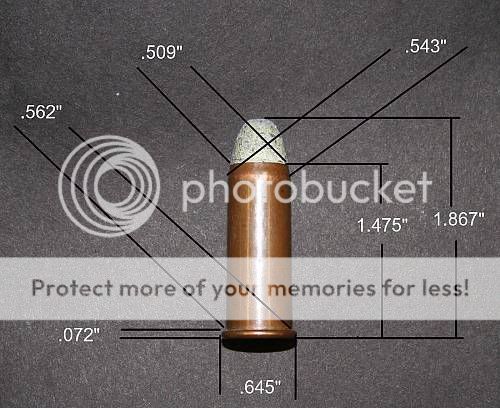
First off, here's a very helpful image provided by fellow-CGN "Beater", who has an original .56-50 Peabody cartridge among his treasures:

CanadianPeabodymeas_sm.jpg


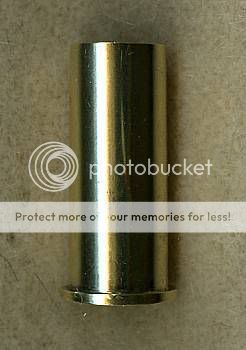
As you'd expect, I immediately found that the full-length .50-70 case (1.75 in.) wouldn't quite "make the turn" into the Peabody chamber, though a test with the rim gave promise that it might fit the rim cutout without any reduction in diameter. Other sources available to me give even shorter case lengths than Beater's measurement in the above photo - Barnes: 1.456"; Logan: 1 7/16" (1.4375"). Today I trimmed the sized .50-70 case to 'Peabody length' - settling on 1.475" as a good starting point (on the theory that it would be a lot easier to take a bit more off the length, if necessary, than try to add it back on! ;) Actually, final dressing of the case mouth left me with a finished length of 1.470" ....)

I am very pleased to report that the trimmed case chambered like a charm - no problem at all with the rim diameter being too great for the recess, and the block closed up on it very nicely, with that ever-so-slight nudge on the base of the case which I have come to view as a sign of good case fit in a Martini action ... :D :D :D

Here's a quick 'scanner plonk' of my prototype ".50-60 Peabody Centerfire" cartridge case ....

Trimmed50_70.jpg


Now for some other observations I find most interesting:

- although the rim diameter of this particular .50-70 case is actually 2 or 3 thousandths over the 0.660" cited by Barnes, it fully enters the rim recess of the chamber on my rifle, as already stated. (I'm wondering if a rimfire firearm might even normally be a bit "oversize" in this respect, to facilitate complete "squashing" of the rim by the striker, in the interests of positive ignition ... :cool: ?) At any rate, I expect that this situation will simply contribute to positive extraction.

- other critical measurements from the .50-70 case are "spot on" in comparison to the measurements in the above photo - diameter of the base just ahead of the rim is 0.562", and the mouth - though slightly out of round - averages 0.5425"! (Low of 0.539", high of 0.546")

- you'll note that the "major" neck diameter of the original round is 0.543", though the crimp reduces it quite sharply to 0.509". Interestingly, for the .50-60 Peabody, Barnes gives a neck diameter of 0.508" and a bullet diameter of 0.499" ... Logan gives no bullet diameter, but a neck diameter of 0.535". (Quite a variance, but may depend on the particualr make of cartridge they were measuring, or even exactly where they took the measurement.)

- Intriguingly, I know that "back in the day" the Canadian Militia issued .56-50 Spencer cartridges to militia armed with Peabody rifles. Cartridge dimensions are very close, though the Spencer cartridge is quite a bit shorter - e.g. Barnes gives a case length of 1.156" and 1.632" for OAL of the complete cartridge. But this would be very much akin to being able to shoot a .22 Short or Long in a .22 Long Rifle chamber, or a .38 Special in a .357 Magnum chamber.

- On that note, Barnes gives the case-mouth diameter of the .56-50 as 0.543" - note that correlation. :eek: The bullet diameter of the .56-50 is given as 0.512" - arguably quite a bit too large, one might think, except that I have slugged my Peabody barrel at about 0.512" groove to groove! (I can only assume that the Peabody cartridge was loaded with a hollowbase bullet, or at least a very soft one, for expansion ... What's more, moulds are now available for bullets of that size, intended for the reproduction Spencers now on the market.)

All in all, things certainly do seem promising! :dancingbanana:
 
Last edited:
well well, looks like you are on your way. brass wont be a prob it looks like.im very suprised to see how close the 50-70 is to the peabody round. i dont have an original 50-70 round in the collection, or id measure it up.
id love to pull the bullet and find out about the hollow base and all....but.....
if i had 2, id do it.
anyways, good to see its gona work well,and happy to be of help and ill hope to get a shot.

Brian
 
Grant,
I recently bought some .512" diameter cast bullets of various weights from Ben Hunchak here on the forum and they look quite good. You might want to send him a note.
Rob
 
Brian and Rob:

To tell the truth, I got so "enthused" following the above discoveries that I immediately ordered some .50-70 cases, a .515" 350 grain mould, .512" lubisizer, reloading dies and a shell holder from Buffalo Arms in Idaho! :runaway: :runaway: :runaway:

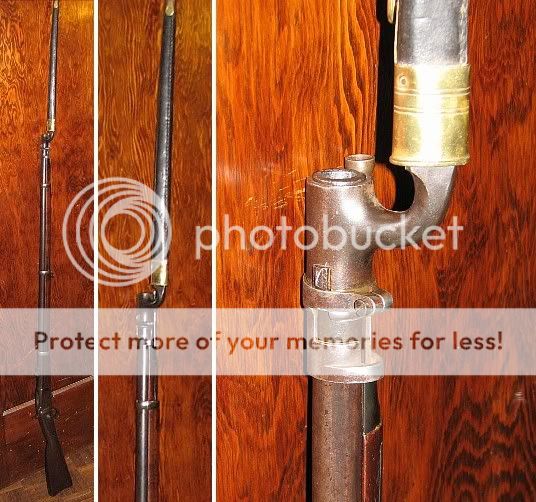
Now, how's this for another intriguing discovery ... looking at the Peabody, I was struck by the similarity of its front sight/bayonet lug, and its position on the barrel, to that of the Pattern 1853 Enfield rifle (and thus the 3-band Sniders, of course) ..... so ..... I got out my original Pattern 1853 socket bayonet and tried it on the Peabody ....

Guess what? It is a perfect fit!!!! :D :dancingbanana: :eek:

The front sight base seems to be a duplicate of the Enfield sight, and fits the slot of the socket accordingly. What's more, the Peabody's barrel thickness at the muzzle is a little bit greater than the Enfield, with the result that the outside barrel dimensions appear to be identical! The bayonet slides on and the locking ring engages just as well as the fit on my 3-band Snider! :eek: The fit is so good that I can't imagine it is coincidence - I'm willing to bet that the specifications for the Peaboy rifles called for them to take the existing Pattern 1853 bayonets .... :)

bayonet00.jpg
 
Last edited:
I have found that only some P53 bayonets fit the Peabody. It was purchased with US M1855 bts and P53 scabbards were modified to fit.
 
bayonet fits

makes sense the bayonet will fit , with the brit,s attitude about "waste not want not"
all these old military rifles should have a pointy end on them...just doesnt look right otherwise:D
 
Back
Top Bottom