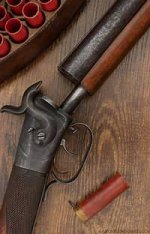
8 Bore Pinfire

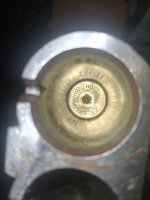
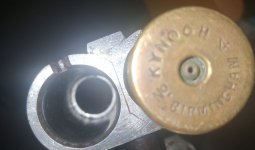
The cap is in upside down, the pointed end of the pin is against the primer compound.
The little index mark on the outside of the face allows the thing to be indexed properly so the pin can be inserted in contact with the cap.
Hmmmm, if it goes into the cap I would have thought a blunt pin would be more efficient and reliable than a sharp one but I guess that depends on hammer spring strength. Maybe they are pointed so a more gentle soft hammer strike will detonate either less abuse of the pin??? Just speculating.
 
I have some of the French made 16g shells. They use a cap carrier inserted from the front of the case. The pin is then inserted.
Priming these pinfire cases is fiddly, but it does make shooting the guns a possibility.
 
Hmmmm, if it goes into the cap I would have thought a blunt pin would be more efficient and reliable than a sharp one but I guess that depends on hammer spring strength. Maybe they are pointed so a more gentle soft hammer strike will detonate either less abuse of the pin??? Just speculating.
If the pin is a tight fit through its hole, misfires can result. Too loose, and there is the risk that the pin can be blown out.
These systems use standard muzzleloading caps. Real pinfire primers were small diameter, sized for the pin.
 
I have only one pinfire shotgun. A ho-hum Belgian 16ga that I got for a nominal price just to have as a pinfire sample. I does work with the French brass 16g reloadable shells.
Pinfire guns do turn up with some regularity. Revolvers, shotguns and much less often, rifles. Most are indifferent original quality, but maybe that is best if one plans on shooting them. The pinfire system lasted in Europe well into the 20th century.

I've have a thread running about an unusual America muzzleloading shotgun I recently acquired. While researching this gun, I came across an AR Davis American pinfire shotgun that I did no know existed. Probably a real rarity. Here is a photo lifted from the 'net.
OIP Pinfire.jpg

The OP of this thread has a really challenging project ahead of him, making a new receiver for the 8ga pinfire. That is something I don't think I would even consider.
 
Last edited:
I have only one pinfire shotgun. A ho-hum Belgian 16ga that I got for a nominal price just to have as a pinfire sample. I does work with the French brass 16g reloadable shells.
Pinfire guns do turn up with some regularity. Revolvers, shotguns and much less often, rifles. Most are indifferent original quality, but maybe that is best if one plans on shooting them. The pinfire system lasted in Europe well into the 20th century.
Only interested in sxs’s shotguns. I see them for sale from fine to time when I was NOT looking specifically for them. Seems right up my alley as I like to tinker and make things from the past that are no longer available. This has become an expensive thread 😁
 
I'm pretty sure you could turn up a functional pinfire double for $200 or less. Not gun like those marvelous British guns in Pinfire's thread, but a plain jane Belgian.
 
I'm pretty sure you could turn up a functional pinfire double for $200 or less. Not gun like those marvelous British guns in Pinfire's thread, but a plain jane Belgian.
Im on the hunt for a 20ga sxs, Damascus hammer gun 2 1/2” but add Pinfire to the search and see what come up first. Would likely look for something along the li es of what Steve showed on his “Pinfire” thread so I don’t expect it to be cheap but hopefully not horrendous in price. Never ever checked going prices on them because if I can’t shoot it o don’t need it snd I didn’t really look into how to make cartridges….. until now. I REALLY appreciate all those that took the time to share their knowledge. I would consider a lower end one if it is sound, just to get me started especially at the price you posted.
 
I'm pretty sure you could turn up a functional pinfire double for $200 or less. Not gun like those marvelous British guns in Pinfire's thread, but a plain jane Belgian.
Mines a single shot Belgian gun think I paid $75 for it so long ago I haven’t a clue. They turn up regularly up here my buddy state side acts like their some rare marvel. For me any 12ga hull I don’t mind burning up with a single round gets used I have a milk crate full of odd ball hulls that I use for black powder.
 
The OP of this thread has a really challenging project ahead of him, making a new receiver for the 8ga pinfire. That is something I don't think I would even consider.
Agreed, although it does not require engraving, and it would only be for black powder, so getting it magnafluxed before and maybe after and proof tested, then proceed?
 
Last edited:
There is no question that this is a considerable project. Without having it “in hand” I didn’t know what exactly I would do but if I really wanted a sxs 8 bore cape gun, I would fix it. HOW I would go about it would depend. If I wanted it mostly as a novelty that I could shoot, i would consider welding, but if I went that route I would shoot light for the calibre loads AND I would stamp the water table with something to indicate light loads only. If I wanted to have something with some resale value that I could shoot with intended loads I would have it duplicated on a CNC. The most important aspect to me would be to permanently mark it indication what was done for future owners.
 
This is my 8 Bore Pinfire Cape gun it has 1 rifle and 1 smooth bore barrel. I have my .500 BPE express double rifle for scale while I was trying to rebuild the 8 bore I found out that action was cracked In bad spot over half way through the action. Once I get some proper machines I plan on making a new action for shooting purposes. Both firearms were legally imported from the UK in 2023 and 2024 as Antiques. View attachment 1061938View attachment 1061939
Who else thinks there is not nearly enough steel mass at the intersection of the breech face and water table for full power black powder loads on this sidelock action? Should the builder, if they go ahead with it, redesign the reciever to include a radius/fillet at the intersection? If they did, the rebuild gets more complicated. Sharp internal corners are stress risers. This would make fitting the barrels more complicated though. If the new receiver is changed to include a thicker breech face, the stock and lock fitment will change a lot of things. I see how precision lock and reciever fit and bedding, fat boy stock wood, and choice of quality lumber becomes vital with the big bores. The project is a worthy opponent. Respect!

PS the antique regs say nothing about teatfire either.

 
Last edited:
I think some of you are overthinking on how to make cartridges. If you go back to my post on page 1, those 16 guage shells made with a lathe turned head and expanded copper water pipe work well. Important is that I drill a flat bottomed recess in the center of the base, using an end mill and a #11 cap upside down in it. I put a paper disc on top of the priming compound to reduce the risk of igniting the primer and importantly I put the brass pin in the cap and then a drop of airplane glue on the outside of the case to keep the pin in place. If the pin backs off just a bit, the shells don't fire even if I push the pin back in. Important that brass or bronze pins are used to prevent damage to the hammer face and to the tumbler on the inside of the lock. The gun in that photo is Danish and very high quality, that I lucked into
An afterthought on pinfire shotguns is that the hammers block your vision quite a bit compared to center fire hammer shotguns
The Moore teat fire shells are something that I would not try making and I question that a reloadable shell could be made

cheers mooncoon
 
Who else thinks there is not nearly enough steel mass at the intersection of the breech face and water table for full power black powder loads on this sidelock action? Should the builder, if they go ahead with it, redesign the reciever to include a radius/fillet at the intersection? If they did, the rebuild gets more complicated. Sharp internal corners are stress risers. This would make fitting the barrels more complicated though. If the new receiver is changed to include a thicker breech face, the stock and lock fitment will change a lot of things. I see how precision lock and reciever fit and bedding, fat boy stock wood, and choice of quality lumber becomes vital with the big bores. The project is a worthy opponent. Respect!

PS the antique regs say nothing about teatfire either.

In the original use case with the original cases it is enough with my experience with other antiques of the age. The understanding of the cartridge for this gun are mixed the shotgun side is mostly standard and BP shotgun easy to load with stand loads, the rifle side judging by the chamber the the case walls were about 1/8 th thick yet still shooting a .88 range bullet. Unfortunately I have no data and a 8 bore 2 5/8 th's pinfire rifle case to go off of. I do plan and making the back thicker not out of safety but out of lack of skill and different rought in tang design to lock fitment. I plan with going with another stock and locks with a new receiver to then have the "originale" for display purposes and then the new one for use and all i have to do is pop the barrels off one and onto the other.

 
I think some of you are overthinking on how to make cartridges. If you go back to my post on page 1, those 16 guage shells made with a lathe turned head and expanded copper water pipe work well. Important is that I drill a flat bottomed recess in the center of the base, using an end mill and a #11 cap upside down in it. I put a paper disc on top of the priming compound to reduce the risk of igniting the primer and importantly I put the brass pin in the cap and then a drop of airplane glue on the outside of the case to keep the pin in place. If the pin backs off just a bit, the shells don't fire even if I push the pin back in. Important that brass or bronze pins are used to prevent damage to the hammer face and to the tumbler on the inside of the lock. The gun in that photo is Danish and very high quality, that I lucked into
An afterthought on pinfire shotguns is that the hammers block your vision quite a bit compared to center fire hammer shotguns
The Moore teat fire shells are something that I would not try making and I question that a reloadable shell could be made

cheers mooncoon
I actually liked what you did and never though of it and was thinking of combining your idea with some of the others i might be able to use a a 10 or 12 ga brass base in the back to seal it up since they will probably fit in side and maybe use it as a cap holder when I put it all together.

 
Excellent point Tony. I should have noticed to sharp right angle (I would have if it was in hand and I was looking it over decide if hiw to proceed. One of my Model A’s pounded out the centre main bearing and when I sent it out to be rebearinged (they use poured Babbitt) the builder said the crack was cracked. Whoever turned the crank last did not put the required radius on the journals so of course it cracked

 
Back
Top Bottom