












































You are using an out of date browser. It may not display this or other websites correctly.
You should upgrade or use an alternative browser.
You should upgrade or use an alternative browser.
8th Annual Upper Canada Double Gun Classic
- Thread starter canvasback
- Start date

Raymund, is that one you’re taking to the Classic?
If you have any questions, PM me.
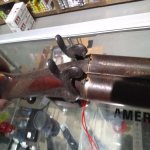
I just found this but I'm not sure if I going to get it .
My biggest concern is the unknown pinfire rifle cartridge for the left barrel , also missing the original fore end.
I think it's maybe to advanced project for my level .
It's very German
Attachments

Last edited:

Bill, we will get one started in Calgary next year!Unfortunately, I can't make it this year due to a bad back and bum knee. Ol Flinter (Doug) has kindly offered to get me there if I can make it to his home in Ottawa---the flight would be a killer.
Maybe, next year we can have a counterpart in Calgary. Perhaps we can convince VictoryXC to work his magic yet again
Bill
I have met a lot of good people at the Double Gun Classic and hope to do the same in Alberta.

8TH ANNUAL UPPER CANADA DOUBLE GUN CLASSIC, Saturday June 1, 2024
Speaking with the committee guys they've asked for some clarification on the issue of Safety.
Further Notes On Safety
The Upper Canada Double Gun Classic is not responsible for the safety of your firearm.
It is the sole responsibility of each firearm owner attending the Double Gun Classic to determine that their gun(s) and chosen ammo are safe to fire.
Only use a gun and ammo that you are certain are safe to shoot.
We recommend that vintage firearms are inspected and measured by a gunsmith or someone knowledgeable in the field.
Concerning safety the condition of vintage firearms can be difficult to judge.
This can be especially so regarding guns that have been restored and look like new.
Although refinished and appearing in excellent condition, metal tolerances and thicknesses may be altered from their original state and become potentially unsafe for use.
Furthermore with respect to vintage guns, chamber sizes and proofs can be different, intended for specific bores and lengths of shells at certain load charges and shot weights.
This can even be the case within a similar model from a specific gun maker from the same era.
Without inspection these important details may go undetected.
If you have a gun that you are unsure about then you may bring it for display purposes only.
As mentioned previously, regarding ammo the clubhouse may have some 12 gauge x 2 ¾” target shells available for sale, however it would be best if you brought your own.
Note that shells need to be 12 gauge equivalent target loads or less, sizes #7.5, #8 and #9, and black powder is not permitted.
Shooting glasses and ear protection are also required.
--------------------------------------------------------------
I'd like to add that if someone were unsure about a firearm or their confidence in evaluating condition that attending the Double Gun Classic would be a great place to start.
Come on out and talk to the people, as there will be a concentration of knowledgeable collectors there.
--------------------------------------------------------------
The fine print aside we're getting close to the event and I'm looking forward to it!
Speaking with the committee guys they've asked for some clarification on the issue of Safety.
Further Notes On Safety
The Upper Canada Double Gun Classic is not responsible for the safety of your firearm.
It is the sole responsibility of each firearm owner attending the Double Gun Classic to determine that their gun(s) and chosen ammo are safe to fire.
Only use a gun and ammo that you are certain are safe to shoot.
We recommend that vintage firearms are inspected and measured by a gunsmith or someone knowledgeable in the field.
Concerning safety the condition of vintage firearms can be difficult to judge.
This can be especially so regarding guns that have been restored and look like new.
Although refinished and appearing in excellent condition, metal tolerances and thicknesses may be altered from their original state and become potentially unsafe for use.
Furthermore with respect to vintage guns, chamber sizes and proofs can be different, intended for specific bores and lengths of shells at certain load charges and shot weights.
This can even be the case within a similar model from a specific gun maker from the same era.
Without inspection these important details may go undetected.
If you have a gun that you are unsure about then you may bring it for display purposes only.
As mentioned previously, regarding ammo the clubhouse may have some 12 gauge x 2 ¾” target shells available for sale, however it would be best if you brought your own.
Note that shells need to be 12 gauge equivalent target loads or less, sizes #7.5, #8 and #9, and black powder is not permitted.
Shooting glasses and ear protection are also required.
--------------------------------------------------------------
I'd like to add that if someone were unsure about a firearm or their confidence in evaluating condition that attending the Double Gun Classic would be a great place to start.
Come on out and talk to the people, as there will be a concentration of knowledgeable collectors there.
--------------------------------------------------------------
The fine print aside we're getting close to the event and I'm looking forward to it!
Last edited:

Time is running out, can we get an address for the event, for benefit of my GPS? I also need to do some side trip planning; last year the side trips kept me away completely.
Oshawa Clay & Target Club
5245 Wilson Rd N
Oshawa ON L9L 1B3
Canada
The Double Gun Classic is many things, including a friendly get-together of fellow enthusiasts, good-natured rounds of skeet with vintage guns, and, hopefully, a day out in the breeze and sunshine. But the big attraction is getting to see a myriad of fine double guns in one place, usually representing the entirety of the 19th and 20th centuries to the present, from flint to newly made.
The double gun, whether you prefer your barrels stacked or horizontal, is, in my opinion, the pinnacle of gunmaking. Few hunting scenarios require an immediate third shot, and anyway, since the central-fire cartridge dominated the scene, double guns are quick to reload. While pumps and autoloaders satisfy the craving for more firepower, the double gun has never left the field, owing to its simplicity and performance. The relative rarity and exclusivity of fine double guns, often associated with high craftsmanship and history, make them a coveted choice for collectors. It is ironic that side-by-sides are deemed old-fashioned (perhaps Elmer Fudd cartoons have something to do with this), considering they are still being made, and ‘modern’ pumps and autoloaders can be over 100 years old. I prefer to think of double guns as being the best design that gunmaking reached before guns were merged with farm machinery.
There is very little extra metal or wood on a good double. William Wellington Greener maintained a gun should weigh 96 times its shot charge to best absorb the recoil and, as a double is generally intended to be carried, combine that formula with the least weight one wishes to heft around all day. Extra weight, outside of the duck blind or competition shooting, runs counter to the qualities of the double gun. The centre of balance should be close to the hinge pin, placing what feels like the weight of the gun ‘between the hands’ and giving the double gun that nimble feel, ready to point. A 12-gauge game gun should be about seven pounds in weight or a touch less. Without space-age alloys, getting to this target is quite a feat.
Some makers toyed with various means to manage weight and balance. Metal was removed where it didn’t show; barrel tubes were thinned as much as safety allowed, and ribs were lightened, sometimes swamped, or sometimes done away with altogether (pick up a Darne and have a look). Stocks could be drilled out for lightness, and barrels shortened (there was a time when 25” barrels were in vogue, for snap-style shooting). But among the more extreme efforts to reduce action weights were the bar-in-wood guns (also called bar-in-the-wood). In these, the action bar (or action flats, or water table) is much reduced to the minimum strength required, and the wood of the stock hid much or all of the action bar and sometimes the hinge itself. This invariably shows off the skill of the stocker, which must be extreme, and gives the gun the looks of a fine muzzle-loader. Not surprisingly, the bar-in-wood gun appeared during the transition between the muzzle-loading and cartridge-loading systems, when (1) muzzle-loaders were considered better-looking guns, and (2) the idea of a hinge was suspect if not heretical. Everyone was coming up with their own ideas on how to make them, decades before the industry settled on the strongest, most reliable and cost-friendly designs for larger-scale production, like the hammerless sidelock and boxlock.
Several gunmakers built their reputation on bar-in-wood guns, like Westley Richards, Thomas Horsley, and James Purdey. Wesley Richards moved on to their proprietary boxlock, and Purdey continued making bar-in-wood guns for some time; unsurprisingly, bar-in-woods were ‘best’ guns, from the extra effort and skill in making them. As far as I know, the most recent bar-in-wood guns were the James MacNaughton “skeleton” guns built on a trigger-plate action (I don’t have one; Google ‘MacNaughton’ and ‘skeleton’ and feast your eyes). The likelihood of anyone bringing back the bar-in-wood design is slim, at least at a price of less than six figures. So, we’re left to appreciate the ones that have been made.
For this year’s Double Gun Classic, I’m bringing a selection of bar-in-wood double guns from my pin-fire collection. There will be two Joseph Needham side-levers, one by John Blissett of London and one by John Rigby of Dublin; a Crofts top-lever by Reuben Hambling of Manchester; two pull-levers by Thomas Horsley of York; a Parker Field & Sons of London patent underlever; a top-lifter by William Powell of Birmingham; and two Westley Richards top-levers to top off the list. Drop by and have a look at the insane engineering and skill that went into making them.
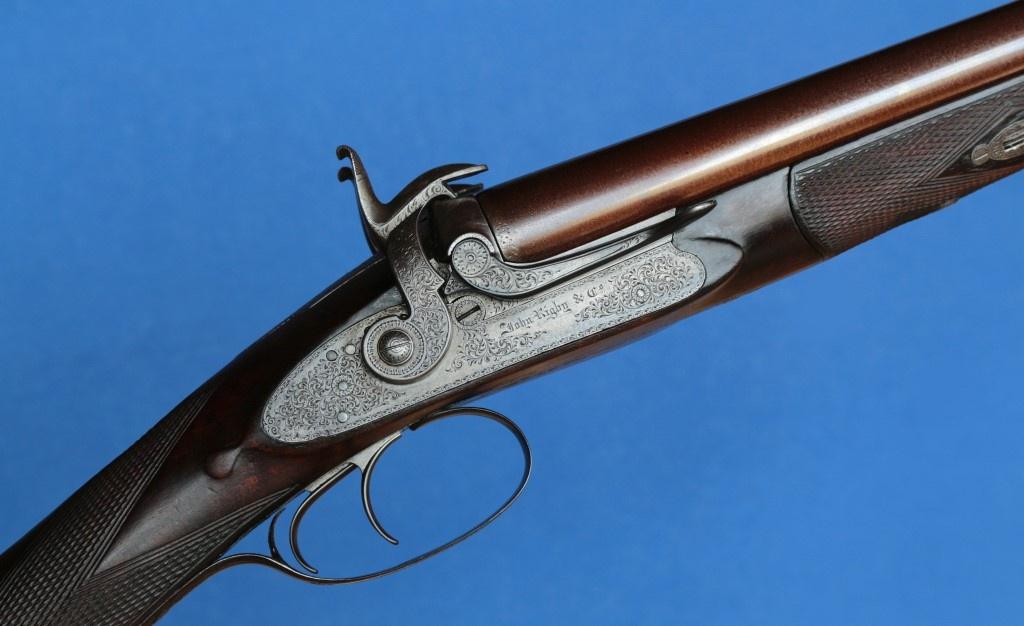
For a taste, here is the Rigby, made around 1868. Yes, it’s a hinge gun.
The double gun, whether you prefer your barrels stacked or horizontal, is, in my opinion, the pinnacle of gunmaking. Few hunting scenarios require an immediate third shot, and anyway, since the central-fire cartridge dominated the scene, double guns are quick to reload. While pumps and autoloaders satisfy the craving for more firepower, the double gun has never left the field, owing to its simplicity and performance. The relative rarity and exclusivity of fine double guns, often associated with high craftsmanship and history, make them a coveted choice for collectors. It is ironic that side-by-sides are deemed old-fashioned (perhaps Elmer Fudd cartoons have something to do with this), considering they are still being made, and ‘modern’ pumps and autoloaders can be over 100 years old. I prefer to think of double guns as being the best design that gunmaking reached before guns were merged with farm machinery.
There is very little extra metal or wood on a good double. William Wellington Greener maintained a gun should weigh 96 times its shot charge to best absorb the recoil and, as a double is generally intended to be carried, combine that formula with the least weight one wishes to heft around all day. Extra weight, outside of the duck blind or competition shooting, runs counter to the qualities of the double gun. The centre of balance should be close to the hinge pin, placing what feels like the weight of the gun ‘between the hands’ and giving the double gun that nimble feel, ready to point. A 12-gauge game gun should be about seven pounds in weight or a touch less. Without space-age alloys, getting to this target is quite a feat.
Some makers toyed with various means to manage weight and balance. Metal was removed where it didn’t show; barrel tubes were thinned as much as safety allowed, and ribs were lightened, sometimes swamped, or sometimes done away with altogether (pick up a Darne and have a look). Stocks could be drilled out for lightness, and barrels shortened (there was a time when 25” barrels were in vogue, for snap-style shooting). But among the more extreme efforts to reduce action weights were the bar-in-wood guns (also called bar-in-the-wood). In these, the action bar (or action flats, or water table) is much reduced to the minimum strength required, and the wood of the stock hid much or all of the action bar and sometimes the hinge itself. This invariably shows off the skill of the stocker, which must be extreme, and gives the gun the looks of a fine muzzle-loader. Not surprisingly, the bar-in-wood gun appeared during the transition between the muzzle-loading and cartridge-loading systems, when (1) muzzle-loaders were considered better-looking guns, and (2) the idea of a hinge was suspect if not heretical. Everyone was coming up with their own ideas on how to make them, decades before the industry settled on the strongest, most reliable and cost-friendly designs for larger-scale production, like the hammerless sidelock and boxlock.
Several gunmakers built their reputation on bar-in-wood guns, like Westley Richards, Thomas Horsley, and James Purdey. Wesley Richards moved on to their proprietary boxlock, and Purdey continued making bar-in-wood guns for some time; unsurprisingly, bar-in-woods were ‘best’ guns, from the extra effort and skill in making them. As far as I know, the most recent bar-in-wood guns were the James MacNaughton “skeleton” guns built on a trigger-plate action (I don’t have one; Google ‘MacNaughton’ and ‘skeleton’ and feast your eyes). The likelihood of anyone bringing back the bar-in-wood design is slim, at least at a price of less than six figures. So, we’re left to appreciate the ones that have been made.
For this year’s Double Gun Classic, I’m bringing a selection of bar-in-wood double guns from my pin-fire collection. There will be two Joseph Needham side-levers, one by John Blissett of London and one by John Rigby of Dublin; a Crofts top-lever by Reuben Hambling of Manchester; two pull-levers by Thomas Horsley of York; a Parker Field & Sons of London patent underlever; a top-lifter by William Powell of Birmingham; and two Westley Richards top-levers to top off the list. Drop by and have a look at the insane engineering and skill that went into making them.
For a taste, here is the Rigby, made around 1868. Yes, it’s a hinge gun.



1963beretta
CGN Ultra frequent flyer
- Location
- Vaughan, Ontario
2 barrels, not 6

Londonshooter
CGN frequent flyer
- Location
- SW Ontario
That John Rigby is gorgeous.
I no longer have one of the guns but I do drink at a bar. In the woods.
I no longer have one of the guns but I do drink at a bar. In the woods.
Well, my health took a downturn this week, and I’m sad to say I won’t be able to attend the Double Gun Classic, to my great frustration. I’m sure you’ll find a way to enjoy yourselves, without some fool prattling on about pin-fires…
Have a great day, everyone. Catch you next year.
Have a great day, everyone. Catch you next year.

Big Bad
CGN Ultra frequent flyer
Well, my health took a downturn this week, and I’m sad to say I won’t be able to attend the Double Gun Classic, to my great frustration. I’m sure you’ll find a way to enjoy yourselves, without some fool prattling on about pin-fires…
Have a great day, everyone. Catch you next year.
That is disappointing to say the least. Get well soon and stay well for next year!

One of the main reasons I’m making the journey was to learn from one of the masters. Your health is everything! Wishing you a speedy recovery. You’ll be very missed!!Well, my health took a downturn this week, and I’m sad to say I won’t be able to attend the Double Gun Classic, to my great frustration. I’m sure you’ll find a way to enjoy yourselves, without some fool prattling on about pin-fires…
Have a great day, everyone. Catch you next year.
ANNOUNCEMENT!
Bring your wallet! This year we will have two vendors on site.
As in past years, Denis the Greek will be there. Those of you who attended last year will remember his two tables of beautiful cased guns.
And new this year, Mike and Seth from Ellwood Epps will be displaying guns across at least two tables. Very pleased to have Epps joining us this year.
Bring your wallet! This year we will have two vendors on site.
As in past years, Denis the Greek will be there. Those of you who attended last year will remember his two tables of beautiful cased guns.
And new this year, Mike and Seth from Ellwood Epps will be displaying guns across at least two tables. Very pleased to have Epps joining us this year.
1963beretta
CGN Ultra frequent flyer
- Location
- Vaughan, Ontario
ANNOUNCEMENT!
Bring your wallet! This year we will have two vendors on site.
As in past years, Denis the Greek will be there. Those of you who attended last year will remember his two tables of beautiful cased guns.
And new this year, Mike and Seth from Ellwood Epps will be displaying guns across at least two tables. Very pleased to have Epps joining us this year.
Sweet! Thats great news
1963beretta
CGN Ultra frequent flyer
- Location
- Vaughan, Ontario
Well, my health took a downturn this week, and I’m sad to say I won’t be able to attend the Double Gun Classic, to my great frustration. I’m sure you’ll find a way to enjoy yourselves, without some fool prattling on about pin-fires…
Have a great day, everyone. Catch you next year.
Crap, that’s terrible news!
Get well soon!
Well, my health took a downturn this week, and I’m sad to say I won’t be able to attend the Double Gun Classic, to my great frustration. I’m sure you’ll find a way to enjoy yourselves, without some fool prattling on about pin-fires…
Have a great day, everyone. Catch you next year.
We'll miss you . Get well soon.






















