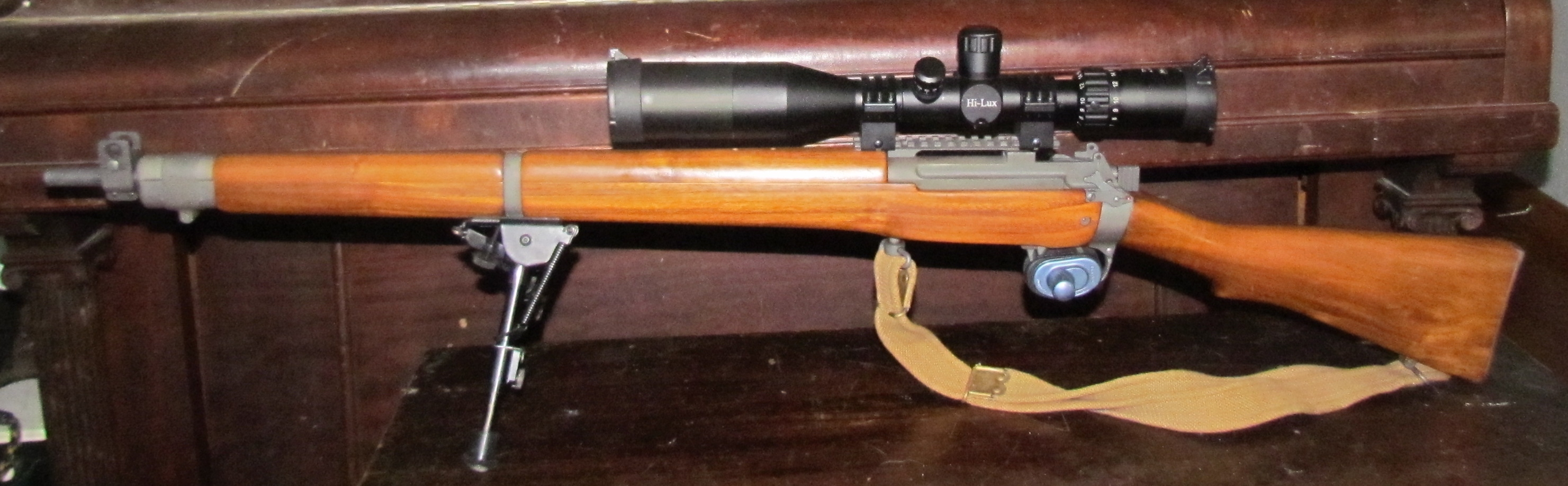
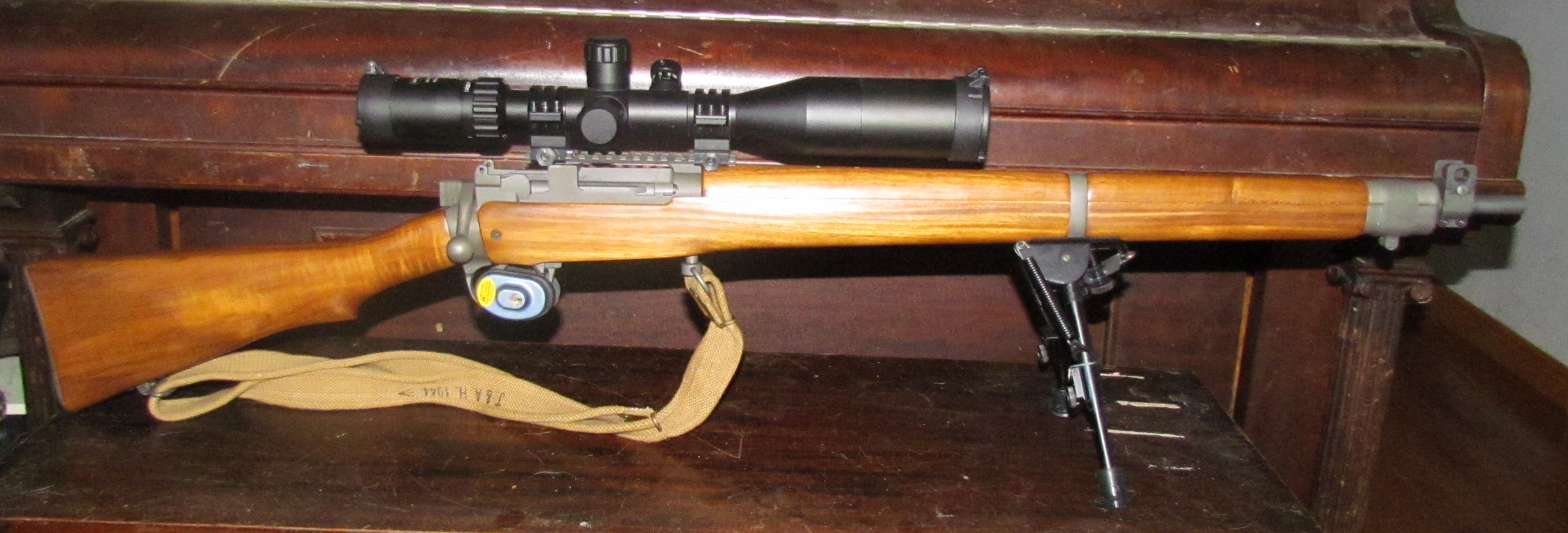
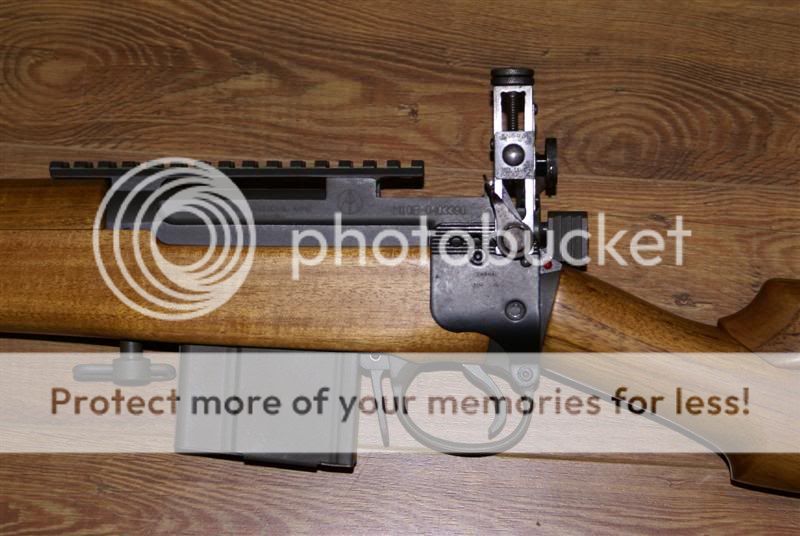
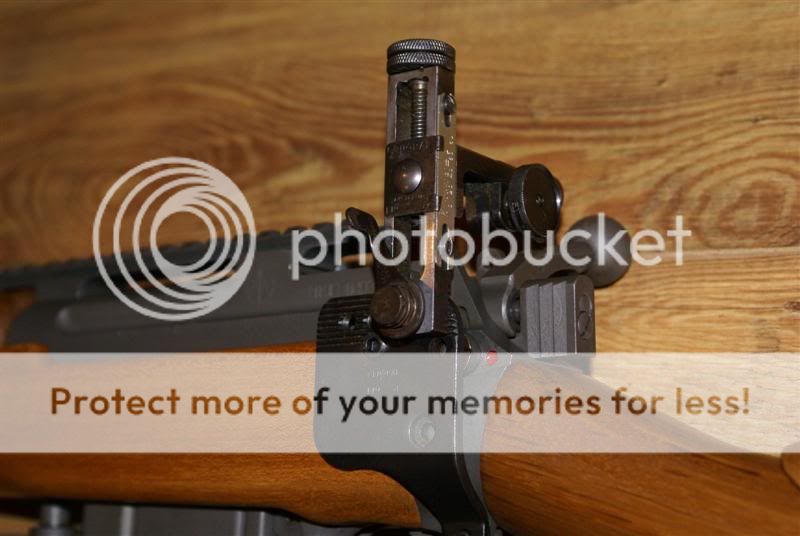
"...unfortunately I had to remove the original rear sight so it would mount."
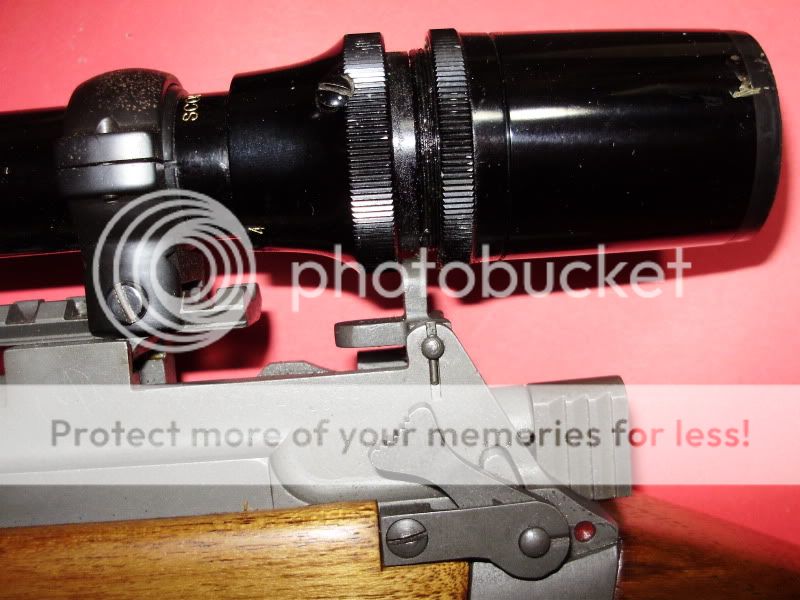
The little L shape peep sticks up into the path of the scope. It is always nice to sight in a rifle with the irons so you have a back up, "just in case". This is especialy true in the case of this rifle because the irons are so easly adjusted, even easier than the original #4. You just screw the front sight post in our out for elevation, much like the SKS.
There are three solutions:
Remove the rear sight.
Install a military ladder sight and grind off the big battle sight ring. This is what you find on the #4T sniper rifle.
Buy a surplus L sight and grind off the top peep.
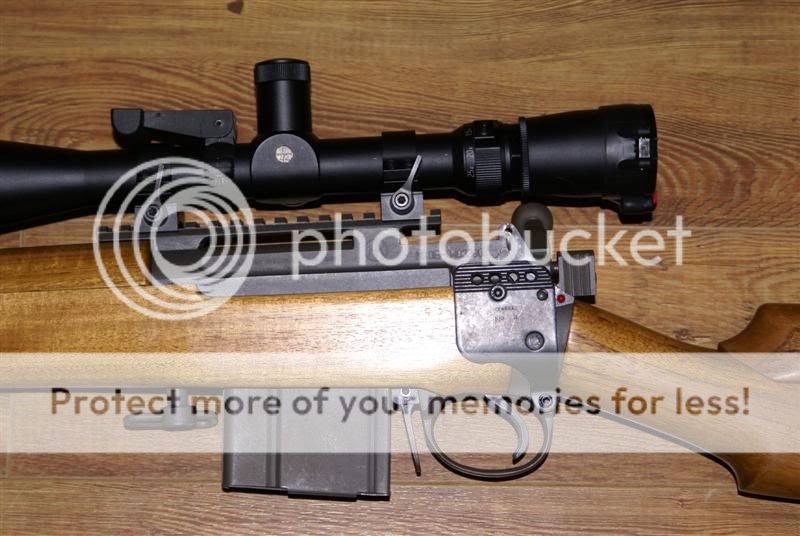
Or use a scope that has a space in the rear eyepiece that will accomodate the peep. My 4-12 Bushnell Scopechief has this feature. In this picture you can see that the sight has clearance in the gap in the scope eyepiece.
"I am curious with the right load and a scope, what this rifle can do on paper. Has anyone tried to load test for the rifle and see what best groups they could get? "
I did a test yesterday. I had a bunch of 308 plinkers to shoot and wanted to find a single handload formula that would work well in all of them. I selected CBC Berdan primed brass, because I have a lot of that, a surplus military ball powder similar to H335 and surplus military 147gr FMJ bullets. The original ammo was loaded with 43gr, but I did not want full power, if I could avoid it, so tested 40, 41 nad 42 in each rifle, at 100 yards.
I found it reamarkable that in EVERY rifle (13 of them) the 41 was the BEST, with 42gr. almost as good in most. None of them did well with the 40 gr load. So now I have a standard load and can run a bunch of it off in the Dillon.
41 gr was the best.
In the past I have run some similar tests in the AIA alone using both the 147 FMJ and 155 and 168 match bullets. The best load in all tests seems to be around 1.5 MOA. Not great for a target rifle, but very acceptable for a military type rifle.
This is not an "out of the box" rifle. I bought it used on EE and found it shot poorly. When I opened it, the barrel was bearing on the barrel channel all along one side. I hogged it out so it did not touch, and then bedded the receiver and made a bearing pad under the muzzle, to control that long skinny barrel. The results were gratifying. It now shoots under 2" consistantly and holds zero well.
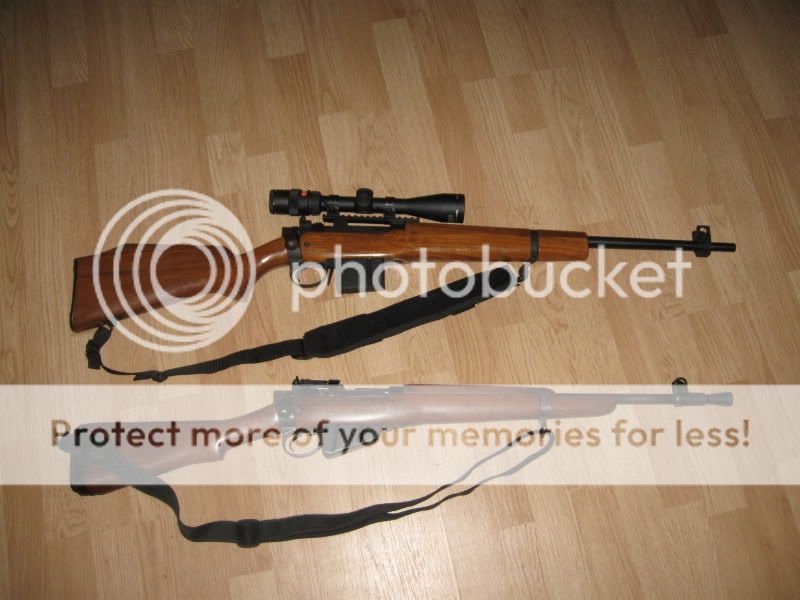
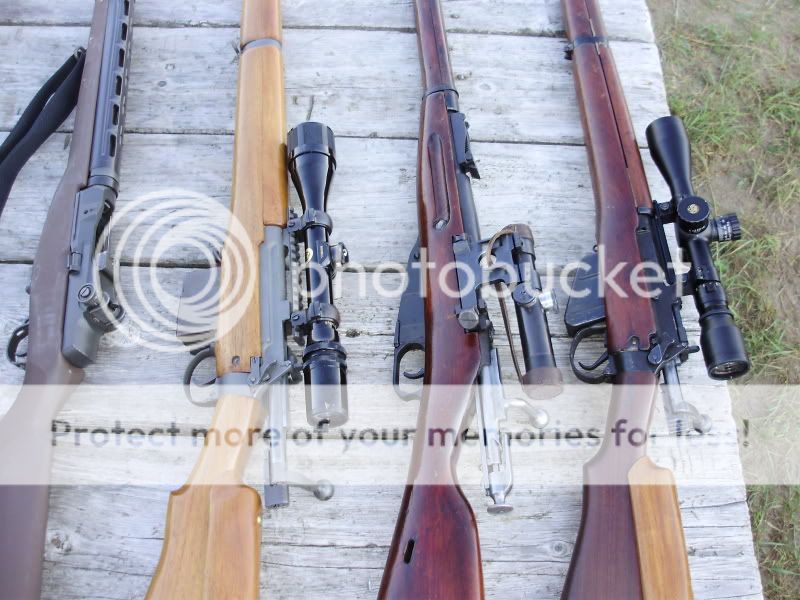
Yesterday I also shot a rifle I made to serve the same purpose as the AIA, several years ago. It was a lot cheaper. I installed an old shot out 308Win match barrel in a #4. Most erosion and wear is in the throat and first 3" of barrel, so we just cut that section off a 30" barrel and chambered it in 308 Brit. That is a 303 case necked down to take a 308 bullet. This way the mag and extractor/ejector still work. The stock was hogged out to take the thicker barrel and the last 4" of barrel was contoured like a #4, right down to the bayo lugs. The result is a rifle that looks like a #4, but shoots 308 bullets. It groups slightly better than the AIA - by about a 1/4 inch.
It is the rifle on the right in this picture. I call it my "Pseudo Sniper". It shoots somewhat better than my real T.
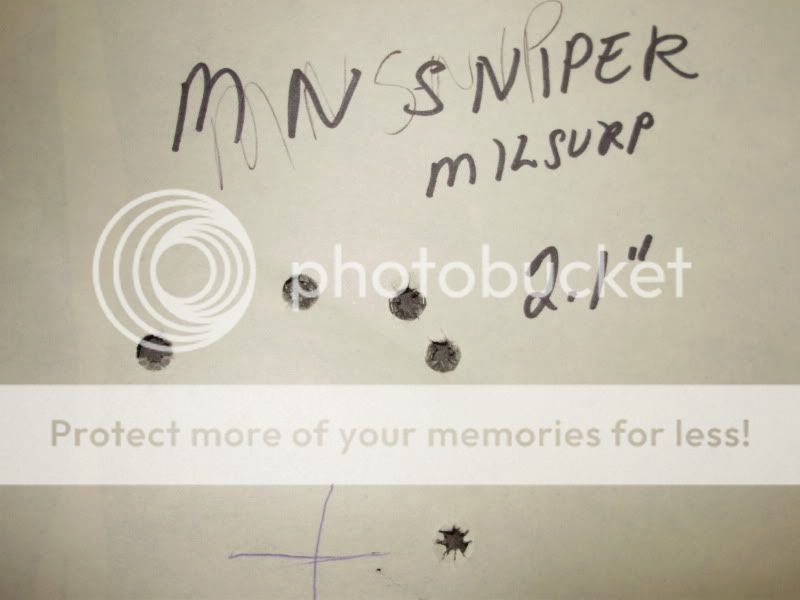
The Moisan Nagant sniper has been my most pleasent surprise. If you can get one with a good barrel, buy it. I have seen them advertised recently for around $500. I used milsurp ammo (Russian) in this test and it shot within an inch of where it was zeroed last year. Group was good too, 2.1". Not bad for millsurp ammo and a 3X scope.
I also shot this same Russian ammo in a MN M44 (5.2") and a SVT40 (4.7")
In the context of other rifles, the AIA shoots about the same as the FR8 I shot yesterday (1.7", with irons) and the two Norinco M14s (2.2" & 1.6", with irons). The FR8 is out of the box. The m14s have been through Hungry's clinic and may have been bedded.