The first order of business relates to the definition of the defensive handgun. A hunting handgun is not a defensive handgun, although in certain circumstances it could be used in the defensive role. The hunting handgun has no limitation to size, length, bulk, weight, power, or sighting. The hunting handgun need not necessarily be more than a single shot and it has no limitation as to its sighting equipment. By contrast the defensive handgun must be small, light, and short enough that it will always be carried rather than left behind because its not worth the trouble. The defensive handgun must be robust and resilient to exposure to the elements over a long period of time. The gun must be capable of fast repeat shots, and it must be as close to 100% reliable as a mechanical devise can be made. The grip size must fit the shooter's hand so that he has optimal control over recoil, and the best chance to hit his target The sighting equipment cannot be fragile or delicate, yet it must provide a fast and easy to acquire sight picture.
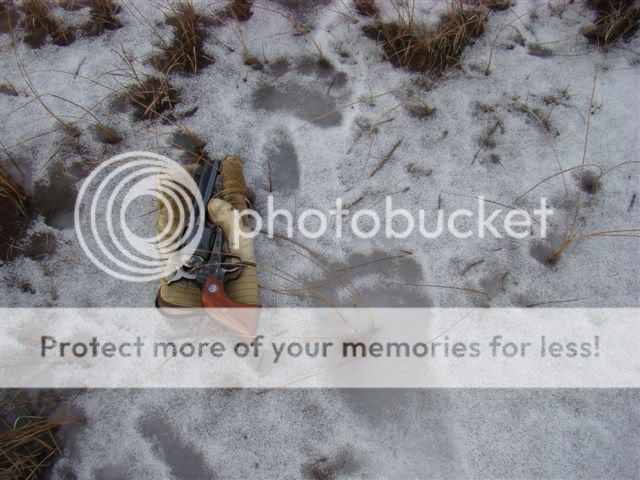
With respect to terminal performance, penetration is the primary concern. The bullet must be able to penetrate heavy hide, dense muscle, and thick bones. Expansion my or may not be a good thing. While it complicates a wound in soft tissue, if the large frontal area prevents penetration through a bone it is then a disadvantage. The purpose of shooting is to stop the forward progression of the animal, and if a CNS shot is not offered, the next best thing is to break the transmission, meaning a hip or shoulder. For this reason I prefer heavy for caliber bullets at a velocity of about 1200 fps. If the bullet is going much faster, it could be heavier, if its going much slower, its too heavy.
This level of performance also has an effect on recoil. It is very difficult to reacquire the target for a follow up shot if the muzzle is pointing at the moon and continues to rise. Bullet weights in excess of 350 grs will produce too much recoil at this velocity for a balance of power and control to be maintained, and bullet weights over 250 grs, while desirable from the aspect of terminal performance, result in a level of recoil that takes a recoil hardened shooter to control. Therefore I consider a hot loaded .45 Colt or a .454 to represent the maximum level of power that is prudent in a light defensive gun. I carry a .44 magnum loaded with 325 gr hard cast WFNs as my primary gun and a .357 loaded with 190 gr hard cast SWCs as my secondary.
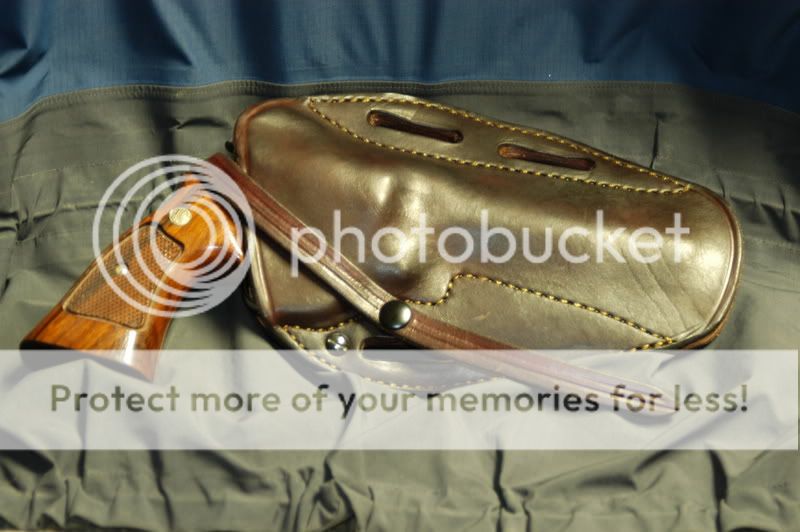
As important as the choice of gun is, the choice of a holster is equally so. Your personal preference, body type, occupation, and the type of country you work in are all relevant to the choice of holster. For example, if your build is thick through the arms, shoulders and chest, a shoulder holster might position the gun so it is all but impossible to reach, and a cross draw holster musty be positioned well to the front for it to be accessible. The holster should have a retaining devise of some kind, be it a strap or thumb-snap. If you work in heavy cover, a holster that covers the trigger guard and hammer is desirable, and an open muzzle will keep debris from collecting in the holster.
What level of proficiency should the pistol shooter have before he can expect to save his life with a handgun? This is tough to answer, as luck is as important as skill is to the outcome we desire. We don't want to be like Cactus Jack, expousing the virtues of the gun which killed the bear that killed him. But if we are in a dangerous bear encounter that can only be resolved by gun fire, luck isn't with us on that day, so you might as well be good with that gun on your hip. The range will be short and the action fast. If the bear is coming straight in and is focused on you, as is the case in a predatory attack, the head is relatively stationary, where it might swing from side to side, in a defensive approach.
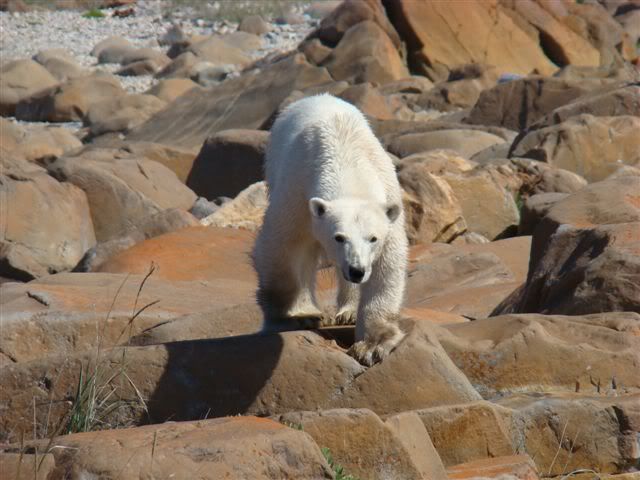

The head appears massive and wide compared to the brain pad which is only the width of his snout and is behind his eyes and ahead of his ears. In a high stress situation, this is a tough target at 5-10 yards, we don't want to start a fight with a bear at longer range if all we have is a handgun; this should be considered a last ditch effort. If the bear has acted aggressively towards you and cannot be driven off, and you have no way to leave the area, a 100 yard shot with a rifle to resolve the matter is better than a 2 am visit to your tent, but under no circumstances should a dangerous animal be fired upon without knowing you can kill it. For handgun proficiency, a 10 yard group that measures 3" wide by 6" high when fired quickly will do. Tight windage is more important than a group that strings out horizontally, because a shot that hits high should strike the spine. Do not expect a chest shot to stop a bear attack, it might, but the experience of many unfortunates suggests otherwise.

Alaskan coastal grizzly that paid us a visit a few days ago at the Chilkoot River

















































 Stuart