












































And Today's Lesson . . .

Boomer

CGN Ultra frequent flyer
Uber Super GunNutz
Rating - 100%
21   0   0
A week or so ago, I went to the range to work up a maximum load for my .308 target rifle with N550 under 210 gr Matrix VLDs. This was my first opportunity to load anything with Vihtavuori powder. My rifle's chamber was cut with a very long lead allowing me to seat long heavy bullets in such a way that the base of the bullet would not intrude upon the powder capacity of the case, thus I can load a slightly heavier and get more velocity than would normally be possible with an SAMI chamber. The maximum load with Winchester 760 under this bullet was 50 grs of Winchester 760, the velocity plateaued being 4 fps slower than the 49 gr load of 2608 fps. The best accuracy came from 47.7 grs of 760 for an average velocity of 2545 fps, and shot into a half minute at 500 yards. Now I had the new powder and the first step was to determine the maximum load then work backwards from that point to find the most accurate load.

It proved to be in interesting day to say the least. I used two chronographs, a P-35 Oehler and a Chrony Beta that was set on the Oehler's 6' screen rail immediately in front of the center screen.

All the brass was trimmed to 2" and chamfered and I loaded in 1 gr increments from 40 to 50 grs. to be sure that I would reach the maximum load. The results were as follows:

Powder Charge.....Oehler.....Chrony
40.0....................2136.......2146
41.0....................2196.......2250
42.0....................2260.......2279
43.0....................2332.......2352
44.0....................2390.......2391
45.0....................2430.......2457
46.0....................2486.......2520
47.0....................2541.......2573
48.0....................2655.......2651
49.0....................2578.......2557

Now here's the interesting part. Up until the 47 gr load there were no high pressure indicators on the brass. The 48 gr load showed a very slight shinny spot from the ejector, but it was so subtle I missed it in the bright sunlight, and even at home in subdued light you have to really look for it to see it. The firing pin strike on the primer was slightly smaller and I missed that too. I suppose I could have/should have used the 2600 fps maximum I observed with 760 as my cut off, but N550 was by all accounts able to produce higher velocities and improved accuracy at those higher velocities than competitive powders, by a fairly wide margin; so I was less cautious than I would have been otherwise.

When I worked up the maximum load with 760, with the same brass, the pressure mark on the brass was obvious, so it was not an instance of a very hard case head. Bolt lift was easy all the way through, with no indication of being sticky. There was no sign of a velocity plateau, which has been present in every other rifle powder I've worked up a load with. But when I touched off the 49 gr load, the results we impressive and unpleasant!

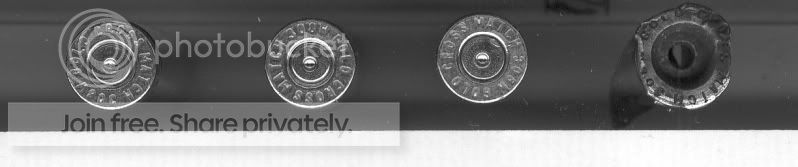
The first thing I was really aware of was a face full of gas and the second was the impact of a very strong pressure wave against my right ear. My immediate impression was that I had a case failure, I did, but not in the way I expected. I had to bump the bolt open with the heel of my hand and once open I was unable to remove case from the bolt face. Attempting to pry it off with my Leatherman mangled the case body, and it required a number of hard blows with a piece of wood to coax it free. The M-700 bolt face didn't fair particularly well, the steel rim that covers the extractor was mostly gone, so its off to my gunsmith for assessment and in all likelihood, replacement.

.308 Case heads from left to right, 46, 47, 48 & 49 gr loads
jpg-2.jpg


Note to self, when working up a load with an unknown powder, do not assume that you will be able to read the brass or rely on a velocity plateau to determine maximum pressure. I emailed Lapua to see if they could provide an insight as to how the pressure curve of their 500 series powders compared to their competitors. They responded that in their opinion a 49 gr load of N550 under a 215 gr bullet represented a massive overload . . . I think I got that.:rolleyes:
 
That is one hell of a pressure jump from 48.0 to 49.0gr. Good to hear you are OK and thanks for the reminder that we are playing with very high pressures and to always respect the possibility of an incident.


Mark
 
I hope every thing is ok

What i would have done is go up by .5g at a time
or .3 g or .2

it might take more than One visit to the range

what you could have done

40.0 3 rounds
41.0 4
42.0 4
43.0 4
44.0 4
45.0 4
46.0 4
46.5 4
47.0 4
47.5 4
48.0 4
48.5 4
49.0 3
50 total

or
rounds
40.0 3
41.0 3
42.0 3
43.0 3
44.0 3
45.0 3
46.0 3
46.3 3
46.6 3
46.9 3
47.2 3
47.5 3
47.8 3
48.1 3
48.4 3
48.7 3
49.0 2
50

I have also split up testing in to two or three days
one day for initial testing
and day 2 for fine tuning like below
46.0 5
46.2 5
46.4 5
46.6 5
46.8 5
47.0 5
47.2 5
47.4 5
47.6 5
47.8 5
50


and you may have seen signs earlier and stopped before you had problems
and if you check your brass the 48g load the primers will pop out easy

Every day is a learning experience
 
That is one hell of a pressure jump from 48.0 to 49.0gr. Good to hear you are OK and thanks for the reminder that we are playing with very high pressures and to always respect the possibility of an incident.


Mark

I'll say, in nearly 40 years of doing this, I've never seen a single grain of powder result in such a pressure spike, from virtually no pressure sign to a catastrophic failure. Thats what led me to emailing Lapua rather than just hang my head and scuff my toe in the dirt. Live and learn they say, but I can't afford to many lessons like that one.

Thanks for everyones kind words.

Kinda interesting the differences between the two chronographs though.
 
Wow!

I'm not quite sure what to do with this information because it screws with a lifetime of experience in load development....I don't know what to say other than this is seriously messing with my head.

Is there some slight extrusion on the "tc" in match?
I suspect some overly hard brass (in the case head) hence the explosion rather than the slightly greater signs of extrusion one would normally see as you worked up one grain further?

The upsetting thing is I know of no way to determine if this is so.

I am very happy you are well.
 
From looking at your pictures the 48 load definitely has a flattened primer flowing into the bevel of the primer pocket.

From looking at the velocity, there remains a 50 -60 fps improvment with added powder, then at 47-48 it increased about a 100 or so. Normally, I would have also seen a slow progression to less fps per added powder an indicator you are entering the area of diminishing opportunity (performance or life). Chronies are great to see where your gains are dropping off but such a spike...wow. Normally I increase by 0.5s with larger cap cartridges, but not sure you would have seen this coming either way.

Perhaps, there was an anomoly like a crimped bullet, or this may be an area where detonation may have happened for some reason (crimped bullet, under charge, etc ref 6br page and berger bullet seating depth topic)
Glad your around to talk about it.
 
I suspect some overly hard brass (in the case head) hence the explosion rather than the slightly greater signs of extrusion one would normally see as you worked up one grain further?

I'm not sure about the overly hard brass. In addition to what was obviously catastrophic failure, there are also signs of gross overpressure. The primer pocket and flash hole both look very large indeed, which would more easily, I think, come with overly-soft brass rather than overly hard. Thoughts?
 
From looking at your pictures the 48 load definitely has a flattened primer flowing into the bevel of the primer pocket.

From looking at the velocity, there remains a 50 -60 fps improvment with added powder, then at 47-48 it increased about a 100 or so. Normally, I would have also seen a slow progression to less fps per added powder an indicator you are entering the area of diminishing opportunity (performance or life). Chronies are great to see where your gains are dropping off but such a spike...wow. Normally I increase by 0.5s with larger cap cartridges, but not sure you would have seen this coming either way.

Perhaps, there was an anomoly like a crimped bullet, or this may be an area where detonation may have happened for some reason (crimped bullet, under charge, etc ref 6br page and berger bullet seating depth topic)
Glad your around to talk about it.


There was no crimp on the bullet, the cases were trimmed to 2" and was chamfered with my Giraud trimmer, immediately before loading the rounds. The lead of my chamber was cut long, 2.370" from the bolt face. The neck thickness is .015", the brass was not turned, and the rifle has a standard neck diameter.

I set up my scale with check weights, and double checked it when I got home again, it was bang on. The scale was still set up because I was going to start working backwards from maximum to find the sweet spot. Over the years I've become very confident using a velocity plateau as a sign that I had gone as far as I could, almost without fail a subsequent increase of 1 gr would result in a sticky bolt. There was no velocity plateau in this case, and the lower velocity on the failed round was undoubtedly due to the ruptured case head allowing gas to enter the bolt body through the firing pin hole. I never found the primer. Perhaps one reason I got gas back in my face was because I have a single shot adaptor in this rifle, which might of prevented the escaping gas from dumping into the magazine and dispersing.

I sent Lapua the lot number of the powder but, they said they had no idea what had caused the lack of pressure signs, although they suggested hard brass, but made of point of saying that 49 grs of N550 under a 210 gr bullet constituted a massive overload. Had hard brass been the cause of the lack of pressure signs, I wouldn't have had easy to see and easy to read pressure signs when I worked up the Winchester 760 loads in the same brass, with the same primers.
 
Wow!

I'm not quite sure what to do with this information because it screws with a lifetime of experience in load development....I don't know what to say other than this is seriously messing with my head.

Is there some slight extrusion on the "tc" in match?
I suspect some overly hard brass (in the case head) hence the explosion rather than the slightly greater signs of extrusion one would normally see as you worked up one grain further?

The upsetting thing is I know of no way to determine if this is so.

I am very happy you are well.

It would be comforting if we could point at the brass and say,"Ah-ha, thats what happened!" The trouble is that the pressure signs showed normally when I loaded 760 in that same brass. I hope an answer can be found . . . perhaps this is just one of those freak things like small charges of slow burning powder in large cases destroying rifle, they couldn't reproduce it in the lab, but it still happened from time to time.
 
I'm not sure about the overly hard brass. In addition to what was obviously catastrophic failure, there are also signs of gross overpressure. The primer pocket and flash hole both look very large indeed, which would more easily, I think, come with overly-soft brass rather than overly hard. Thoughts?

Had a very soft case head been the cause, would not early pressure signs from a lower charge weight been apparent? Certainly if the head and web of the case were soft, a sticky bolt lift would have signaled a problem.
 
I'm not sure about the overly hard brass. In addition to what was obviously catastrophic failure, there are also signs of gross overpressure. The primer pocket and flash hole both look very large indeed, which would more easily, I think, come with overly-soft brass rather than overly hard. Thoughts?

I don't know...I might be wrong on the hard brass.
The primer does look flattened but they tend to do that for no reason at all some times.
I suspected hard cases because 47 grains looks flawless and while 48 grains has the slightest of ejector marks (that indicates pressure), but not enough for me to consider myself in extreme danger. I too would have gone to the next grain if even to confirm my high pressure suspicions.

I am thinking the pressure curve of N-550 might be an issue at real high pressure?

215 grains at 2600?
I can't put that into perspective as I don't load the 308, but I looked it up and the hottest load with a 200grain bullet i could find is 2500fps.
I would like to say that the velocity would have cued me in, but those cases look safe enough and I would have also made the N550 assumption. :redface:

Boomer,
You should rebuild the rifle in 30-06. :D
Way better choice for the long bullets and its a cool long range cartridge.
Check it out!
http://www.6mmbr.com/gunweek091.html
 
It would be comforting if we could point at the brass and say,"Ah-ha, thats what happened!" The trouble is that the pressure signs showed normally when I loaded 760 in that same brass. I hope an answer can be found . . . perhaps this is just one of those freak things like small charges of slow burning powder in large cases destroying rifle, they couldn't reproduce it in the lab, but it still happened from time to time.

I have seen high pressure (via velocity) with no case related pressure signs before. Get the right powder, bore size, and case capacity
Even then pressure signs came late, but gradual.

Perhaps N550 is one of those with a nasty twist??
 
Boomer,
Where did you get your load data? I can't find ANY data that matches up N550 and a 215gn bullet AND that gives you 2600fps.

Or was this in the order of, "I have no data so I will work this up for my own use" type of thing.

Even if that was the case, I would have been extremely skeptical about going to 50gns since, according to the Lapua website, a maximum load of N550 behind a 190gn bullet is 47.2gn, giving just over 2600fps. (2624 fps actually)

Back when I did this sort of thing, thinking it was fun, I would immediately expect that to exceed 47gns would be to max out pressures behind a 215gn bullet and I probably would have stopped the 1gn increments at 45gn. I would have moved forward, with an unknown powder, in .1gn increments up to 47gns. But that was just me following the advice of a really old guy who I trusted. It worked for me, still have all fingers, eyes, and ears.

I am really glad you are all right.
 
I have done a lot of testing with real pressure guns. If you can see an ejector shiny spot you are in proof round range or higher.

Modern rifles are so good we can routinly shoot in that pressure range, until something goes wrong.

The velocity limit should be considered a speed imit, not to be exceeded. But I undertand the attraction of a fancy new powder and the reports of other shooters - who are probably blissfully shooting proof rounds.
 
When ever I get ejector marks on my brass I back off a full gr, the fact is I missed seeing it in the bright light on the range that day, but in all honesty I'm not sure I'd have seen it had the day been overcast. If I had, I would certainly have stopped at that point and backed off.

As you suggest, I wasn't concerned when I went past 2600 due to the reports of others who made fantastic velocity claims with the various 500 Series powders in a number of cartridges . . . again without signs of undue pressure. The fact of the matter is that N550 isn't magic, and it produces similar pressure in my rifle with a 210 gr bullet at 2600 as does any other powder with a similar burning rate like the H 4350, W 760, or H 414.

As for the advantage of modern actions, I am frankly underwhelmed by the 700's performance. A 113 year old Mauser dumps excess gas though huge vents down into the magazine more efficiently and safer than does the little vent in the 700's bolt body. I got gas in the face with the 700, but not with an accident I had with an old M-17 Enfield. The 700 is out of service until the bolt can be repaired or replaced, the '17 Enfield shrugged it off and kept shooting. Remington's famed ring of steel is much to do about nothing if you ask me.
 
Last edited:
Boomer,
Where did you get your load data? I can't find ANY data that matches up N550 and a 215gn bullet AND that gives you 2600fps.

Or was this in the order of, "I have no data so I will work this up for my own use" type of thing.

Even if that was the case, I would have been extremely skeptical about going to 50gns since, according to the Lapua website, a maximum load of N550 behind a 190gn bullet is 47.2gn, giving just over 2600fps. (2624 fps actually)

Back when I did this sort of thing, thinking it was fun, I would immediately expect that to exceed 47gns would be to max out pressures behind a 215gn bullet and I probably would have stopped the 1gn increments at 45gn. I would have moved forward, with an unknown powder, in .1gn increments up to 47gns. But that was just me following the advice of a really old guy who I trusted. It worked for me, still have all fingers, eyes, and ears.

I am really glad you are all right.

Due to the chamber dimensions and the long barrel of my rifle, .308 book data, as it relates to maximum loads and maximum velocity, isn't relevant. For example, the Sierra manual states 2450 fps is the maximum velocity for a .308 with a 200 gr bullet backed by 45.5 grs of W-760, yet my rifle can drive a 200 gr MK to 2660 with 50 grs of W 760. My proven loads have much more in common with a .308 AI than with a SAMI .308. When I looked at the Lapua data for the 190 with N550, I figured that 47 grs should be close to maximum in my rifle with the 210, which turned out to be accurate. Yet I do not hot rod my loads, when I have pressure signs on my brass, I back off a full grain and consider that to be my maximum working load, then work down from that point to find the best accuracy.

The trouble was I observed nothing to suggest this was the case. I started well short of maximum at 40 grs, which would allow me to get a good idea of how the velocity progression with equal increments in propellant weight, and I had no reason not to assume I would have plenty of warning (I thought) of high pressure as I approached maximum. Never before, and I've been at this for some time, have I experienced a catastrophic failure with new brass and with such little space between the first inkling of pressure, which was easily missed under the light conditions I was shooting in, and a catastrophic failure without further warning.

Note there was no pressure warning on the brass which I had previously seen with the same batch of brass with other powders. There was no decrease in the velocity rise which is a warning of high pressure common with other propellants, and there was no sticky bolt, which even after the failure wasn't as sticky as I'd have expected, being able to bump the action open with my hand.

But now I know that the maximum pressure with N550 under a 210 gr bullet, in my rifle, is 47 grs, and once it is back in service I will be interested to see if the accuracy claims of this stuff is as inflated as the velocity claims.
 
Im surprised that this powder and load behaved like this and Ill have to rethink my approach in the furture. According the hodgdon's burn rate chart its slower than the 4350's (and 760) and given the fact that the throat allows you not to compress the load . Mind you I once pierced a primer by going up one full grain with H870 within printed reloading data specs so nothing surprises me all that much anymore . Stay safe, take care.
 
Just wondering if you measured case web expansion at all, and if you did, did you find anything conclusive?

Happy to hear you fared much better than your bolt. I shudder to think of other possible outcomes.
 
Back
Top Bottom






















