













































- Location
- Somewhere on the Hudson Bay Coast
A week or so ago, I went to the range to work up a maximum load for my .308 target rifle with N550 under 210 gr Matrix VLDs. This was my first opportunity to load anything with Vihtavuori powder. My rifle's chamber was cut with a very long lead allowing me to seat long heavy bullets in such a way that the base of the bullet would not intrude upon the powder capacity of the case, thus I can load a slightly heavier and get more velocity than would normally be possible with an SAMI chamber. The maximum load with Winchester 760 under this bullet was 50 grs of Winchester 760, the velocity plateaued being 4 fps slower than the 49 gr load of 2608 fps. The best accuracy came from 47.7 grs of 760 for an average velocity of 2545 fps, and shot into a half minute at 500 yards. Now I had the new powder and the first step was to determine the maximum load then work backwards from that point to find the most accurate load.
It proved to be in interesting day to say the least. I used two chronographs, a P-35 Oehler and a Chrony Beta that was set on the Oehler's 6' screen rail immediately in front of the center screen.
All the brass was trimmed to 2" and chamfered and I loaded in 1 gr increments from 40 to 50 grs. to be sure that I would reach the maximum load. The results were as follows:
Powder Charge.....Oehler.....Chrony
40.0....................2136.......2146
41.0....................2196.......2250
42.0....................2260.......2279
43.0....................2332.......2352
44.0....................2390.......2391
45.0....................2430.......2457
46.0....................2486.......2520
47.0....................2541.......2573
48.0....................2655.......2651
49.0....................2578.......2557
Now here's the interesting part. Up until the 47 gr load there were no high pressure indicators on the brass. The 48 gr load showed a very slight shinny spot from the ejector, but it was so subtle I missed it in the bright sunlight, and even at home in subdued light you have to really look for it to see it. The firing pin strike on the primer was slightly smaller and I missed that too. I suppose I could have/should have used the 2600 fps maximum I observed with 760 as my cut off, but N550 was by all accounts able to produce higher velocities and improved accuracy at those higher velocities than competitive powders, by a fairly wide margin; so I was less cautious than I would have been otherwise.
When I worked up the maximum load with 760, with the same brass, the pressure mark on the brass was obvious, so it was not an instance of a very hard case head. Bolt lift was easy all the way through, with no indication of being sticky. There was no sign of a velocity plateau, which has been present in every other rifle powder I've worked up a load with. But when I touched off the 49 gr load, the results we impressive and unpleasant!
The first thing I was really aware of was a face full of gas and the second was the impact of a very strong pressure wave against my right ear. My immediate impression was that I had a case failure, I did, but not in the way I expected. I had to bump the bolt open with the heel of my hand and once open I was unable to remove case from the bolt face. Attempting to pry it off with my Leatherman mangled the case body, and it required a number of hard blows with a piece of wood to coax it free. The M-700 bolt face didn't fair particularly well, the steel rim that covers the extractor was mostly gone, so its off to my gunsmith for assessment and in all likelihood, replacement.
.308 Case heads from left to right, 46, 47, 48 & 49 gr loads
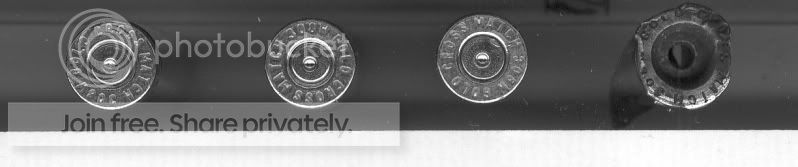
Note to self, when working up a load with an unknown powder, do not assume that you will be able to read the brass or rely on a velocity plateau to determine maximum pressure. I emailed Lapua to see if they could provide an insight as to how the pressure curve of their 500 series powders compared to their competitors. They responded that in their opinion a 49 gr load of N550 under a 215 gr bullet represented a massive overload . . . I think I got that.
It proved to be in interesting day to say the least. I used two chronographs, a P-35 Oehler and a Chrony Beta that was set on the Oehler's 6' screen rail immediately in front of the center screen.
All the brass was trimmed to 2" and chamfered and I loaded in 1 gr increments from 40 to 50 grs. to be sure that I would reach the maximum load. The results were as follows:
Powder Charge.....Oehler.....Chrony
40.0....................2136.......2146
41.0....................2196.......2250
42.0....................2260.......2279
43.0....................2332.......2352
44.0....................2390.......2391
45.0....................2430.......2457
46.0....................2486.......2520
47.0....................2541.......2573
48.0....................2655.......2651
49.0....................2578.......2557
Now here's the interesting part. Up until the 47 gr load there were no high pressure indicators on the brass. The 48 gr load showed a very slight shinny spot from the ejector, but it was so subtle I missed it in the bright sunlight, and even at home in subdued light you have to really look for it to see it. The firing pin strike on the primer was slightly smaller and I missed that too. I suppose I could have/should have used the 2600 fps maximum I observed with 760 as my cut off, but N550 was by all accounts able to produce higher velocities and improved accuracy at those higher velocities than competitive powders, by a fairly wide margin; so I was less cautious than I would have been otherwise.
When I worked up the maximum load with 760, with the same brass, the pressure mark on the brass was obvious, so it was not an instance of a very hard case head. Bolt lift was easy all the way through, with no indication of being sticky. There was no sign of a velocity plateau, which has been present in every other rifle powder I've worked up a load with. But when I touched off the 49 gr load, the results we impressive and unpleasant!
The first thing I was really aware of was a face full of gas and the second was the impact of a very strong pressure wave against my right ear. My immediate impression was that I had a case failure, I did, but not in the way I expected. I had to bump the bolt open with the heel of my hand and once open I was unable to remove case from the bolt face. Attempting to pry it off with my Leatherman mangled the case body, and it required a number of hard blows with a piece of wood to coax it free. The M-700 bolt face didn't fair particularly well, the steel rim that covers the extractor was mostly gone, so its off to my gunsmith for assessment and in all likelihood, replacement.
.308 Case heads from left to right, 46, 47, 48 & 49 gr loads
Note to self, when working up a load with an unknown powder, do not assume that you will be able to read the brass or rely on a velocity plateau to determine maximum pressure. I emailed Lapua to see if they could provide an insight as to how the pressure curve of their 500 series powders compared to their competitors. They responded that in their opinion a 49 gr load of N550 under a 215 gr bullet represented a massive overload . . . I think I got that.
























