













































You are using an out of date browser. It may not display this or other websites correctly.
You should upgrade or use an alternative browser.
You should upgrade or use an alternative browser.
Barrel facing / crowning tools
- Thread starter Goodwin81
- Start date

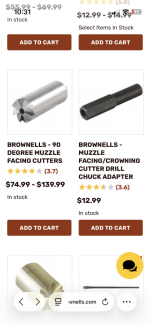


I first dealt with Brownells in 1966. They always have strived to provide the best tools for their customers and their staff are knowledgable.This shouldn’t have problem getting shipped from Brownells
Not neccessarily inexpensive, but they need to pay their overhead too.
football37
Member
- Location
- Southern AB
Manson usually has good stuff. That kind of tooling is not cheap, from no matter who you get it.
I'm assuming you don't own a lathe and are wanting to do this by hand. One of those kits would get you a third of the way to purchasing a decent used lathe.
Once a lathe is in the equation, there are many ways to skin that cat.
For hand tool stuff, Manson has a kit available.
I'm assuming you don't own a lathe and are wanting to do this by hand. One of those kits would get you a third of the way to purchasing a decent used lathe.
Once a lathe is in the equation, there are many ways to skin that cat.
For hand tool stuff, Manson has a kit available.
I had the Brownells crowning tools, do not get it, the bits of metal will get between the pilot and lands and scratch your rifling, it will also leave chatter marks, I would get the Manson Precision crowning tools instead, it's worth every penny, ther bore guide expands to hug the lands and doesn't turn unlike the Brownells brass one that spins and the cutters do not leave chatter marks.This shouldn’t have problem getting shipped from Brownells
I've been using the Brownells tools for around 15 years and they work just fine. Maybe the problems you had were user error?I had the Brownells crowning tools, do not get it, the bits of metal will get between the pilot and lands and scratch your rifling, it will also leave chatter marks, I would get the Manson Precision crowning tools instead, it's worth every penny, ther bore guide expands to hug the lands and doesn't turn unlike the Brownells brass one that spins and the cutters do not leave chatter marks.

Ya gotta use lots of thick cutting oil and go slowly with multiple "passes" to clear chips. Like most things, its not necessarily the tool but how you use it.
fingers284
CGN Ultra frequent flyer
- Location
- Alberta Cowboy Ranges
There is a thread on making your own precision crowning tools on the Canadian Hobby Metal Workers site that you would do well to join up and read it (no matter what tool you use).
All that is required to make one is a simple piece of square HSS and a bench grinder.
Before that discussion, i considered the crown "just a gaurd against bore damage from mishandling" but that thread has made me realize how important a well done crown is to a rifle...how well or not well done a crown is can make every aspect of your rifle to be a mute point...the crown is the last tip of lip that all your reloading ,glass cost action & stock bedding relies on to send that bullet on the rest of its path.
Editing to add...if I have given you the sense that you can cut "the perfect crown" with a cutter I'm sorry but that is wrong...I dont think anybody, professional gunsmith or professional machinist can cut a perfect crown, some will cut better than others but the physics of cutting bores with grooves & lands. A bore crown cut has 3 different facets that need cutting, the groove, the land cut where the cutter enters the land and the "exit cut" where the cutter leaves the land. the first two cuts are "supported by steel backing" while the exit cut has no steel backing and no matter what cutter you use will leave a bump or burr/flashing of steel...its just a certainty in steel machining.
How well you can minimalize this bur/bump will determine how well done your crowning is done.
All that is required to make one is a simple piece of square HSS and a bench grinder.
Before that discussion, i considered the crown "just a gaurd against bore damage from mishandling" but that thread has made me realize how important a well done crown is to a rifle...how well or not well done a crown is can make every aspect of your rifle to be a mute point...the crown is the last tip of lip that all your reloading ,glass cost action & stock bedding relies on to send that bullet on the rest of its path.
Editing to add...if I have given you the sense that you can cut "the perfect crown" with a cutter I'm sorry but that is wrong...I dont think anybody, professional gunsmith or professional machinist can cut a perfect crown, some will cut better than others but the physics of cutting bores with grooves & lands. A bore crown cut has 3 different facets that need cutting, the groove, the land cut where the cutter enters the land and the "exit cut" where the cutter leaves the land. the first two cuts are "supported by steel backing" while the exit cut has no steel backing and no matter what cutter you use will leave a bump or burr/flashing of steel...its just a certainty in steel machining.
How well you can minimalize this bur/bump will determine how well done your crowning is done.
Last edited:
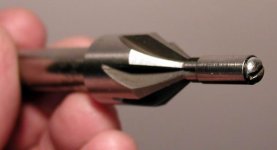
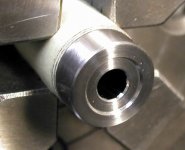
After machining on a lathe I always 'finished' my crowns using a piloted 60 degree cutter. I had the opportunity once to have a crown finished that way be inspected on an electron microscope. The fellow doing that said the edges appeared to be cut as smooth as any he had inspected and better than many.
fingers284
CGN Ultra frequent flyer
- Location
- Alberta Cowboy Ranges
I'm going to suggest that where he has that microscope focused on might be different than another spot in the bore.
A rifled bore has 3 different directional facets that need cut when doing a crown and a barrel rotating in one direction cannot be "burr free" cut with a stationary cutting tool...it just cant happen and an exit cut will always either smear or cut a burr or bump in the steel it is exiting...the cutting pressure to the steel is unavoidable and steel is pushed ahead of the cutter. Especially guntecks photo'd cutter, those straight faced cutters all exit a land cut absolutely parallel to the back face of every land it contacts.
personally I think the best way to cut the perfect crow for presision shooting would be to cut the crown angle immediately after caliber boring and then rifle "wether button or cut, it doesnt mater" after the angle is cut...this pushes the burr out the front of the bore instead of on the land side surface that every bullet fired would contact it.
A rifled bore has 3 different directional facets that need cut when doing a crown and a barrel rotating in one direction cannot be "burr free" cut with a stationary cutting tool...it just cant happen and an exit cut will always either smear or cut a burr or bump in the steel it is exiting...the cutting pressure to the steel is unavoidable and steel is pushed ahead of the cutter. Especially guntecks photo'd cutter, those straight faced cutters all exit a land cut absolutely parallel to the back face of every land it contacts.
personally I think the best way to cut the perfect crow for presision shooting would be to cut the crown angle immediately after caliber boring and then rifle "wether button or cut, it doesnt mater" after the angle is cut...this pushes the burr out the front of the bore instead of on the land side surface that every bullet fired would contact it.
football37
Member
- Location
- Southern AB
Guntech’s crown does indeed look quite flawless using the piloted cutter so certainly cannot argue with something that works that well.
fingers284 does bring up a golden piece of information regarding the CHMW thread on crowning. The tool and method described therein works very, very well and is what I use now since discovering it. I’ve never been able to produce a crown as flawless as I can now, and indeed, the tool is a piece of 1/8” HSS with a custom grind. Used on a lathe of course after dialing in the bore of the muzzle.
fingers284 does bring up a golden piece of information regarding the CHMW thread on crowning. The tool and method described therein works very, very well and is what I use now since discovering it. I’ve never been able to produce a crown as flawless as I can now, and indeed, the tool is a piece of 1/8” HSS with a custom grind. Used on a lathe of course after dialing in the bore of the muzzle.
You sound very knowledgeable with lots of experience. Just wondering how many rifle barrels have you crowned?I'm going to suggest that where he has that microscope focused on might be different than another spot in the bore.
A rifled bore has 3 different directional facets that need cut when doing a crown and a barrel rotating in one direction cannot be "burr free" cut with a stationary cutting tool...it just cant happen and an exit cut will always either smear or cut a burr or bump in the steel it is exiting...the cutting pressure to the steel is unavoidable and steel is pushed ahead of the cutter. Especially guntecks photo'd cutter, those straight faced cutters all exit a land cut absolutely parallel to the back face of every land it contacts.
personally I think the best way to cut the perfect crow for presision shooting would be to cut the crown angle immediately after caliber boring and then rifle "wether button or cut, it doesnt mater" after the angle is cut...this pushes the burr out the front of the bore instead of on the land side surface that every bullet fired would contact it.
fingers284
CGN Ultra frequent flyer
- Location
- Alberta Cowboy Ranges
Actually, I have very limited experience at cutting crowns, maybe 1/2 dozen , and at the time I did them I was way more lackadaisical at realizing the importance of what I was doing...to me it was just an operation to create a good bore guard from damage. Not giving it any thought that the actual last cut will determine if a barrel will be accurate or not. Every slug that is fired from a barrel has to leave that bore at precisely the spot that your cutter will leave a bump or burr at the end of every land ever made.You sound very knowledgeable with lots of experience. Just wondering how many rifle barrels have you crowned?
My renewed interest in crown cutting came about from the thread postings over at Canadian Hobby Metal Workers and I had the time to think & corelate machining principles to cutting a perfect crown.
Machining experience tells me that it is virtually impossible to cut an absolute perfect crown by rotating a rifled bore against a stationary cutter....it just cant be done with the 3 facets ( the groove face, the first land face and the land face that the cutter exits from) of a bore that presents itself to a cutter. The cut tru the groove face & entering the land side's are both supported by barrel steel so no burr is possible but when that cutter ecits the land , that is unsupported by barrel steel and it is a machining property that steel will be pushed ahead of that cutter, creating an anomaly to that land side face.
Now i will muddy the waters a bit more on crowns...which side of that land do you prefer the burr to be on, the pressure side that has bullet thrust & rotational torque against it or the non pressure side that just acts as a slide path for the slug after rifling is engraved in it...because which side has the burr can be changed by simply rotating the barrel the other way and re-orientating your cutter to work backwards.
ill bet a few folks reading this will be giving the crown on their rifles a new thought , especially a few class 7 shooter that have spent thousands of dollars trying for perfection when simply having a new crown cut could change their rifle to a tack driver.
Traditionally the most accurate shooters on the planet are Centerfire Benchrest Shooters and traditionally when crowning the last cut will be very light and with an extremely sharp tool... and the ever so slight 'burr' that may be left was removed by shooting. Many found by using a piloted 60 degree to 'finish' the crown worked extremely well and did not detract or impair accuracy.
I (since the early 70's) and others have been using a 60 degree piloted tool with excellent success for the best accuracy.
Accuracy wise it does not matter if the crown is recessed, faced off square, faced with an 11 degree angle, faced round as many factory hunting rifles, if it is finished with a piloted 60 degree tool. You can even hack saw a muzzle off and use this tool to 'finish' the crown and as ugly as it is, it will shoot.
The most important part of the crown is where the bullet last touches the barrel as it exits.
I (since the early 70's) and others have been using a 60 degree piloted tool with excellent success for the best accuracy.
Accuracy wise it does not matter if the crown is recessed, faced off square, faced with an 11 degree angle, faced round as many factory hunting rifles, if it is finished with a piloted 60 degree tool. You can even hack saw a muzzle off and use this tool to 'finish' the crown and as ugly as it is, it will shoot.
The most important part of the crown is where the bullet last touches the barrel as it exits.
I never saw any accuracy shooter using that method.^^^^^
Any slight burr is going to disappear when the rifle is fired.
If desired, the crown can be lapped with a brass lap and compound. That is what the round headed brass screw and compound accomplish.
^^^^^
Any slight burr is going to disappear when the rifle is fired.
If desired, the crown can be lapped with a brass lap and compound. That is what the round headed brass screw and compound accomplish.
One would never do this if the crown is cut correctly on the lathe. Use a freshly stoned tool everytime you cut a crown. I'm assuming most people are using a hand ground high speed steel, carbide can be used, but you are not going to want to spin your barrel in the steady rest fast enough to get the correct surface feet per minute for the carbide to cut it correctly. If that's how you are doing it, many ways it can be done.
Have the proper spindle speed, and most lathes you are going to cut the crown on do not have a feed on the compound rest. So a steady hand on the compound or drive the compound with nut driver if you want, as long as it's consistent, and proper feed rate for you spindle speed. You will be left with a perfect finish that doesn't need any lapping. And don't drag your cutter back across your fresh cut on the finishing pass, like most gunsmith videos show. Cross slide should be locked before cutting the crown, then unlocked and the tool back away from the final cut, no drug back across.
And as far a a burr left, if done properly it will be non existent and whatever is there will be fully cleaned up with the first bullet down the barrel. There will be no bump, or lump or whatever was mentioned before. There will be if your cutter is not sharp, too large of nose radius on the cutter, or your speed and feeds are incorrect.






















