What magazine and edition was it? I’m trying to find it in my stash. lol.Yes, the Lon Paul custom and yes on the bear being wounded by a client. I'd say ol' Phil had a charmed day that day. Sorry to be dense, i'm not sure what you mean by posting the link. If you mean online, i have the magazine hard-copy. Dunno if the article exists online or not.













































You are using an out of date browser. It may not display this or other websites correctly.
You should upgrade or use an alternative browser.
You should upgrade or use an alternative browser.
Bear Protection Shotgun
- Thread starter RedTeam98
- Start date

thewoodsrunner
Regular
It's the March/April 2014 issue. One of the shorter articles towards the front of the issue.What magazine and edition was it? I’m trying to find it in my stash. lol.
Seeking to understand here. My current understanding is that a 400 grain bullet travelling at 2700fps will out penetrate a 400 grain bullet travelling at 2200fpm. I think this because the faster bullet has more energy than the slower bullet. All other things being equal.Jeepers, fellas. Such hostility...
The problem is that a number of things are all true at the same time, and some of those truths work against each other at the extremes:
Slower bullets out-penetrate faster bullets, sturdier bullets out-penetrate softer bullets, bullets with more energy out-penetrate bullets with less energy, softer bullets create better wound profiles, harder bullets create deeper wound profiles, etc, etc.
You can play the same game with external ballistics as well.
A rifle bullet that penetrates 30 or 40 inches but creates a calibre-sized wound channel is a terrible bear defense round (for obvious reasons); likewise a bullet that creates a 12 inch wide wound channel 3 inches deep (again, for obvious reasons).
Research from Fackler suggests that 12ga slugs penetrate reasonably well, although (interestingly) not with nearly as much penetration as that from a 170gr .30-30 Win (Fackler, again). Furthermore, rifled slugs do not expand well, if at all, and as they're moving at not much more than pistol-bullet speeds, they produce very narrow wound channels (~.70 Cal), albeit very deep ones.
But put all the terminal ballistics nerdery aside for a moment to examine the platform itself: you would be hard pressed to find a more appropriate short-range defensive weapon than a pump action 12ga (or a good semi). Cheap, reliable, easy to maintain, easy to procure ammo for, easy to operate, easy to train with, easy to find safe venues to train at, light, compact, reasonably high capacity ... The list goes on.
At the end of the day, a defensive weapon, from the perspective of the user, needs to be accessible, reliable, capable of being used confidently and competently, and reasonably adequate for it's purposes in a terminal-ballistics sense. Like any other firearm, if you choose a projectile that creates a broad and deep enough wound channel, and superimpose that wound channel over a part of the target's anatomy that is essential to the target's health and wellbeing, then you will have succeeded.
The 12ga shotgun is more than adequate for bear defense. There are many other weapons that are also adequate.
And now no one needs to be touchy about the subject.

Depends on the construction of the bullet. An expanding bullet increases in diameter when it hits something. Higher velocity typically means a larger increase in diameter, which reduces penetration.Seeking to understand here. My current understanding is that a 400 grain bullet travelling at 2700fps will out penetrate a 400 grain bullet travelling at 2200fpm. I think this because the faster bullet has more energy than the slower bullet. All other things being equal.
Expanding bullets also loose weight upon impact which reduces penetration. Some bullets don't lose much weight - monometals in particular tend to have very high weight retention, as do some designs like Swift A-frames - but a lot of premium bullets still shed like 25-40% of their weight even if they're bonded.

Here’s how the conversation started for me. I hunt the mid-Ontario to lower north big woods for whitetails. I’m also scouting whitetails in Muskoka. The terrain we hunt in either WMU ranges from open shooting lanes of about 100 yards, in some places up to 200 yards and dense cover with shots about 50 yards or under.
My buddy suggested bringing two guns along on the ATV to the stands and picking the flat trajectory shooter in open areas or bush-smashing rounds in denser areas. He has a .243 and 30-06 for open woods and a 30-30 for the dense bush. I agreed. I like 30-06 and have mine set up with a 2.5-10X quick acquisition reticle scope.
My outfitter and his right-hand man like bear meat. We get happen-upon bears in November, and I don’t mind sharing game meat. I also meet happen-upon grumpy boars and sows with cubs in Muskoka in spring while scouting whitetails as it’s heavily populated. I take appropriate precautions, including bear spray because nobody wants to shoot a sow with cubs.
A shotgun is excellent for close range, quick, handy and packs a lot of power, if needed to defend or take a good eater in fall in the dense growth. A Winchester Defender SXP 18.5” 12 gauge with Federal Deep Penetrators should do me fine. The 30-06 is good for open spots and will do the job. Dual purpose for whitetails and bears. The 30-06 is filled with bonded bullets or monoliths to cover both jobs.
My chances of being attacked by a black bear compared to a grizzly in Ontario are 100% greater. Go figure. So, here’s the thread I opened on the hunting forum. Please help me understand this.
I'd like the MNRF and COs to answer this question, considering this revealing statistic and problem:
"Rate of fire is another criterion that isn’t on most hunters’ radar. Statistics vary, but most police officers don’t exceed a 50% hit rate. Even if you train regularly, you might not hit a bear on your first, second, or third shots, especially if the bear is charging. “If you think you’re gonna go out and shoot a moving target with 100% accuracy, you’re one brick short of a full wheelbarrow,” said MeatEater’s Clay Newcomb."
Reference the article "The Best Bear-Defense Guns and Cartridges"
https://www.themeateater.com/gear/g...tridges?rbid=da06c7bdabd14ad86998d4c0cdb3ac0d
Thanks for all the input on this. I didn't expect that volume of response so quickly. Its truly appreciated. Ontario is terrible. Or maybe Ontario is weird. It is three rounds for a shotgun regardless of game in Ontario. Why I asked is I'm scouting an area for whitetail in the spring heavily occupied by black bear. I've had encounters. Most of them escape if you keep an eye but encounters with ornery boars who are hungry and sows with cubs are common. If they're startled, they can be dangerous. Nobody wants to kill a sow with cubs. I'll be in an open season WMU and I carry bear spray plus other precautions. If it's a last resort, I'll justify it to the CO after. The usual glib answer is "carry a rifle." Well the shotty is quicker, lighter, I'm better with it and the slugs at close range are a stopper. I wrote the MNRF. I'll let you know what the answer is.
I'm adding thoughts that come up. Here's another good reason I like a shotgun for the area I'll be hunting bears. Increased danger from range of the projectile from a rifle compared to a shotgun. I'm acutely aware of "know your target and your backstop." I pay attention to my shooting lane, direction and anticipate what lies beyond. When hunting areas with wilderness homes/cottages or party hunting in dense cover, ricochets are a possibility to consider, and I believe a heavy slug is less likely to bounce off a branch and generally not carry as far as a high velocity rifle round.
That's why we have some controlled hunts limited to shotguns, muzzle loaders and bows, only, right? In the USA there are several "straight wall projectile states" for the same reasons. Please correct me if I'm wrong. So, in an aggressive bear encounter, like hunting down a wounded animal in dense cover that I have an obligation to retrieve, why is my government limiting me to a potential to miss or only hit with one round, increasing risk? How many rounds do rural police and COs shuck into the tube of their 12 Ga to euthanize bears hit by cars?
My buddy suggested bringing two guns along on the ATV to the stands and picking the flat trajectory shooter in open areas or bush-smashing rounds in denser areas. He has a .243 and 30-06 for open woods and a 30-30 for the dense bush. I agreed. I like 30-06 and have mine set up with a 2.5-10X quick acquisition reticle scope.
My outfitter and his right-hand man like bear meat. We get happen-upon bears in November, and I don’t mind sharing game meat. I also meet happen-upon grumpy boars and sows with cubs in Muskoka in spring while scouting whitetails as it’s heavily populated. I take appropriate precautions, including bear spray because nobody wants to shoot a sow with cubs.
A shotgun is excellent for close range, quick, handy and packs a lot of power, if needed to defend or take a good eater in fall in the dense growth. A Winchester Defender SXP 18.5” 12 gauge with Federal Deep Penetrators should do me fine. The 30-06 is good for open spots and will do the job. Dual purpose for whitetails and bears. The 30-06 is filled with bonded bullets or monoliths to cover both jobs.
My chances of being attacked by a black bear compared to a grizzly in Ontario are 100% greater. Go figure. So, here’s the thread I opened on the hunting forum. Please help me understand this.
I'd like the MNRF and COs to answer this question, considering this revealing statistic and problem:
"Rate of fire is another criterion that isn’t on most hunters’ radar. Statistics vary, but most police officers don’t exceed a 50% hit rate. Even if you train regularly, you might not hit a bear on your first, second, or third shots, especially if the bear is charging. “If you think you’re gonna go out and shoot a moving target with 100% accuracy, you’re one brick short of a full wheelbarrow,” said MeatEater’s Clay Newcomb."
Reference the article "The Best Bear-Defense Guns and Cartridges"
https://www.themeateater.com/gear/g...tridges?rbid=da06c7bdabd14ad86998d4c0cdb3ac0d
Thanks for all the input on this. I didn't expect that volume of response so quickly. Its truly appreciated. Ontario is terrible. Or maybe Ontario is weird. It is three rounds for a shotgun regardless of game in Ontario. Why I asked is I'm scouting an area for whitetail in the spring heavily occupied by black bear. I've had encounters. Most of them escape if you keep an eye but encounters with ornery boars who are hungry and sows with cubs are common. If they're startled, they can be dangerous. Nobody wants to kill a sow with cubs. I'll be in an open season WMU and I carry bear spray plus other precautions. If it's a last resort, I'll justify it to the CO after. The usual glib answer is "carry a rifle." Well the shotty is quicker, lighter, I'm better with it and the slugs at close range are a stopper. I wrote the MNRF. I'll let you know what the answer is.
I'm adding thoughts that come up. Here's another good reason I like a shotgun for the area I'll be hunting bears. Increased danger from range of the projectile from a rifle compared to a shotgun. I'm acutely aware of "know your target and your backstop." I pay attention to my shooting lane, direction and anticipate what lies beyond. When hunting areas with wilderness homes/cottages or party hunting in dense cover, ricochets are a possibility to consider, and I believe a heavy slug is less likely to bounce off a branch and generally not carry as far as a high velocity rifle round.
That's why we have some controlled hunts limited to shotguns, muzzle loaders and bows, only, right? In the USA there are several "straight wall projectile states" for the same reasons. Please correct me if I'm wrong. So, in an aggressive bear encounter, like hunting down a wounded animal in dense cover that I have an obligation to retrieve, why is my government limiting me to a potential to miss or only hit with one round, increasing risk? How many rounds do rural police and COs shuck into the tube of their 12 Ga to euthanize bears hit by cars?
If those bullets are both designed to fragment (or not) at equal rates for their respective impact velocities, then yes. More energy will produce more penetration than less energy will produce. The physics behind bullet terminal performance dictate that if/as a bullet sheds mass through fragmentation, it's remaining energy will decline at a disproportionate rate as it's mass is reduced.Seeking to understand here. My current understanding is that a 400 grain bullet travelling at 2700fps will out penetrate a 400 grain bullet travelling at 2200fpm. I think this because the faster bullet has more energy than the slower bullet. All other things being equal.
So the general tendency is for slower bullets to retain their mass more readily, and this penetrate more deeply. A couple examples of what might generally happen terminally with a couple different bullets (keep in mind that individual bullet designs are "rated" to perform a certain way at a certain impact velocities). Assuming the same diameter bullet throughout the examples:
1: 150gr Hornady SST impacting at 2700fps vs 150gr Hornady Interlock RN impacting at 2200fps. You will almost certainly get more penetration from the Interlock, although the SST will produce a FAR more dramatic wound channel.
2. If the same Interlock RN we're driven to an impact velocity of 2700fps, it may well fragment shortly after impact and produce very poor wounding. Why? Namely because that particular bullet (common in the .30-30, and designed for those velocities) is not designed to impact above ~2400fps.
3. Two homogeneous copper bullets, which fragment poorly or not at all, when driven at different velocities, could be expected to penetrate to a depth determined by their respective energy levels, i.e the faster bullet will go further, because everything else is equal, and neither bullet will shed mass after impact.
That's why I say that this is all a bit more complicated than most people truly understand (myself included); it can get a bit contradictory, as in "how come my 300RUM bullet with more energy only penetrated 3 inches into my elk, but Grandpa knocks 'em dead every year with his .30-30?!?" Ballistics is a science, and terminal ballistics is absolutely the most poorly understood and difficult to study branch of ballistic science.
And we ALL have limited understanding, limited experiences, and are victims of small sample sizes.
Very good point about picking a spot that the bear would be shot at. My reflexes don’t operate as quickly as many of my hunting buddies. SO I pick a spot which is point of no return for the bear. Done this a number of times ( not hundreds like the obvious experts here) with both black and grizzly in the Yukon.Defensive situation is when a bear is interested or acts aggressively towards you.
Distance largely depends on the bears behaviour. I've been within a few yards of a bear that was not acting aggressively and didn't feel it was a danger (other than the fact it was a bear)
If a bear is coming at you aggressively and less than 50 yards away it's sure as hell a danger. It may break off the charge but once it gets past 50 you better be ready to shoot. Hopefully you won't have to but you better be ready.
I had a grizzly that kept coming towards me, not fast, not super aggressive but wouldn't stop advancing despite warnings (he was trying to decide what I was) and I picked a spot about 20 yards out that if he went past there I was going to shoot. Luckily the wind changed and he didn't like my scent so turned around and ran off.
Fortunately didn’t have to act on it, but I had it worked out in my mind so I only had to act if it became necessary.
Firearms in my hands at the time included a 30/06 with premium 180 grain bullets. A gun that I am very confident and comfortable with. On one occasion a short barreled Mossberg pump 12 with lead slugs. Also a combination I have practiced with enough to be comfortable.
Also subscribe to the theory that the only warning shot will be into the bear’s vitals.
Worth what you paid for it.
Very informative and helps me understand. Thank you.If those bullets are both designed to fragment (or not) at equal rates for their respective impact velocities, then yes. More energy will produce more penetration than less energy will produce. The physics behind bullet terminal performance dictate that if/as a bullet sheds mass through fragmentation, it's remaining energy will decline at a disproportionate rate as it's mass is reduced.
So the general tendency is for slower bullets to retain their mass more readily, and this penetrate more deeply. A couple examples of what might generally happen terminally with a couple different bullets (keep in mind that individual bullet designs are "rated" to perform a certain way at a certain impact velocities). Assuming the same diameter bullet throughout the examples:
1: 150gr Hornady SST impacting at 2700fps vs 150gr Hornady Interlock RN impacting at 2200fps. You will almost certainly get more penetration from the Interlock, although the SST will produce a FAR more dramatic wound channel.
2. If the same Interlock RN we're driven to an impact velocity of 2700fps, it may well fragment shortly after impact and produce very poor wounding. Why? Namely because that particular bullet (common in the .30-30, and designed for those velocities) is not designed to impact above ~2400fps.
3. Two homogeneous copper bullets, which fragment poorly or not at all, when driven at different velocities, could be expected to penetrate to a depth determined by their respective energy levels, i.e the faster bullet will go further, because everything else is equal, and neither bullet will shed mass after impact.
That's why I say that this is all a bit more complicated than most people truly understand (myself included); it can get a bit contradictory, as in "how come my 300RUM bullet with more energy only penetrated 3 inches into my elk, but Grandpa knocks 'em dead every year with his .30-30?!?" Ballistics is a science, and terminal ballistics is absolutely the most poorly understood and difficult to study branch of ballistic science.
And we ALL have limited understanding, limited experiences, and are victims of small sample sizes.
Okay, yah, I did not consider cup and core designs that are designed to shed weight and spread a lot like a Nosler Partition - although as I think about it if the bullet goes slower a partition design may spread and shed less but not penetrate as well due to lower energy....and I don't care enough to go down this rabbit hole as I shoot Swift AFrames.
Anyway I think I see where you were coming from.
Anyway I think I see where you were coming from.
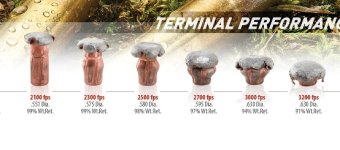
Even with something like an Aframe, higher velocity gets you a bigger mushroom which reduces penetration. Look at the difference in penetration at 50yds vs 400yds with a 300mag, the slower impact velocity expands less but penetrates more:Okay, yah, I did not consider cup and core designs that are designed to shed weight and spread a lot like a Nosler Partition - although as I think about it if the bullet goes slower a partition design may spread and shed less but not penetrate as well due to lower energy....and I don't care enough to go down this rabbit hole as I shoot Swift AFrames.
Anyway I think I see where you were coming from.
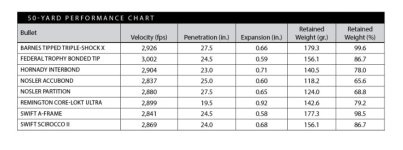
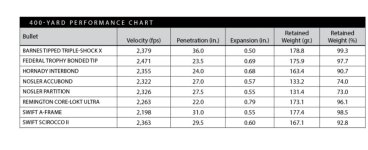
And if you look at the pictures from Swifts website it makes sense:
Last edited:

Okay, yah, I did not consider cup and core designs that are designed to shed weight and spread a lot like a Nosler Partition - although as I think about it if the bullet goes slower a partition design may spread and shed less but not penetrate as well due to lower energy....and I don't care enough to go down this rabbit hole as I shoot Swift AFrames.
Anyway I think I see where you were coming from.
Inadequate penetration is not something you need to concern yourself with when using A-Frames.

Hi Suther, I shoot 250grain Swift AFrames out of my 338wm at about 2750.
The last grizzly I harvested was when it was still legal in BC. About 100 yards, he kind of turned sideways to look at me. The bullet smashed that big plate attached to the shoulder structure, took out a big pipe off the heart, and stopped against the hide on the far side shoulder. I didn't measure the distance traveled but it did retain 98% of its weight and expanded to around 1/2" If I can remember where I put that bullet I will measure it and post a picture. I am thinking though if it had not busted through that big hunk of bone I would never have recovered the bullet.
The first black bear I shot with that set up was about 125 yards and that broke the right back leg, traversed through the lungs, and broke the left front leg. That bullet went right through.
Most of the animals I have taken with this set up I never recover the bullets because they go through and that includes quite a few moose and elk. And there was a whitetail in northern Alberta that took one through the lungs at about IIRC 425 to 450 yards. It went right through.
I appreciate your thoughts and the chart you posted. I need to think about this.
The last grizzly I harvested was when it was still legal in BC. About 100 yards, he kind of turned sideways to look at me. The bullet smashed that big plate attached to the shoulder structure, took out a big pipe off the heart, and stopped against the hide on the far side shoulder. I didn't measure the distance traveled but it did retain 98% of its weight and expanded to around 1/2" If I can remember where I put that bullet I will measure it and post a picture. I am thinking though if it had not busted through that big hunk of bone I would never have recovered the bullet.
The first black bear I shot with that set up was about 125 yards and that broke the right back leg, traversed through the lungs, and broke the left front leg. That bullet went right through.
Most of the animals I have taken with this set up I never recover the bullets because they go through and that includes quite a few moose and elk. And there was a whitetail in northern Alberta that took one through the lungs at about IIRC 425 to 450 yards. It went right through.
I appreciate your thoughts and the chart you posted. I need to think about this.
There's always a balance to be struck between wound channel depth, and wound channel diameter. The goal is always to superimpose the wound channel over something anatomically vital (a major joint, for instance) or physiologically vital (heart/lungs, for instance). But don't sacrifice adequate penetration for wound channel diameter.
A standard cup and core will tend to fragment comparatively rapidly, and depth can be controlled through sectional density (heavy-for-calibre equals higher sectional density, essentially). That makes "standard" bullets often the best killers on the widest range of game.
Something like an A-Frame goes the other way by being an incredibly tough bullet that will expand well, but hold together, essentially guaranteeing the maximum penetration. The Nosler Partition is such a great bullet because it really just splits the difference: the front half of the bullet behaves like a C&C, while the back half of the bullet retains ~100% of it's mass, so bullet weight never drops below a level where it can still penetrate.
A standard cup and core will tend to fragment comparatively rapidly, and depth can be controlled through sectional density (heavy-for-calibre equals higher sectional density, essentially). That makes "standard" bullets often the best killers on the widest range of game.
Something like an A-Frame goes the other way by being an incredibly tough bullet that will expand well, but hold together, essentially guaranteeing the maximum penetration. The Nosler Partition is such a great bullet because it really just splits the difference: the front half of the bullet behaves like a C&C, while the back half of the bullet retains ~100% of it's mass, so bullet weight never drops below a level where it can still penetrate.
Last edited:

- Location
- West Central Alberta
I think you guys scared the OP off, he hasn't been back for ten days, but carry on.
One of the elders in my whitetail party had an experience with a black bear a few years ago. Was sitting on his stand, turned his head and the big fellow was sitting next to him sniffing his lunch. The bear was dead silent approaching. He quietly told it to F off and the bruin left. That's a close encounter.Very good point about picking a spot that the bear would be shot at. My reflexes don’t operate as quickly as many of my hunting buddies. SO I pick a spot which is point of no return for the bear. Done this a number of times ( not hundreds like the obvious experts here) with both black and grizzly in the Yukon.
Fortunately didn’t have to act on it, but I had it worked out in my mind so I only had to act if it became necessary.
Firearms in my hands at the time included a 30/06 with premium 180 grain bullets. A gun that I am very confident and comfortable with. On one occasion a short barreled Mossberg pump 12 with lead slugs. Also a combination I have practiced with enough to be comfortable.
Also subscribe to the theory that the only warning shot will be into the bear’s vitals.
Worth what you paid for it.
In 12 Ga I've picked Fed deep penetrator 2 3/4" because I can't find the correct Brennekes locally. In 30-06 I've been using Nosler Partition and experimenting with others to assess performance from my rifles. This year it looks like Norma Oryx 165 grain that shoot well, are reasonably priced, and available. I stocked a supply of discontinued Sako Powerhead Blade 170 grain using the Barnes bullets. I will test these for performance soon. In the event I get a chance for moose I have some Barnes TTSX 180 grain in 30-06 and 300 WM. What do you think of my plan? ThanksThere's always a balance to be struck between wound channel depth, and wound channel diameter. The goal is always to superimpose the wound channel over something anatomically vital (a major joint, for instance) or physiologically vital (heart/lungs, for instance). But don't sacrifice wound channel diameter for adequate penetration.
A standard cup and core will tend to fragment comparatively rapidly, and depth can be controlled through sectional density (heavy-for-calibre equals higher sectional density, essentially). That makes "standard" bullets often the best killers on the widest range of game.
Something like an A-Frame goes the other way by being an incredibly tough bullet that will expand well, but hold together, essentially guaranteeing the maximum penetration. The Nosler Partition is such a great bullet because it really just splits the difference: the front half of the bullet behaves like a C&C, while the back half of the bullet retains ~100% of it's mass, so bullet weight never drops below a level where it can still penetrate.
I'd say that the Partition and the Oryx are very well-known performers. Both tough bullets (one partitioned, the other is bonded). In .30-06, I'd expect them to perform very well. They're probably ideal for the heaviest game you might hunt with that cartridge. If you're shooting at a lighter critter, you'll probably get the fastest kills with a standard bullet in a medium weight.In 12 Ga I've picked Fed deep penetrator 2 3/4" because I can't find the correct Brennekes locally. In 30-06 I've been using Nosler Partition and experimenting with others to assess performance from my rifles. This year it looks like Norma Oryx 165 grain that shoot well, are reasonably priced, and available. I stocked a supply of discontinued Sako Powerhead Blade 170 grain using the Barnes bullets. I will test these for performance soon. In the event I get a chance for moose I have some Barnes TTSX 180 grain in 30-06 and 300 WM. What do you think of my plan? Thanks
The Sakos and Barnes' coppers I'm not super sold on, but that's just opinion and I have no personal experience with them. I might just be ignorant, but both are monometal bullets that will retain nearly 100% of their weight. They will penetrate very well, and being somewhat lighter for length than a C&C equivalent, will have somewhat higher high muzzle velocity. At the same time, from what I've seen, they will tend to produce extremely narrow wound channels: minimal expansion, zero fragmentation. Some reports I've read suggest that they can produce only calibre-sized wound channels.
Again, I have no personal experience with mono bullets, but my gut feeling is that they were born out of regulatory necessity, rather than terminal performance. I THINK you could probably maximize their performance by driving them to the highest impact velocities you can achieve (even by going light-for-calibre, knowing that the bullets will hold together).
In any situation where you might genuinely demand the kind of performance that you'd get from something like an A-Frame (trophy moose would be a good example, where you need to guarantee penetration), I think a mono in those situations would do quite well.
Thank you very much for the opinion to consider. It is respected and appreciated.I'd say that the Partition and the Oryx are very well-known performers. Both tough bullets (one partitioned, the other is bonded). In .30-06, I'd expect them to perform very well. They're probably ideal for the heaviest game you might hunt with that cartridge. If you're shooting at a lighter critter, you'll probably get the fastest kills with a standard bullet in a medium weight.
The Sakos and Barnes' coppers I'm not super sold on, but that's just opinion and I have no personal experience with them. I might just be ignorant, but both are monometal bullets that will retain nearly 100% of their weight. They will penetrate very well, and being somewhat lighter for length than a C&C equivalent, will have somewhat higher high muzzle velocity. At the same time, from what I've seen, they will tend to produce extremely narrow wound channels: minimal expansion, zero fragmentation. Some reports I've read suggest that they can produce only calibre-sized wound channels.
Again, I have no personal experience with mono bullets, but my gut feeling is that they were born out of regulatory necessity, rather than terminal performance. I THINK you could probably maximize their performance by driving them to the highest impact velocities you can achieve (even by going light-for-calibre, knowing that the bullets will hold together).
In any situation where you might genuinely demand the kind of performance that you'd get from something like an A-Frame (trophy moose would be a good example, where you need to guarantee penetration), I think a mono in those situations would do quite well.
I'd say that the Partition... If you're shooting at a lighter critter, you'll probably get the fastest kills with a standard bullet in a medium weight.
One of my favorite aspects of the partition is how the soft nose half still works pretty darn good on lighter critters. Makes for a good all-around bullet, it doesn't excel in any one way, but it does a lot of things pretty darn well.





















