Best Tumbler?

Ultrasonic does not peen the case mouths, does an okay job on the primer pockets (if you are fussy you'll still be manually cleaning / uniforming them) and is quiet.

It's worth having, as the bowl is also the separator so there is no separate, super dusty/dirty, step. Unlike someone else in this thread, my plug has never popped. Twenty+ years of using the thing.

Yes, the shaking moves the media out. swishing something through the brass while this is happening will get the media out of the cases.

Crushed walnut. Regular corncob sticks in the primer pockets. With the walnut you will have some bit stick in the flash hole, so depending on your load method you either push it out manually when priming or, if on a progressive, run the cases through a deprimer befor priming.

So which cleans better? Ultrasonic or dry tumbler? Strongly suspect neither will clean as good as wet tumbling.

I sense that question may lead to some spirited "debate"......... :D
 
I use basically (maybe even exactly, right down to the graphite lube) the same process. Been doing this for a while and I prefer it.

Ultimate Reloader did a video this week showing the difference in consistency with this process compared to others using the data from an AMP press. Seemed pretty conclusive to me.

I did find that even after the mandrel the peening was still there (was like a raised ring around the mouth, you could both see it and feel it). Not a surprise really as that isn't the purpose of the mandrel.

Trying to avoid trimming each time. That was the only thing that fixed this issue and I had to remove more material than I felt comfortable doing. If I had to do that each time it has to have a negative effect long term.
I'm guessing that my external deburring is probably a little more *robust* than what you use. I run L3i 3-way cutters in my Lyman Xpress, the outer cut is set at ~1/3 of what the inner chamfer is. Just enough that there is no raised lip on my cases. But that might be more than you're willing to lose.
Ultrasonic cleaning may be the solution you're looking for, but I don't have any experience with that.
 
When you say peening , do you mean dents? Or the raised lip on the outside side of the case mouth?

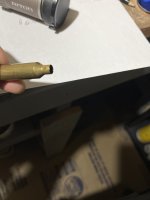
Here’s a Picture of fired case that’s been chamfered inside and out.
You can still see the chamfer but I can feel a rough edge on the outside.

I’m going to clean them now and see what happens
 

Attachments

  • image.jpg
    image.jpg
    41.7 KB · Views: 16
I'm a big fan of stainless steel media wet tumbling. Cleans rifle cases inside and out including primer pockets. Found it a pain in the but for pistol brass trying to get all the pins back.
 
When you say peening , do you mean dents? Or the raised lip on the outside side of the case mouth?

Here’s a Picture of fired case that’s been chamfered inside and out.
You can still see the chamfer but I can feel a rough edge on the outside.

I’m going to clean them now and see what happens

Not dents. I get the raised lip on the outside of the case mouth. It is visible and you can feel it too. Suspect my mandrel exacerbates this (kinda pushes the interior and exterior peening all to the outside to make a ring / lip).

I have never dry tumbled but I very much doubt it would be an issue with that process (much slower and much more media to prevent things bashing into each other with the same energy).
 
I'm a big fan of stainless steel media wet tumbling. Cleans rifle cases inside and out including primer pockets. Found it a pain in the but for pistol brass trying to get all the pins back.

I don't believe any other process will beat the cleanliness of wet tumbling but at the cost of mouth peening in my experience.
 
Not dents. I get the raised lip on the outside of the case mouth. It is visible and you can feel it too. Suspect my mandrel exacerbates this (kinda pushes the interior and exterior peening all to the outside to make a ring / lip).

I have never dry tumbled but I very much doubt it would be an issue with that process (much slower and much more media to prevent things bashing into each other with the same energy).

Yes but I’m getting that raised edge (peening) after firing, not cleaning
 
Yes but I’m getting that raised edge (peening) after firing, not cleaning

Mine is deffo after cleaning (wet tumbling specifically).

Not sure how the brass would get it from firing? Too long / needing trimmed maybe (that is a guess on my part as I have never had that issue)?
 
So which cleans better? Ultrasonic or dry tumbler?
Ultrasonic, it gets the insides as well and does a slightly better job on the primer pockets.
Strongly suspect neither will clean as good as wet tumbling.
If you mean wet with steel pins, you are correct.
I sense that question may lead to some spirited "debate"
So I have seen wet with pins and have direct experience with ultrasonic and dry vibratory tumbling (with many different media). Not much of a debate on my side. As far as just cleaning, wet with pins > ultrasonic > dry vibratory. Then you apply the other pros and cons of the various methods, which is where people have different values for different tradeoffs. There is no way I'll fight with steel pins / peening, so that's out for me. I dislike the dust and noise of the dry vibratory ... but then ultrasonic needs to be dried, which I take care of simultaneously with annealing. And both wet methods get the inside of the necks so clean that they need to be lubed, not so much with vibratory. So it's the tradeoffs and different tolerances for different pros and cons.

The only perfect case cleaning method is a manservant.
 
Mine is deffo after cleaning (wet tumbling specifically).

Not sure how the brass would get it from firing? Too long / needing trimmed maybe (that is a guess on my part as I have never had that issue)?
The pc of brass in the picture was chamfered inside and out and it had a small raised edge around the outside perimeter of the case mouth after firing.
All brass was trimmed to book length.
It’s fired out of a 6.5 PRC

It probably don’t need Champfering but I pre to do it.
Hasn’t had any effect on case longevity…. Yet
 
I searched this topic and didnt find any recent threads so here goes.

I already have a wet tumbler setup (so please dont recommend one of those). I very much doubt that any other tumbler will get the brass as clean as the wet setup does (spotless). So why do I want a dry tumbler if it doesn't clean so well you may ask?

Well, as good as wet is it has some downsides. Mouth peening being the main one and a PITA. I have one gun that has a tight chamber and it seems no matter how long I clean the brass in the wet tumbler the mouths get peened enough to give me hassle (tight closing the bolt). I have tried with pins / without pins. Longer time / shorter time. More brass / less brass. My other practice gun is a little less fussy but it still happens. I am sure peening is the issue because when I trim and chamfer the peening away the issue goes away too.

So I am hoping that the more sedentary dry tumbler will eliminate the peening issue and still get the brass clean enough.

It seems there a bunch of different options out there. As mentioned for volume reloading (like 9mm) I will still be using the wet setup. This will be for precision rifle so probably 500 cases max (more likely 300).

Are some noisier than others? Plan to use this outside under my deck so it stays dry (have heard they can emit dust?).

Do some clean better than others? If so why (different / better technology)?

Are there more efficient / powerful versions?

The Lyman keeps catching my eye as some of their models have an "Auto Flo" feature (best I can tell this means that there is a plug in the bottom of the bowl that lets the media flow out of the tumblers when the cycle is complete (should make brass retrieval easier?). Is this feature worth having or a gimmick? Do you run the tumbler while the media is flowing?

What is good for media?

Thanks in advance.
I run a few Lyman 1200 and a Hornady sonic. I also clean my brass multiple times through my process. I anneal with primer still in the case. Then sonic wash using Hornady One Shot solution before resize without de-priming, this prevents getting the dies dirty. I made a drying rack out of a piece of butcher block countertop that I drilled and added wood dowels to. After resize and trim I use the walnut shell (12-20 bulk from Amazon) in the tumbler with Lyman or Rosso additive until the cases are shiny and smooth. Then after emptying them out I use my RCBS universal de-primer. Last step before reload is to sonic wash with just a dab of Dawn blue soap. Rinse then dry on the rack. I like the finish that I get from the walnut shells better than the wet pin. I leave the primers in because I noticed the pockets get loose faster if exposed to the cleaning process. They come out clean enough with the final sonic wash. As far as the Auto flow tumbler goes I can't say. I just use a bucket with the sifter. Cheers
 
  • Like
Reactions: DGY
Ultrasonic, it gets the insides as well and does a slightly better job on the primer pockets.

If you mean wet with steel pins, you are correct.

So I have seen wet with pins and have direct experience with ultrasonic and dry vibratory tumbling (with many different media). Not much of a debate on my side. As far as just cleaning, wet with pins > ultrasonic > dry vibratory. Then you apply the other pros and cons of the various methods, which is where people have different values for different tradeoffs. There is no way I'll fight with steel pins / peening, so that's out for me. I dislike the dust and noise of the dry vibratory ... but then ultrasonic needs to be dried, which I take care of simultaneously with annealing. And both wet methods get the inside of the necks so clean that they need to be lubed, not so much with vibratory. So it's the tradeoffs and different tolerances for different pros and cons.

The only perfect case cleaning method is a manservant.
So how long are you cleaning with ultrasonic?

And what are you using for cleaning solution?
 
So does peening come from cases bashing into each other or from cases hitting the pins?

I have read a theory that the pins "cushion" the brass as it tumbles which should lessen the peening? If this is accurate it makes me think the issue is from contact between the brass cases. But logically the pins are harder than the brass so maybe they are the cause?
 
So does peening come from cases bashing into each other or from cases hitting the pins?

I have read a theory that the pins "cushion" the brass as it tumbles which should lessen the peening? If this is accurate it makes me think the issue is from contact between the brass cases. But logically the pins are harder than the brass so maybe they are the cause?
I suspect you are running too many cases by volume of pins... The pins do mark the cases but I doubt they damage them.. I think your cases are damaging themselves against each other due to mass. The pins don't have the mass to effect the damage.. Just my weird brain... feel free to call me crazy... or maybe just a mad scientist.... Cheers
 
Last edited:
For years I used a small Thumbler's Tumbler - rotary type. Then I tried a CT vibrating thing. It fell apart, so I bought a Frankford Arsenal vibrate, works ok. Then I bought a FA wet/steel pin tumbler. That's pretty much all I use now. I've never noticed any peening that's ...well...noticeable.
 
I suspect you are running too many cases by volume of pins... The pins do mark the cases but I doubt they damage them.. I think your cases are damaging themselves against each other due to mass. The pins don't have the mass to effect the damage.. Just my weird brain... feel free to call me crazy... or maybe just a mad scientist.... Cheers
Never - ever had any peanning or damage to any case while wet tumbling. Some guy can screw up anything !
 
Back
Top Bottom