












































You are using an out of date browser. It may not display this or other websites correctly.
You should upgrade or use an alternative browser.
You should upgrade or use an alternative browser.
Blow Up USSR, Nuclear Apocalypse
- Thread starter gewehr76
- Start date


Turkinator
CGN frequent flyer
- Location
- Onterrible
Please don't waste your gun fund money on the iPhone rad meter apps, they will not work I assure you. Even if it somehow had the hardware necessary to detect Alpha, Beta, Gamma it would not detect the low level contamination being talked about here
That's an interesting idea.
Unless my knowledge of radioactivity is flawed, the SKS themselves would not have become radioactive, though they certainly could pick up radioactive matter. Would not the potentially contaminated matter be removed by the vigorous cleaning required due to the corrosive ammo.
Exposure to radiation doesn't make an object radioactive. If you live in an industrial city you are at way more risk breathing the air.
Exposure to Ionising radiation will make steels radioactive, but that fuel would have been used up during the reaction that caused the big boom from a bomb. Cleanup afterword would only be exposed to leftover alpha, beta and gamma radiation, which does not turn things radioactive. The reason with chernobyl is that everything got exposure to ionising radiation because there was still a significant amount of hot/spent fuel that was unshielded and emitting ionising radiation.
So like Stevebot said, the whole refurb/cosmoline/cleaning/recleaning after corrosive process would have likely gotten rid of any possible contamination that may have possibly gotten onto any rifles.
And like it was said by a few people, take a flight down south or out to alberta and you'll pick up more radiation from the sun than from anything else. Hell, plane flights combined with banana's, granite counter tops and cigarettes exposed people to more radiation than anything else.
Exposure to Ionising radiation will make steels radioactive, but that fuel would have been used up during the reaction that caused the big boom from a bomb. Cleanup afterword would only be exposed to leftover alpha, beta and gamma radiation, which does not turn things radioactive. The reason with chernobyl is that everything got exposure to ionising radiation because there was still a significant amount of hot/spent fuel that was unshielded and emitting ionising radiation.
So like Stevebot said, the whole refurb/cosmoline/cleaning/recleaning after corrosive process would have likely gotten rid of any possible contamination that may have possibly gotten onto any rifles.
And like it was said by a few people, take a flight down south or out to alberta and you'll pick up more radiation from the sun than from anything else. Hell, plane flights combined with banana's, granite counter tops and cigarettes exposed people to more radiation than anything else.
It will not turn steel radioactive. And you're contridicting yourself. Gamma radiation IS ionizing radiation...
The reason things like Chernobyl and the Japan meltdown are dangerous is actual radioactive material being spread around, not "ionizing radiation" irradiating materials... Which simply doesn't happen.

Turkinator
CGN frequent flyer
- Location
- Onterrible
Ionizing just means that it will steal electrons from other substances. Alpha will steal electrons from kittens, is highly ionizing (+2) but quickly robs electrons from air or skin etc to become helium which is why it is it is not highly penetrating. Beta is less ionizing (-1) as it is just an electron and gamma is only indirectly ionizing meaning occasionally it will force an electron to be emitted when the gamma photon thermalizes an atom. As far as I know the only thing that will cause a substance to become radioactive is the absorption of a neutron or the fission of the atom by a neutron.
What activates an atom to produce alpha is the absorption of a neutron in transuranics and Beta is the result of fission byproduct decay.
What activates an atom to produce alpha is the absorption of a neutron in transuranics and Beta is the result of fission byproduct decay.
Turkinator
CGN frequent flyer
- Location
- Onterrible
The only thing you would be worried about with this is loose Alpha/Beta contamination but most rifles have been refurbished and BBQ painted making whatever loose was on the rifle "fixed" contamination and not really concerning. Also the cosmoline would capture the particles and just be washed off when you degrease it. Hypothetically if this was a real issue.
Turkinator
CGN frequent flyer
- Location
- Onterrible
What is a NBCW course? Curious
Turkinator
CGN frequent flyer
- Location
- Onterrible
Oh I see lol

gewehr76
CGN Ultra frequent flyer
Yes sir, who knows how much contammination west coast got from Japan's power plant explosion.
I'd be more concerned about the huge amount of above ground nuclear testing the US did, and yes, a lot of it rained down on us in Canada.
I'd also be more concerned with purchasing surplus that was in Iraq with all the DU used.
As for paranoia, you should be asking yourself why it seems Russia is more on our side than our own frickin' government these days ....

"This eerie setting is not quite like any other junkyard — these are the rescue vehicles left behind by the Chernobyl nuclear disaster. They are so saturated with radiation that they can never be used again, so they have been abandoned to rust in this huge, kilometer-long scrapyard. In fact, this is one of those rare times when recycling really is not a good idea. However, terrifyingly, anecdotal evidence suggests that the scrapyard has started to be used as just that.
Nearly 25 years after the accident took place, these wrecks still throw off up to 30 roentgens an hour — approximately one-third of the amount needed for a lethal dose after prolonged exposure. Now they sit in a field in Rassokha, 25 km southwest of the power plant.
To prevent the spread of irradiated material, there are strict criminal penalties against looting in the Chernobyl Exclusion Zone, which does not retain normal civil rule. Despite this, year by year, the assembled mass of metal apparently diminishes, suggesting that parts are illegally being hauled off for sale — despite the fact that they carry a potentially deadly level of radiation. There have even been suggestions that some of the machines are being shredded for scrap, while many of the cars appear to have had their engines removed. From April 2008, the government banned all access to the junkyard as a preventative measure."
http://1800recycling.com/2010/06/chernobyl-radioactive-scrapyard
(This report doesn't seem to jive with the CGN naysayers who claim that "metal cannot be irradiated". I suppose the commies just had so much money and equipment kicking around, they decided to scrap a bunch of perfectly good helicopters, tanks, trucks, buses, trains, etc. instead of just hosing them down... right, lol!)


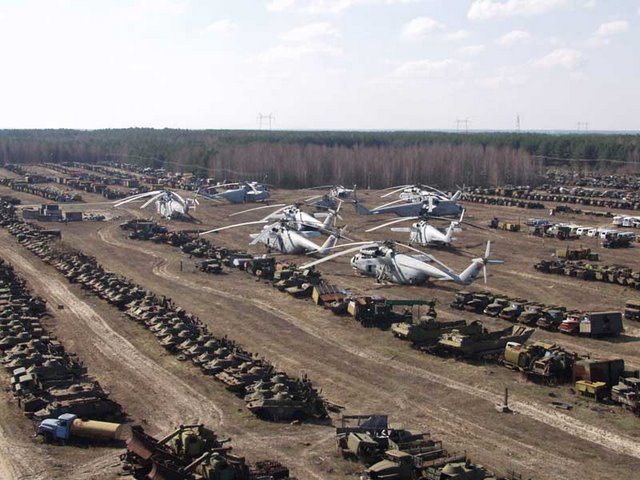

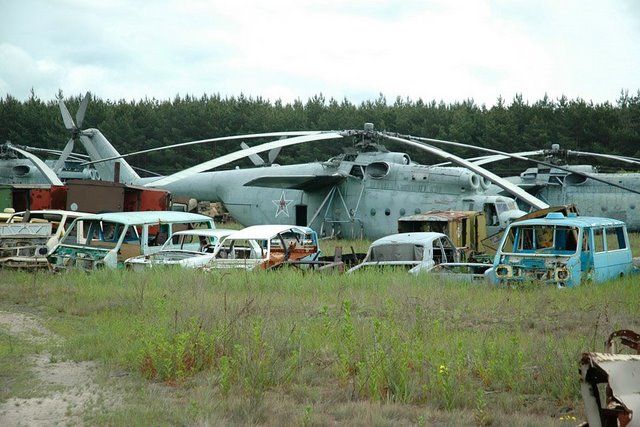
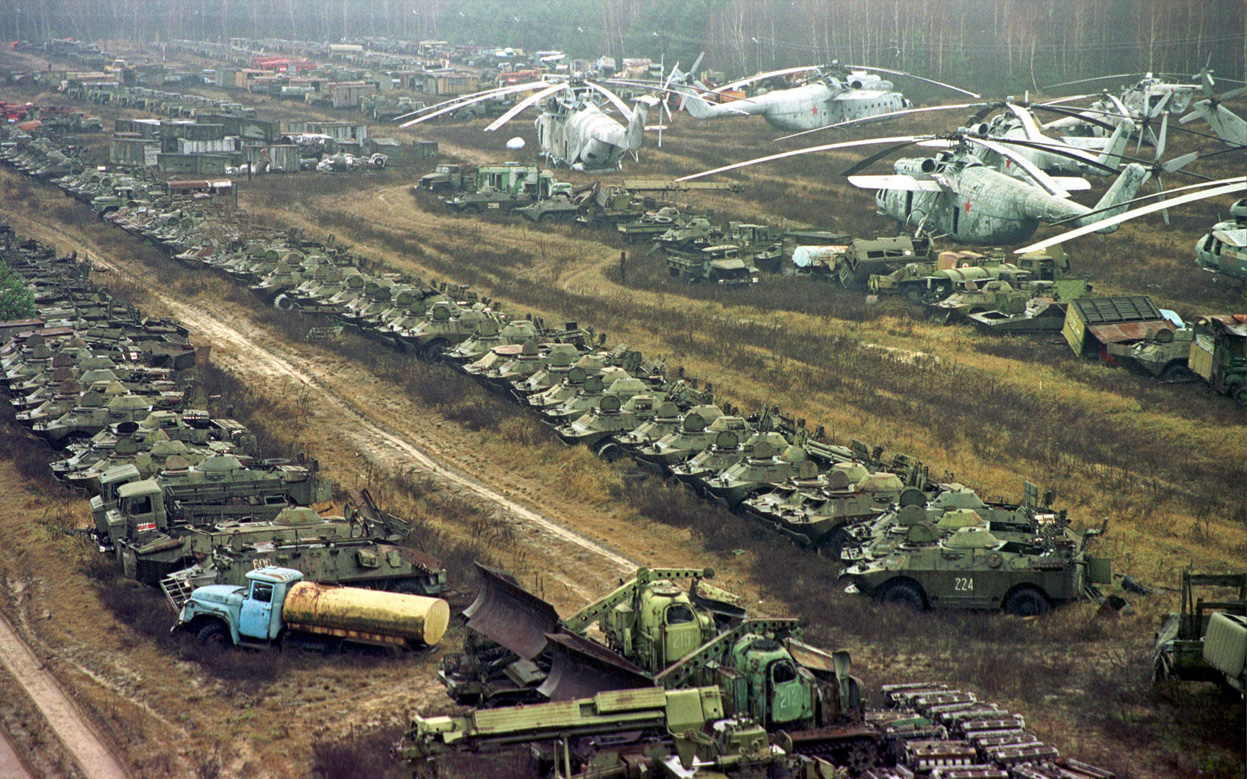
Nearly 25 years after the accident took place, these wrecks still throw off up to 30 roentgens an hour — approximately one-third of the amount needed for a lethal dose after prolonged exposure. Now they sit in a field in Rassokha, 25 km southwest of the power plant.
To prevent the spread of irradiated material, there are strict criminal penalties against looting in the Chernobyl Exclusion Zone, which does not retain normal civil rule. Despite this, year by year, the assembled mass of metal apparently diminishes, suggesting that parts are illegally being hauled off for sale — despite the fact that they carry a potentially deadly level of radiation. There have even been suggestions that some of the machines are being shredded for scrap, while many of the cars appear to have had their engines removed. From April 2008, the government banned all access to the junkyard as a preventative measure."
http://1800recycling.com/2010/06/chernobyl-radioactive-scrapyard
(This report doesn't seem to jive with the CGN naysayers who claim that "metal cannot be irradiated". I suppose the commies just had so much money and equipment kicking around, they decided to scrap a bunch of perfectly good helicopters, tanks, trucks, buses, trains, etc. instead of just hosing them down... right, lol!)
Last edited:
Take everything written in the above post. Change irradiated to contaminated and it would then be correct. Whoever wrote that does NOT work in the nuclear industry. Take my word for it or not. I work with this stuff every day. I'm hardly a naysayer.
A simple analogy: Follow directions and microwave a pizza pocket. You just irradiated it. Put it in for too long and it explodes. You just contaminated your microwave. Contamination can be cleaned, but sometimes the job is impossibly huge as in the case of Chernobyl. If one were to recycle contaminated metals from Chernobyl, the contamination would be mixed into the metal. That would be considered fixed contamination. Detectors will pick it up, but that doesn't mean it's irradiated. Just "hosing it down" will work, to a point. You have to contain the run off. Not everything will get clean. Contamination will stick in the pores of some metal, get trapped under paint, etc.
A simple analogy: Follow directions and microwave a pizza pocket. You just irradiated it. Put it in for too long and it explodes. You just contaminated your microwave. Contamination can be cleaned, but sometimes the job is impossibly huge as in the case of Chernobyl. If one were to recycle contaminated metals from Chernobyl, the contamination would be mixed into the metal. That would be considered fixed contamination. Detectors will pick it up, but that doesn't mean it's irradiated. Just "hosing it down" will work, to a point. You have to contain the run off. Not everything will get clean. Contamination will stick in the pores of some metal, get trapped under paint, etc.
Last edited:
Turkinator
CGN frequent flyer
- Location
- Onterrible
Nearly 25 years after the accident took place, these wrecks still throw off up to 30 roentgens an hour — approximately one-third of the amount needed for a lethal dose after prolonged exposure. Now they sit in a field in Rassokha, 25 km southwest of the power plant.
They don't say if that's Beta or Gamma? It sounds impressive because we all assume it's gamma. If it's Beta that's a different story especially if it was a contact survey.
^ No clue what it is... beta or gamma... but I still wouldn't take the chance of spending my vacation there if the dose is reputed as being "near lethal". In a documentary I watched a couple years ago, I believe they've stated that it will take something in the order of tens of thousands of years before the area is completely safe from radiation. That's of course if some drunk Russkie doesn't accidentally detonate another reactor or warhead nearby in the meantime.
As for hosing it down, why not? Everything around is already contaminated, so just let it run off into the ground after you hose down your chopper or APC... right? The U.S. Navy personnel who were tasked with hosing down ships used in nuclear testing in the middle of the ocean all died of radiation poisoning in late 1940's / 1950's. Apparently it ain't that simple.
As for hosing it down, why not? Everything around is already contaminated, so just let it run off into the ground after you hose down your chopper or APC... right? The U.S. Navy personnel who were tasked with hosing down ships used in nuclear testing in the middle of the ocean all died of radiation poisoning in late 1940's / 1950's. Apparently it ain't that simple.

And on the lighter side: There is no truth to the rumor that Norincos are made from steel out of defunk nuclear reactors.
...because they're made from the steel that "disappeared" in the Chernobyl junkyard! (lol)


Take everything written in the above post. Change irradiated to contaminated and it would then be correct. Whoever wrote that does NOT work in the nuclear industry. Take my word for it or not. I work with this stuff every day. I'm hardly a naysayer.
A simple analogy: Follow directions and microwave a pizza pocket. You just irradiated it. Put it in for too long and it explodes. You just contaminated your microwave. Contamination can be cleaned, but sometimes the job is impossibly huge as in the case of Chernobyl. If one were to recycle contaminated metals from Chernobyl, the contamination would be mixed into the metal. That would be considered fixed contamination. Detectors will pick it up, but that doesn't mean it's irradiated. Just "hosing it down" will work, to a point. You have to contain the run off. Not everything will get clean. Contamination will stick in the pores of some metal, get trapped under paint, etc.
I dont work with radioactive stuff ,so I am not an expert. That is why I ask...
I recall asking an NDT welding inspector about radiation.
He compared it to lighting up something with a flashlight.
Turn of the light, and it is no longer lit up.
But, if I understand the difference between Irradiated and Contaminated correctly, Contaminated refers to smoke and dust particles spewing out of the burning reactor covering everything around with fallout. This fallout is what poisoned the field of vehicles.
Correct?
Turkinator
CGN frequent flyer
- Location
- Onterrible
This is a pretty easy way to explain it since light is a form of radiation.I dont work with radioactive stuff ,so I am not an expert. That is why I ask...
I recall asking an NDT welding inspector about radiation.
He compared it to lighting up something with a flashlight.
Turn of the light, and it is no longer lit up.
But, if I understand the difference between Irradiated and Contaminated correctly, Contaminated refers to smoke and dust particles spewing out of the burning reactor covering everything around with fallout. This fallout is what poisoned the field of vehicles.
Correct?






















