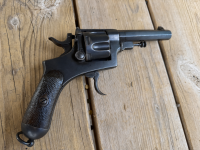
Bodeo M1889 load confusion

Well, I got my cerrosafe, and I'm back.

I'll attach a picture.

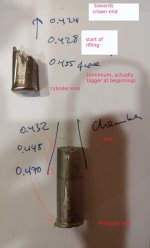
Definitely an interesting alloy. I followed advice and blocked the barrel with a cleaning patch, then poured some in. I didn't want to overfill it, as I was afraid to have it spill into other parts. That causes me not to have the full forcing cone cast. Still, I think that it's useful: the forcing cone is at least .455 (but visibly more). The rifling right after is is .428. Then it goes down to .424. Knocking out the cerrosafe was quite difficult: I ended up putting a wooden dowel in the barrel and smacking it with a rubber mallet. Several times.

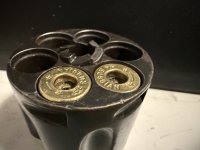
As for the cylinder, that was uglier. Try as I might, I couldn't get it out. I figured that it probably had a lip on the part that would be closer to the barrel, so I heated a piece of metal and wiped off the excess cerrosafe. I still couldn't get it out. I was banging with the dowel, with no movement. I ended up having to use hot water to get it moving, so I partly damaged it. That being said, enough of it wasn't melted to get a diameter measurement that is probably reasonably accurate. It looks like those go from .470 at the head of the cartridge, to .432 on exit of the cylinder.

In other words, the restriction is at its most just after the forcing cone, at .424.

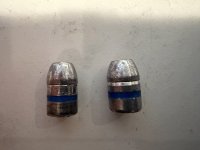
Separately, I also got the H&C kit. The bullets in there measure .431 or maybe .4315 at their widest (a driving band with a lube groove in the middle). The heel seems to be .409-.411. They're 170 gr.

Anyway, I await more advice! Thanks.
 

Attachments

  • cerrosafe_casting_annotated.jpg
    cerrosafe_casting_annotated.jpg
    47.4 KB · Views: 16
We always try to be cautious with the Antiques.
I've found some wild arse dimensions doing the barrel diameter on various.
My take? Pure Lead is not even a question; PL and BP... it's pretty hard to damage a good Antique.
Got one with the drop trigger and a chipped hand... not 100 %.
But the Gilsenti is one of my strongest I'd bet.
Good luck and keep us posted.
 
This one also has a drop trigger. It stays where it should, until cocked. It's ugly cosmetically, but seems to be in very good condition otherwise.
I'm getting closer to being willing to try it :).
 
This thread is an absolute goldmine. I’ve been trying to load 10.4mm Bodeo for a while now, and sourcing proper components has been a nightmare. The tip about running a .44 Russian cartridge into a .303 British sizing die is brilliant—it essentially transforms the cartridge into a workable 10.4mm Bodeo equivalent.

I gave it a try today and wanted to share my process and results.

I started with my standard antique .44 Russian loads:

  • 240 gr RNFP (.430”, 0.69” length, cast by Rustywood)
  • OAL: 1.24”
  • 3.5 gr Unique (very mild load)
First, I ran the cartridges fully into a .303 sizing die. This required significant force. The resulting cartridges did chamber in the Bodeo cylinder, but I noticed the rounds headspace on the rim but sit slightly recessed and not flush with the cylinder face.

Interestingly, when I compared this to original Bodeo cartridges (both military and Fiocchi), they behaved similarly—the rim diameter is comparable, and they also sit slightly recessed in the cylinder.

I wanted my reloads to sit flush, so I adjusted my approach. Since a standard .44 Russian cartridge protrudes about 0.72” from the cylinder, I backed off the .303 sizing die so the case only enters the die by that same amount. With this adjustment, the cartridges now sit flush in the cylinder.

Final cartridge measurements:

  • OAL: 1.248”
  • Case mouth diameter: 0.445”
Out of curiosity, I pulled one bullet after sizing to see what happened. The die effectively formed a slight “heel” on the bullet:

  • Heel diameter: ~0.43”
  • Bullet length increased slightly from 0.69” → 0.695”
This is very interesting because it closely matches the diameter of factory Bodeo projectiles, which I also measured at ~0.43” at the heel.

Initially, I was slightly concerned because the sized bullets will just pass through the chamber throats with a gentle tap (rather than dropping freely). However, given the very mild loads and the fact that factory rounds are a similar and they are copper/brass coated, so this seems acceptable.

Overall, I’m really impressed by how simple and effective this method is for creating a functional 10.4mm Bodeo equivalent.

Next step is range testing—I’ll report back once I’ve had a chance to shoot them. I’ll start with these mild loads and work up cautiously if performance looks good.

For reference, I measured eight different Bodeo revolvers:
  • Chamber throats: 0.420”–0.428”
  • Groove diameter (muzzle): 0.420”–0.425”
Lots of process pictures;
IMG_0508.jpeg
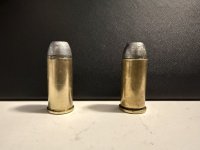
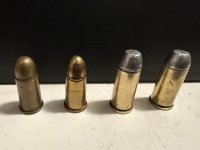
Left side bode equivalent, right .44 Russian
IMG_0515.jpeg
Left bodeo equivalent bullet right .44 Russian
IMG_0522.jpeg
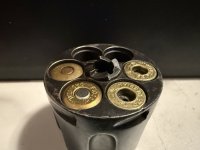
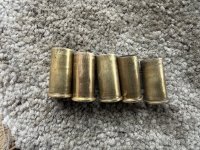
Left bodeo equivalent sitting flush, right bodeo equivalent slightly recessed
IMG_0529.jpeg
Leftmost original 10.4mm, 2nd from left fiocchi 10.4mm, fully .303 sized bode equivalent and bodeo equivalent flush
IMG_0528.jpeg
Leftmost original 10.4mm, 2nd from left fiocchi 10.4mm, bode equivalent and .44 Russian
 
Got out to the range today and happy to report the loads cycle well in the revolver. Doesn’t matter if the rims seat superficial or deep, both worked fine. They seemed reasonably accurate. Cases extracted well, apart from one chamber that might be tighter than the others. Primers looked fine and looks like the powder all ignited fine. The brass mouth appears pretty worn. These loads feel “hot” with pretty hefty recoil, similar to Fiocchi factory .44 Russian loads. It’s safest to down-load these a bit and work out a softer shooting load not to stress this old steel. I’ll probably start again at 2.5-2.7gr unique and work up from there.

IMG_0647.jpeg
IMG_0636.jpeg
 
Nice to see the range report. Always a bit of a worry when one is due and doesn't show up...

This is great information! To me, it provides some maximum load information. Not saying I'd want to go that high, but definitely not above. I'm very much looking forward to your 2.5-2.7 gr Unique workup report. Watch for squibs!

BTW, I think that the original bullet was something like 177 gr. Have you considered a lighter bullet? There are 200 gr and 180 gr .430 (or .429? it probably hardly matters given the crushing that they're getting) fairly easily available out there. If you don't have any and want to try, feel free to PM me an address to have a few of them show up in the mail.
 
.428 200gr bullets meant for 44-40, loaded into 44 Russian brass, then "crimped" with a .303 British die until they fit in the chambers: confirmed to work.

Next time, I'll probably "crimp" them just a tiny bit more than the bare minimum if shooting more than one cylinder, to account for fouling in the chambers. I noticed that this fouling was significant, despite full loads of BP, whatever that means.

But it definitely worked!
 
Interestingly, when I compared this to original Bodeo cartridges (both military and Fiocchi), they behaved similarly—the rim diameter is comparable, and they also sit slightly recessed in the cylinder.

I wanted my reloads to sit flush, so I adjusted my approach. Since a standard .44 Russian cartridge protrudes about 0.72” from the cylinder, I backed off the .303 sizing die so the case only enters the die by that same amount. With this adjustment, the cartridges now sit flush in the cylinder.

Re-reading this, I think that your original approach--slightly recessed--is better: the primer seems to be hit quite hard, almost to the point of puncture, with the "flush" approach. Also, it can be difficult to turn the cylinder after firing. That's what I noticed, anyway.

Other than that, it's totally usable, and accuracy was similar to that obtained with H&C brass and bullets. Cost is obviously a lot lower! It seemed to be a bit more powerful judging by recoil, probably closer to the original (I'm assuming that the original were balloon cases, and that the slightly longer case approximates that difference, which is why--along with the advice here--I wasn't too worried about it). OTOH, 200gr is more than the original bullet weight, so maybe this isn't as good an idea as it seems?
 
Re-reading this, I think that your original approach--slightly recessed--is better: the primer seems to be hit quite hard, almost to the point of puncture, with the "flush" approach. Also, it can be difficult to turn the cylinder after firing. That's what I noticed, anyway.
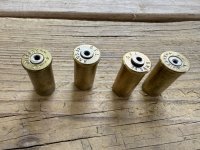
This has now been tried. The negative about forcing them a bit more into the .303 British die so that they're no longer flush is that the primers end up looking totally squashed--just like pictures about overpressure. I figured that there's no way it can have had such high pressure and not blown up, so the more likely explanation is that the primers backed out a bit on firing, then the cartridge slammed into them, flattening them. It didn't seem to cause any problems, and did work better, other than this. Maybe there's a desirable midpoint. It was reasonably accurate, BTW. Overall, not a bad piece of kit.
 
Follow-up on the 2.5 gr and 2.8 gr Unique loads.

I was shooting both loads at 1.244" OAL using the .303 dies, compressed and seated flush with the rear of the cylinder. I finally made it out to the range, 25°C and a perfect day for shooting.

The 2.5 gr Unique load was very light shooting. Recoil was minimal, and I noticed a fair amount of unburned powder. The primers were also all cratered and accuracy seemed okay at 10 yards.

The 2.8 gr Unique load had what I'd describe as moderate recoil. There was noticeably less unburned powder compared to the 2.5 gr load, and the primers were again cratered.

At this point, I think seating the cartridges flush with the rear of the cylinder is a bad idea. The Bodeo's firing pin appears to hit quite hard, and I suspect that's causing the primer cratering. Going forward, I think it's best to keep them recessed.

My next step will be to test 2.6 gr and 2.7 gr Unique loads and to retest the 2.8 gr load with the primers recessed to see if the cratering issue improves. Hopefully that will help narrow down the ideal light-shooting load.

I'm also surprised by how much I enjoy shooting the Bodeo. It has a very natural grip angle, a decent trigger, and is simply a pleasant revolver to shoot. Some other antique revolvers are fairly heavy, but the Bodeo feels light, handy, and well-balanced. I've read that Italian troops generally liked their Bodeo revolvers, and after spending more time with mine, I can certainly understand why.

IMG_1262.jpeg

ChatGPT Image Jun 7, 2026 at 03_35_31 PM.png
 
Thanks Thiopento! I'm looking forward to your next update. My primers looked more like yours on the right, though they didn't puncture. I suspect that my hammer is a bit shorter or something... probably for the best. Or maybe I used primers with stronger cups?

I'm not sure what to make of the Bodeo. I didn't like the handling that much, though it was definitely usable and I think a bit underrated by the antique-happy population in general--likely because of the ammo situation, is my guess.
 
Back
Top Bottom