As stated on the Canadian War Museum site...
"The officers of Canada's first contingent to South Africa, the 2nd (Special Service) Battalion, Royal Canadian Regiment of Infantry, carried the old Colt .44 Calibre Model 1878 pistol acquired at the time of the North-West Campaign in 1885."
This is incorrect isnt it?
This issue, which started out this thread, bears further comment ....
It is important to correct the erroneous impression which arises from the above quoted suggestion that it was "[t]he officers of Canada's first contingent" who carried the government-owned Colt 1878 revolvers. The facts which such an assumption ignores are that:
(a) at that time, British Empire officers (including Canadians) were required to supply all of their own kit (including weapons) at personal expense. In other words, they were
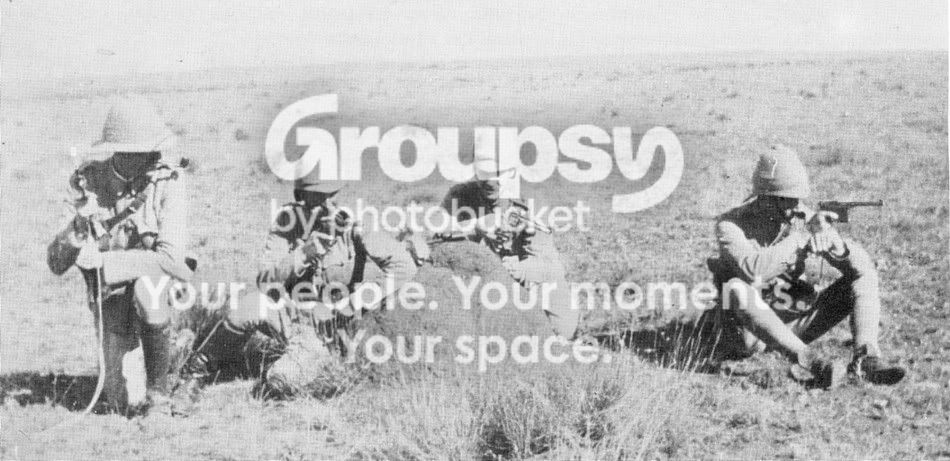
not issued Government-owned revolvers - rather, they purchased whatever appealed to them and was deemed suitable - the latter consideration gave rise to a "rule" that such a privately-owned handgun should be chambered for ammunition which would be available through the official military supply system (which, for a Canadian serving in South in and after 1899 would be either the British .455 service cartridge or .45 Colt.) Having said that, it was possible for an officer to arrange for purchase of his sidearm from Government stores ... so that he might well thus own a "standard issue" pattern of revolver, but it then had become a privately owned item (and could be marked with the owner's name etc, such as is often seen.) In fact the ammunition "rule" referred to above was not universally adhered to - here, for example, is a photo of four British officers at pistol practice on the veldt - firstly, of course, these would be personally-owned weapons. Note that the revolver (possibly a Webley-Pryse such as Dingus posted a photo of) of the fellow second from the right is nickel-plated (most definitely not the finish to be expected on any British
issued military revolver) and the revolver on the extreme left may also be plated. Most notable, however, is the Mauser C'96 semi-automatic pistol held by the chap on the extreme right -
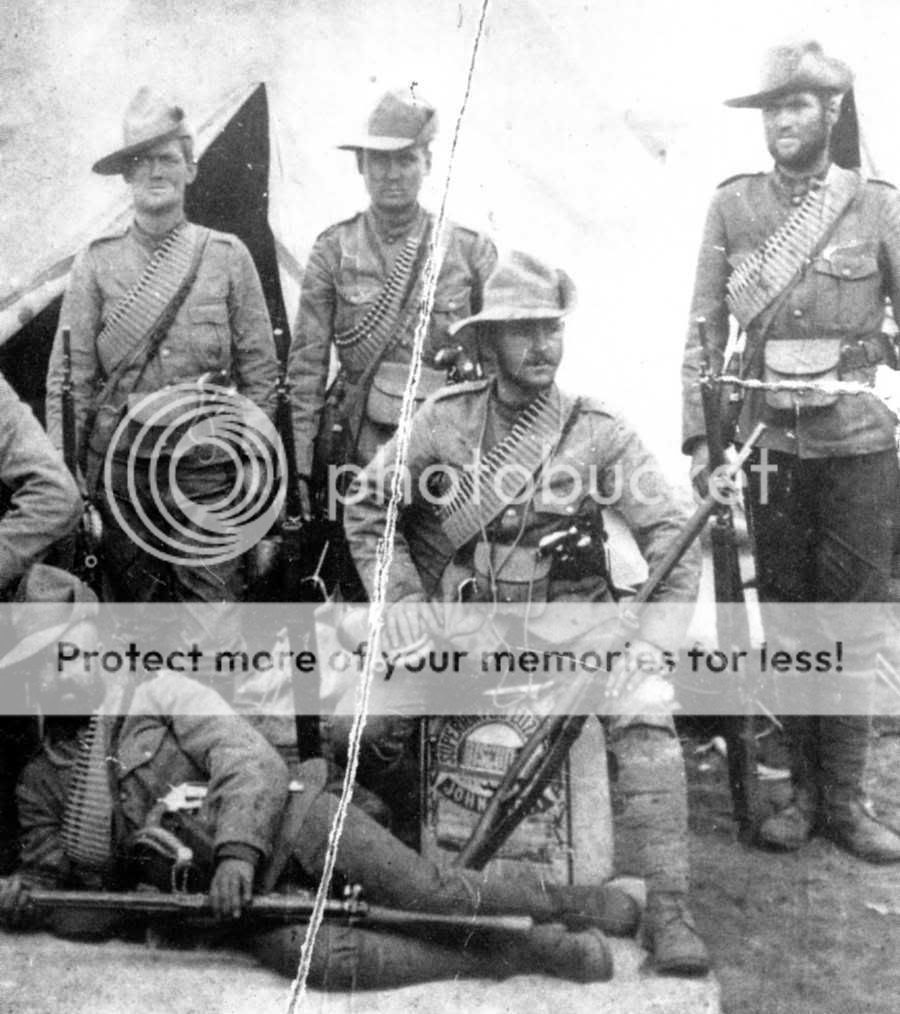
(b) handguns were (and still are) very much a secondary/supplemental military weapon in any event - the rifle was (and still is) the primary small arm of any infantry force. To the extent they were issued at all, for the most part, the government-owned revolvers were issued to NCOs and "Other Ranks" who were deemed to need a handgun, such as mounted troops or others whose duties made it inconvenient for them to have a rifle as their primary firearm ..... Here is a detail from a photograph of members of the Royal Canadian Regiment who, in their capacity as buglers, could be expected to keep their rifles slung while in action (if they took them into action at all) and were thus issued with revolvers. They have adopted the rather swashbuckling practice of having their revolvers thrust into their belts, rather than holstered. These are some of the .45 cal. 1878 Colt Double Action revolvers acquired by Canada in 1885 for the North-West Rebellion which, uncustomarily (and perhaps ironically, in view of my above comments) were all nickel-plated. I don't believe that the fellow standing at right is a bugler - he has no slung bugle like the other four, nor does he have a revolver you'll note ....
What side arm did the Boers use?
The above comments about handguns apply generally to all military forces, of course. On top of that, the Boer Republics engaged in the Second Anglo-Boer War of 1899-1902 - the "South African Republic" (
Zuid-Afrikaansche Republiek or ZAR, also referred to as the Transvaal) and the "Orange Free State" (
Oranje VrijStaat or OVS) - had no standing military forces to speak of (except artillery) and the bulk of the Boer forces were non-uniformed irregulars or "guerillas" organized into Commandos, who for the most part supplied their own weapons and mounts. So, much like the
Metis in Canada's 1885 North-West Rebellion, they used a wide variety of firearms. What's more, both Republics were nations of mounted - and thus highly mobile -
riflemen (which the British forces soon learned in most unpleasant fashion, and had to convert the bulk of their forces to Mounted Infantry before they could start gaining the upper hand.) As a result, handguns are seldom seen in photos of Boer fighters - and just about anything available was used. In fact, I'm not aware that either Republic had any "official" military handgun at all.
The Boers woman and Children being starved to death in British prison camps by the thousands musta given the Boers plenty Reason to want to kill as many British as posible.
They talk about hitler and the Jews but ya never hear about what the British Did to inocent Women and Children in the Boer war EVER.
I guess its cause the Victors write the history eh.
It is not a commonly know fact (at least here and elsewhere in the erstwhile British Empire -
except in South Africa) that the British invented the very concept, and the name, of "concentration camp" during the Second Anglo-Boer War, as Dingus has indicated. It was decided that the only way to finally defeat the free-ranging Boer Commandos .... who could simply come and go from their own farms at will, re-supplying themselves as needed ..., was to round up the women and children and "concentrate" them in such guarded camps (where they were not provided with adequate food or medical care) and then burn the farms and crops. Brutal indeed, but ultimately effective .... and also not forgotten by the Boer population of South Africa more than a century later!





































































