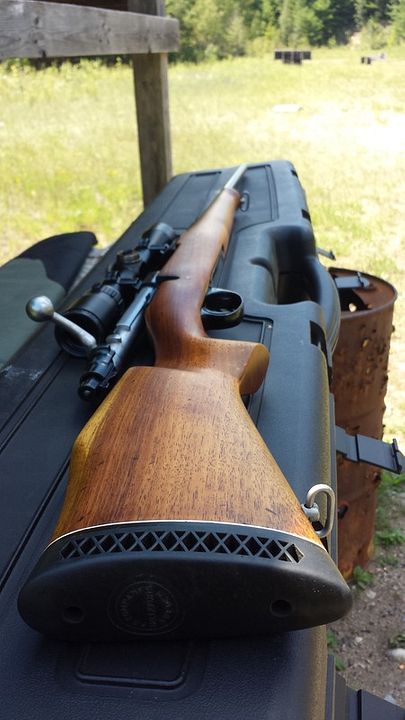
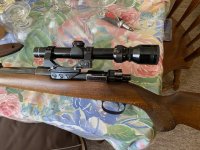
BSA CF2's

Shoots very well too, they made less then 1700 in 6.5x55.
For carry, I have an unusual HVA Dahlberg in 6.5x55 with 53cm barrel that light and handy.
It has the cheek piece flattened which allows you to get right behind the scope with your eye, works very well.
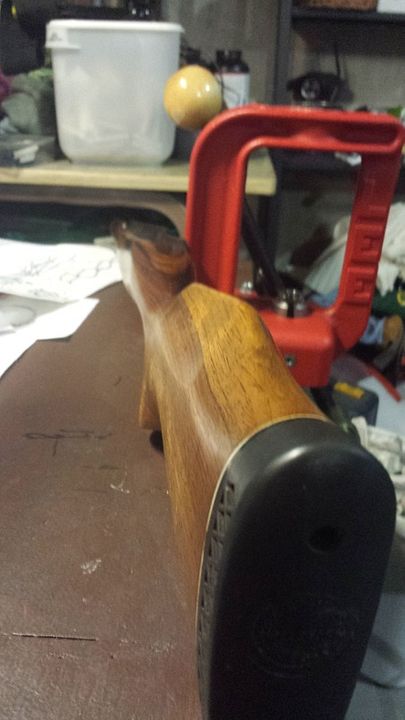
20160713-183204-zpstymeonwm.jpg

20160722-144142-zps2ropmtbs.jpg

6.5x55 is a great caliber. Really under rated in North America in my opinion.
 
Well I definitely did not know that! I always thought BSA was similar to Midland and Parker Hale, just rebuilding surplus actions or commercial continental actions.

I am not an expert on BSA, but I think they did get there start in the bolt action hunting rifle business converting P14 and P17 actions to sporters, my Dad bought a "new" 30 06 in Nelson B.C. in 1952 He gave it to me and I have since given it to my Son, they are a #### on closing fairly heavy rifle and they lack a hinged floor plate. They are quite different from the CF2s.
 
I am not an expert on BSA, but I think they did get there start in the bolt action hunting rifle business converting P14 and P17 actions to sporters, my Dad bought a "new" 30 06 in Nelson B.C. in 1952 He gave it to me and I have since given it to my Son, they are a #### on closing fairly heavy rifle and they lack a hinged floor plate. They are quite different from the CF2s.

BSA made Lee's for the military, they had a long history in the UK. They also made cars/motorcycles commercially, they started with sporter military rifles then turned to home grown actions for the commercial market, all very well made.
Look up Lady Docker, she kind of sank the entire division...
 
I recently acquired a BSA Majestic, chambered in the good ole 30-06. Gun is in very good condition (90%), with a true 24" barrel, sans integral muzzle brake. The barrel was dirty and could not view the rifling for pitting or rust, however I still gambled. I've heard good things about these British rifles, I heard they are unrecognized and undervalued for their quality. Well I had to see for myself.

Almost immediately when returning home with my unsure prize, I striped it down, right to the wood. The main thing which I was most impressed with is the inletting...........superb!!! I've never witnessed such great inletting for a firearm, especially for several decades old, better than $3,000 firearms today. Was also impressed with the barrel profile, it was machined to include an integral platform for the rear sight. Also, the receiver has integral dovetail bases for the rings, similar to BRNO and Sako. I thoroughly cleaned the entire rifle and was please to see that the rifling was bright and shiny.

Sometime within the next few weeks I'll give it a test-run. I have a box of Nosler custom ammo that was gifted to me, that will be a good start.
 
Nice pick up track. We need some pics!
How is the trigger?

Thanks Buck!. The trigger is a two stage, set at 5 pounds. I'll have Henry Rempel reduce it for me, if it's possible. The rifle is still dismantled at the moment, photo's will have to be later. Man, this rifle is very well put together!..........great workmanship.
 
Hey all,
I realize this thread is a few days old...but I am in need of some experienced based knowledge on the CF2 and hoping someone in here can shed some light on the pothole I have come across.

The CF2, along with most other BSA firearms don't often make its way to my door. As well, in-depth information regarding many BSA rifles have little documentation for the tradesman or enthusiast. Ergo.....forums. I am attempting to remove the ejector (not the extractor) from a CF2 bolt face. However, it appears the ejector retaining (roll) pin hole is blind - there is no out. Just below and to the left of the plunger ejector on the bolt lug, there is shown the ejector retaining pin hole - and on mine, the roll pin is quite visible. However, if you follow the trajectory of that hole, there is no "other end". I cannot imagine BSA used a blind hole for this pin. Assuming they did not, how is that pin removed to free the ejector plunger and spring? IF there are any CF2 aficionados out there (as it seems there may be a couple), I would appreciate any guidance or direction you can share related to this. Cheers-
 
I understand this is not a showstopper in the sense that if I cannot properly obtain the correct process (or if there truly is no other process), it can be drilled out and replaced. But I hide no shame in calling on those more intimate with the CF2 than I to explain what I may be missing. When was the last time you EVER saw a firearms manufacturer use a blind hole with a roll pin to secure something that may, at some point, require replacement or cleaning? I can say I have never witnessed that.
 
My 6.5x55 and 30'06 have a through hole for the ejector.
My 222Rem is like yours with only one hole.
Only option I guess is to drill it out and replace with new roll pin. Not ideal for sure lol
 
Action wise they are very different, PH is basically a commercial Mauser 98 (early ones were actual military 98 sporters). The actions were made in different places for PH...FN, Santa Barbara, Zastava.
BSA CF2 is a push feed design, they made the entire rifles in house, similar in quality and design to the Sako rifles of that era.
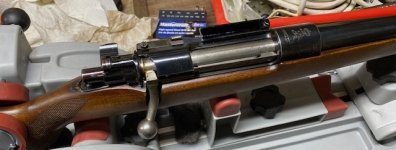
Some were military action conversons, others, like my 9.3 x 62 were a sporter action built by FN; I know it is a sporter action as there is no thumb cut for stripper clips. Some of the earlier comercial actions did however have a cut, but were either surplus production left over after the war, or early post war production.

As you can see, not thumb cut.
IMG_4571.jpg

Closed Receiver.jpg
 
Some were military action conversons, others, like my 9.3 x 62 were a sporter action built by FN; I know it is a sporter action as there is no thumb cut for stripper clips. Some of the earlier comercial actions did however have a cut, but were either surplus production left over after the war, or early post war production.

As you can see, not thumb cut.
View attachment 1129549

View attachment 1129550
That's an HVA no? Lol
 
I understand this is not a showstopper in the sense that if I cannot properly obtain the correct process (or if there truly is no other process), it can be drilled out and replaced. But I hide no shame in calling on those more intimate with the CF2 than I to explain what I may be missing. When was the last time you EVER saw a firearms manufacturer use a blind hole with a roll pin to secure something that may, at some point, require replacement or cleaning? I can say I have never witnessed that.

I have seen a few that do that, including some Model 700 version bolts (like the one on my Italian Sabatti) and some AR pattern bolts.

Bolts utilizing a blind roll pin hole for the ejector pin, sometimes found in some AR-15 and LR-308 (AR-10) platforms, are designed to retain the ejector plunger and spring securely within the bolt body. A blind hole, as opposed to a through-hole, does not pass all the way through the bolt, requiring specific tools or techniques for removal instead of being punched out.

Key Aspects of Blind Ejector Pin Holes:
  • Design & Function: The ejector on an AR-15/AR-10 is often held in place by a single roll pin (often a slotted tension pin). The pin runs perpendicular to the ejector plunger, passing through a machined slot on the plunger to allow for normal travel while preventing it from launching out of the bolt face.
  • Proprietary or Custom Bolts: Some manufacturers create proprietary bolt designs to improve strength, which may use a blind hole (a hole that does not go all the way through the bolt) to house the ejector pin, making them harder to service without specialized techniques.
  • Blind Hole Nature: The hole is often a "blind" hole, meaning it terminates or ends within the bolt body, making removal tricky compared to a through-hole, especially if the pin is seized.
  • Platform Specifics: While AR-15s typically use a 1/16" roll pin, LR-308/AR-10 bolts may have tighter tolerances or slight variations in pin seating, with some pins sitting below flush.
  • Removal/Installation: Because the hole is blind, typical punch-through methods do not work. Specialized bolt ejector tools or small punches are used to press the ejector in, relieving pressure on the retaining pin, which can then be pulled out or removed.
  • Removal Difficulties: If a roll pin is in a blind hole and does not have a "break-through" channel, it is usually somewhat difficult to remove, sometimes requiring drilling through from the other side or using a slide hammer to pull it out. If you are encountering a "non-owner serviceable" blind pin, technicians often recommend turning the inside of the pin with a screw extractor or carefully drilling it out.
  • Material & Maintenance: The pins are often subjected to high tension and should be replaced during maintenance, as they can wear or mushroom, making removal difficult.

When I had to remove the ejector for cleaning on my Sabatti M700 clone all I did was after stripping the rest of the bolt I placed it in a vise with wood blocks to protect the bolt body and after compressing the ejector I lightly tapped the opposite side of the bolt with a small hammer until the pin started to back out and then using small pliers I removed it completely.

I'm sure the procedure is the same or similar for the BSA CF2.

The Ejector and it's spring is placing tension on the round ejector retaining pin and when that tension is removed the pin is able to be removed.
 
Back
Top Bottom