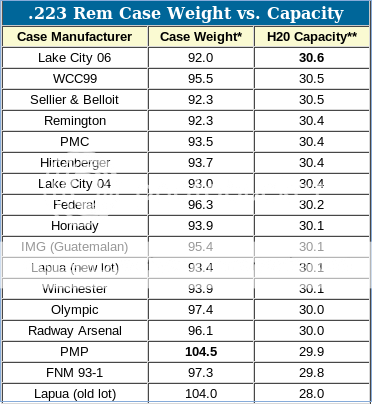
Case Capacity Difference By Brand

Amen to that!

Three months ago I stopped posting or even looking in reloading forums and deleted my photobucket pictures because of all the stupidity, posturing and ego tripping in forums.

Then I started to miss this forum and I was pulled in again a few weeks ago, I shouldn't let it bother me, but some postings are pure BS.
 
Last edited:
If he needs to know the actual volume of the brand, he would take the middle weight sample of each brand and fill with water. H20 volumes are often used to compare capacity. When I do it I use a syringe.

If you are suggesting using powder to measure the capacity of 100 or so cases, I find that ridiculous.

I find it ridiculous to fill 100 cases with water using a syringe. Each to their own...
 
I have been reloading for over 50 years. If you want to know the weight of the brass, then weigh the brass. If you want to know the volume of the case then fill the case with powder, and weigh the powder. When you fill one case with powder then dump it into the next case after you have weighed it. Speeds the process up. Some do it with water, but I find that very messy.

Remember it is the volume of the case that affects ballistics, not the weight of the case.
Wow, this is great info! Advanced math and calculus. Honor student in physics and chemistry throughout high school and NOW I find out the volume is measured in weight and NOT cubic cms, inches, litres, or ounces. I also now know that mass doesn't matter, it's WEIGHT that counts.
I HAVEN'T been reloading for 50 years. 35, but not 50 and I know that if one "vessel" conforming to the same external physical dimensions is heavier than another, then there must be more material in its construction. More material, same external dimensions, equals different internal dimensions. Now, that's just a basic scientific principle called "empirical observation" widely used since man began thinking.
Solids are immutable as to shape unless pressure, in quantities high enough to deform them, is applied to fill ALL voids within a vessel. Liquids, on the other hand, readily adapt themselves to the shape characteristics of any vessel to fill all voids. That's why knowledgeable reloaders determine case capacity using water volume and not powder weight.
One must never overlook the possibility that education can occur.
 
Three months ago I stopped posting or even looking in reloading forums and deleted my photobucket pictures because of all the stupidity, posturing and ego tripping in forums.

Then I started to miss this forum and I was pulled in again a few weeks ago, I shouldn't let it bother me, but some postings are pure BS.

And some people use heavy water to measure case capacity. :)
 
Is there a chart or table available that shows the different case / brand capacities, so that one could compare?

Let me tell you the flat out facts (and even though threads are turning into insult rife, conflict rife dumpster fires on CGN nowadays, sorry to tell you, but I'll weigh into the shark waters to try and help you).

Always sort by manufacturer and try to stick to one for that firearm. Know that exact metallurgy of each case is not flawlessly the same from the physical one made after the other (in strictest sense) let alone any in one batch, from one batch to another; and certainly not from one manufacturer to another. The chamber and all of its variables, the number of firings and all of its variables, the reloading process and all of its variables... Ok, a lot of variables that make microscopic changes, but that can be important when you reach a level of reloading precision you want to be worried about it (and don't let someone tell you when that is, even me).

If you are shooting larger targets at shorter distances then if you quickly measure case weight and cull out the top 2.5% and the bottom 2.5% then you are fine: other concepts in the reloading make larger changes. You just want to negate any possibility of other variables added onto a bad case adding to a poor shot.

If you start getting into very fine target shooting or shooting deer at farther ranges (again, what is a "far" shot is opinion, so don't listen to the fail cake eaters) then you should start getting into doing as Ganderite said: really get into weighing your cases and trying to accumulate cases of the same manufacturer, dimensions, number of firing from the same chamber, weight and so forth. The smaller cases will show almost immeasurable changes of course: a case weighing 10 grains will be damn hard to tell over a case that is 200 grains.

If you are looking for farther ranges yet you need to get into knowing the brand and choosing what works for you. Case quality, metallurgy, ductility and so forth will matter. Only as a matter of opinion I find PVRI a quality substitute for Lapua (which will make the fan-bois mad) but that is what works for me at the shooting distances I am working on now. This topic is filthy with opinion over fact.

Charts like bigedp51 linked will help you decide, but they are only the barest reference.

223_case_capacity.png

When you get into pushing your own limits, when you are out practicing a lot, when precision is beyond key, then you must start capacity measuring cases. Weighing the cases will not be enough. Once again, the smaller cases will show almost immeasurable changes of course: a case holding 10 grains will be damn hard to tell over a case that can hold 200 grains of powder. You will have to do it after each rotation of firing and reloading.

At what level you do each step is up to you, how precise you get for what you are doing is up to you, and you will have to be comfortable with the level of reloading precision you are doing for the shooting you are doing. Mentors will advise on the levels or steps of precision, but what level you need for what you are doing will be evident in the groups you fire: you have to be happy.

Oh, and someone will chime in on all the stuff missed, I expect that, but I am trying to narrow the focus to case capacity and facts on levels of precision regarding them only.

I only politely ask you do enough precision to ensure humane kills at that distance, if that is what you are doing.

Good luck...

 
Last edited:
Three months ago I stopped posting or even looking in reloading forums and deleted my photobucket pictures because of all the stupidity, posturing and ego tripping in forums.

Then I started to miss this forum and I was pulled in again a few weeks ago, I shouldn't let it bother me, but some postings are pure BS.

I'm glad you are here. You've helped steer me away from passing on crap I read and thought was gospel. You actually back your post up with facts and usually great drawings. I've learned from it and I am sure others have learned a lot also.
Thank you for posting here!
 
That's why knowledgeable reloaders determine case capacity using water volume and not powder weight.

Hear hear!

I'm new to reloading but just wanted to add my support to this conversation. I have several brands of brass (Hornady, Federal, PMC, Norma, etc.) and have noticed a wide variation in case capacity between them even though their external dimensions are similar. I weigh my brass, and of course keep my brands separate throughout the reloading process. I have measured the different volumes with water, as a small case capacity means more pressure inside which impacts ballistics.

I'm trying now to stick with one brand for each of my rifles, so there's less variation and more accuracy at POI.
 
Wow, this is great info! Advanced math and calculus. Honor student in physics and chemistry throughout high school and NOW I find out the volume is measured in weight and NOT cubic cms, inches, litres, or ounces. I also now know that mass doesn't matter, it's WEIGHT that counts.
I HAVEN'T been reloading for 50 years. 35, but not 50 and I know that if one "vessel" conforming to the same external physical dimensions is heavier than another, then there must be more material in its construction. More material, same external dimensions, equals different internal dimensions. Now, that's just a basic scientific principle called "empirical observation" widely used since man began thinking.
Solids are immutable as to shape unless pressure, in quantities high enough to deform them, is applied to fill ALL voids within a vessel. Liquids, on the other hand, readily adapt themselves to the shape characteristics of any vessel to fill all voids. That's why knowledgeable reloaders determine case capacity using water volume and not powder weight.
One must never overlook the possibility that education can occur.

Not only that, but with the volume of the water you can easily calculate the mass via the density of water (or visa versa). Math is f***ing amazing!

(Technically you also need the temperature of the water because density varies with temp, but if it's all room temperature water then T is constant and can be ignored for comparison purposes.

Also, powders dont always fill the same place in exactly the same way. Notice how powder throwers aren't ultra-precise? So weighing powder weight of a full case is LESS accurate than using water. How about that...

Finally, weight of case is not prefect, because differences in alloys would weigh slightly different - hence why you sort by brand.
 
I'm far as I'm concerned the volume is set by the chamber which is constant.
All my match brass is from the same lot so alloy density should be constant as well. After that, if a case weighs more, it has less volume and will cause more pressure/high impact.
If you buy a few 100's of the same lot, its not uncommon to have a few light and heavies that could be 3-4grains different, with the bulk being closer to the middle. I have tested and seen a difference at long range within those 2 extreme ones, but within 1gr, not nearly as much. I still sort within +/0.2 for the most part which can be done before or after loading.

Try to not mix brands at the very least.
 
Wow, this is great info! Advanced math and calculus. Honor student in physics and chemistry throughout high school and NOW I find out the volume is measured in weight and NOT cubic cms, inches, litres, or ounces. I also now know that mass doesn't matter, it's WEIGHT that counts.
I HAVEN'T been reloading for 50 years. 35, but not 50 and I know that if one "vessel" conforming to the same external physical dimensions is heavier than another, then there must be more material in its construction. More material, same external dimensions, equals different internal dimensions. Now, that's just a basic scientific principle called "empirical observation" widely used since man began thinking.
Solids are immutable as to shape unless pressure, in quantities high enough to deform them, is applied to fill ALL voids within a vessel. Liquids, on the other hand, readily adapt themselves to the shape characteristics of any vessel to fill all voids. That's why knowledgeable reloaders determine case capacity using water volume and not powder weight.
One must never overlook the possibility that education can occur.

Believe it or not, it is tradition to express cartridge case capacity in grains of water -- i.e. weight of water. Perhaps mass if you happen to live on another planet... Powder is close to the same specific gravity as water, so if you are doing a relative comparison, grains of powder works too.


 
I have been reloading for over 50 years. If you want to know the weight of the brass, then weigh the brass. If you want to know the volume of the case then fill the case with powder, and weigh the powder. When you fill one case with powder then dump it into the next case after you have weighed it. Speeds the process up. Some do it with water, but I find that very messy.

Remember it is the volume of the case that affects ballistics, not the weight of the case.

Ron AKA

In another posting you told the forum to lube their cases to fire form them and that almost doubles the bolt thrust and all the reloading manuals tell you to not do it.

In another posting you told the forum there is no difference in hardness or thickness in primer cups.

The advice on lubing the cases was bad enough and then you screwed up about primers.

In 50 years of reloading Ron AKA you seem to have missed some of the basics.

On top of this even your postings at Accurate Shooter are a joke, like recommending the primer method to check head clearance when you have never done it. You just read my posts here and just repeated them at Accurate Shooter. Or telling someone his fired primers look OK when you didn't know about primer hardness and thickness. You do a lot of recommending on things you have never done and just read someplace else and that is called being a poser or a parrot repeating what you see or hear. Meaning you are posting on things you have no actual knowledge or experience on trying to inflate your on-line image.

Lapua brass is known for being the most consistent in weight and volume and the vast majority of competitive shooters at Accurate Shooter just shoot them without weighing or checking volume.

Below is a link to Accurate Shooter for case prep and they just "weigh the cases". And at Accurate Shooter very few of the shooters that are more anal fill every case with water or powder.

The author of the link below has competed for 25 years in 100/200/300 and 1000-yard benchrest competition. And has written for several magazines for the past 20 years, including GUNS, Guns & Ammo, Safari, Tactical Shooter, The Accurate Rifle, SWAT, Tactical Response, and Precision Shooting magazines.
(meaning he knows more than you do Ron AKA and is not repeating what he read someplace else)

Preparing Cases for Long-Range Accuracy
http://www.accurateshooter.com/technical-articles/reloading/complete-precision-case-prep/
 
My Lee Perfect Powder Measure must be the exception then. I find it to be accurate within +/- 0.1 grains of H322.

And yet a mere few hours ago you contradict yourself.
http://www.canadiangunnutz.com/foru...r-Beginner?p=13225070&viewfull=1#post13225070

If you load for speed you will likely use a powder measure which dumps powder directly into the cartridge. That is fine for pistol, and other guns where accuracy is not a big concern. For rifle cartridges most weigh every powder charge. They may use a powder measure to slightly undercharge the powder pan, and then weigh it while tricking the last few grains into the pan to get the exact load.

Could that be because powder measures are inherently inaccurate?
 
I weigh my powder in an accuracy load to 0.05 grains, not +/- 0.1 grains. And yes powder measures are not accurate to 0.05 grains. I don't use it, but Lee sells a whole powder measure kit based on volume.

I'm sure that they do ... but no serious long range competitor is using Lee volume measures and I say this from shooting F-Class seriously since 2008 (off/on since 2002).

PO Ackley appears to be the first to discover the relation between case weight and internal volume, probably 50+ years ago.

FWIW ... I check average internal capacity (.308W) in grains of water, as it's pretty easy to deal with - including getting a flat meniscus with a bit of minor effort .... WW (new brass) was about 57.7 gr (older brass weighed in about 15gr greater in average weight, so would have a lessor internal volume), Norma (old) 56.7gr and Lapua (old) 56.0gr. I'd never use powder to measure internal capacity, as the compaction factor is much more complicated than using a liquid like water (or mixed with methanol or soap). You need to weigh what you have, as production averages will change between lots or years. Weighing by case weight is the simplest way to deal with internal case volume.
 
I have dozens of 1 liter plastic pails from the casino. They used to issue them to hold your coins.

When I get a new batch of brass (usually 500 to 1000 pieces - all same lot number) I sort them by weight. I put a masking tape label on each pail in 0.3 gr increments. When done I transfer the brass to 50 round plastic boxes, and put a label inside the lid, showing the weight of that brass.

When I am done, the pail of lightest and the pail of heaviest brass gets boxed and labelled "FOULERS". This ammo is handy for firing fouling shots, for the initial zeroing of a new scope, etc.

The balance of the boxes get arranged in order, lightest first, and each box is numbered on the outside, as 1, 2,3,4, etc. In a week long match, they get shot in order. If the weight (volume) of a case matters, shooting in order minimise the difference between one weight range and the next.

The only time I am interested in the water capacity of a case is when comparing one caliber to another. 6.5x55, 260Rem and 260Rem Ackley all shoot the same bullet. I had enjoyed great success with a 6.5x55 rifle but afrer 5000 rounds the barrel was pooched. I wanted a caliber that would yoield similar velocity. A water test confirmed the 260Rem was smaller than a 6.5x55 but a 260Rem Ackley was about the same capacity, if I used light brass. This is what I now shoot.

Lapua gave me 2000 pieces of brass for it. As I sit here I don't recall if I sorted them by weight or not.
 
Back
Top Bottom