
Londonshooter
CGN frequent flyer
- Location
- SW Ontario
I just looked. You are in red, John.













































I just looked. You are in red, John.

Well maybe this is contentious and of course is a matter of personal preference, but personally am not a fan. This gun on the EE for example to my tastes would have more value if had been left alone. Am I alone in this? I suspect possibly, yes.
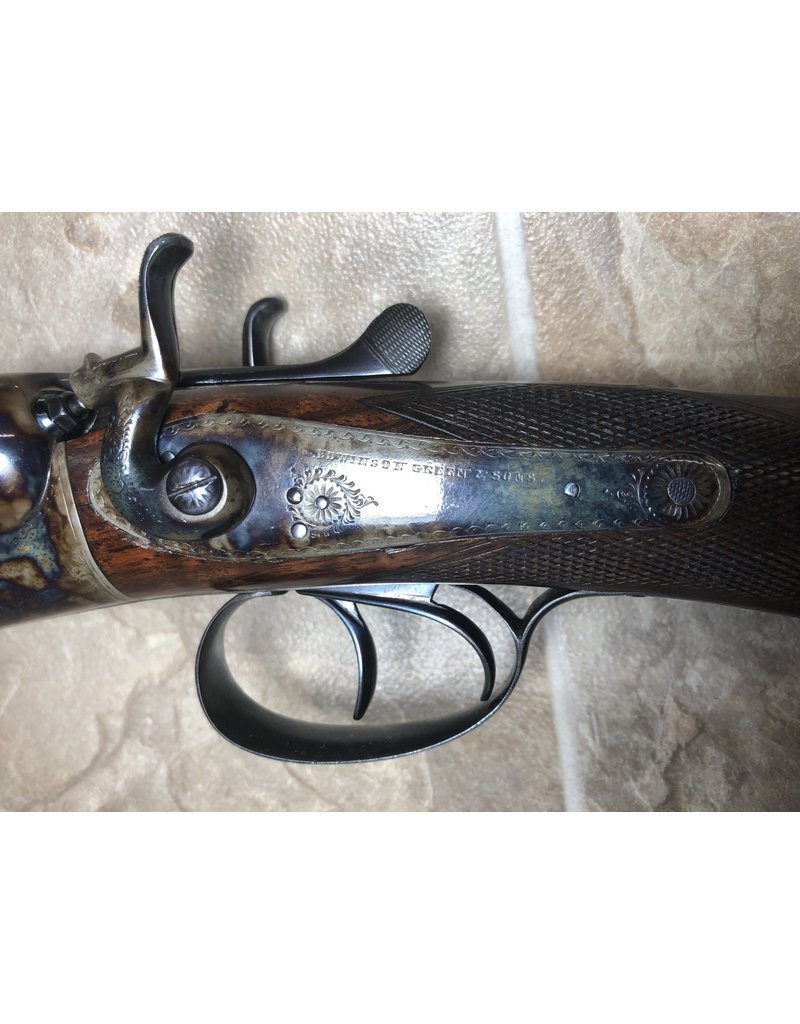
Personally, i think the case coloring on this one looks really nice, but definitely a matter of personal taste.
mmm probably '63. Not if I discover I can't hit anything with it. The lineup this year is looking like MacNaughton, Green, Thuillier, Horsley, and Atkin. Maybe Powell. And I guess Jefferies since Patrick wants a group photo of past years' best guns, although I don't see a red 2018 beside my name. The Atkin is (gasp) hammerless. The others are proper guns.

mmm probably '63. Not if I discover I can't hit anything with it. The lineup this year is looking like MacNaughton, Green, Thuillier, Horsley, and Atkin. Maybe Powell. And I guess Jefferies since Patrick wants a group photo of past years' best guns, although I don't see a red 2018 beside my name. The Atkin is (gasp) hammerless. The others are proper guns.
In the Bad home and on classic double guns, that effect is called case hardening and is perfectly authentic to such a gun. I wouldn't change it, would you gild a lily?
That sounds like a killer lineup, Londonshooter. I’m still debating whether I should go for ‘different’ actions and fastening mechanisms rarely encountered, or just bar-in-woods, or go with a ‘top’ lineup of Bosses, Hollands, Dickson, Woodward and Moore. All pinfires of course. Proper guns.
I think what the OP is asking about, BB, is whether on vintage guns, the case colours that were originally on the gun should be refreshed or not. It’s a stictly cosmetic choice as the case hardening that originally was done, and produced the colours as a by-product, will be as hard as ever. It’s only the colours that fade.
This is an often debated subject because, among other things, each and every time the metal is case hardened, there is the possibility of distortion of the metal. And that’s a big problem on vintage guns with extremely tight tolerances.
All pinfires of course. Proper guns.
I was taught that you don't ever do anything to "freshen up" the appearance of an antique, but that was in the days when people were buying old things because they... well, they liked antiques. People talked about patinas and stuff.
To each his own, and while I truly appreciate and marvel at the beauty of a fine gun that has managed to remain in new or nearly new condition for 100, 125, 150 years, I really consider these to be collector oieces, maybe museum pieces, too valuable as original to really be used. A properly restored gun on the other hand can have the beauty while still being a practical gun for every day use without the guilt. My personal preferance is for fine high quality guns that have been used as intended and given continuous meticulous care throughout their working life, never damaged, never extensively restored, still completely fit for service and showing their honest wear proudly.
I agree.
If colour casehardening were to be redone, it would only make sense if part of a total refurbishment. New colour case hardening on a gun with faded bluing and well used wood with worn checkering would be a waste of time.
And if done as part of a complete restoration, the type of colour case hardening should be appropriate to the gun. There were quite a variety of coloured effects.
To redo the first gun 'correctly' -- and let me be clear I imply absolutely zero criticism; none whatsover -- the action would first be annealed in an oxygen purged kiln, struck, refitted, and with the engraving recut by someone expert in push graving using carbon steel tools. Screws would be made up and etc.
After receiving the gun back from the engraver, the polishing would need to be redone using stones to approx 400 grit, and depending on the original, corondum or rottenstone or pumice (all different effects) mixed with 'sweet' oil (olive) or 'colza' (canola/rape) on leather, wool, or felt (all different effects). Then, the metal parts would be boiled hard in a lye bath until a break test with distilled water shows they are clean, before being stored overnight in a vat of boiled (oxygen free) distilled water.
When planning the case hardening, the original would need to be taken into consideration. In this case, the original appears to be done with bone char, while the replacement predominantly wood and a small amount of leather. The original was likely also dumped into used water which was high in calcium, pertinent to chalk streams and bone origin of the char. So now it'd be a trip down to the garden supply to get a sack of bone meal. In the yard the smith would then set up a tumbler or roaster and would supervise the charring of the meal until all fat and impurity was cooked out, a job taking several hours of black smoke then supervised cooling to ensure no over or re combustion.
Following this, the action would be removed from the water and carefully inspected before being dried carefully in a box of clean and non-oily hardwood sawdust, then brushed off. It would then be cooked to a cherry red/1450 heat for an hour and a half to two hours with the chosen char.
After quenching, the parts would be inspected and checked for spec. Warpage or other movement would be sent to a hard-fitter, a specialist in the adjustment of case hardened low-carbon steel, who would then fit the action back together.
The final lacquer would be made in shop from multiple (now) hard to source materials. The unique diffraction of the light falling on classic guns, giving them the unique look, is the result of distinct processes and ingredients not replicated with modern manufacturing methods. Many ingredients are controlled, some are illegal; nearly all formal instruction on how to make the gun lac is incorrect. In such a case, the smith will have had to have done the appropriate practical research. The ingredients themselves range to about $300 to make one batch of finish (not that the finish costs $300, just the shopping list).
Finally, the metalwork is complete. Now for touchups on the wood: sourcing more authentic ingredients, making checkering tools with identical geometry (country and shop specific) using identical tools, sourcing appropriate wood, etc. Duplicators or clones at this point can not be used for true authenticity sake, as each stock would be fitted and cut by hand using blade and not rotary tools.
Now the big question is: are you willing to pay for it?

























