Chambers Matter

Ganderite

CGN Ultra frequent flyer
Rating - 99.7%
355   1   0
I was cranking out 1000 38Spl rounds loaded with the lead 158 SWC. Powder similar to Power Pistol.

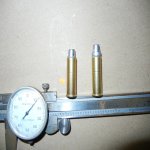
I noticed that about 1 in 20 rounds would seat the bullet too deep. The brass was a bit thin, I guess, and the ID was not enough to hold the bullet in place.

I put these is a separate container.

Then I got to thinking "If the bullet is seated deeper, will this increase pressure & velocity?" Conventional wisdom is that it will, because of reduced inside capacity.

So I decided to test some of these deep-seated bullets against the correct length ammo.

This load was already a 900 fps load (I would consider 950 to be Max) so in an abundance of caution, I decided to test in a 357, just in case the pressure was much higher. (I am becoming slightly less venturesome in my old age.)

So I shot some of the deep seated rounds and the velocity was in the same ballpark as the "normal" round. Actually, it was slightly slower. This was not what I expected and did not seem right.

So I shot some "normal" rounds and found them to be much slower than 900 fps. They were only 837.

So then I hypothesised that the longer 357 chamber acted like a lot of freebore and reduced the pressure in the short 38Spl case.

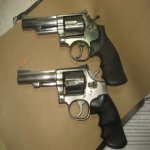
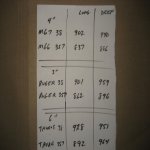
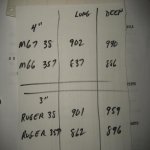
So I shot the same two batches (long and short rounds) in a similar revolver, except in 38SPl. (The two revolvers were a Smith M66 and M67.) Sure enough, the 38SPL chamber showed normal velocity (902 fps) with the correct seating depth and 990 fps with the deep seated bullets.

So this confirmed that seating deeper increases pressure and that a 357 chamber will reduce pressures with a 38SPL case.

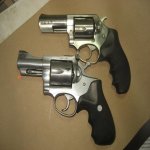
I then grabbed a pair of Rugers (SP101 38Spl and Security 6 357) and repeated the test. Same result. Deep seated bullets shot faster and 357 chamber reduced pressures.

Note: S&W revolvers were 4" and the Rugers are both 3" barrels.

I was going to repeat with a pair of 6" Taurus revolvers, but is started to rain quite hard.
IMG_2962.jpg

IMG_2959.jpg

IMG_2958.jpg
 

Attachments

  • IMG_2959.jpg
    IMG_2959.jpg
    66.7 KB · Views: 414
  • IMG_2962.jpg
    IMG_2962.jpg
    37.8 KB · Views: 413
  • IMG_2958.jpg
    IMG_2958.jpg
    61.2 KB · Views: 416
Last edited:

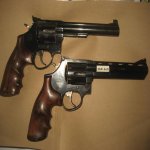
I finished the test. I shot the standard ammo and the deep-seated bullets in a pair of 6" Taurus revolvers. A 38SPL and a 357Mag.

In each case the deep seated bullet shot faster (higher pressure), so pay attention to seating depths and work up to what ever depth you want.

And once again, the 357 chamber reduced the pressure quite a bit.

If you develop a hot 38Spl load using a 357 revolver, the result could easily be over pressure if it is ever shot in a 38Spl.

IMG_2963.jpg

IMG_2964.jpg
 

Attachments

  • IMG_2963.jpg
    IMG_2963.jpg
    60.1 KB · Views: 331
  • IMG_2964.jpg
    IMG_2964.jpg
    40 KB · Views: 330
My PPC loads out of custom model10, were 148 gr. Hollow based wadcutters 3.6 gr. Win 231 no problems seated flush, Smith 586 liked .357 case 3.1 gr. 231 win same wad cutter flush seated both loads 900 FPS
 
My PPC loads out of custom model10, were 148 gr. Hollow based wadcutters 3.6 gr. Win 231 no problems seated flush, Smith 586 liked .357 case 3.1 gr. 231 win same wad cutter flush seated both loads 900 FPS

??

Are you saying 3,1 in a 357 case gets the same velocity as a 38Spl case with 3.6gr? Sounds backwards.
 
Ganderite: I always find your posts very interesting and useful. I shudder when I read about some experiments with "hot' loads in handguns. Your trial shows what actually happens when certain things are are changed, even a seemingly small amount.

Thanks for sharing your experience! :)
 
Chapter 7 of Hatcher's Notebook describes the loss of velocity the farther up the barrel the projectile is.

He used 1903 Springfield, with bullets placed at different distances up the barrel.

He fired a bulllet-less cartridge to eject the bullet in the barrel.

A summation would be, the bigger the chamber, the lower the velocity.
 
Chapter 7 of Hatcher's Notebook describes the loss of velocity the farther up the barrel the projectile is.

He used 1903 Springfield, with bullets placed at different distances up the barrel.

He fired a bulllet-less cartridge to eject the bullet in the barrel.

A summation would be, the bigger the chamber, the lower the velocity.

Yes, and that same test explains the easy way to get stuck bullets out of a barrel.

I have done it many times, but I dump at least half of the powder before shooting it out.
 
Yes, and that same test explains the easy way to get stuck bullets out of a barrel.

I have done it many times, but I dump at least half of the powder before shooting it out.

I'm sure I've said it before, but I feel like I learn something new every day here. Thanks guys.
 
Yes, and that same test explains the easy way to get stuck bullets out of a barrel.

I have done it many times, but I dump at least half of the powder before shooting it out.

The way I remove a stuck bullet from a bore is to fill the bore behind the bullet with water and fire a primer over it. Water isn't compressible and acts like a non-marring solid rod behind the bullet, and the primer alone usually has enough power to spit the bullet clear.

I'm trying to wrap my head around the difference in velocity you observed between your .38 and a .357 guns and it seems to me that there are so many variables built into revolver design that suggesting the difference pertains to chamber length alone doesn't tell the full story. Often two seemingly identical revolvers firing the same load produces significant differences in velocity due to differences in the cylinder throat diameter, how perfectly the chamber indexes with the bore, the length of the flash gap, the length and angle of the forcing cone, and the condition of the bore. Once you begin to compare guns of different manufacture, possibly built in different decades, the variables keep getting bigger. If the gun that reliably produces lower velocities is the more accurate one, chances are it isn't chamber length alone that accounts for the disparity.
 
The way I remove a stuck bullet from a bore is to fill the bore behind the bullet with water and fire a primer over it. Water isn't compressible and acts like a non-marring solid rod behind the bullet, and the primer alone usually has enough power to spit the bullet clear.

I'm trying to wrap my head around the difference in velocity you observed between your .38 and a .357 guns and it seems to me that there are so many variables built into revolver design that suggesting the difference pertains to chamber length alone doesn't tell the full story. Often two seemingly identical revolvers firing the same load produces significant differences in velocity due to differences in the cylinder throat diameter, how perfectly the chamber indexes with the bore, the length of the flash gap, the length and angle of the forcing cone, and the condition of the bore. Once you begin to compare guns of different manufacture, possibly built in different decades, the variables keep getting bigger. If the gun that reliably produces lower velocities is the more accurate one, chances are it isn't chamber length alone that accounts for the disparity.

I quite agree. It is easy to jump to conclusions based on a small sample size. When I worked in the lab I thought I had found lots of things, but my boss would look at the data and say "Not statistcaly valid."

When the hot 38Spl round was first found to be much slower in the 357, I decided to repeat it in other pairs to see if it held up. I keep the make of the pairs the same (Ruger and Taurus) to reduce the differences in chamber designs. I might repeat one more time in a pair of Colts, just be more inclusive.

All the variables you mention explain why all the velocities vary, but the fact that every 357 is somewhat slower than a 38 suggest that the longer chamber makes a difference.

It does not matter, so long as you don't develop your 38 loads in a 357.
 
Back
Top Bottom