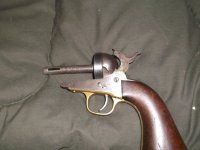
colt 1860 army conversion cylinder

holy pusy cat!!! this is my first time playing with a a antique 1860 army colt this frame is made out of high carbon steel and heat treated
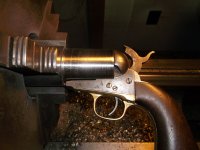
to glass hard or case hardening glass hard. any how i made the breach back plate and miscalculated on the od so i made another one.
this time i made the od last and filed down the last few thou for a hand snug fit.. the kirst 1860 breach plate in there website shows the bottom
of the plate being flat. my colt the bottom of the frame is radiused. noticed the pic on the kirst web site for the 1860 army conversion.
the backing plate is flat on the bottom and notice the thin web thickness on the outside . i think the original colt culinder would be thinner yet.
the material i used a axel of a cat front end loader. all newer cars and trucks and logging eqipment axel and gears are all cro mo steel.
i made the plate .400 thick.
 

Attachments

  • colt (8).JPG
    colt (8).JPG
    94.3 KB · Views: 26
  • colt (7).JPG
    colt (7).JPG
    83.9 KB · Views: 26
this is a good read on the 1860 colt army. this is when colt imported shefeild steel.
i was compareing the psi tensile strength on the diferant steels in the varius old revolver

The Colt Model 1860 Army revolver features a proprietary material marketed as "Silver Spring Steel" (supplied by Thomas Firth & Sons), which provided more than three times the tensile strength of the hammered iron or traditional steel used in earlier firearms like the Colt Dragoon. [1, 2, 3]
While Samuel Colt kept the exact engineering specifications a trade secret, metallurgical history and contemporary testing reveal how this tensile strength changed the firearm industry. [3, 4]

The Impact of "Silver Steel" Metallurgy​


  • The Bessemer Process: The steel was smelted in a pioneering blower furnace that forced out slag, resulting in a cleaner, high-carbon steel alloy. [1, 3]
  • Upgraded Caliber, Same Size: This massive jump in tensile strength allowed Colt to safely upsize a lightweight .36 caliber Navy frame to handle powerful .44 caliber black powder loads. [1, 5]
  • Weight Reduction: By leveraging stronger metal, engineers shaved the weight of a .44 military revolver down from over 4 pounds (the Dragoon) to just 2 pounds, 11 ounces. [6, 7]

Limits and Structural Strength​


  • The Fluted Cylinder Issues: In early production runs (below serial number 8,000), Colt thinned out the metal by cutting deep flutes into the cylinders. The tensile strength of the steel was pushed past its limits, causing several cylinders to burst under pressure. Colt quickly corrected this by switching to a stronger, solid rebated cylinder. [1, 3, 8, 9]
  • The "Open-Top" Constraint: Unlike its main competitor, the Remington Model 1858, the Colt 1860 lacked a top strap bridging the frame over the cylinder. Frame rigidity relied entirely on the bottom frame and a massive, fixed cylinder pin. [10, 11]

Modern Reproductions vs. Originals​

If you are looking at a modern replica made by manufacturers like Uberti or Pietta, the tensile strength is significantly higher than the 19th-century originals. Modern reproductions are CNC-machined out of contemporary medium-carbon or chrome-moly steels (similar to AISI 4140), featuring modern yield and tensile strengths built to easily withstand standard black powder pressures. [3, 12, 13, 14, 15]
Are you researching the tensile strength to evaluate a historical original, or are you looking for the pressure limits of a modern reproduction for shooting?

[1] https://www.quora.com
[2] https://www.lodgewood.com
[3] https://civilwartalk.com
[4] https://www.lodgewood.com
[5] https://www.youtube.com
[6] https://gunsmagazine.com
[7] https://smith-wessonforum.com
[8] https://military-history.fandom.com
[9] https://www.coltforum.com
[10] https://varnumcontinentals.org
[11] https://www.wildwestoriginals.com
[12] https://www.guns.com
[13] https://www.youtube.com
[14] https://www.canadiangunnutz.com
[15] https://www.youtube.com
 
this is a good read on the 1860 colt army. this is when colt imported shefeild steel.
i was compareing the psi tensile strength on the diferant steels in the varius old revolver

The Colt Model 1860 Army revolver features a proprietary material marketed as "Silver Spring Steel" (supplied by Thomas Firth & Sons), which provided more than three times the tensile strength of the hammered iron or traditional steel used in earlier firearms like the Colt Dragoon. [1, 2, 3]
While Samuel Colt kept the exact engineering specifications a trade secret, metallurgical history and contemporary testing reveal how this tensile strength changed the firearm industry. [3, 4]

The Impact of "Silver Steel" Metallurgy​


  • The Bessemer Process: The steel was smelted in a pioneering blower furnace that forced out slag, resulting in a cleaner, high-carbon steel alloy. [1, 3]
  • Upgraded Caliber, Same Size: This massive jump in tensile strength allowed Colt to safely upsize a lightweight .36 caliber Navy frame to handle powerful .44 caliber black powder loads. [1, 5]
  • Weight Reduction: By leveraging stronger metal, engineers shaved the weight of a .44 military revolver down from over 4 pounds (the Dragoon) to just 2 pounds, 11 ounces. [6, 7]

Limits and Structural Strength​


  • The Fluted Cylinder Issues: In early production runs (below serial number 8,000), Colt thinned out the metal by cutting deep flutes into the cylinders. The tensile strength of the steel was pushed past its limits, causing several cylinders to burst under pressure. Colt quickly corrected this by switching to a stronger, solid rebated cylinder. [1, 3, 8, 9]
  • The "Open-Top" Constraint: Unlike its main competitor, the Remington Model 1858, the Colt 1860 lacked a top strap bridging the frame over the cylinder. Frame rigidity relied entirely on the bottom frame and a massive, fixed cylinder pin. [10, 11]

Modern Reproductions vs. Originals​

If you are looking at a modern replica made by manufacturers like Uberti or Pietta, the tensile strength is significantly higher than the 19th-century originals. Modern reproductions are CNC-machined out of contemporary medium-carbon or chrome-moly steels (similar to AISI 4140), featuring modern yield and tensile strengths built to easily withstand standard black powder pressures. [3, 12, 13, 14, 15]
Are you researching the tensile strength to evaluate a historical original, or are you looking for the pressure limits of a modern reproduction for shooting?

[1] https://www.quora.com
[2] https://www.lodgewood.com
[3] https://civilwartalk.com
[4] https://www.lodgewood.com
[5] https://www.youtube.com
[6] https://gunsmagazine.com
[7] https://smith-wessonforum.com
[8] https://military-history.fandom.com
[9] https://www.coltforum.com
[10] https://varnumcontinentals.org
[11] https://www.wildwestoriginals.com
[12] https://www.guns.com
[13] https://www.youtube.com
[14] https://www.canadiangunnutz.com
[15] https://www.youtube.com
Good info and much apreciated - Thanks
 
progress update. the cylinder that i got with this antique colt was not original and was defective.
one chamber the .454 round speer soft lead balls would drop right in . it served as a test bed. i sleved 2 of the
chambers back halfs and chambered them for 22 long rifle. today i fired one round with thr reminton browm
power blank and got a little over 2 inches of penetration in pine 2x4. i set up the chrono and with the reminyon
brown power blank , 409 fps. then all i had was the red power lods. 2 shots , this is with the speer .454 soft lead balls
lubed with LLA. 909 and 949 fps. a little hot for this old girl. got to get some yellow loads. i,m waiting for my new uberti
cyliders to show up . it,s gona be a while i,m told. with this 22 power shot blanks i get 6 shots, and no loading dies
no cases no primers and powder and no problems with the big sick bird.
 
yuor being paranoid, there are thousands of ram set drivers that are all chambered for 22 cal shells.
non of them have ever been bothered. this is chambered to use the ram set power blank cartridges
to propell a round ball in my antique colt. i hope some RCMP sees this and chimes in
 
yuor being paranoid, there are thousands of ram set drivers that are all chambered for 22 cal shells.
non of them have ever been bothered. this is chambered to use the ram set power blank cartridges
to propell a round ball in my antique colt. i hope some RCMP sees this and chimes in
https://laws-lois.justice.gc.ca/eng/regulations/SOR-98-464/FullText.html

1 The firearms listed in the schedule are antique firearms for the purposes of paragraph (b) of the definition antique firearm in subsection 84(1) of the Criminal Code.

...

6 A handgun manufactured before 1898 that is capable of discharging only rim-fire cartridges, other than 22 Calibre Short, 22 Calibre Long or 22 Calibre Long Rifle cartridges.

***

So if that's not what you just did - all good. I saw you saying you chambered for 22lr
 
https://laws-lois.justice.gc.ca/eng/regulations/SOR-98-464/FullText.html

1 The firearms listed in the schedule are antique firearms for the purposes of paragraph (b) of the definition antique firearm in subsection 84(1) of the Criminal Code.

...

6 A handgun manufactured before 1898 that is capable of discharging only rim-fire cartridges, other than 22 Calibre Short, 22 Calibre Long or 22 Calibre Long Rifle cartridges.

***

So if that's not what you just did - all good. I saw you saying you chambered for 22lr
Note the term "capable" in the definition. Is the thing capable of discharging .22 calibre Short, Long or Long Rifle cartridges?
Or is it only capable of discharging power tool blanks?
If the former, antique status is lost.
 
Note the term "capable" in the definition. Is the thing capable of discharging .22 calibre Short, Long or Long Rifle cartridges?
Or is it only capable of discharging power tool blanks?
If the former, antique status is lost.
i think u and koko are full of it. the intent and designe is to fire powder blank cartridge to shoot a round ball out of this antique colt
revolver. u could argue about the adapter brass that shoot 32 rimfire with blanks and them shooting 22 shorts instead. i just went out
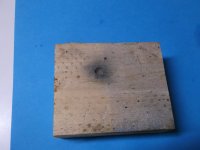
and fired 5 shots with 22 long rifle to clock the velocity and error on all 5 shots. so i fired one at point blank to see the penetration.
notice the powder burns around the little indent. the indent is .037 deep. this is obviously non leathal. bring on the big sick bird.
 
i think u and koko are full of it. the intent and designe is to fire powder blank cartridge to shoot a round ball out of this antique colt
revolver. u could argue about the adapter brass that shoot 32 rimfire with blanks and them shooting 22 shorts instead. i just went out
and fired 5 shots with 22 long rifle to clock the velocity and error on all 5 shots. so i fired one at point blank to see the penetration.
notice the powder burns around the little indent. the indent is .037 deep. this is obviously non leathal. bring on the big sick bird.
 

Attachments

  • colt (10).JPG
    colt (10).JPG
    77.5 KB · Views: 3
A .32 rimfire revolver is chambered for .32 rimfire.
Your revolver is now chambered for .22LR. The law says nothing about ballistic performance. You have altered an antique to accept ammunition which specifically negates antique status.
 
A .32 rimfire revolver is chambered for .32 rimfire.
Your revolver is now chambered for .22LR. The law says nothing about ballistic performance. You have altered an antique to accept ammunition which specifically negates antique status.
I agree with you... If it were me doing this and I wanted to be sure to be safe, I would cut the chamber in such a way as to be able to chamber the light ramset but so that even 22short would not fit by only cutting that 'chamber' to about .400 length or less... I think this is feasible - too much effort to search for both ramset and 22s ammo just now to measure carefully, perhaps you'd know off the top of your head?

It's an interesting legal question. If I understood correctly, his cylinder will accept and let him shoot 22lr. His barrel is still 45 (?) bore so the 22lr projectile is not engaged in the rifling...

What determines the caliber of a revolver - is it the cylinder or the bore? My opinion is that it's the cylinder, but...

I have posed this type of question to the RCMP lab in the past when I tried to convert a prohibited H&R revolver in 32sw which had a barrel over 105mm so the caliber was the only thing making it so. I asked if reaming the cylinder to 7.62nagant would make it restricted. I think you and I discussed the feasibility of this back then... The analyst was adamant that wouldn't be enough until I also changed the barrel... Very obviously a 'we just don't want you doing it' answer but whatever. Are they going to now accept that just changing the cylinder is not all there is to rechambering? Given the potential repercussions I'd run this modification past them. If I'm wrong, jbunny gets to enjoy his gun with no issues, no big deal, I'll survive :) If jbunny is wrong, he is going to have some unpleasant experiences, so better to be safe?

 
A .32 rimfire revolver is chambered for .32 rimfire.
Your revolver is now chambered for .22LR. The law says nothing about ballistic performance. You have altered an antique to accept ammunition which specifically negates antique status.
wrong!!! the law does talk about velosities under 500 fps and under x # of ft pounds of muzzle energy.
first of this is still a 45 caliber. the cylinder is still a 45 caliber cylinder. the back part of the cylinder is sleeved to
accept 22 powder charge cartridge to propell the round ball out of this old antique colt revolver. i did not want to use
corosive black powder any more. the bottom line is that this is not a 22 rimfire conversion. me thinks u wana be lawers
are out to lunch.
 
The ballistics to which you are referring have to do with airguns, which ones require a PAL, etc.
You have altered the cylinder to function with .22 rimfire cartridges.
An option which would avoid this would be to use the larger Hilti rimfire blanks.
Methinks you should go to the Terms and rules section and read #1.
 
i think u and koko are full of it. the intent and designe is to fire powder blank cartridge to shoot a round ball out of this antique colt
revolver. u could argue about the adapter brass that shoot 32 rimfire with blanks and them shooting 22 shorts instead. i just went out
and fired 5 shots with 22 long rifle
to clock the velocity and error on all 5 shots. so i fired one at point blank to see the penetration.
notice the powder burns around the little indent. the indent is .037 deep. this is obviously non leathal. bring on the big sick bird.
The "intent" of what you have done is irrelevant in the eyes of the law, just as an unprovoked killing would still be manslaughter or murder even if it was done because "righteous reason X compelled you to do so".

What does the law say? Oh look it was already posted in the thread above:

Per Statement of Regulations 1998, Regulation 464

Handguns​

  • 6 A handgun manufactured before 1898 that is capable of discharging only rim-fire cartridges, other than 22 Calibre Short, 22 Calibre Long or 22 Calibre Long Rifle cartridges.

So we have the following

Handgun - Yes
Manufactured before 1898 - Yes
*Capable* of *discharging* only rimfire cartridges, OTHER THAN .22 Short, .22 Long or .22 LR - NO

By your own admission, the handgun is capable of discharging .22LR, therefore it fails the criteria to be considered exempt. The fact that it does not discharge at the muzzle velocity or foot-lb energy would be an exemption under CC 84(3)(d) rather than antique 84(3)(a).

The following section reads:

  • (d) any other barrelled weapon, where it is proved that the weapon is not designed or adapted to discharge
    • (i) a shot, bullet or other projectile at a muzzle velocity exceeding 152.4 m per second or at a muzzle energy exceeding 5.7 Joules, or
    • (ii) a shot, bullet or other projectile that is designed or adapted to attain a velocity exceeding 152.4 m per second or an energy exceeding 5.7 Joules.
It cannot be proven that the weapon was not designed to discharge a shot lower than 152.4m/s or 5.7J as the Colt 1860 originally exceeded both of these. So your incredibly shaky legal ground is that it can be proven that *your intent* is that the firearm has supposedly been permanently "adapted" to discharge .22 caliber projectiles through an over-bored barrel. Seeing as nothing has been done to the firearm to weaken it or prevent it from being able to be restored to a properly-firing Colt 1860 with full velocity and energy rounds (in fact, you even took great care in documenting that you made this a reversible conversion), then the idea that it was permanently adapted woul(d be moot. Therefore this is an unregistered restricted firearm you have created since it does not meet any of the exemption criteria under CC 84(3) whatsoever.

If you still think you are in the clear then I suggest you go read the Supreme Court ruling R. v. Hasselwander (1993) and explain to us how this conversion actually does not meet the "capable" test as is applied in general terms towards the Firearms Act.
 
These chaps are trying to help you out here, taking it one step further modern axles are made from sintered powder metal. Its good steel in the shape it was originally made but microporosity beyond the surface layer would make me leery of recommending it for chamber pressures, even if they are low. grab some traditionally milled/forged steel and have a go at making one that takes a different caliber blank.
 
The "intent" of what you have done is irrelevant in the eyes of the law, just as an unprovoked killing would still be manslaughter or murder even if it was done because "righteous reason X compelled you to do so".

What does the law say? Oh look it was already posted in the thread above:

Per Statement of Regulations 1998, Regulation 464

Handguns​

  • 6 A handgun manufactured before 1898 that is capable of discharging only rim-fire cartridges, other than 22 Calibre Short, 22 Calibre Long or 22 Calibre Long Rifle cartridges.

So we have the following

Handgun - Yes
Manufactured before 1898 - Yes
*Capable* of *discharging* only rimfire cartridges, OTHER THAN .22 Short, .22 Long or .22 LR - NO

By your own admission, the handgun is capable of discharging .22LR, therefore it fails the criteria to be considered exempt. The fact that it does not discharge at the muzzle velocity or foot-lb energy would be an exemption under CC 84(3)(d) rather than antique 84(3)(a).

The following section reads:

  • (d) any other barrelled weapon, where it is proved that the weapon is not designed or adapted to discharge
    • (i) a shot, bullet or other projectile at a muzzle velocity exceeding 152.4 m per second or at a muzzle energy exceeding 5.7 Joules, or
    • (ii) a shot, bullet or other projectile that is designed or adapted to attain a velocity exceeding 152.4 m per second or an energy exceeding 5.7 Joules.
It cannot be proven that the weapon was not designed to discharge a shot lower than 152.4m/s or 5.7J as the Colt 1860 originally exceeded both of these. So your incredibly shaky legal ground is that it can be proven that *your intent* is that the firearm has supposedly been permanently "adapted" to discharge .22 caliber projectiles through an over-bored barrel. Seeing as nothing has been done to the firearm to weaken it or prevent it from being able to be restored to a properly-firing Colt 1860 with full velocity and energy rounds (in fact, you even took great care in documenting that you made this a reversible conversion), then the idea that it was permanently adapted woul(d be moot. Therefore this is an unregistered restricted firearm you have created since it does not meet any of the exemption criteria under CC 84(3) whatsoever.

If you still think you are in the clear then I suggest you go read the Supreme Court ruling R. v. Hasselwander (1993) and explain to us how this conversion actually does not meet the "capable" test as is applied in general terms towards the Firearms Act.
can u explain how all the various power ram shot tools
out there that are capable of shooting 22 rimfire amo get away around this law???????
 
can u explain how all the various power ram shot tools
out there that are capable of shooting 22 rimfire amo get away around this law???????
2 different things allowing that:

1) Generally their chamber is really short and only allows the ramset blanks to be loaded, at the mouth of the chamber the "bore" diameter is a lot smaller as to only let the gases vent out. This means a .22 cartridge could not be loaded and even if you "cut down" the projectile from one to a wadcutter type length, it would not be able to fire through the barrel. The ramset nails have little plastic fins around them which help it remain centered when you load the nail into the front of the barrel - the nail is never directly touching/stacked on top of the ramset load.

2) The simpler answer is that these tools have their own exemption similar to antiques or airguns in the criminal code so long as they are being used for their intended purpose. CC84(3) has 4 exempt categories and these are captured under the second type:

CC 84(3)(b) read as follows:
  • (b) any device that is
    • (i) designed exclusively for signalling, for notifying of distress, for firing blank cartridges or for firing stud cartridges, explosive-driven rivets or other industrial projectiles, and
    • (ii) intended by the person in possession of it to be used exclusively for the purpose for which it is designed;
 
Another thing I thought of when I was reading over your planning thoughts for this project, would it make sense to try and re-chamber for the old .44 Colt cartridge? It's fine for antique purposes and I think some of the old Colt and Remingtons were re-chambered to this - pickle is they use a bit of an odd heeled bullet like the other Colt revolver rounds but it would allow you to keep using the factory .454-.457 barrel and have six chambers. Might be a bit too long with the way you've got the recoil plate adapter setup though? The chambers are bored straight through so as long as you had the right dia. drillbit and put the cylinder in a dividing head you could probably get it done fairly easily
 
19th century conversions involved installation of a breech ring, and conversion of the percussion cylinder to accept cartridges. A firing pin was added, usually to the hammer; the modern Kirst conversion uses a floating firing in the breech ring. It is full length - with the hammer down, the firing pin protrudes from the breech face; their cylinder has dimples between the chambers, so the firing pin holds the cylinder in place for safety purposes. The rear of the percussion cylinder was turned off, removing the nipple area, but leaving the ratchet and locking recesses.. The chambers were bored out, full diameter all the way through to accept the cartridges. The catch is that the .44 cylinders are rebated at the breech end. The percussion chambers are reduced at the rear as well, in the rebated area. This leaves the chamber walls thin when opened out for cartridges. The locking notches are another issue with chamber wall thickness. Thus the need for a heeled bullet design, whether rim or centerfire.
The 1860 revolver frame was essentially that of a .36 Navy, with the rebated cylinder and a relief cut in the frame to allow for .44 caliber. The 1860 is a much smaller, handier revolver than the previous .44 Colts.
From a safety standpoint, the Kirst 5 shot cylinder is way ahead of a converted original percussion cylinder. Or a converted modern percussion cylinder.
 
Last edited:
Back
Top Bottom