












































You are using an out of date browser. It may not display this or other websites correctly.
You should upgrade or use an alternative browser.
You should upgrade or use an alternative browser.
Colt (Pall Mall England).476
- Thread starter eddycurrents
- Start date


Like I said I remember shooting 455 in it but I think they rattled down the bore, If I retreve it next spring I might want to load up some rounds, who has some experience loading these up? any suggestions? I havent reloaded in years so I am a little rusty..
Unless your bore was shot out, I suspect the bullets "rattling down the bore" is a false memory induced by the "caliber" marking, since a ".476" revolver is really a .455, and should fire .455 cartridges just fine. In fact, all you need to do is load .455 cartridges .... ideally in the longer .455 Webley Mark I or .455 Colt case length, rather than the more readily available but somewhat shorter Mark II case) .... and preferably with a hollow-base .455" bullet. However, even a soft-cast solid-base bullet of slightly smaller diameter (say .452" - .454" for .45 Colt) which can "bump up" to bore diameter should also give reasonable accuracy.
Despite the confusing nomenclature used by the British, all of their 19th Century service revolver cartridges (.450 Adams, .476 Enfield and .455 Webley) had the same effective bore diameter and used .455" bullets (with the sole exception of the Mark III Enfield bullet, which was a "heeled" design with a very short ".476/.477" section). In fact, when its adoption was documented in the War Department's "List of Changes", the Enfield was referred to as being of .455" calibre .... not .476 as some later began calling it. Any other revolver chambered for one of those cartridges, such as your British-retailed Colt, should have much the same requirements for cartridge case and bullet diameters .... and ".455" and ".476" revolvers should chamber and fire cartridges designated as either, equally well.
Here is a diagram giving original British War Department cartridge case dimensions -
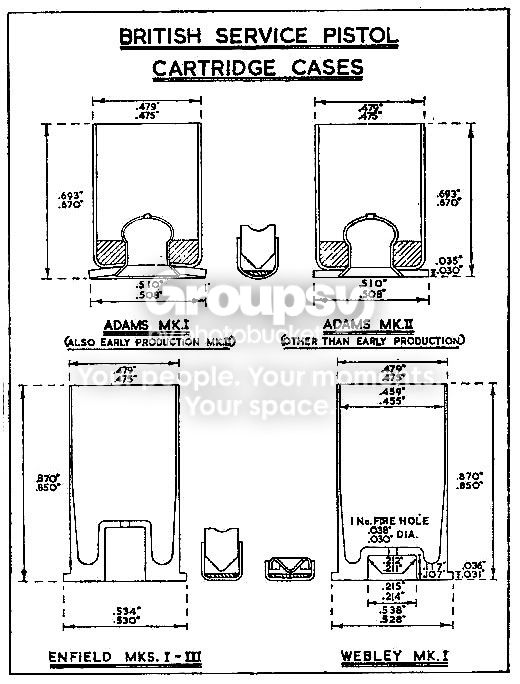
Note that the case-mouth diameter is the same on all of them (even though only the Webley Mark I diagram also gives the inside diameter ....) As for overall case dimensions, note that they are essentially the same for the Enfield and Webley cartridges.
Similarly, note that the effective bullet diameter for all of these service revolver cartridges was .455" -

I own, reload for and regularly shoot a considerable variety of 19th Century British revolvers marked as being .476 and .455 - e.g. Enfield Mark II, Webley No.4 (Webley-Pryse), Webley WG Army, Webley WG Target, Webley RIC New Model, Webley Mark IV - and use the same loads in all of them. Indeed, many British revolvers of that vintage are even marked as being ".455/.476" (or vice versa) -


GrantR is correct of course. The dimension .476" is actually the OD of the brass on .455 Webley, 450 Adams, and .476 Enfield cartridiges (also .45 colt and 45 Schofield).
The ".476" nomenclature is a holdover from the period of cap and ball revolvers, where the diameter of the chamber was the same as the diameter of the bullet.
I have slugged several ".455/.476" and ".476" marked Webley revolvers and found most of them to have groove to groove diameter of between .455-.457", although a few earlier RIC and WG had slightly larger g2g measurements in the .456-.459" range. I have only ever slugged one Colt .476, it was a perfect .455".
I load for a few .476 webley revolvers. My best loads are all soft cast bullets, both hollow base and flat base. There is quite a variance in chamber length in the .455/476 Webely pistols, many of them will chamber much longer brass - I have unaltered RIC and WG that will chamber and fire .45 S&W Schofield cartridges perfectly.
The ".476" nomenclature is a holdover from the period of cap and ball revolvers, where the diameter of the chamber was the same as the diameter of the bullet.
I have slugged several ".455/.476" and ".476" marked Webley revolvers and found most of them to have groove to groove diameter of between .455-.457", although a few earlier RIC and WG had slightly larger g2g measurements in the .456-.459" range. I have only ever slugged one Colt .476, it was a perfect .455".
I load for a few .476 webley revolvers. My best loads are all soft cast bullets, both hollow base and flat base. There is quite a variance in chamber length in the .455/476 Webely pistols, many of them will chamber much longer brass - I have unaltered RIC and WG that will chamber and fire .45 S&W Schofield cartridges perfectly.
Last edited:






















