concentricity gauge

I agree with that. But what if your runout happens while seating. I guess it shouldn't if you trim correctly. I would like to get a better trimmer.
Steve

I just recently had an issue with my seating die causing runout. It's a cheap Lee set for a 22-250. After checking the first couple rounds I realized that I didn't have it set up in the press properly. A bit of adjusting my runout was cut in half ( from 6-7 thou around 3 thou). Without the gauge I wouldn't have noticed. What the gauge also tells me that investing in a better die set would probably help with the run out a little more.

I've also found that a good inside chamfer with a vld chamfer tool and using dry neck lube help ease runout while seating.

As far as a better trimmer goes I have the wilson ultimate trimmer (from sincliars) and it's a nice piece of gear.
 
^^^^^^^^
Bingo. Cheap dies are the biggest problem. Also your case neck thickness may not be the same all the way around which will cause a out of round loaded cartridge .
 
^^^^^^^^
Bingo. Cheap dies are the biggest problem. Also your case neck thickness may not be the same all the way around which will cause a out of round loaded cartridge .


I'm running Lapua brass so I'd say most of the runout problems are due to the cheap dies (not that Lapua brass doesn't benefit from neck turning). In any case it's a perfect example of what the concentricity gauge can show you. Unfortunately it often shows you it's time to spend more money!
 
I'm running Lapua brass so I'd say most of the runout problems are due to the cheap dies (not that Lapua brass doesn't benefit from neck turning). In any case it's a perfect example of what the concentricity gauge can show you. Unfortunately it often shows you it's time to spend more money!

dfrombc, or change your reloading habits..............and a Lee collet die is a "cheap" die that can produce very little runout. (its not cheap dies, it the person pulling the handle of the press)

More ammunition is reloaded with excessive runout for the simple reason that the expander button is locked down off center and pulling the necks off center.

Below is a modified RCBS die to reduce runout, it has a Lee lock ring with its rubber O-ring on its base. It also has a Forster decapping spindle and expander button and only tightened finger tight to allow the die to float in the press and self center.

IMG_2140_zpsea657d9e.jpg


Below on the left is the standard RCBS spindle unit and on the right is the Forster spindle unit. The Forster setup has a thick rubber washer under the locknut that allows the spindle to float and self center. The Forster unit also has the expander button located high on the spindle. This allows the expander button to enter the neck of the case while the case neck is still centered in the neck of the die. With this setup this die is capable of producing resized cases with under .001 runout with brass with uniform neck thickness.

IMG_2141_zps77852ff6.jpg


With a neck thickness and runout gauges you will find out "why" you have runout and how to fix it.

1. Resize a few cases "without" the decapping rod in place and check your runout and neck thickness. Next reinstall the spindle/expander button and check your runout.
2. On a standard die an rubber o-ring can be installed under the spindles lock nut that allows it to float. Most dies if threaded high up on the spindle will allow you to raise the expander button as the Forster unit is.

The majority of your runout is caused by the expander button being off center and unequal case neck thickness.
And by full length resizing you minimize the "steering" effect the case has in centering the bullet in the bore.

Below is a chambered full length resized case, the rear of the case is being supported by the bolt face and by the bullet in the throat of the chamber and the case walls are not touching the chamber. By full length resizing you are reducing the chances of regular off the shelf brass that is of average quality from misaligning the bullet in the axis of the bore. The majority of you do not have custom made rifles with precision aligned minimum dimension chambers capable of shooting bug hole groups. Meaning the majority of you shoot off the shelf rifles and brass and need to find the "bad" average off the shelf cases.

chamber-neck-diagram-with-cartridge2x_zps7395df40.jpg


NOTE: The U.S. military match grade ammunition is to have .003 or less runout. :cheers:
 
dfrombc, or change your reloading habits..............and a Lee collet die is a "cheap" die that can produce very little runout. (its not cheap dies, it the person pulling the handle of the press)

More ammunition is reloaded with excessive runout for the simple reason that the expander button is locked down off center and pulling the necks off center.

Below is a modified RCBS die to reduce runout, it has a Lee lock ring with its rubber O-ring on its base. It also has a Forster decapping spindle and expander button and only tightened finger tight to allow the die to float in the press and self center.

IMG_2140_zpsea657d9e.jpg


Below on the left is the standard RCBS spindle unit and on the right is the Forster spindle unit. The Forster setup has a thick rubber washer under the locknut that allows the spindle to float and self center. The Forster unit also has the expander button located high on the spindle. This allows the expander button to enter the neck of the case while the case neck is still centered in the neck of the die. With this setup this die is capable of producing resized cases with under .001 runout with brass with uniform neck thickness.

IMG_2141_zps77852ff6.jpg


With a neck thickness and runout gauges you will find out "why" you have runout and how to fix it.

1. Resize a few cases "without" the decapping rod in place and check your runout and neck thickness. Next reinstall the spindle/expander button and check your runout.
2. On a standard die an rubber o-ring can be installed under the spindles lock nut that allows it to float. Most dies if threaded high up on the spindle will allow you to raise the expander button as the Forster unit is.

The majority of your runout is caused by the expander button being off center and unequal case neck thickness.
And by full length resizing you minimize the "steering" effect the case has in centering the bullet in the bore.

Below is a chambered full length resized case, the rear of the case is being supported by the bolt face and by the bullet in the throat of the chamber and the case walls are not touching the chamber. By full length resizing you are reducing the chances of regular off the shelf brass that is of average quality from misaligning the bullet in the axis of the bore. The majority of you do not have custom made rifles with precision aligned minimum dimension chambers capable of shooting bug hole groups. Meaning the majority of you shoot off the shelf rifles and brass and need to find the "bad" average off the shelf cases.

chamber-neck-diagram-with-cartridge2x_zps7395df40.jpg


NOTE: The U.S. military match grade ammunition is to have .003 or less runout. :cheers:

Thanks for the info. I like how you've modified your dies.

In my limited experience I've found that my redding bushng dies and co-axe press have always produced very good ammo with very little runout. When I refer to my cheap lee 22/250 set I'm not talking about their collet die. It is their bottom shelf 2 die set (can't remember what's it's called). I've had them forever so I thought I'd see how they would do. Surprisingly enough the gun hovers around 3/4 MOA at 200m with the ammo they produce. If I decide to upgrade I will definently take note of your setup.

 
As others have said it is the Die and brass that make the difference.
I have the Hornady tool. When I first started I was using a Hornady seating die and Win brass. Runout was between 3-5 thou and I would constantly correct rounds with the concentricity tool.
Then I started using Lapua brass and a Redding competition seating die. Runout dropped down to 1 thou or none at all (zero). Over time I kept checking the rounds just to be sure until I eventually stopped using the concentricity tool altogether.
 
Thanks for the info. I like how you've modified your dies.

In my limited experience I've found that my redding bushng dies and co-axe press have always produced very good ammo with very little runout. When I refer to my cheap lee 22/250 set I'm not talking about their collet die. It is their bottom shelf 2 die set (can't remember what's it's called). I've had them forever so I thought I'd see how they would do. Surprisingly enough the gun hovers around 3/4 MOA at 200m with the ammo they produce. If I decide to upgrade I will definently take note of your setup.

dfrombc

You can test any set of full length or neck dies for accuracy, meaning low runout figures by removing the decapping spindle and expander button and check the case for runout after sizing. Now take the same case and resize it again with the decapping unit installed and see if your runout increases. Your worst enemy is brass with unequal case wall thicknesses because they warp when fired and become banana shaped.

And "no" I did not make up the term "banana shaped" for fired cases. And this problem becomes worse with larger diameter military chambers and poorly made brass.

Below is from the NECO website.

runout_zpsfe87d011.jpg


And not to be argumentative but I get the least amount of runout with full length resizing dies (properly adjusted) and the worst from bushing dies with standard factory chambers. It is recommended with bushing dies and a standard chamber to resize the neck with progressively smaller bushings in several steps. If the neck is sized in just one step it will increase the runout due to the neck expanding so much in a standard size chamber and then being reduced by the bushing. Also with a bushing die the necks should be turned because any case neck irregularities will be pushed to the inside of the neck.

Below are just a few of the .223/5.56 dies I have and tested, not shown are a full length set of Lee dies and a Lee collet die. The Lee dies do not allow you to use the same setup I have on my RCBS dies, meaning the expander button can not be made to "float" and self center in the die and reduce the runout. The Lee dies use a different system to lock the spindle and can be locked down with the spindle off center very easily.

dies003_zpsf9af9a52.jpg


NOTE: Any dings or deformities in the cases extractor groove, rim or base can cause the case to tilt in the shell holder on the down stroke of the press and pull the necks off center.
 
Last edited:
flat base bullets can cause runout too….

Actually if a VLD deburring tool with a 22 degree chamfer is used on the inside of the necks your runout will be less with "any" type bullet base. It not the type bullet but how easy the bullet can enter the neck and some people use a type "M" seating die for uniform seating.
 
OK I'll give you my back from the dead answer.

I have the RCBS case mastering gauge and the Hornady gauge and I wish I had the Sinclair Concentricity Gauge.

sinclairgauge_zpse8618264.jpg


Its a better gauge and you want to check the case neck runout after sizing and make sure the die is setup correctly or a case neck thickness problem. Meaning stopping the runout before needing the Hornady gauge to bend the case. NOTE, the Hornady gauge holds the case as if it is chambered in your rifle. Meaning supported by the bolt face and the bullet in the throat, this method will read half of what the Sinclair gauge does

The RCBS gauge was OK for a while, and is the Swiss Army Knife of reloading tools for all it does measure. "BUT" you spin the case on painted aluminum V-blocks and when the paint wears off the brass case drags on the aluminum and you get erratic readings. I have to keep greasing the V-blocks to get smooth readings.

runout003_zpsd19b7cc3.jpg


The Sinclair runout gauge has ball bearings the case rotates on and it will work much smoother. The second gauge I would recommend would be the Sinclair neck thickness gauge below.
This thickness gauge tells you a great deal about the quality and uniformity of your brass. And one turn of the case gives you a better and faster reading than a ball micrometer does.

IMG_2137_zps66bcfc13.jpg


If you want to make straight ammo the two Sinclair gauges and a set of Forster benchrest full length and benchrest seating die are the way to go.
In my opinion the Forster die set is just as good as a Reading die set and much cheaper. "And" the Forster die set makes straighter ammo with its high mounted floating expander.

In a seating die test the inline benchrest seating die like the Forster and Redding seating dies produced the least amount of bullet runout.

Both the above type sliding sleeve seating dies hold the case and bullet in perfect alignment.

Seater_Die_02_zpsolsd3ibr.gif


As you can see above the die chamber holds the case and bullet and thus prevent the case or bullet from tilting during seating.
 
I got to bring this back up because I am considering one now.

Good information Ed, you've used the RCBS and Hornady and preference is Sinclair.

Anyone use the Forster concentricity unit?

Regards
Ronr
 
if the Sinclair gauge cause of the difference in how it holds the brass reads double of the hornady which one is the correct runout number?

would it be the hornady as the Sinclair reads for instance 3 thou up and 3 down as you rotate the case for a total of 6 thou. is the runout 6 or 3?
 
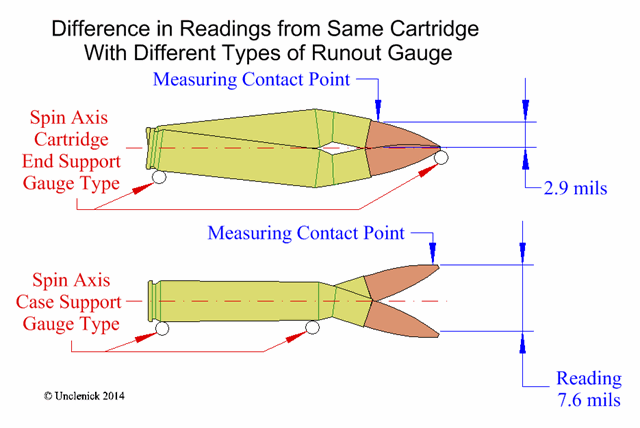
The Hornady concentricity gauge holds the case just like if the case was chambered in the rifle. Meaning with the bolt face holding the rear of the case and the bullet in the throat.

The Sinclair and other concentricity gauges spin the case on its body, "BUT" a full length resized case body does not touch the chamber walls.

If the case has thinner case thickness on one side of the case when it is fired the case can become egg shaped. Meaning the warped case will add to the bullet runout.

Last night I was using a mandrel die to expand and straighten some new .243 cases for reloading. When I checked the neck runout it was all over the place on a runout gauge spinning on the case body. Meaning the "unfired" case body was not perfectly round. "BUT" the Hornady gauge showed very little runout with a bullet seated.

Just remember about full length resizing and the case should fit the chamber like a rat T U R D in a violin case. Meaning a full length resized case has more "wiggle room" to let the bullet be self aligning with the bore.

Bottom line, if your runout gauge spins the case off the body then divide the runout in half.

RunoutGaugeTypesb_zps6cd0e11c.gif


Bullet Concentricity Basics — What You Need to Know
http://bulletin.accurateshooter.com/2016/05/bullet-concentricity-basics-what-you-need-to-know/comment-page-1/

Below was written by German A. Salazar and at his now closed down website. A question was asked about the advantage of "partial neck sizing" and Mr. Salazar is tell the advantages of full length resizing.

Reloading: Partial Neck Sizing
by German A. Salazar
http://riflemansjournal.########.com/2010/06/reloading-partial-neck-sizing.html

"Now the last scenario, a full-length sized case in which the neck is also fully sized. There is clearance at the neck and in the body of the case, the closest fit anywhere is the bullet in the throat. If the neck to bullet concentricity is good (although it needn't be perfect), then the bullet will find good alignment in the throat and the case body and neck will have minimal influence. Let's not forget that the base of the case is supported by the bolt face or the extractor to a certain degree as well; this is yet another influence on alignment. As you can see, there are several points from base to bullet that can have an effect. My procedure is to minimize the influence of those that I can control, namely the case body and neck, and let the alignment be dictated by the fit of the bullet in the throat and to some extent by the bolt's support of the base. Barring a seriously out of square case head, I don't think the bolt can have a negative effect on alignment, only a slightly positive effect from minimizing "case droop" in the chamber. Given that a resized case will usually have a maximum of 0.001" diametrical clearance at the web, this isn't much of a factor anyway."


And as you can see above if the case body does not touch the chamber walls then any misalignment from the case body and the bullet in the bore is greatly diminished.

The U.S. Military considers .003 or less bullet runout to be match grade ammunition and a Forster full length die will produce this all day long.
 
I just recently had an issue with my seating die causing runout. It's a cheap Lee set for a 22-250. After checking the first couple rounds I realized that I didn't have it set up in the press properly. A bit of adjusting my runout was cut in half ( from 6-7 thou around 3 thou).

What was the set-up issue with the die?
 
I have the Sinclair runout gauge. When I bought it and checked all my ammo which was loaded on various Lee, rcbs and redding dies, nothing fancy like the competition dies just the normal ones, I found tat out of 7 die sets only one was making straight ammo. It was a Lee set in 223. It consistently had 5 thou or less needle movement with half of them 3 thou. Divide that by 2 to get ur total runout number I am told. All the rest had 8 thou and the odd shell up to 12. Divide by 2 again for the actual runout. 5 thou actual runout u can see the bullet wobble by eye. Using the gauge I have corrected most of it down to acceptable levels. I have not played around with o rings under the spindles yet but I have cracked some of the threaded ones loose so they can self center. I had one Lee die there the expander button was rough on one side, not polished nice, but just on one side. It pulled necks crooked every time. I polished out the roughness and it fixed it. I also used to dab sizing lube into the case on just one side. I am using hornady unique or redding imperial sizing wax. There very close. I would put that dab of lube to 12 o'clock for the first, 6 for the second, then 3 then 9 to keep the sizing button lubed. It was not enough. The dry side would pull the neck crooked. I started dabbing 2 dabs in each neck opposite of esch each other. And stagger that so the lube is distributed evenly. That works a lot better.


Then I still had issues with my 204 rcbs dies. I got a Lee collet die. It makes perfect straight necks. Still I has up to 7 the odd time 8 thou needle movement so 3.5 to 4 though total runout. It drove me nuts. I bought a forester ultra bench rest seater which like the redding bench rest holds everything in alignment before seating. It helped but it was still more than this 100$ die should have. Long story short it turned out being the #### ty Remington brass. Neck thickness variances were all over the place. I don't neck turn so tat is what it is. The brass with bad neck variations were the crooked ones as one side will have more neck tension than the other and makes crooked ammo. So here I wait and am still waiting for lapua to make 204 brass. Beats me why they make 20 tactical and not 204.
 
Then I still had issues with my 204 rcbs dies. I got a Lee collet die. It makes perfect straight necks. Still I has up to 7 the odd time 8 thou needle movement so 3.5 to 4 though total runout. It drove me nuts. I bought a forester ultra bench rest seater which like the redding bench rest holds everything in alignment before seating. It helped but it was still more than this 100$ die should have. Long story short it turned out being the #### ty Remington brass. Neck thickness variances were all over the place. I don't neck turn so tat is what it is. The brass with bad neck variations were the crooked ones as one side will have more neck tension than the other and makes crooked ammo. So here I wait and am still waiting for lapua to make 204 brass. Beats me why they make 20 tactical and not 204.

I hear ya prairie lover. (I use the Lee collet neck dies as well.) Was using Federal brass here and had all kinds of issues with seating depths and seating forces which got me into neck turning to remove the variability in the process. Neck thickness variation was considerable using this brass but PRVI and Lapua are much more consistent.

Interesting point about the bench rest seater...I want to test the concentricity with how things are here to indicate whether a seating die like that is worth it and if investing in one would provide any improvement. Further I'd like to recreate non turned brass dummy loads to indicate whether neck turning has an effect on concentricity. (I also have a lot of once fired 303br brass I'd like to run to see if it's worth re using.)

I am hypothesizing here but I think the neck turned brass will produce more concentric ammo...and that the bench rest seater may not provide significant runout improvement.:eek:

Regards
Ronr
 
My redding comp seater made very concentric 6.5 rounds before I started neck turning. I should do a comparison now that I'm all fancy and turning......

GGG
 
Your normal seater is rather loose inside. The forester bench rest is rather tight holds the bullet straight and only then begins to seat it. It should not make the runout any worse on good brass then the neck already is. The normal seating dies can and do to a small degree. The main thing is to have a straight neck before you seat a bullet.
 
My redding comp seater made very concentric 6.5 rounds before I started neck turning. I should do a comparison now that I'm all fancy and turning......

GGG

I value that insight GGG and it's good to know. I'm likely barking up the wrong tree but I'll find out. ;)

Your normal seater is rather loose inside. The forester bench rest is rather tight holds the bullet straight and only then begins to seat it. It should not make the runout any worse on good brass then the neck already is. The normal seating dies can and do to a small degree. The main thing is to have a straight neck before you seat a bullet.

Rodger that!

Regards
Ronr
 
Back
Top Bottom