Controlling muzzle jump at the bench.

I’ve noticed point of impact changes when I change just about anything in relation to how the gun is held in all of my rifles…a lighter gun in a bigger cartridge just makes a more noticeable change.
Using a bipod shots land different than using a front rest which lands differently from holding the forend to using both hands to cradle the butt stock.
Some show substantial differences, some not so much and all in their own use can produce good groups for me but to expect a rifle to deliver the same payload to the same address regardless of the hold (without a scope adjustment) has never proven out for me.
On the bench with a hunting rifle I always shoot it as I would likely shoot it in the field; the only thing the gun is touching is me.
I’m right handed so the butt stock is in my right shoulder pocket, my right hand is doing the work and my left hand is holding onto the forearm with the back of my left hand resting on a sandbag with both elbows touching the bench. Before I brake a shot I relax my grip, if the cross hairs move I know I’m torquing the gun and the group will open up, my best groups are when the cross hairs remain in the same place and I reset that after every shot.
This is stable and repeatable for me.
I’ve found a light snappy gun and the anticipation of knowing what’s coming can provide an opportunity for bad habits to show up which can just kill group size…if I can’t mitigate the recoil to a manageable amount (brake/butt pad/load/etc..) my best defence has been to recognize it and focus on fundamentals while shooting smaller strings (3 rounds max) with longer time between strings and less strings in a day.
I also take a few other rifles that are comfy and confidence inspiring to shoot in between.
I definitely recommend practicing different positions and holds on a hunting rifle once the load is figured out to know what works, what doesn’t and the limitations of the various options as it builds confidence which leads to success.
 
Sitting behind your rifle instead of beside it helps a ton, but 90% shooting benches aren’t laid out in a way to allow for it.
Well put, all of my local ranges have benches that put the shooter in a bladed stance. I have to shoot off the ground if I want to be square to the rifle.
 
I use the bench only to work up loads or zero a rifle.
After that, the rifle is shot for practice in the same positions I would use while hunting- prone kneeling and standing, and using my mono pod.
Shooting a hunting rifle continually from the bench only at the range serves no purpose at all except to burn up ammo IMO

 Cat
 
Last edited:
Have been shooting a 6.5lb M700 358Winchester at the bench. It has been shooting well enough as I have learned over the years that I have better results with a lightweight rifle by holding the forend on the bag. This rifle has been the same but every once in a while it gets away from me and torques skyward at the shot landing 3" up and away.

I have seen shooters on line and at the club place downward pressure on the front scope ring and am wondering if this might be a more consistent hold giving better results.

Scroll to 7:30


(y)(y)(y)
 
“Special gear”?
special to bench shooting, not hunting related
Enough to matter in the field?
certainly possible, so needs to be tested and proven,


I think what you mean is... how many hunters practice from field positions. Mechanical zero is just that. The fact someone applies poor technique in the field to affect POI does not change the zero of the rifle.
correct. i was thinking 'poi' and wrongly said 'zero'
 
On the bench with a hunting rifle I always shoot it as I would likely shoot it in the field; the only thing the gun is touching is me.
I agree, thus the reason why I would hold the forend at the bench (for a LW recoiling rifle) as that is the way I would shoot it in the field.

I found that a heavier rifle of lesser recoil would not require the same technique.
 
When I was working up 225 grain and 250 grain loads for my Model 70 Winchester in 338 Win Mag, I settled on holding the forearm as if I was "offhand", but resting the back of that hand on the front sandbag. The rifle butt was tight into my shoulder. I would usually fuss to get the rabbit ear rear sandbag to support the butstock behind the trigger. The rifle had been getting away on me (as in jump off the sandbags and table) previous to that. For my Ruger No. 1 in 7x57, I found it shot best with one sandbag under the receiver - directly in front of the trigger guard - nothing supporting the fore-end at all.
 
For the poster who mentioned "hunched over" at a bench - many years ago there was pictures in an article in a magazine (Guns and Ammo?) of old guy Elmer Keith "bench resting" a 458 Win Mag rifle - he used multiple sandbags - no "hunching over" - he wanted to be as erect as he could be so that his upper body could "rock" and flex backward with the recoil. I used similar for 338 Win Mag and 9.3x62 - much more comfortable.
 
Interesting thread. I've never shot my lightweight rifles any different than I would my regular weight rifles. Most of the time when I'm shooting off a bench it's off a front sand bag only. I feel this simulates a hunting situation the best like shooting off my pack, the rail of my tree stand, a fence post, etc.
I go a step further and have my hand under the rifle, resting on the sand bag. It's a hunting rifle; I want to know how it shoots in a hunting situation. And in a hunting situation, my hand is always under the fore-end, resting on whatever is available.

I’ve noticed point of impact changes when I change just about anything in relation to how the gun is held in all of my rifles…a lighter gun in a bigger cartridge just makes a more noticeable change...Using a bipod shots land different than using a front rest which lands differently from holding the forend to using both hands to cradle the butt stock...On the bench with a hunting rifle I always shoot it as I would likely shoot it in the field; the only thing the gun is touching is me.
I’m right handed so the butt stock is in my right shoulder pocket, my right hand is doing the work and my left hand is holding onto the forearm with the back of my left hand resting on a sandbag with both elbows touching the bench. Before I brake a shot I relax my grip, if the cross hairs move I know I’m torquing the gun and the group will open up, my best groups are when the cross hairs remain in the same place and I reset that after every shot.
This ^ absolutely.

I use the bench only to work up loads or zero a rifle.
After that, the rifle is shot for practice in the same positions I would use while hunting- prone kneeling and standing, and using my mono pod.
Shooting a hunting rifle continually from the bench only at the range serves no purpose at all except to burn up ammo
This ^ too!

When I was working up 225 grain and 250 grain loads for my Model 70 Winchester in 338 Win Mag, I settled on holding the forearm as if I was "offhand", but resting the back of that hand on the front sandbag...For my Ruger No. 1 in 7x57, I found it shot best with one sandbag under the receiver - directly in front of the trigger guard - nothing supporting the fore-end at all.
Yup. I've found that most of my singleshot rifles shoot their best with a soft rest (sandbag) in that far-backward position. So that's how they are shot to work up a load. After that, I hold them just like every other hunting rifle, i.e. with my hand between the fore-end and whatever rest is available...the way they will be shot while hunting.

The only rifles that I shoot off an attached bipod or tripod are the ones that I will only ever shoot that way, i.e. a couple of target-only, range-only guns I have. But almost all my rifles will be shot in the field, and once a load has been established off the bench, I'll check the zero from a hunting position and might adjust it to suit. I do use shooting sticks and tripods a lot while hunting...but they're not attached to the rifle, and as always, the rifle rests on my hand which rests on the support.
 
I didn’t know what a 358 winchester was so I just gave it a google to find out it’s a necked up 308 case(which makes sense now, lol). I thought it was some kind of big heavy magnum for some reason. Judging by the weight of your gun I’m guessing it’s a fairly thin and short barrel?

I have the best results shooting from a bipod with just enough shoulder pressure to load the bipod. My trigger is set fairly light, I think around 2 pounds or a little less. Soft grip and the less torque or touching the rifle the better. I try and stand around the rifle and let it do it’s thing instead of trying to muscle it in any way or hang on.

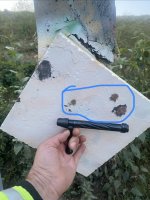
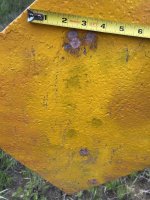
This rifle is fairly new and I haven’t shot it very much, but here’s a couple groups I just shot at 300m(yellow plate) and 500m (white plate). The rifle is a 7saum shooting 168 barnes lrx at 2750fps. The bare rifle is under 6 pounds, not sure what it is with optics. I actually dialed my load back a bit and gave up some performance so it was easier to shoot. Maybe it’s a figment of my imagination, but I also find magnum powder like h1000 to have more of a push than something like h4350 which feels like a snap in a magnum. IMG_7557.jpegIMG_7158.jpeg
 
^ ^ All of the above of jjohn's post, with the caveat of using a VERY Tight hold, like pulling down when shooting offhand or w- a shotgun. More control of recoil, opposed to the 'artillery hold' like used in springer-pellet guns.
My 22cals I shoot with 'almost free recoil', using a 'trigger-pinch' on those rifles that allow it. I have 3-4 rifles with sub 2# triggers that can do that.
 
I run a strap through my sling swivel that attaches to my front bag. Seems to keep it in place.
I had read of an idea to put the front strap ahead and hang over front edge of shooting table - suspending a weight - I never tried it. It was alleged to prevent the gun from coming back on shooter in recoil and prevent muzzle from going up, but had capacity to move - was not "solid". I suppose that strapping to the front sandbag would have similar effect - at least for the "going up" part.

It all probably relies / depends on the security of the front strap swivel to hold into the fore-stock.
 
This discussion is of interest to me - I built an enclosed "shooting shack" - the idea of it is to fire through a port in the wall - the rifle's muzzle wilI be outside the wall - I did not know how tall to make the port - I do intend to fire healthy rifles through there - 338 Win Mag and 416 Rem Mag are the "buckiest" that I have at the moment.
 
I don't know if SuperCub is using any type of rear bag/support other than his shoulder. Hunching over the rifle has been mentioned a couple of times. I see this happen when shooters "stock walk" to get their head close enough to see through the scope. Also when they are really trying to control recoil and rather than be truly behind the rifle they force their body weight forward and wind up slightly on top of the buttstock. The downward pressure both of these scenarios create coupled with no rear support cause the front of the rifle to jump up as the rifle recoil takes the path of least resistance and drives the rear of the rifle back and down and the front of the rifle jumps up. I am not suggesting rear support to prevent this but rather adjusting your shooting form/position to be truly behind the rifle, similar to the reference to Elmer Keith in an earlier post. Having your upper body get pushed straight back is a bunch more pleasant than getting smacked in the jaw when the rifle jumps up as well. I find mounting my scope higher also helps me to be behind the rifle with less downward pressure on the rear of the stock.
 
I don't know if SuperCub is using any type of rear bag/support other than his shoulder.
I use an adjustable stable front rest and a leather rabbit ears sand bag for the rear. It has always been my habit to sit as upright as possible. This allows the body to move with the recoil as opposed to being hunched and anchored behind the fired rifle.

I don't find this rifle to be excessive recoil wise but it does like to fly off the front rest when fired.

Up next are a good batch of Speer 250s.
 
Back
Top Bottom