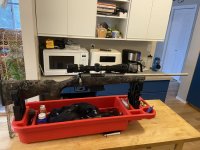
Controlling muzzle jump at the bench.

Hmmm I wouldn’t call that a win, if you need to find out what pressure she likes and then need to find out how to duplicate that same pressure every shot… all my rifle are shot the same way even the 6lbs one when at the bench, metal adjusting support with cradle bag and a sand bag at the rear with a rabbit hears bag on top, I make sure the forehand is resting firmly on the front rest and that the front sling swivel stuff ain’t in contact with the rest, the back is the back, I get behind the rifle as square as I can and bring the rifle into my shoulder pulling with my hand that is on the forehand not my trigger hand. About that trigger hand I try keeping it relax but with a consistent grip making sure I don’t do any torquing what so ever and that is also really important through out the entire firing process. Light rifle need a light touch including cheek weld, you don’t want to push your face onto the stock. Front bag has to be coushy! That is what I do and my shooting did improved quite a bit!
That is exactly the same technique I use to shoot most rifles.

This 358 is a likes to fly a bit and thus seems to need a different approach. The fun is figuring it out. :)
 
  • Like
Reactions: DGY
I find it hard to get downward pressure on the scope in a lot of field shooting positions often I’m using that hand to make the rest. Easy to do it on the bench. Mind you this method is all over the internet so it must be working for some people.

I had muzzle flip on my lightweight rifle and it helped to change the stock to something with less comb drop. Initially I used a clamp on muzzle brake that controlled my muzzle flip. I think I also just got used to shooting it and I just let it go. I get decent results. killed 7 or 8 big game animals with that little rifle.

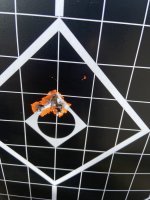
5 shot group in the picture below. 308 winchester either 130grain ttsx or 165 grain SST
 

Attachments

  • IMG_0549.jpeg
    IMG_0549.jpeg
    119.4 KB · Views: 9
  • IMG_9712.jpeg
    IMG_9712.jpeg
    98.4 KB · Views: 8
Last edited:
  • Like
Reactions: DGY
I use a rock rest and a rear bag which i picked up last year when i got into shooting off the bench at the club. When I started i would wrap my left hand around the stock and then started moving it further down the rifle when I found my best groups resulted from wrapping my hand over the front scope ring gently. I find it really helps stabilize the rifle. As mentioned in the video I am at the point now where I feel my heart beating and am so much more aware of my breathing. In a way I always thought good accuracy came purely from a good rifle. I still go out and have good days and poor days but its all me.
 
Last night I was testing out some new ammo in my Sako A7, 300 WSM, the Federal Premium loaded with Barnes TSX 165 grain bullets. I used a rear bag, front rest with legs, positioned the front rest rearward enough I could comfortably firmly hold the front of the stock and pull it rearward into my shoulder. Got the best groups out of my rifle ever, very little movement between shots, next to no muzzle jump.
 
Last edited:
Here's a tid bit of info regarding that 358. I decided to double check the action screws and found that they were only snug not torqued. This might be the source of the horizontal groups. Oopsie. :)

Update pending ..........
 
Here's a tid bit of info regarding that 358. I decided to double check the action screws and found that they were only snug not torqued. This might be the source of the horizontal groups. Oopsie. :)

Update pending ..........
It happens… on my free 300wim mag mod70 I torqued the front action screw with the bolt in… the screw bottomed out on the bolt lug, I thought all was good, rifle shot poorly. After redoing the stock, bedding the action etc the rifle still shot somewhat poorly, anyway I decided to give the rifle a good clean up, bore and bolt, so I remove the bolt, disassemble the bolt, clean all good, while the bolt was out I thought let’s have a look at the screws, the front action screw was just snug so I thought let’s tight her up, torqued it real good, went back to the bolt reassemble the bolt put it back onto the rifle and the bolt wasn’t closing anymore I thought fyck I fvcked up the bolt…. No the front action screw was protruding into the lugs raceway… took the bolt out filed it down put it back retorqued it put the bolt back all close well and 1” groups followed !!!
Hmmm that was a lot of writing for noting….
 
It happens… on my free 300wim mag mod70 I torqued the front action screw with the bolt in… the screw bottomed out on the bolt lug, I thought all was good, rifle shot poorly. After redoing the stock, bedding the action etc the rifle still shot somewhat poorly, anyway I decided to give the rifle a good clean up, bore and bolt, so I remove the bolt, disassemble the bolt, clean all good, while the bolt was out I thought let’s have a look at the screws, the front action screw was just snug so I thought let’s tight her up, torqued it real good, went back to the bolt reassemble the bolt put it back onto the rifle and the bolt wasn’t closing anymore I thought fyck I fvcked up the bolt…. No the front action screw was protruding into the lugs raceway… took the bolt out filed it down put it back retorqued it put the bolt back all close well and 1” groups followed !!!
Hmmm that was a lot of writing for noting….
I had the reverse problem. I replaced the dovetail bases on my HVA 1640 with weaver bases, and the screws that came with them were the right thread pitch and diameter. Imagine my (unpleasant) surprise when a heretofore smoothly kachunking Mauser-style bolt had to be forced to cycle. And had an evident score along the top side. Turned out the screws protruded into the inner diameter of the rear ring by about EDIT: damn talk-to-type: 13 thou. I couldn't find ones with the right length with the right head locally, so I chucked them up in the lathe and turned them down. What a lot of effort for 16 thou worth of metal :|
 
Last edited:
  • Like
Reactions: DGY
So I was at the range yesterday with the 358. Had three different loads (of 4 shots ea) that showed promise before. Shot the 3 batches with my hand firmly over the front scope ring. This method does a great job of controlling muzzle jump and is quite easy to prepare for the shot with little movement in the scope. All shots were fired off the front rest with a rabbit ears bag in the rear.

Results .... The original vertical stringing was completely eliminated but the loads were now showing horizontal dispersions up to about 2.5". Not sure if this is a win or not.

Maybe the technique needs to have less pressure applied to the front ring. Another option is to shoot the rifle off front sand bags with the forend held by hand instead of holding the forend while using the mechanical rest.

Thoughts?
Where do you have the front rest in relation to the front action screw? Is it closer or further away?
How do you shoot this rifle when not on the bench? Where is your hand on the fore end?
Also…and asking for a friend…where is your thumb? ; )

R.
 
  • Like
Reactions: DGY
I understand "mag-na-porting" addresses muzzle jump (though apparently not recoil.) I imagine your issue is compounded by the light weight of the rifle in this fairly substantial calibre.

You could always take this fella's approach. "Muzzle jump? What muzzle jump?":
 
Last edited:
I understand "mag-na-porting" addresses muzzle jump (though apparently not recoil.) I imagine your issue is compounded by the light weight of the rifle in this fairly substantial calibre.
I had a 375 magnum magnaported a few years ago. It worked very well to control the dreaded jump.

I've had other lightweight rifles that did the same and found that holding the forend on sand bags helped a lot. I wanted to try a light pressure on the front scope ring to see how that would work and found that method completely eliminated vertical stinging. I will continue to use this method for this and similar rifles.

As for that 416, I'd bet that holding the forend would change the POI. That's a very nice classic rifle.
 
All i will say is, ive known many shooters who had "issues" they couldn't resolve and nothing they tried "fixed" their groupings. Then i put a dummy round in their rifle and told them to fire at the target and i and they saw some pretty serious flinching. Its sort of taken as an insult but flinching effects literally everyone if you shoot big calibers in light guns. I flinch, you flinch, we all flinch, its a matter of whether we are flinching more than we think or admit we are. A fraction of a mm flinch can result in a 3 inch miss easily at 100...get a buddy to load your mag for you and include 1 dummy round at their discretion, sometimes loading one sometimes not...the results can be embarrassing but they can also potentially help you address another real problem many of us are afraid to admit we may have...costs nothing and worth a try. Also a funny gag to pull on someone who needs some humbling.

Again, not calling you a flincher, but its funny the lengths SOME will go to explain odd groups, before even beginning to think about this...
 
During the first minutes of the Spooner video above, he is "Bench shooting" that rifle from sandbag rests - he is using about the same hold as I did with my Winchester MODEL 70 in 338 WIN MAG - and he was getting about the same results. As in, the rifle often "jumped off" the front sandbag holder. So my question - how high is that muzzle end of barrel going up? My "shooting shack" has a port through which I intend to fire from an interior "shooting table" - but I do not know how tall to make the port - currently I have circa 7" (not quite 18 cm) clearance - is that enough? Too much?

I suspect that I will want to be back far enough from the wall with the front sandbag, that my off hand can hold the rifle forearm down - either by holding the forearm in front of the sandbag or the back of that hand resting against the sandbag - but, so far, the idea is that the muzzle of the rifle will protrude through the wall. I believe that the 338 Win Mag and the 416 Remington rifles will "jump", if I let them (maybe even if I try to hold them down?) - but I do not want those barrels to hit the top edge of the port. I have not noticed the issue of "jumping off the sand bag" with the Husqvarna 9.3x62. At the moment, the 416 Remington (400 grain Woodleigh RNSN bullets) is the "biggest" boomer that I have - I had sold my 458 Win Mag barrel some time ago.
 
Another aspect of muzzle jump (and recoil) is stock design. Drop at the heel improves the reflex "birdgun-like shoulderability/pointability" but contributes to muzzle jump. Straight-back stocks as many are today (better for scopes) help with muzzle jump but hinder handling, apparently. Seems there is no perfect world.

Here's the same fella as in the vid posted above with the same calibre rifle by the same maker only in this one a modern version with a more straight-back stock. Compare the scenes shooting at the bench and note how the muzzle jump is tamed over the previous vid of the vintage gun by the stock design on the modern one.
 
Last edited:
^ Ok so 7 lbs even with a fill mag I'd say.
That's still pretty light.

Fwiw that worst rifle I've ever played with on the bench was a M1895GS Marlin Guide Gun, with the short 18-1/2" barrel. Wicked recoil characteristics with full loads (which naturally I was cranking them too high).
With that rifle I had to try to hold down the barrel.
Once Marlin brought out the M1895XLR with the 22" barrel I got that and sold the M1895GS. Vastly superior recoil characteristics with the longer barrel.

I've never gone for trying to create a lightweight rifle. And most of my rifles end up in the 8lb+ range without even trying, so right on up to .30-06 I can generally hold them conventional rear bag style, where I'm not bothering to reach forward to control the barrel.
Once I get into the .300H&H, .338WM then I find reaching up with my left hand helps.

I just go forward of the scope.
 
I've never gone for trying to create a lightweight rifle.
Lightweight was not my goal here as well. I just used what I had on hand and went with a std 700 contour. The stock is a Brown Precision so that saved a lot of weight. Recoil isn't all that bad, it's just jumpy. I wish I had gone with a longer bbl at 23".

Next up are the Speer 250gr HCs. :)

.
 
Back
Top Bottom