














































I don't think you'll regret getting this pistol .... so what if the round might be considered "anemic" by some? How much power does one need to punch a hole through a paper target?
As others have mentioned, owning one of these military-surplus pieces can open up an entire subsidiary collection: i.e. picking up the correct holster(s) and other web gear, accessories, and such .... This stuff is still quite readily available, often in "unissued" condition ...
(Hopefully, however, you won't get quite as carried away as I did. I previously had much more interest in 19th century and earlier firearms, and never gave much thought to 20th century designs, let alone anything as "newfangled" as a semi-automatic handgun. I did think that if I ever got one, however, it had to be a WWII Canadian-made Inglis High Power. After I finally got a nice Inglis, I decided I should acquire a nice WWII web holster and belt for it ... then discovered how many different holster designs (WWII and post-war) there are, and how many other items of webbing there are. Now I have a virtually complete collection of Pattern 1937 Web Equipment (plus every later 20th century pattern of web holster for the Inglis) and a whole swack of other accessories and equipment for the Inglis and the various other 20th century Canadian and British military handguns I subsequently succumbed to acquiring ....)
A sampling of items which would go with your revolver:
The "piéce de resistance", so to speak, for a "tanker" Enfield revolver ..... a "Case, pistol, R.A.C." (Royal Armoured Corps) along with an illustration from the original Pattern 1937 Web Equipment manual showing how it was worn (click thumbnails to enlarge) -


This oddball bit of kit was introduced at the same time as all of the other Pattern 1937 web gear, and the low slung design was intended to minimize "hang ups" in armoured vehicles and when going through their hatches. In fact it turned out to be less than efficient in that respect, and rather unpopular, so a modified pattern was adopted -

A great many of the first-pattern holsters were cut down to this simplified pattern, so the original configuration is rather uncommon and quite expensive - you could expect to pay more for an original first pattern "tanker holster" than you did for your revolver!
In fact, as I mentioned in an earlier post, although the spur-less revolvers are generally referred to as the "tanker model", all military-issue Enfield revolvers were made that way from late 1938 on. The absence of a hammer spur is the most distinctive feature of the Mk I* version, officially adopted in June 1938, at which time the relevant War Department "List of Changes" entry included the following: "Mk I No. 2 pistols will be converted to Mk I* pattern as and when they pass through Ordnance Factories for repair", and also ".... the Mk I pattern is hereby declared obsolescent."
Accordingly, the chances of a Mk I* Enfield revolver actually having been carried by a "tanker" are pretty low - most likely it was used by one of the much larger branches of the Army, such as Infantry, Artillery, etc. In that case it would have been carried in a standard P'37 "case, pistol" like this:

The P'37 Web Equipment had two configurations in which this flapped holster would be worn. Here they are, again from the original manual (although not showing various "universal" items such as the haversack, water bottle carrier, etc.) On the left, the "Set for Officers, W.O.s and certain N.C.O.'s", with pistol case, ammunition pouch (above the pistol case), binocular case and compass pouch. On the right, the "Set for Personnel armed with pistol only" (this would be enlisted men in roles such as dispatch rider, driver, etc.)


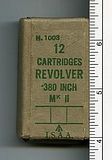
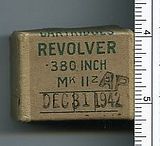
Original WWII military-issue cartridges and boxes - here are the two commonest configurations (which actually use the same label) - on the left a flat, shallow box which holds the twelve cartridges in two layers of six, and a more cubical box which holds the cartridges vertically -
As others have mentioned, owning one of these military-surplus pieces can open up an entire subsidiary collection: i.e. picking up the correct holster(s) and other web gear, accessories, and such .... This stuff is still quite readily available, often in "unissued" condition ...
(Hopefully, however, you won't get quite as carried away as I did.
I previously had much more interest in 19th century and earlier firearms, and never gave much thought to 20th century designs, let alone anything as "newfangled" as a semi-automatic handgun. I did think that if I ever got one, however, it had to be a WWII Canadian-made Inglis High Power. After I finally got a nice Inglis, I decided I should acquire a nice WWII web holster and belt for it ... then discovered how many different holster designs (WWII and post-war) there are, and how many other items of webbing there are. Now I have a virtually complete collection of Pattern 1937 Web Equipment (plus every later 20th century pattern of web holster for the Inglis) and a whole swack of other accessories and equipment for the Inglis and the various other 20th century Canadian and British military handguns I subsequently succumbed to acquiring ....)A sampling of items which would go with your revolver:
The "piéce de resistance", so to speak, for a "tanker" Enfield revolver ..... a "Case, pistol, R.A.C." (Royal Armoured Corps) along with an illustration from the original Pattern 1937 Web Equipment manual showing how it was worn (click thumbnails to enlarge) -


This oddball bit of kit was introduced at the same time as all of the other Pattern 1937 web gear, and the low slung design was intended to minimize "hang ups" in armoured vehicles and when going through their hatches. In fact it turned out to be less than efficient in that respect, and rather unpopular, so a modified pattern was adopted -

A great many of the first-pattern holsters were cut down to this simplified pattern, so the original configuration is rather uncommon and quite expensive - you could expect to pay more for an original first pattern "tanker holster" than you did for your revolver!
In fact, as I mentioned in an earlier post, although the spur-less revolvers are generally referred to as the "tanker model", all military-issue Enfield revolvers were made that way from late 1938 on. The absence of a hammer spur is the most distinctive feature of the Mk I* version, officially adopted in June 1938, at which time the relevant War Department "List of Changes" entry included the following: "Mk I No. 2 pistols will be converted to Mk I* pattern as and when they pass through Ordnance Factories for repair", and also ".... the Mk I pattern is hereby declared obsolescent."
Accordingly, the chances of a Mk I* Enfield revolver actually having been carried by a "tanker" are pretty low - most likely it was used by one of the much larger branches of the Army, such as Infantry, Artillery, etc. In that case it would have been carried in a standard P'37 "case, pistol" like this:

The P'37 Web Equipment had two configurations in which this flapped holster would be worn. Here they are, again from the original manual (although not showing various "universal" items such as the haversack, water bottle carrier, etc.) On the left, the "Set for Officers, W.O.s and certain N.C.O.'s", with pistol case, ammunition pouch (above the pistol case), binocular case and compass pouch. On the right, the "Set for Personnel armed with pistol only" (this would be enlisted men in roles such as dispatch rider, driver, etc.)


Original WWII military-issue cartridges and boxes - here are the two commonest configurations (which actually use the same label) - on the left a flat, shallow box which holds the twelve cartridges in two layers of six, and a more cubical box which holds the cartridges vertically -


Last edited:























