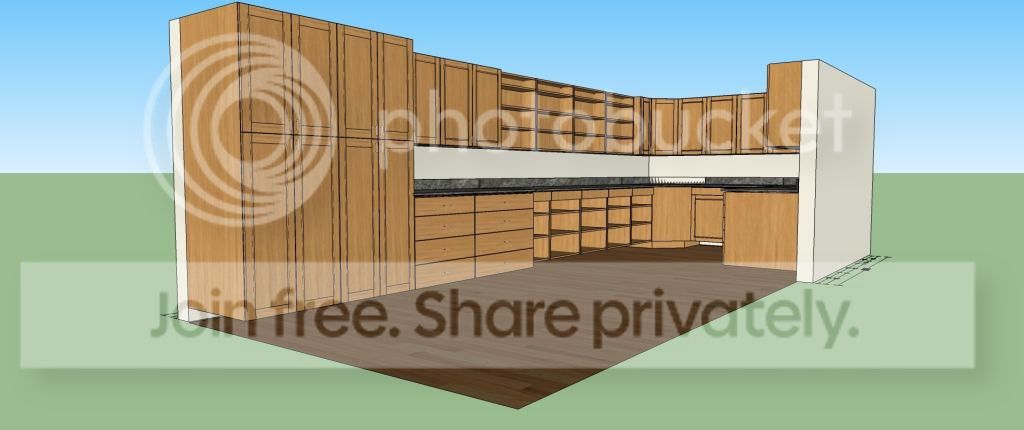
Custom Reloading Bench

Latest revision

Truly a "Cadillac" design...can I come play when you get that monster all kitted with press's, tooling, loading supplies... cuv it's gonna hold a pile of "goodness" .

A suggestion if I may...the top drawer, use it for die storage. I would cut a false floor to fit and cut a couple hundred (Just thinking ahead...) 15/16 holes in it. place the false floor high enough that a die will sit in it resting on the "locking ring". If the drawer is deep enough a similar stand affair could be made to hold tool heads (sans the measures) for your progressives.
 
You show and mention a rather wide measurement for the drawers. I'd suggest that it's going to be tough to make 36 inch units that are strong enough to avoid flexing and distorting given the heavy nature of the metal parts we use. Also the counter top is really only supported well by the uprights and can flex in between.

Also when I was picking a width for the lower units I calculated a few sizes that were easier to get the most use out of a sheet of plywood. So when I opted for making my own lower units after a bunch of figuring I went with 19.5 inch outside width and using 5/8 prefinished plywood. I wanted a stable and sturdy top well supported to both the wall and floor. I'd happily have gone with 24 to 25 inch units but the cutting proved to just not work well with the sheet layout. I was always looking for another 3/4" or so more width or length.

The resulting drawers after allowance for the stock thickness and slides ended up being a little wider than 16 inches. So my units are basically half the width of what you're considering. And as it is by the time I've loaded up the drawers with tools, dies, press bits and other things they are coming out about as heavy as I would ever want. It was more work to make them of course. And I used double the number of slides compared to what you're planning at this point.

One reason I limited my choice to something like 18 to 24 inch wide lower units is that even with good quality slides a drawer which is a lot wider than it is long tends to want to wrack the slides as it moves in and out. So it's seldom smooth to open and close unless pulled or pushed directly from in front. With my drawers that are more narrow they can be pulled or pushed from just about any angle and move with no fuss. So I'd suggest some re-consideration on the idea of 36 inch width units with 23.5 or 19.5 being better options. If you're planning on making your own units some calculating for cutting will quickly show how to get the most with the least waste from the sheets.

It was this most product with the least waste that also led me to make the lower cabinets as cabinets only with no integral base. Instead I built up 3.5" ladder bases that were put in place and shimmed to height and leveled. This let me get the lowers to the right height while getting an honest 6 side panels from a single sheet with just a few small strips as waste.

Before you commit to a 36 inch wide unit I'd see if you can find one in a kitchen store. Try opening and closing it from other than directly in front with direct pulling. Instead try standing off to one side and pull on the handle at an angle and close it the same way. I think you'll find that it seems enough off that it'll make you reconsider. And if you need anything else to add to the test consider what it'll be like with 30lbs of tools and other stuff in it. I think you'll end up switching to the idea of 23.5" or the same 19.5" units that I did.

If you decide to stick with the 36 inch units anyway I'd suggest using 1/2 or even thicker for the drawer bottoms. The typical light duty bottoms found in regular kitchen cabinets just won't stand up to what we're using them for. And with the support from the sides being that much farther between the sides you WILL want to go with a double layer of 3/4 that is glued and screwed or well screwed in a pattern to "sew" the two layers solidly together. Otherwise there will be too much flex. And even so I'm thinking that you'll want to use a strengthening stiffener where the press will be. It's surprising how even 1/5 inches of plywood will flex over a 36" span. Especially when you're feeling the flex multiplied by the length of the hand lever on the press.

I'm not a fan of all the drawers being the same depth. But the thinking in my case was that the top drawers along the counter top are my tool drawers for all the hand tools and smaller items I use frequently. So I set them to be the same 3.5" depth as a typical cutlery drawer. The rest are for equipment and bulkier items. This has worked out superbly. I like that I don't need a machinist's chest or anything else on the counter top.
 
You show and mention a rather wide measurement for the drawers. I'd suggest that it's going to be tough to make 36 inch units that are strong enough to avoid flexing and distorting given the heavy nature of the metal parts we use. Also the counter top is really only supported well by the uprights and can flex in between.

Also when I was picking a width for the lower units I calculated a few sizes that were easier to get the most use out of a sheet of plywood. So when I opted for making my own lower units after a bunch of figuring I went with 19.5 inch outside width and using 5/8 prefinished plywood. I wanted a stable and sturdy top well supported to both the wall and floor. I'd happily have gone with 24 to 25 inch units but the cutting proved to just not work well with the sheet layout. I was always looking for another 3/4" or so more width or length.

The resulting drawers after allowance for the stock thickness and slides ended up being a little wider than 16 inches. So my units are basically half the width of what you're considering. And as it is by the time I've loaded up the drawers with tools, dies, press bits and other things they are coming out about as heavy as I would ever want. It was more work to make them of course. And I used double the number of slides compared to what you're planning at this point.

One reason I limited my choice to something like 18 to 24 inch wide lower units is that even with good quality slides a drawer which is a lot wider than it is long tends to want to wrack the slides as it moves in and out. So it's seldom smooth to open and close unless pulled or pushed directly from in front. With my drawers that are more narrow they can be pulled or pushed from just about any angle and move with no fuss. So I'd suggest some re-consideration on the idea of 36 inch width units with 23.5 or 19.5 being better options. If you're planning on making your own units some calculating for cutting will quickly show how to get the most with the least waste from the sheets.

It was this most product with the least waste that also led me to make the lower cabinets as cabinets only with no integral base. Instead I built up 3.5" ladder bases that were put in place and shimmed to height and leveled. This let me get the lowers to the right height while getting an honest 6 side panels from a single sheet with just a few small strips as waste.

Before you commit to a 36 inch wide unit I'd see if you can find one in a kitchen store. Try opening and closing it from other than directly in front with direct pulling. Instead try standing off to one side and pull on the handle at an angle and close it the same way. I think you'll find that it seems enough off that it'll make you reconsider. And if you need anything else to add to the test consider what it'll be like with 30lbs of tools and other stuff in it. I think you'll end up switching to the idea of 23.5" or the same 19.5" units that I did.

If you decide to stick with the 36 inch units anyway I'd suggest using 1/2 or even thicker for the drawer bottoms. The typical light duty bottoms found in regular kitchen cabinets just won't stand up to what we're using them for. And with the support from the sides being that much farther between the sides you WILL want to go with a double layer of 3/4 that is glued and screwed or well screwed in a pattern to "sew" the two layers solidly together. Otherwise there will be too much flex. And even so I'm thinking that you'll want to use a strengthening stiffener where the press will be. It's surprising how even 1/5 inches of plywood will flex over a 36" span. Especially when you're feeling the flex multiplied by the length of the hand lever on the press.

I'm not a fan of all the drawers being the same depth. But the thinking in my case was that the top drawers along the counter top are my tool drawers for all the hand tools and smaller items I use frequently. So I set them to be the same 3.5" depth as a typical cutlery drawer. The rest are for equipment and bulkier items. This has worked out superbly. I like that I don't need a machinist's chest or anything else on the counter top.


I appreciate the advise but a big difference is that I have a CNC machine doing all the cutting and optimizer programs that completely fill the sheet in best way possible. also having done this many times and doing this for a living ive learned many things. for example I have 36" roll out trays that I can stand on and my 3 yr old daughter can push them in and out in my kitchen. it all starts with I don't use a single thing less then 3/4" material next is you have to use heavy duty under mounted ball bearing slides which in my experience never rack no matter where there closed from. it is true that most cabinets cannot do this and most people do not have access to CNC machines. I always use ladder kicks they are much easier to install and level then integrated kicks. I too prefer the top drawer smaller then the others for the same reason as you usually small parts go in them. the counter top wont flex between the cabinets for sure. I build everything overkill.
 
Truly a "Cadillac" design...can I come play when you get that monster all kitted with press's, tooling, loading supplies... cuv it's gonna hold a pile of "goodness" .

A suggestion if I may...the top drawer, use it for die storage. I would cut a false floor to fit and cut a couple hundred (Just thinking ahead...) 15/16 holes in it. place the false floor high enough that a die will sit in it resting on the "locking ring". If the drawer is deep enough a similar stand affair could be made to hold tool heads (sans the measures) for your progressives.

ya for sure it will be a few months yet electricians and plumbers come in next week
 
That's a whole lot of storage. Maybe layout the area above your main workzone so that you can add the extra boxes latter if you need more shelving but leave it open to give you a more open feeling work space and allow for wall mounting some tools or even some rifle/pistol racks above your main zone? A range hood or some other exhaust fan would be good as well.

I see you are in northern BC so another thing I'd consider is a zone where you can place guns that just came in from the cold and have a heater set up to warm and dry the guns before you clean them or put them away.
I have a spot in my shop where I lean the cold guns and then I just plug in a small fan heater and rest a piece of SM insulation above the guns to trap the heat around the guns instead of warming the whole shop.

With what you have planned it would be pretty easy to work a heat able temp storage area for a few guns and even in the summer it's nice to have a temporary place to park a few guns out of the way but near your bench while you clean or work on them.


Edit, OK I just noticed your cleaning area is in the corner so if you are working there on the angle you should have a pretty open feeling and not feel crowded by the uppers.
 
The big panty units on the end here would be good for your custom, pull out, gun warming rack and temporary out of the safe storage area.


Room1.jpeg
 
That's a whole lot of storage. Maybe layout the area above your main workzone so that you can add the extra boxes latter if you need more shelving but leave it open to give you a more open feeling work space and allow for wall mounting some tools or even some rifle/pistol racks above your main zone? A range hood or some other exhaust fan would be good as well.

I see you are in northern BC so another thing I'd consider is a zone where you can place guns that just came in from the cold and have a heater set up to warm and dry the guns before you clean them or put them away.
I have a spot in my shop where I lean the cold guns and then I just plug in a small fan heater and rest a piece of SM insulation above the guns to trap the heat around the guns instead of warming the whole shop.

With what you have planned it would be pretty easy to work a heat able temp storage area for a few guns and even in the summer it's nice to have a temporary place to park a few guns out of the way but near your bench while you clean or work on them.


Edit, OK I just noticed your cleaning area is in the corner so if you are working there on the angle you should have a pretty open feeling and not feel crowded by the uppers.

The cleaning area is between the 2 corners. And a wall to hang tools might be a good idea specially all the wrenches and gun tools which I have a ton of. I like the idea of a place to put a few guns while working on them aswell. not sure if I understand the purpose of a exhaust fan. I never plan on molding my own bullets at least not in this house.
 
Compressor is a good idea I may have to but one in my mechanical room and run a line to the bench. Power is planned for in both upper cabinets which I have edited again. I will put revised plan up tomorrow. And Yes there is drawers on poising side it's a 36" unit with 5" drawers for the small reloading stuff. I Did plan on putting a couple under cabinet garbage slideouts but I haven't decided on there locations yet. The Flooring in the basement will be a epoxy stone floor with foot relief mat in all reloading area so won't even see the floor. But those foot relief mats are just so nice to have under your feet there warm and soft. I will most likely have a drag around vaccum due to my hatred for the hoses on a central vac.

If your house has the built in vac already you might as well run some outlets..... way quiter unless you are rocking a euro shop vac and you can always custom shorten the length of your hose to suit your room. No need for the regular long hose.
 
The cleaning area is between the 2 corners. And a wall to hang tools might be a good idea specially all the wrenches and gun tools which I have a ton of. I like the idea of a place to put a few guns while working on them aswell. not sure if I understand the purpose of a exhaust fan. I never plan on molding my own bullets at least not in this house.

Exhaust fan would be more for solvents or any "smelly" projects that may creep into your room.... :)
For all I know though you can do that in your main "Shop"

The temp storage racks for guns on the go is a lot nicer then leaning them here and there and if you plan that area you might as well set it up with a bit of warm air flow to deal with condensation issues from coming in from the cold.
 
A gun warming area is a great idea if you have kids. I hate coming home with a cased frozen rifle and waiting till the kids go to bed before I dry it out.
 
A gun warming area is a great idea if you have kids. I hate coming home with a cased frozen rifle and waiting till the kids go to bed before I dry it out.

For sure and even without kids around it's nice to put them in the warming zone right away when you get home and then come back to them later in the evening or even the next day when they are warm and dry.
My hot water closet is another such zone that I use at my place.
 
I appreciate the advise but a big difference is that I have a CNC machine doing all the cutting and optimizer programs that completely fill the sheet in best way possible. also having done this many times and doing this for a living ive learned many things. for example I have 36" roll out trays that I can stand on and my 3 yr old daughter can push them in and out in my kitchen. it all starts with I don't use a single thing less then 3/4" material next is you have to use heavy duty under mounted ball bearing slides which in my experience never rack no matter where there closed from. it is true that most cabinets cannot do this and most people do not have access to CNC machines. I always use ladder kicks they are much easier to install and level then integrated kicks. I too prefer the top drawer smaller then the others for the same reason as you usually small parts go in them. the counter top wont flex between the cabinets for sure. I build everything overkill.

That was my last concerns that I personally encountered that I wanted to pass on. And now that I know you've done this for a living before clearly I was preaching to the choir. So all that's left is to await the pictures of the completed area.

Sure wish I'd had access to a CNC shop saw. It sure would have saved a bunch. Mind you I CAD'ed out the cutting "long hand" so perhaps I did what you can do but just took a lot longer... :d

The one thing that KILLED me was the edge banding. I wish I'd bought a machine then sold it once done. As it was a local buddy that is stuck at home due to a stroke a few years back came over and the two of us banded all the doors front edges and drawer fronts BY HAND with an iron, trimming knife and sanding block. But hey, it's done now.

.... I NEVER want to build another kitchen style cabinet as long as I live.... :d

Cheers.

Candown, my own retirement shop areas are chocked full of drawers and cabinets similar to ripitup's plan. If there's any one thing I've learned in a lifetime of shop related hobbies it is that a set of good storage cabinets trumps any single snazzy first rate power tool. You just can't do good work if you're up to your keester in krap :D So when I look at ripitup's plan I just nod my head while a drawn out sub vocalized "nice......" sneaks out... :d

 
Last edited:
Ripitup911.
I like that you added the deeper drawers on a few of the 36" lowers, they are good for lots of larger but lights items like powder, media, paper towel... I use Baltic birch for all my drawers, I used them for the 29" drawers in my router table as well and they are all but bullet proof, I love Baltic birch. Keep us up to date on how the project goes, looks great so far.

BCRider,
Oh I know how you feel about the edgebander, I ended up getting a poor mans edgebander from Freud, basically a heat gun mounted on a table and a small stand where your edge tape sits while you feed it in front of the heat gun. Its no edgebander but its better than the iron method.
 
That was my last concerns that I personally encountered that I wanted to pass on. And now that I know you've done this for a living before clearly I was preaching to the choir. So all that's left is to await the pictures of the completed area.

Sure wish I'd had access to a CNC shop saw. It sure would have saved a bunch. Mind you I CAD'ed out the cutting "long hand" so perhaps I did what you can do but just took a lot longer... :d

The one thing that KILLED me was the edge banding. I wish I'd bought a machine then sold it once done. As it was a local buddy that is stuck at home due to a stroke a few years back came over and the two of us banded all the doors front edges and drawer fronts BY HAND with an iron, trimming knife and sanding block. But hey, it's done now.

.... I NEVER want to build another kitchen style cabinet as long as I live.... :d

Cheers.

Candown, my own retirement shop areas are chocked full of drawers and cabinets similar to ripitup's plan. If there's any one thing I've learned in a lifetime of shop related hobbies it is that a set of good storage cabinets trumps any single snazzy first rate power tool. You just can't do good work if you're up to your keester in krap :D So when I look at ripitup's plan I just nod my head while a drawn out sub vocalized "nice......" sneaks out... :d

Ya having a Cnc is nice specially for doing all the hole drilling for adjustable shelves and all the dados. And edge banding sucks with or without a machine. Banding machines are the most finicky peices of equipment on earth. In reality though its software that does most of the work. Hopefully in a couple months I will have completed pictures if I finalize my design I hope to start getting boxes made in next couple weeks depending on how busy work is.
 
Edge banding by hand isn't as easy as some might think when they first try it. I can do it better now then when I first attempted years ago but I much prefer solid wood corners to the thin banding.
I can also agree that organized space is better then cluttered space and I'm a big fan of full depth drawers.

I don't have a CnC cabinet shop but I've built some nice cabinets with the basics that most carpenters have after 20 plus years. I also fully endorse the overbuilt 3/4" approach and solid countertops that you can walk/dance on..... :)

I'm just throwing out some ideas that may or may not be useful based on my experience as a gun enthusiast more then my experience as a carpenter. The OP is obviously confident enough to ask for suggestions here even though he has skills and does this type of work at a professional level.

I don't have much to add to the reloading set up side of things but reading through the responses I thought I'd add some original ideas that have not been discussed yet.

At the end of the day I have no doubt rip will have a setup that while not perfect is pretty damn close!
 
Rip, what does it cost these days for an entry level CnC wood shop? A buddy of mine is a cabinet maker but he built his shop about 12 years ago before and is more old school.
 
Back
Top Bottom