Does accuracy matter?

Accuracy is everything.

I don't give a damn how powerful it is, if you can't hit anything with it, it's useless. On the other hand, if it's a 1/2 MOA rifle in the hands of a "hubcap" shooter, then I guess it doesn't really matter much.

Only accurate rifles are interesting.
 
Essentially, i think supreme accuracy really matters if you are into target sports. Sufficient accuracy is however still important for hunting to ensure clean kills, but sub MOA accuracy in a hunting rifle is only really necessary if you are one of those guys who is into taking eyeball shots. not my cup of tea.
 
Clearly, you should use the .223 with 80gr Bergers for moose and grizzly bear. :evil:

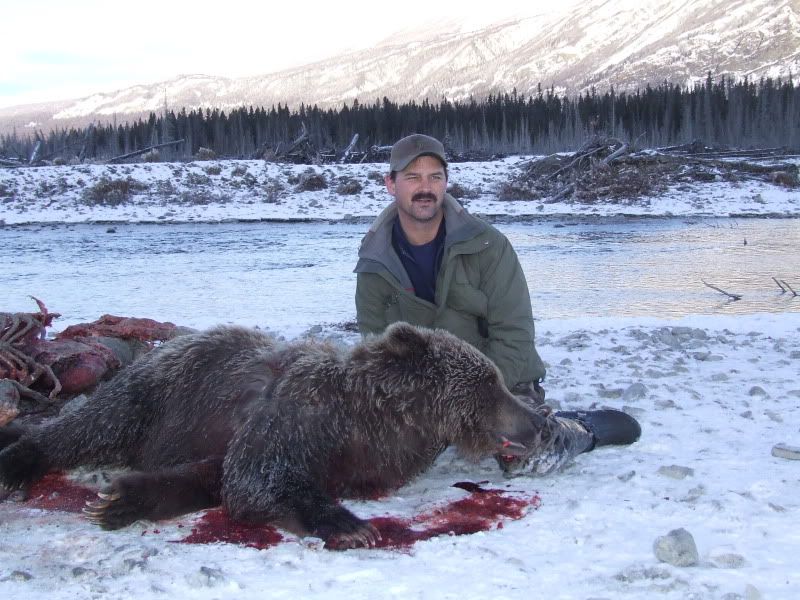
Only on calm days. ;) Maybe I'll do that for the next grizz, this one just fell on his chin when the .338 hit him at 66 yards. Talk about anti-climatic, then to make it worse the petals fell off the TSX.:( Everyone knows that it can't work after that.

I can't for the life of me see why I worked up a MOA load to 500 yards. Waste of time, really.
 
Accuracy is everything.

I don't give a damn how powerful it is, if you can't hit anything with it, it's useless. On the other hand, if it's a 1/2 MOA rifle in the hands of a "hubcap" shooter, then I guess it doesn't really matter much.

.

Shot placement is everything, mechanical accuracy is a small component of that.
 
Kinda late to jump in but I think sub 2" is probably fine for any shot I'd call ethical, at least for myself. Am I happy with 2" groups, no way. I want my hunting guns to do at least 1" groups just for my own confidence. I used to strive for sub inch but as I have less time and inclination for load developement these days I find one inch is fine. My .40+ guns I might let slide to 1 1/2".
 
The smaller the target the more it matters, for big game anything that can shoot into 1.5" at 100 yds is fine, for varmint 3/4" is fine, they all shoot good from the bench, we should be practicing more position shooting as far as I'm concerned.
bb
 
Years ago I read an article about the length of various hunters "yard".
White tail hunters - 11 inches
Upland game - 17 inches.
Varmint hunters - 35 inches

So for a white tail hunter that 6 moa would be a 2 inch group?
 
Only on calm days. ;) Maybe I'll do that for the next grizz, this one just fell on his chin when the .338 hit him at 66 yards. Talk about anti-climatic, then to make it worse the petals fell off the TSX.:( Everyone knows that it can't work after that.

I can't for the life of me see why I worked up a MOA load to 500 yards. Waste of time, really.

Grizzlies shouldn't be taken at anything longer than a couple of hundred yards anyway. Not only are bears (any bear) hard to judge at longer ranges, you kinda rob yourself out of the grizzly experience by "sniping" them.

66 yards? I think you got a good experience.;)

Well done, look forward to the pics!:)


(Yeah, when you see a MONSTER grizz through a spotter you can judge it and know to go after it...Just a final close range check is a good idea, IMHO):p
 
Does accuracy matter? Hmmm.....yes, I think it does....or does it?

Hmmmm....on second thought.........yes, yes it does. Why you may ask? Since I don't hunt, I am not sure, but I know it does and I am sticking with that answer.....yes, that is my final answer.
 
I've only had one shot over 500 this year, and I could have made that with a 2 MOA rifle. That's the Leica 36 inch yard. Most of the rest of them wouldn't have even needed sights.
 
Last edited:
..... I could have made that with a 2 MOA rifle. ..........

Yah, but lets be honest here.
You didn't use no stinking 2 MOA rifle did ya! ;) :D

I bet you don't even own a modern bolt action that doesn't shoot!
IMHO why would you in this era of great accuracy?
I guaranty you don't own an open country rifle that doesn't shoot!
Cmon...Fess up!
Don't tell me I'm the only one with OCD here! :D
 
What can be done on a rifle range has little relevance to what must be done in the field for the shot to be successful. On the range we shoot from a bench or a solid position, from known distances, at stationary well defined targets, with plenty of time to shoot. Some ranges even have wind flags and number boards to prevent us from getting confused.

But now you find yourself out on the tundra. The wind is quartering towards you, gusting to 60 clicks, its overcast and gloomy, there are occasional snow squalls and periods of freezing rain and ice pellets. The ground is really wet, you are in calf deep water and your boots break through the thin crust of ice on the surface. You see movement near a knoll to your right and you raise your glasses in time to see a magnificent bull caribou drop out of sight behind the hill. You begin your stalk, taking your time so as to make as little noise as possible, and you hope the wind will mask the noise you are making. It seems to take forever to reach the crest of the knoll. Your bull is in the midst of a small herd of a half dozen animals 300 yards distant. The are moving steadily away and you only have a moment before they once again drop out of sight behind the next ridge line. You drop into a shooting position, but when you look through the scope the image is obscured with snow that has collected in the objective's recess. You blow it clear, but when you snap the rifle back to your shoulder the caribou are again out of sight. The footing is better here, and you run across the rough rocky ground, though the stunted willows, to get to that ridge line. Now and then you foot finds a soft spot where the yellow grass has prevented the ground from freezing. You sink and fight to get clear. Your energy drains. When you are still 50 yards away the the crest, you slow to a walk, winded, and knowing it will take a couple of minutes before your breathing and your heart rate slows enough to shoot. You take the time to collect your thoughts and you suck in deep breaths of cold air, forcing yourself to relax. You squirm up to the ridge line on your belly and there he is at the back of the heard, just 150 yards away. They are crossing a dry lake bed 30 degrees below you. You are in sort of a jackass prone position with your legs well below the height of your shoulders, and your elbows are rested on a layer of large flat stones that forms an ancient beach. The gusting wind at almost 90 degrees and the restless animals are steadily increasing their distance from you, not running but moving steadily away in that strange gate which allows them to travel across huge distances in a just a few hours. You sight midway up the body, behind the ribcage hoping your bullet will range forward to destroy the lungs and the plumbing across the top of the heart, and you hold off for half the wind value, hoping the trigger doesn't break on a gust. You have to shoot quickly. The range is steadily increasing and you can't lie on the cold ground for long without shivering. You press your cold numbed finger on the side of the trigger guard to coax feeling back into it, then you're on the trigger and begin to press as the image in the scope blurrs as your eyes tear up from the wind and ice pellets . . .


Back to reality, does anyone really believe that shot is going to be more successful with a MOA rifle than with a 6 MOA rifle, particularly if the 6 MOA rifle always puts the first round to point of aim? A talented marksman will make the shot while the duffer will miss. The accuracy potential of the rifle is almost irrelevant in either case. Anyone reading this is probably a rifle enthusiast, and will probably not be satisfied with even a 2 MOA rifle, but across the country few hunters are rifle enthusiasts, yet they still manage to collect meat for the freezer. How many deer are taken annually across North America with shotguns that shoot barely minute of pick-up truck? Many on this site have expressed an interest in handgun hunting, now we are talking about firearm accuracy that isn't 2 MOA, its more like 10 MOA and there is some difficulty in shooting up to that.

The ability of the marksman trumps the intrinsic accuracy of the firearm. The rule is if you can get closer, get closer and if you can get lower, then get lower. The design and construction of a quality game bullet trumps the accuracy gain through the use of match bullets across normal hunting ranges because effective terminal performance means much more to the success of the shot than does bullet placement within a couple of inches.

If rifle precision is what encourages you to shoot more, then by all means pursue that interest. Intrinsic rifle accuracy is a great confidence builder, but don't think for a minute that shooting from the bench will make you a good game shot. The two things are related but not synonymous. A good game shot has discovered his limitations when shooting from field positions. Knowing what you can't do is as important as knowing what you can. This provides you with the ability to determine if in fact you have a shot or if you have to reposition. If you are shooting at the range with your MOA rifle, if you shoot at a target that is neutral in color, with no obvious aiming point, what happens to your group size? If you can arrange for a target that moves, how do you group on that? You might even discover that if your rifle was half as accurate as it is, it would still be twice as accurate as it needs to be.
 
Last edited:
Yah, but lets be honest here.
You didn't use no stinking 2 MOA rifle did ya! ;) :D

I bet you don't even own a modern bolt action that doesn't shoot!
IMHO why would you in this era of great accuracy?
I guaranty you don't own an open country rifle that doesn't shoot!
Cmon...Fess up!
Don't tell me I'm the only one with OCD here! :D

You didn't use no stinking 2 MOA rifle did ya!
It was a Weatherby Mark V Ultralight Weight that I rebarrelled in .300 Win to get rid of the free-bore. Barrel is a #2 Gaillard 1-10", and it will keep cold shots under 5 inches at 500 where it might matter a little tiny bit, while cutting cloverleafs where it doesn't matter at all. Scope is a VXL 3.5-10 X 50 with illuminated B&C. The last animal I took with it was a red stag at 568 yards, the next animal was a 30 yard moose my kid shot.


I'm trying to harrness my OCD and put it to more constructive use.;) I do a lot of things that don't make sense; includeing rebarrelling rifles that shoot better than they have to, and buying/building a 1/2 mile range so I could shoot farther than I should. After a while some patterns emerge, things like that the ability to flop on your belly and get a first round hit at 700 has little to do with where the next 20 are going to go. Then there's my old compulsion for trying to take a fraction of an inch off a close range group while trying to deal with a wind that varies drift from 2 to 5 feet where it matters. Then there's finding out that the 100 yard bug holer may turn into a shot stringing monstrousity when those velocity variations make themselves known.
Then there's those annoying animals that won't wear their orange Tar-dots. It gets worse when the aiming point is an estimated distance in the sky above some luckless mammal. That would really hurt the group, if there was one.
 
But now you find yourself out on the tundra. The wind is quartering towards you, gusting to 60 clicks, its overcast and gloomy, there are occasional snow squalls and periods of freezing rain and ice pellets. The ground is really wet, you are in calf deep water and your boots break through the thin crust of ice on the surface. You see movement near a knoll to your right and you raise your glasses in time to see a magnificent bull caribou drop out of sight behind the hill. You begin your stalk, taking your time so as to make as little noise as possible, and you hope the wind will mask the noise you are making. It seems to take forever to reach the crest of the knoll. Your bull is in the midst of a small herd of a half dozen animals 300 yards distant. The are moving steadily away and you only have a moment before they once again drop out of sight behind the next ridge line. You drop into a shooting position, but when you look through the scope the image is obscured with snow that has collected in the objective's recess. You blow it clear, but when you snap the rifle back to your shoulder the caribou are again out of sight. The footing is better here, and you run across the rough rocky ground, though the stunted willows, to get to that ridge line. Now and then you foot finds a soft spot where the yellow grass has prevented the ground from freezing. You sink and fight to get clear. Your energy drains. When you are still 50 yards away the the crest, you slow to a walk, winded, and knowing it will take a couple of minutes before your breathing and your heart rate slows enough to shoot. You take the time to collect your thoughts and you suck in deep breaths of cold air, forcing yourself to relax. You squirm up to the ridge line on your belly and there he is at the back of the heard, just 150 yards away. They are crossing a dry lake bed 30 degrees below you. You are in sort of a jackass prone position with your legs well below the height of your shoulders, and your elbows are rested on a layer of large flat stones that forms an ancient beach. The gusting wind at almost 90 degrees and the restless animals are steadily increasing their distance from you, not running but moving steadily away in that strange gate which allows them to travel across huge distances in a just a few hours. You sight midway up the body, behind the ribcage hoping your bullet will range forward to destroy the lungs and the plumbing across the top of the heart, and you hold off for half the wind value, hoping the trigger doesn't break on a gust. You have to shoot quickly. The range is steadily increasing and you can't lie on the cold ground for long without shivering. You press your cold numbed finger on the side of the trigger guard to coax feeling back into it, then you're on the trigger and begin to press as the image in the scope blurrs as your eyes tear up from the wind and ice pellets . . .

Wow..... there have been good stories in Penthouse Forum that haven't managed to hold my attention like that.

Nice read, well done.
 
Boomer, I would enjoy reading a book about different hunting senerios if it were written with your attention to detail. Well done.
 
But now you find yourself out on the tundra. The wind is quartering towards you, gusting to 60 clicks, its overcast and gloomy, there are occasional snow squalls and periods of freezing rain and ice pellets. The ground is really wet, you are in calf deep water and your boots break through the thin crust of ice on the surface. You see movement near a knoll to your right and you raise your glasses in time to see a magnificent bull caribou drop out of sight behind the hill. You begin your stalk, taking your time so as to make as little noise as possible, and you hope the wind will mask the noise you are making. It seems to take forever to reach the crest of the knoll. Your bull is in the midst of a small herd of a half dozen animals 300 yards distant. The are moving steadily away and you only have a moment before they once again drop out of sight behind the next ridge line. You drop into a shooting position, but when you look through the scope the image is obscured with snow that has collected in the objective's recess. You blow it clear, but when you snap the rifle back to your shoulder the caribou are again out of sight. The footing is better here, and you run across the rough rocky ground, though the stunted willows, to get to that ridge line. Now and then you foot finds a soft spot where the yellow grass has prevented the ground from freezing. You sink and fight to get clear. Your energy drains. When you are still 50 yards away the the crest, you slow to a walk, winded, and knowing it will take a couple of minutes before your breathing and your heart rate slows enough to shoot. You take the time to collect your thoughts and you suck in deep breaths of cold air, forcing yourself to relax. You squirm up to the ridge line on your belly and there he is at the back of the heard, just 150 yards away. They are crossing a dry lake bed 30 degrees below you. You are in sort of a jackass prone position with your legs well below the height of your shoulders, and your elbows are rested on a layer of large flat stones that forms an ancient beach. The gusting wind at almost 90 degrees and the restless animals are steadily increasing their distance from you, not running but moving steadily away in that strange gate which allows them to travel across huge distances in a just a few hours. You sight midway up the body, behind the ribcage hoping your bullet will range forward to destroy the lungs and the plumbing across the top of the heart, and you hold off for half the wind value, hoping the trigger doesn't break on a gust. You have to shoot quickly. The range is steadily increasing and you can't lie on the cold ground for long without shivering. You press your cold numbed finger on the side of the trigger guard to coax feeling back into it, then you're on the trigger and begin to press as the image in the scope blurrs as your eyes tear up from the wind and ice pellets . . .



You gonna shoot that thing, or wait 'til the antlers fall off on their own?;)
 
2010_0424Grizzly0125.jpg


Minute of Grizzly. The carcass in the background was the first bear, he was about done eating it when we ruined his whole day.

 
Totally agree with you Boomer, but I am also willing to bet your rifles also shoot very well! :D
Though you may not be as obsessed with accuracy as Dog and I are, I also bet your CCB shot is right on the money every time for every rifle you seriously hunt? :)

There is something very satisfying and confidence inspiring about a very accurate rifle that (I readily admit) has little or nothing to do with hunting.
Strangely enough that works for me!

You are of course right Dogleg, but as long as I have a little extra money in the bank my rifles will shoot A LOT better than they need to. :p
I suspect yours will as well.
 
Back
Top Bottom