But now you find yourself out on the tundra. The wind is quartering towards you, gusting to 60 clicks, its overcast and gloomy, there are occasional snow squalls and periods of freezing rain and ice pellets. The ground is really wet, you are in calf deep water and your boots break through the thin crust of ice on the surface. You see movement near a knoll to your right and you raise your glasses in time to see a magnificent bull caribou drop out of sight behind the hill. You begin your stalk, taking your time so as to make as little noise as possible, and you hope the wind will mask the noise you are making. It seems to take forever to reach the crest of the knoll. Your bull is in the midst of a small herd of a half dozen animals 300 yards distant. The are moving steadily away and you only have a moment before they once again drop out of sight behind the next ridge line. You drop into a shooting position, but when you look through the scope the image is obscured with snow that has collected in the objective's recess. You blow it clear, but when you snap the rifle back to your shoulder the caribou are again out of sight. The footing is better here, and you run across the rough rocky ground, though the stunted willows, to get to that ridge line. Now and then you foot finds a soft spot where the yellow grass has prevented the ground from freezing. You sink and fight to get clear. Your energy drains. When you are still 50 yards away the the crest, you slow to a walk, winded, and knowing it will take a couple of minutes before your breathing and your heart rate slows enough to shoot. You take the time to collect your thoughts and you suck in deep breaths of cold air, forcing yourself to relax. You squirm up to the ridge line on your belly and there he is at the back of the heard, just 150 yards away. They are crossing a dry lake bed 30 degrees below you. You are in sort of a jackass prone position with your legs well below the height of your shoulders, and your elbows are rested on a layer of large flat stones that forms an ancient beach. The gusting wind at almost 90 degrees and the restless animals are steadily increasing their distance from you, not running but moving steadily away in that strange gate which allows them to travel across huge distances in a just a few hours. You sight midway up the body, behind the ribcage hoping your bullet will range forward to destroy the lungs and the plumbing across the top of the heart, and you hold off for half the wind value, hoping the trigger doesn't break on a gust. You have to shoot quickly. The range is steadily increasing and you can't lie on the cold ground for long without shivering. You press your cold numbed finger on the side of the trigger guard to coax feeling back into it, then you're on the trigger and begin to press as the image in the scope blurrs as your eyes tear up from the wind and ice pellets . . .















































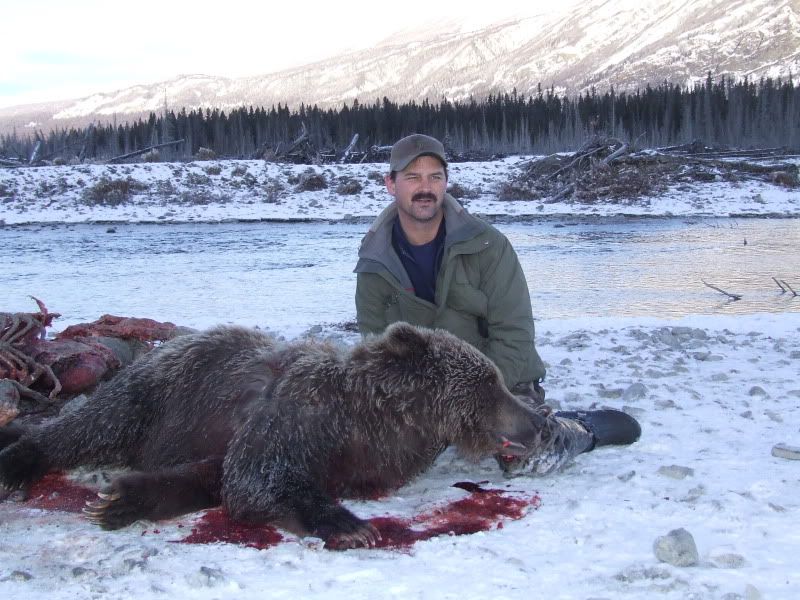
 Maybe I'll do that for the next grizz, this one just fell on his chin when the .338 hit him at 66 yards. Talk about anti-climatic, then to make it worse the petals fell off the TSX.