Calmex
I wrote a lengthy response to your last, hit the wrong key and lost it ....
Your memory of those days is remarkable.
We were a pretty motley crew. Hyper active Murray, Rod Phillipsen, Blair Molesbury, Elder Jeske and me not long out of Regular Army. Randy came later. I first met them when I heard gun fire on the Thompson Mountain 'Black Powder Trail'. If memory serves, I was wearing a breech clout and leggings when I approached them. They had the "deer in the headlights" look until I asked if they had ever heard of a guy named Jeff Cooper. That opened the door and I was admitted into the fold. I loaned them my copy of "Cooper On Handguns" and it came back to me dog eared. They devoured it.
My Hi-Power was stock save for an extended safety and removal of the mag safety. An early model with internal extractor. Later I acquired another from Alan Lever, one of our early sponsors. Remember the "Lever Arms" trophy? There was also a more impressive trophy for "Top 9mm" that had my name on it more than once. No idea where it went ....
I never met Cooper. Fisher won a course at GunSite and didn't go. I was disgusted with him as it was a chance to meet Cooper. Fisher was a "gamesman" from the get-go and not a martial artist like most of us.
Murray's energy, drive and organizational skills were exceptional and he can be regarded as the grandfather of practical pistol shooting in Canada. Heady days and not likely to repeated in this anti-gun era. Even back in the day, it was an uphill fight as we got no support from clubs, the BCRA or other shooting sports. We heard things like: "the rcmp won't like it", "it's illegal to shoot from a holster in Canada", "it will attract an unsavoury element", etc., etc.
If indeed you are "last man standing", it may fall to you to record the era and history. The current crop of shooters response when you mention Jeff Cooper is: "Who's Jeff Cooper"?
My memory is only remarkable for the things that really touched me or impacted me. The whole IPSC/Canada thing, at the beginning, was something that really touched me. If I could have chosen a role to have in life at the age of 20, it would have been what I did at 21 with the rest of you. Nobody could have done it alone, but Murray came as close as one person could come, and he had the rest of us to push him that last little bit.
In my own opinion, Murray wrote the rulebook for IPSC, with our input. I have asked him about this several times over the years and he has been evasive. I believe (and this is only my opinion, not any "fact"), that Rulebook one that was put together in rough form by us in Paul Merrett's basement on the 3rd of August, 1980. Sent on for approval from Cooper by Murray after some editing and then published and in our hands for the Spring of 1981. USPSA and NRA Action copied directly all the salient parts and changed a word or two and then printed their own rulebooks based on that work. Maybe I'm wrong, but it's certainly what I have told the Mexicans, and written about at length (in Spanish) on the Latin American Gun Forum "Mexico Armado". So it's what they will take as "history" also. Tell me where I'm wrong, but only if you were actually there. Then go tell the Mexicans. When they introduced me as guest speaker at the first Mexican Police National Combat Championships, they introduced me as "One of the founders of IPSC/Canada." Walking to the podium, I thought for an instant that Todd, Ken and Murray might have something to say about that...but then I was there, staring at all of them waiting to hear what I had to say, and so I said what I had to say. Water under the bridge now.
Driving down to the Bianchi Cup in a rented Winnebego in May 1981 with Ken Kulach and his wife, #### Leer and his wife, Rick Miller (and wife? I think so...) and my girlfriend at the time, being the youngster aboard I was given the late-night Midnight to 5:00 AM driving shift through the Middle U.S. on the way to Missouri. Ken Kulach elected to stay awake and sit in the Co-Pilot seat and "keep me awake" which was probably a good idea. Driving is not my forte, I personally hate it, and prefer to have someone drive me around when possible.
*
"I've written up some amendments I think we should make to the holster rules," he said, and then kept me awake while driving reading them to me. At that time, in the first rule book, there wasn't a lot specified about holsters except that "gunbelts" were no longer
de moda and that the belt should pass through the trouser loops -- I think. Ken went a lot further than that. I think the rules as they now stand were basically what Ken read aloud to me that night.
I would say Murray was responsible for the first real set of rules past Cooper's first 47. Ken was responsible for the holster rules, basically, such as they stand for IPSC and NRA Action. But maybe I'm wrong. Maybe there were a lot of other people involved, but I like to credit them. Even when I write my memoirs, I will credit them. As I say, when I tried to pin Murray down on this, he refused to take the credit. Murray has his detractors, as does anyone who has actually done something the nay-sayers declared to be impossible, and some of them have told me that Murray would NEVER refuse to take credit for anything, anywhere, anytime. I, personally, feel that Murray considers the whole thing too sacred to play with lightly and refuses "to go there". Fine. He can be Henry Fonda to my Terence Hill. In my mind, he did it. So there. And as for Ken, I have not talked to since those days. But ditto.
* My "driver" in San Miguel was something that came about once the small town, with streets designed for horse-drawn wagons, became inundated with cars and one could no longer conveniently park anywhere. One night I met "George", a Gringo with a Mexican wife who was retired and living in San Miguel. He did not speak Spanish, but he wanted to be in the Club. When I asked him what he had done "back in the World", he told me he was a retired U.S. Navy Captain.
"I worked on Carriers," he told me simply. "I started as an Ensign on the USS Bon Homme Richard during the Vietnam War, and later worked on Independence and Enterprise. I finished up again on the Richard. Then I worked at the Pentagon." I liked him and told him that if he had nothing better to do, he could help me by driving me around town a couple times a week when I had stuff to do because I was tired of taking Taxis and parking had become impossible. In return, I'd help him join the Club and get his permits.
Another one of the men I often associated with (and helped get gun permits) was filthy rich: that's his family's home that is used as a Louisiana plantation and Leo DiCapprio's house in "Django Unchained". Filmed from the other side, it's Don Johnson's Plantation and house, but it's all the same place. Showing up with George in tow one night at one of his gala dinners in his Boutique Hotel Matilda in San Miguel, the rich man's peanut gallery asked George what he was doing with me.
"He's my driver," I responded, letting my hand waver most arrogantly in the air, "I have determined I require a driver that is at least a U.S. Navy Captain from the Carrier Force. Anything less would be beneath me." There were some pretty pricey people, albeit without Mexican gun permits, at the table that night, but I think they caught my drift. When George went to register his first guns and apply for a transport permit, the usual Mexican Army Officer appeared to question him. Fortunately, it was a Captain who was known to me.
"George here is with me." I told the Captain. "He served in the U.S. Navy on Aircraft Carriers." The two men started talking, through me as an interrpreter. And George got his permits. It strikes me, right now, that a future might be had helping non-Spanish speaking Gringos and Canadians get gun permits in Mexico, although that would fizzle as soon as one of them were to over-step their bounds I guess. So, maybe not.
George got to go to a few of the big matches and Gun Club parties before I returned to Canada. He was super-popular -- as was my father, a Normandy Veteran who would come out to spectate at my matches a generation earlier -- with the Club members on his squad. Telling them, albeit in English, story after story about working aboard operational Aircraft Carriers had members pulling strings to "be with George". It was cute, and he loved it. This photo is from last February, 2019. George driving me, once more, around San Miguel to shore up old alliances and try to make new ones. Just like the old days!
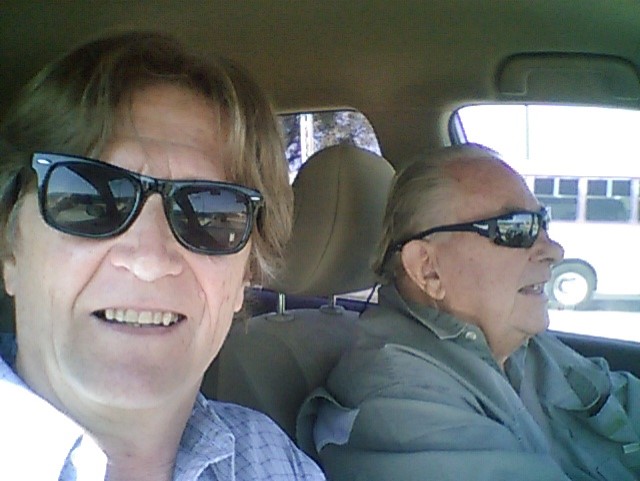
George has a nice, big, salt-water infinity pool at his house overlooking San Miguel. "I could never afford to live like this," he told me, "on my retirement salary in the U.S. Here, I live like a King." Well, that's my intention too! 3 years to go and I'll be going back. I keep my S&W Heavy Duty and my Model 28/23 in George's safe, and I plan to spend a week there this winter in his 97 degree salt-water pool listening to Aircraft Carrier stories and drinking like a fish. Oh, woe is me.