Double Action Snubby

This is very interesting information.

I recently loaded a batch of 38Spl at max load using Power Pistol. i wanted to see how the various guns felt shooting "real" ammo.

The S&B primers extruded onto the firing pin and bound up the revolvers. Pressure is ok - but not with those primers. I guess magnum primers would solve the problem.

I was thinking of the primer problem when I was concerned about your hot load.

All reloading equipment and components have to be smuggled into Mexico, at some considerable risk. There is no place that sells them to you "over the counter". We imported (and I mean imported "under the table") hundreds of thousands of primers at a time for the San Miguel/Queretaro Club needs. Figure the guys from Mexico City and Guadalajara are doing the same using different methods. Also, Merida (with whom we maintain contact and a loose friendship but do not interchange much although I want to work on that moving forward) is another big player but their product arrives by sea instead of overland. Or at least, it's what I was told. We all lie to each other all the time about how stuff is done and never tell anyone, anywhere who is not directly involved in the "how", so maybe they misled me as well. I'd do it to them, too.) Usually CCI or Winchester being the favourites. CCI being the choice as they were probably the least likely to detonate under the rather primitive methods that were used early-on to bring in large quantities of primers.* Later on, methodology became more sophisticated and now they arrive right in the factory boxes. It was amazing to me -- and still is, in fact -- that a large "quantity buy" in the U.S. could be moved to Mexico with all the costs and risks involved and we paid very little more per 1000/count than retail ends up being here in Canada. Something's wrong there. Someone has their hand out a little too much on the Canadian side of things for it to be that bad for legal purchasers compared to the smuggled product. Just my opinion.

Anyway, we never had any problems with either Winchester or CCI primers and none of them were MAGNUM primers. All standard. Elmer also used Standard Winchester in his loadings I believe. I was considering getting the S&B primers to sell here in the store, but not if they give problems. They would come in 10.00 dollars cheaper per 1000/count than CCI or Winchester or Federal....but it's not worth it if they're too soft.

We did notice once some problems with some of the guns "sticking" on extraction when using Heavy Duty loads made of Green Dot. However, my own opinion is that the group of people experiencing the problem might have mixed (accidently) some Bullseye and Green Dot together before preparing the loads on a Dillon 650 because it only happened the one time and was limited to one "group reload" using that powder. At the Tulsa Gun Show in 2011 some of the Big Guns from the S&W Forum told me at the dinner after the S&W Collector's Association meeting that Green Dot had been used in .357 Factory loads for several years, so I think it was more an "idiot mistake" than a powder or primer problem. None of the San Miguel guys had any problem with their Green Dot H.D. reloads.

*Years ago, talking to an old lady at a dinner somewhere, she started to ask me about my interest in shooting. It came out that she had worked in one of the large Remington Arms ammunition plants during World War II. "I was up on a large winged balcony full of machines overlooking the plant floor," she told me. "I saw one of the men down on the plant floor below me walking through the machinery carrying two 5 gallon buckets full of loose primers, one in each hand." She paused for a second, and then said: "There was a flash, and he was gone. There was a lot of noise anyway, so I heard hardly anything but it's what I saw." True, or not? Maybe.

When I saw large bags of loose primers being unloaded one day I pointed out that this was really, really dangerous. I ran into about as much opposition from the Mexicans over this as I did for insisting that they not start drinking alchohol on the range until after the guns were put away. I was totally able to change completely the way primers are handled and moved but as for the drinking and shooting and shooting and drinking, I was only really able to stamp out that fire on the Practical Shooting side of things. The shotgunners and .22 Silhouette and Center-fire Silhouette, Live Pigeon, and Running Goat events are still a booze-fest free-for-all. Oh, well, I made some progress at least.
 
You mean, like these? ;)


I love those. I have a 4-inch Model 65 that has been remarked as a Model 64 and registered as a .38 Special sitting in the Custom Shop in Queretaro right now as I type this. So far, I have had it round-butted. I am trying to find myself an original 3-inch Model 65 barrel to install so I myself can have a 3-inch snubby. However: they are not all that concealable compared to a 5-shot J-frame which can be worn easily in your pants pocket. The upside is that they bring serious power to the table. My wife likes to point out that when we move back, I won't be working a day-to-day existance running an Ice Cream Store on mainstreet San Miguel, so I might be able to relax a little on my requirements and carry something a little bigger since I won't be in such a scrutinized environment. I guess we'll have to wait and see on that. If the S.S. catch you running about armed, it may or may not go well so it's just better that they (and all the people you run into in your day) never suspect you are armed. Surprise is to your advantage.


I thought I had a photo of that Model 65/64 on my computer here but it seems I do not. It will have to wait until my next day off next Wednesday and I'll look for it on my USB's full of photos from back there.
 
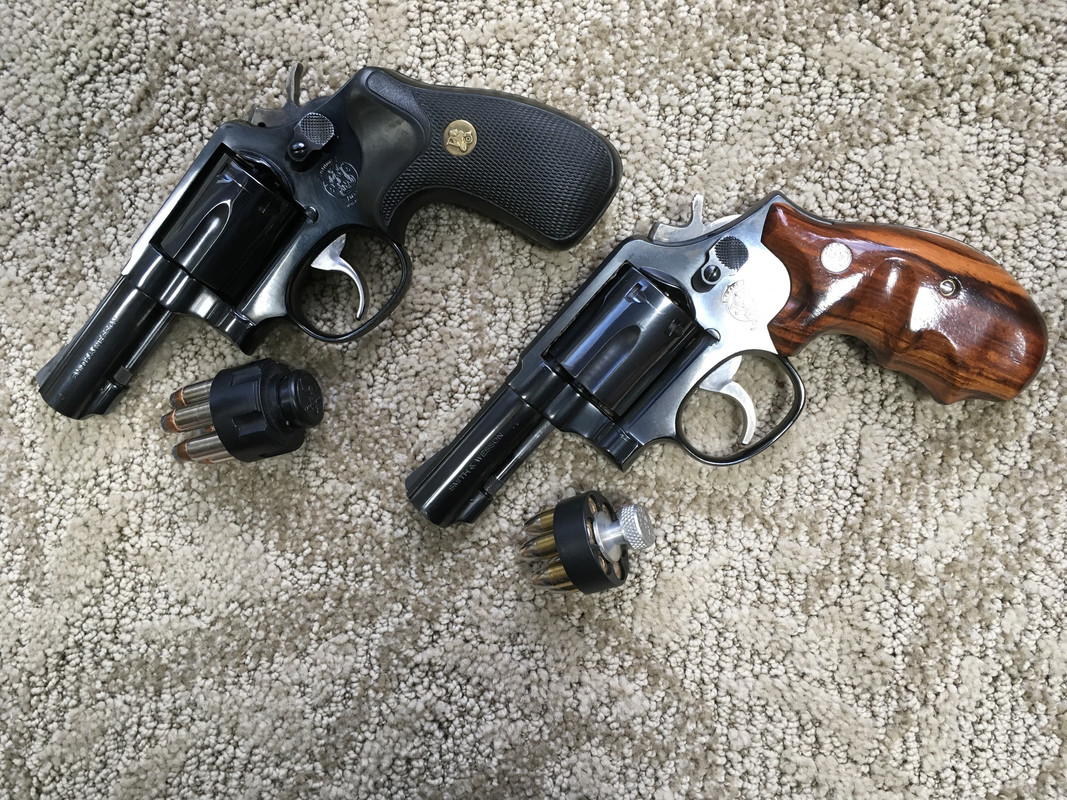
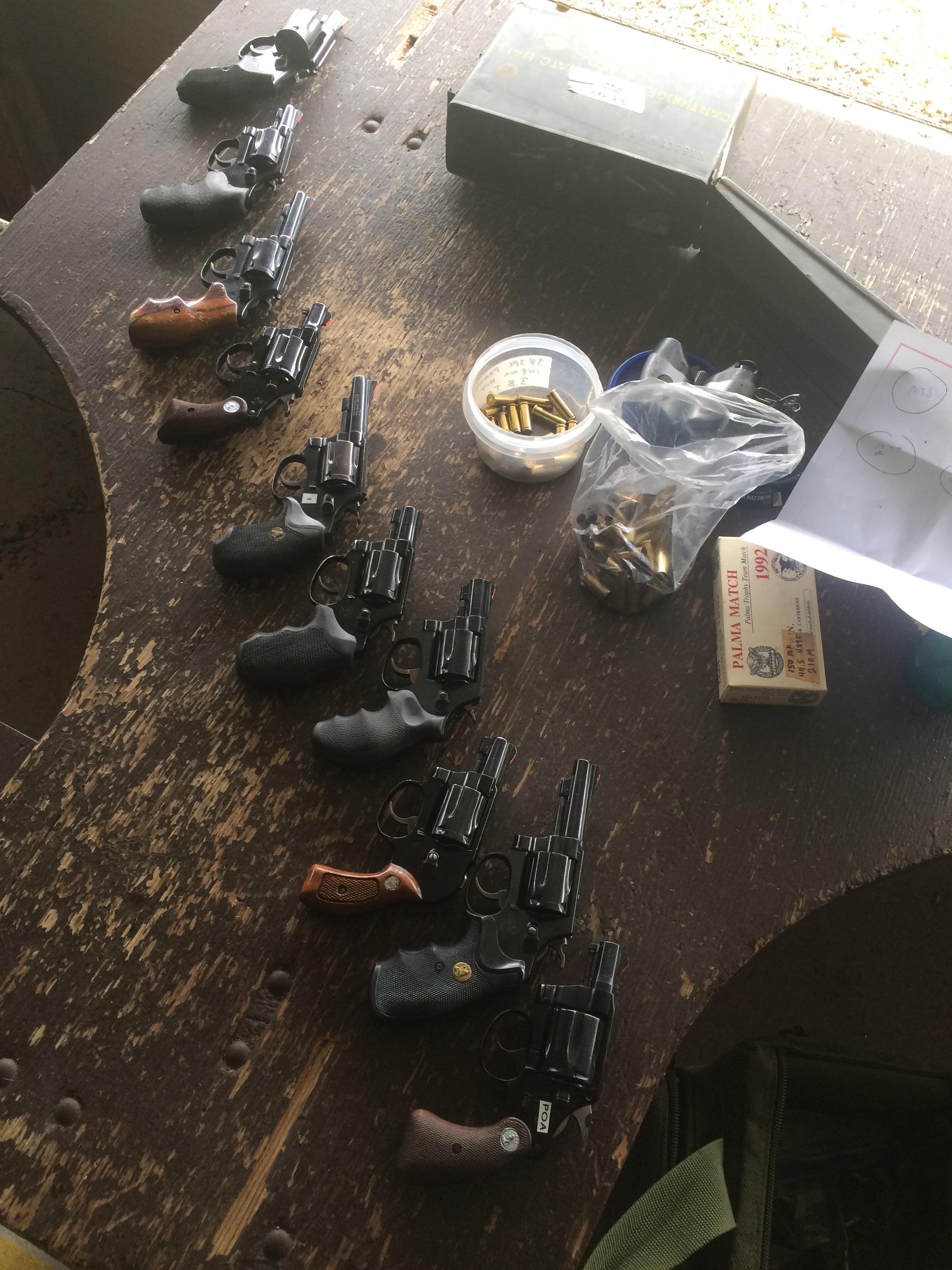
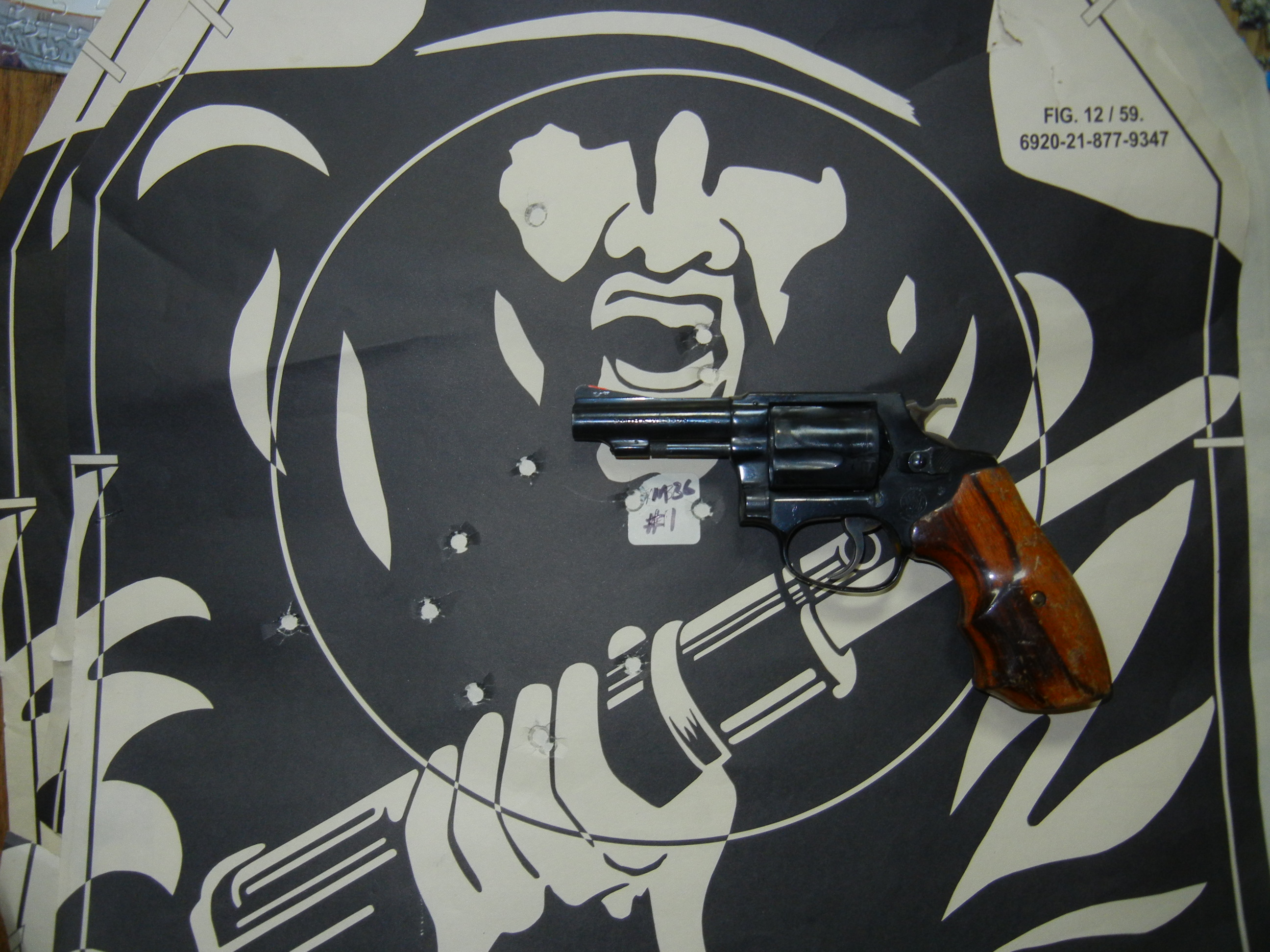
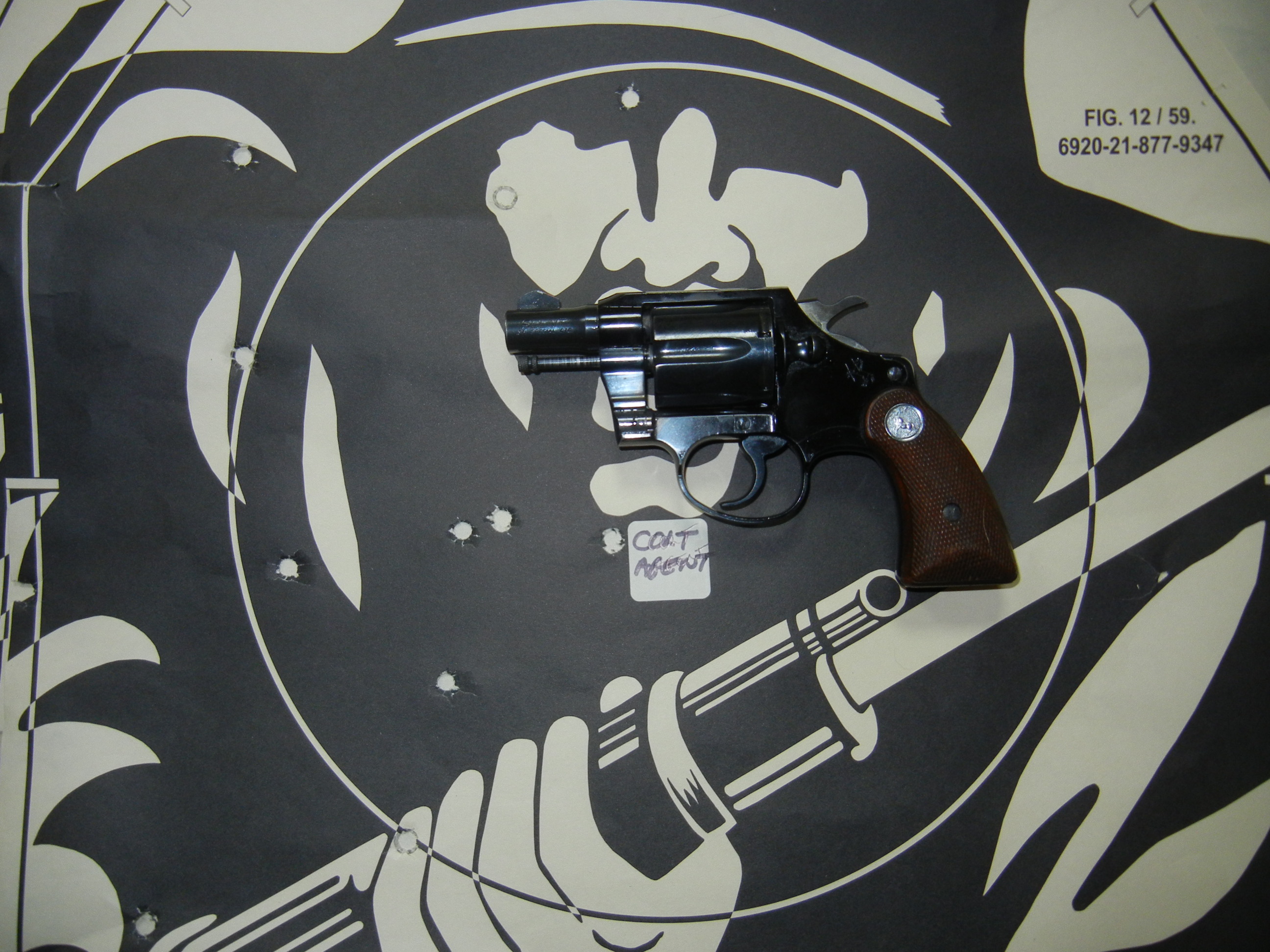
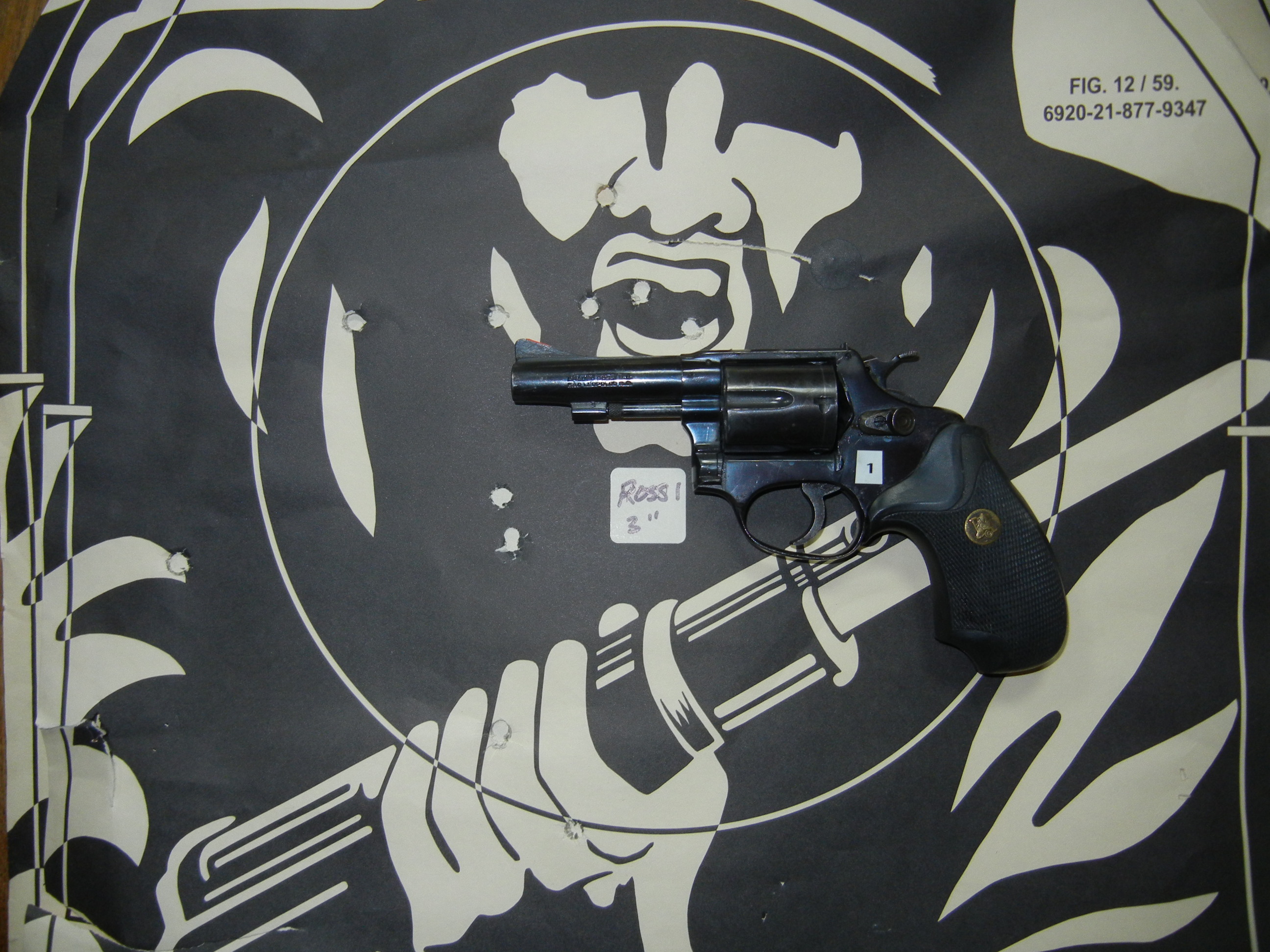
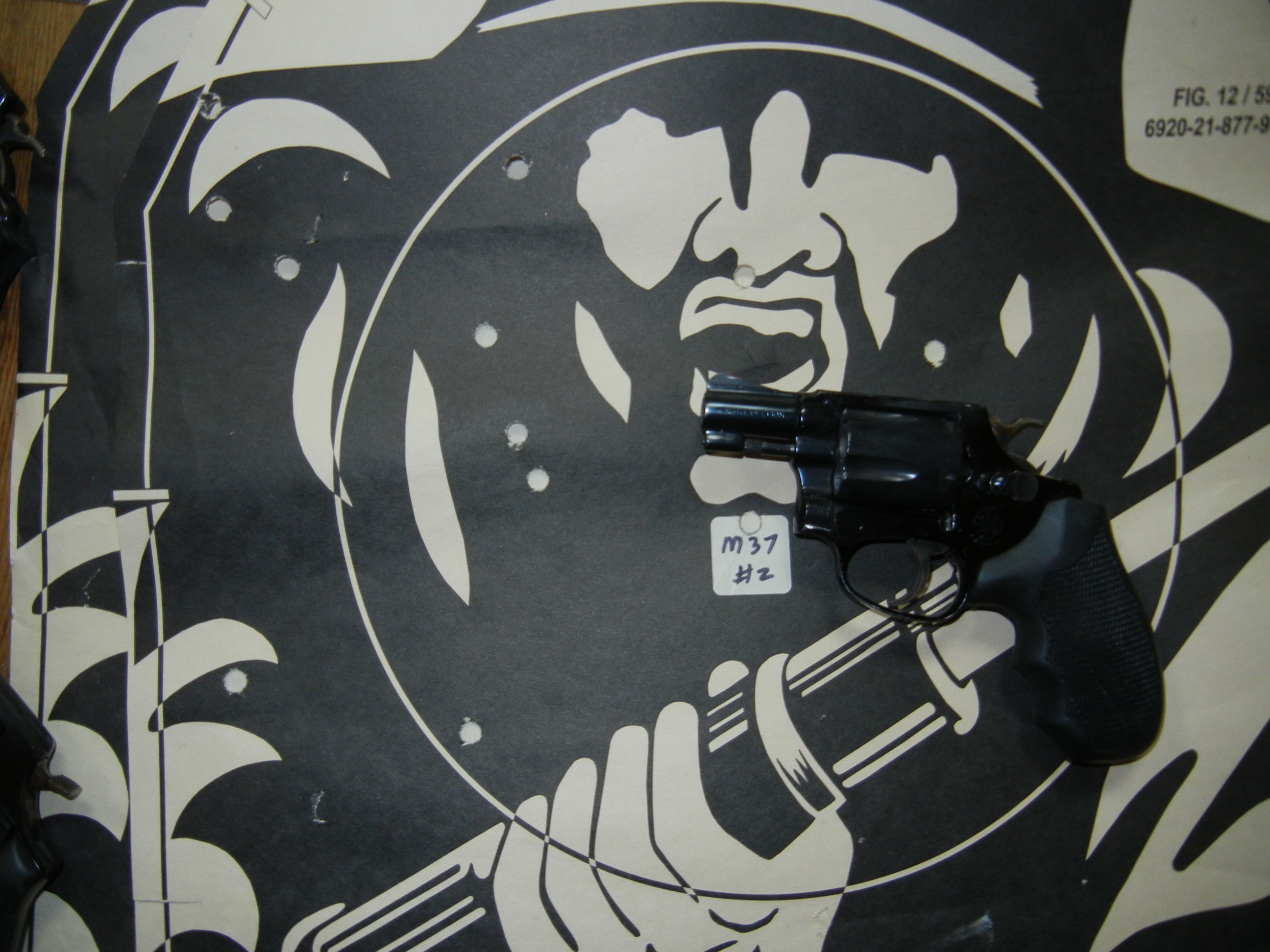
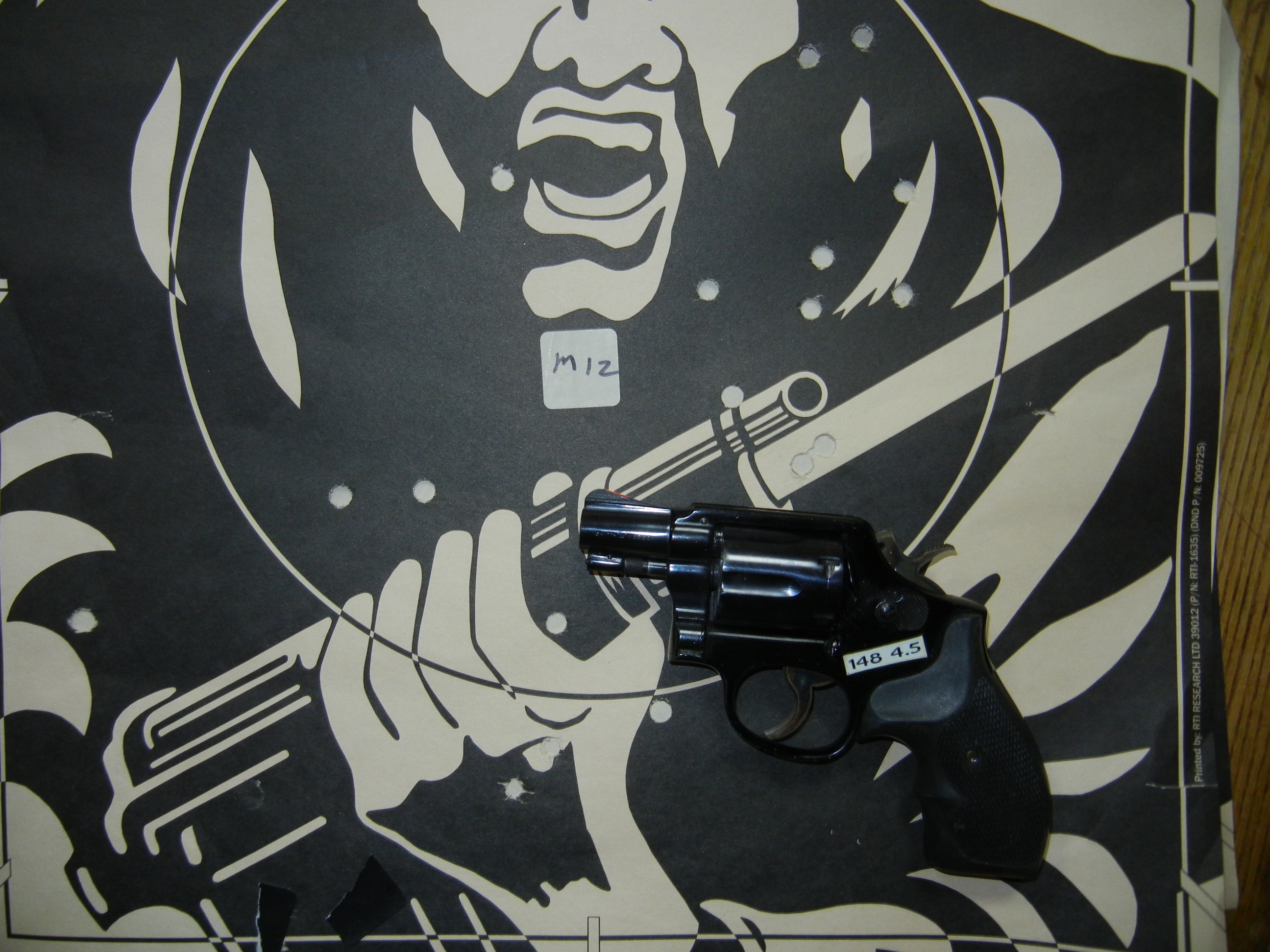
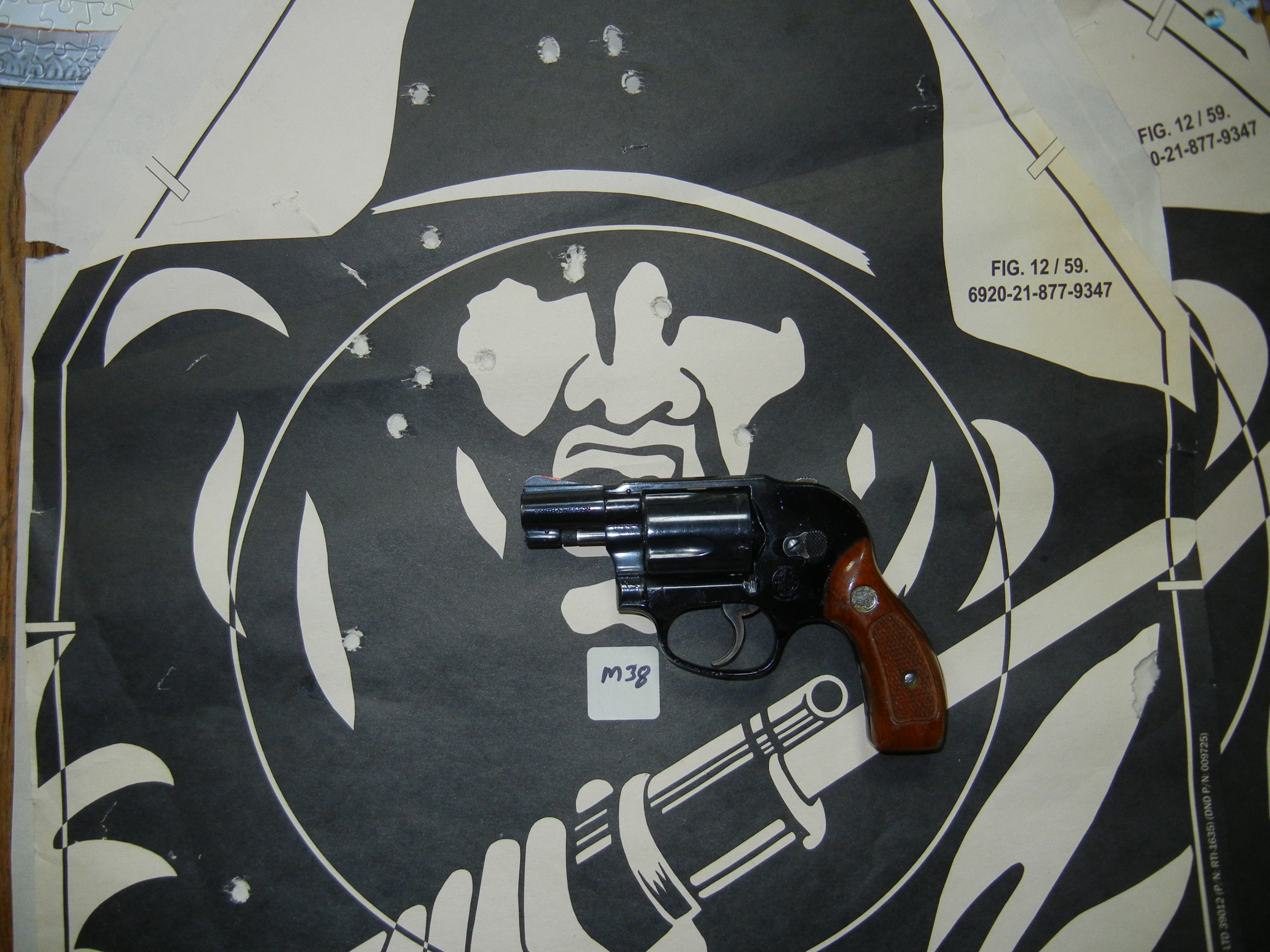
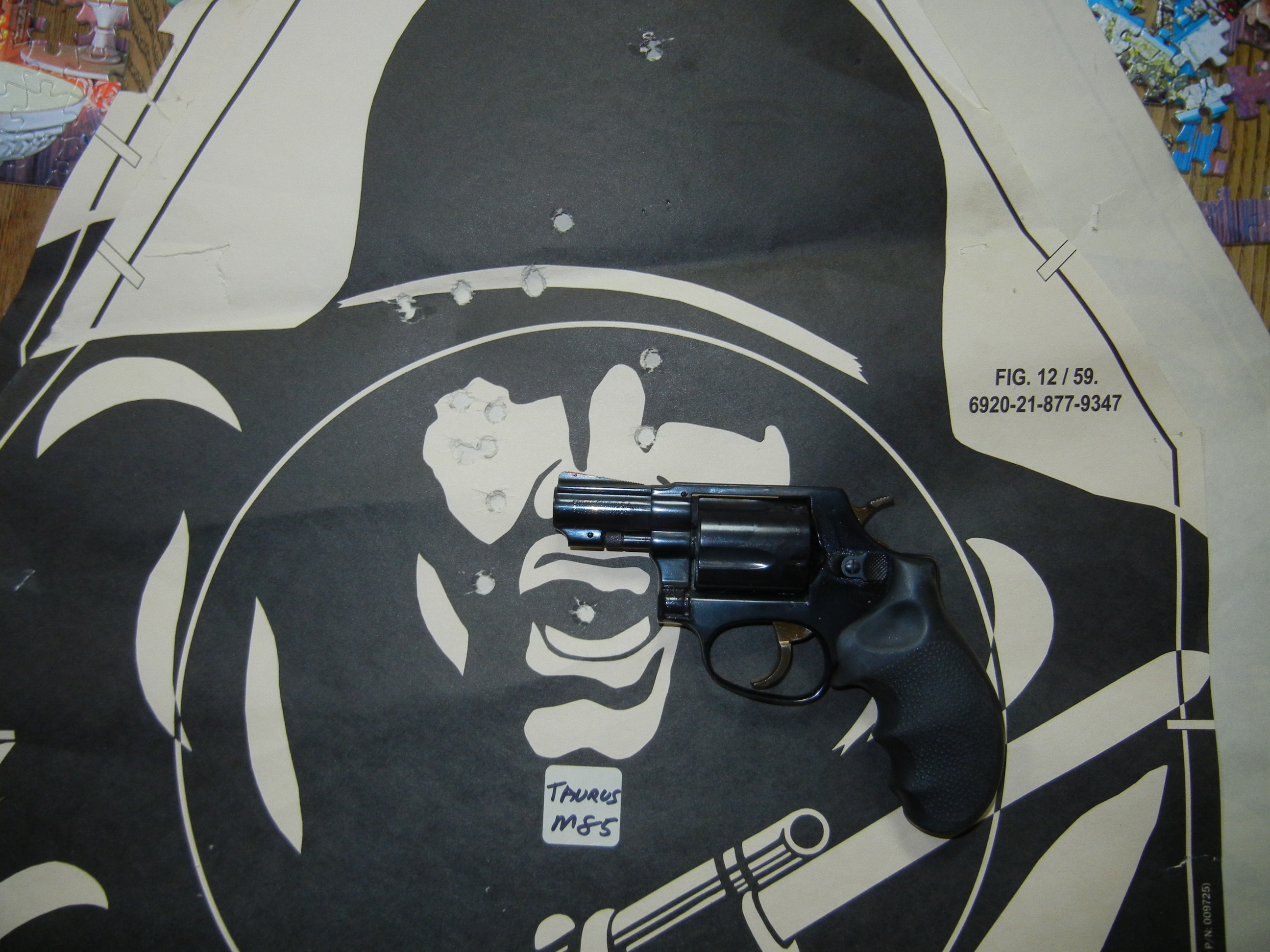
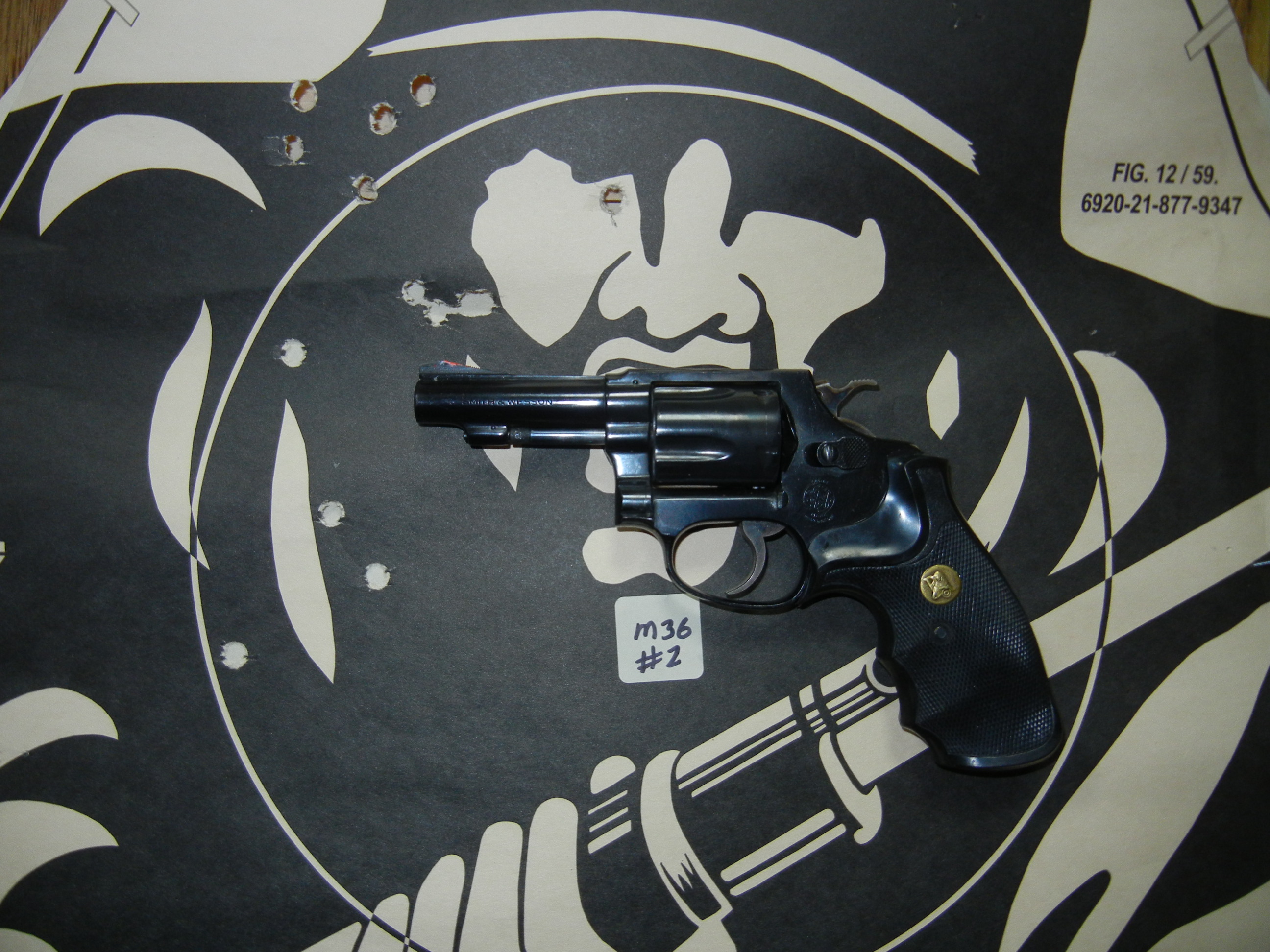
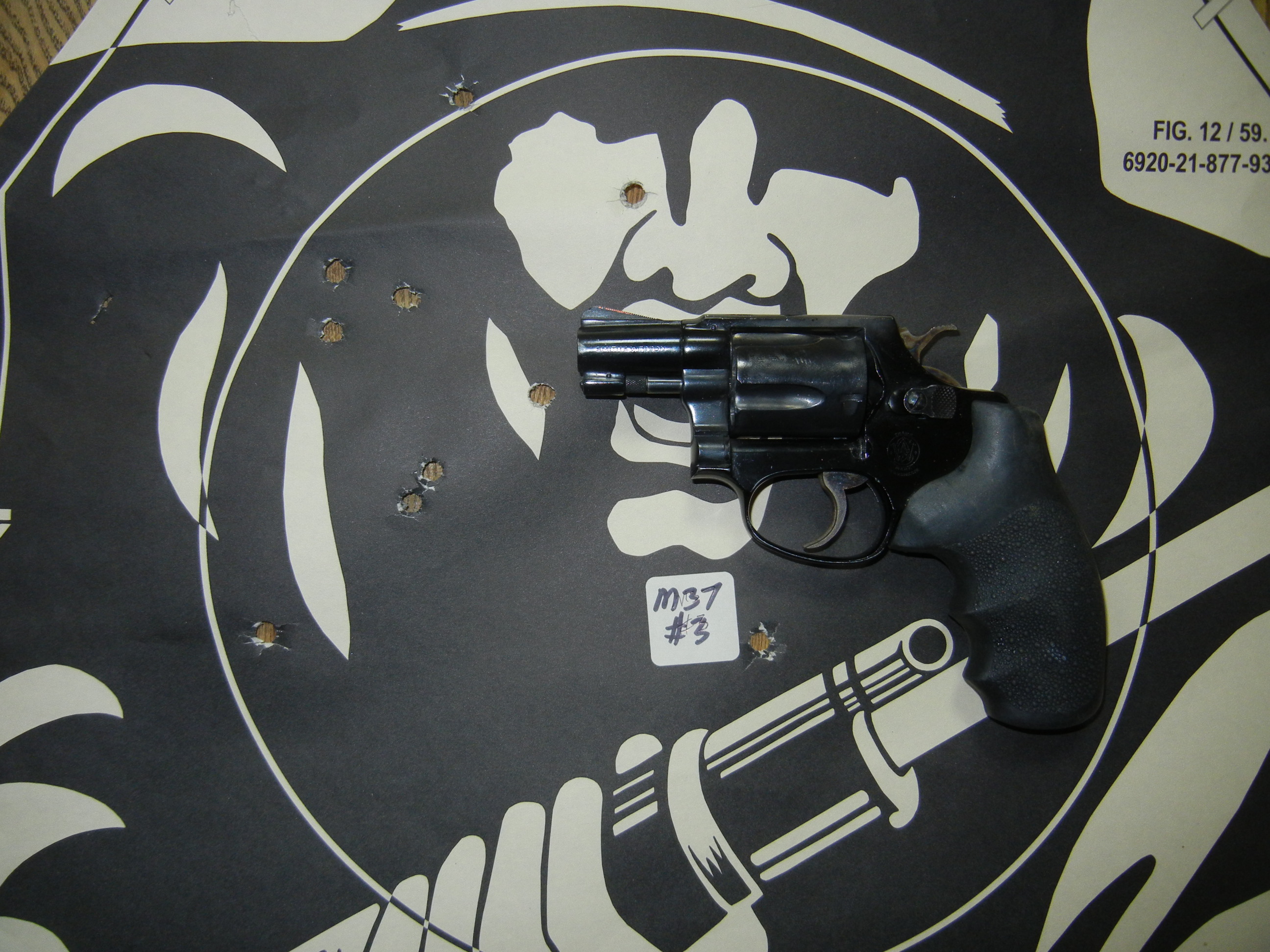
Today I took another bucket of 38Spl Snubbies to the range. My plan is to eventually shoot all of my snubbies at 25 yards, double action.
xlsQoYc.jpg


The objective is to note how they feel, shooting double action – something I have not ever done with them before and to see how well they group and where they shoot.

The big circle on the target is 12” and it seems that the groups are that size or better, at 25 yards. At altercation distances, groups would be much better and close enough to Point of Aim to be effective.

The ammo used was odds n ends from the bunker. It was all full power. 2 or 3 cylinder loads through each gun.

As for “feel” there are very significant differences in triggers and grips.

The factory grips suck, but they are the smallest and probably most effective for CCW. An otherwise good revolver with a poor grip can easily be made better with a new grip.
iZ9wmDg.jpg


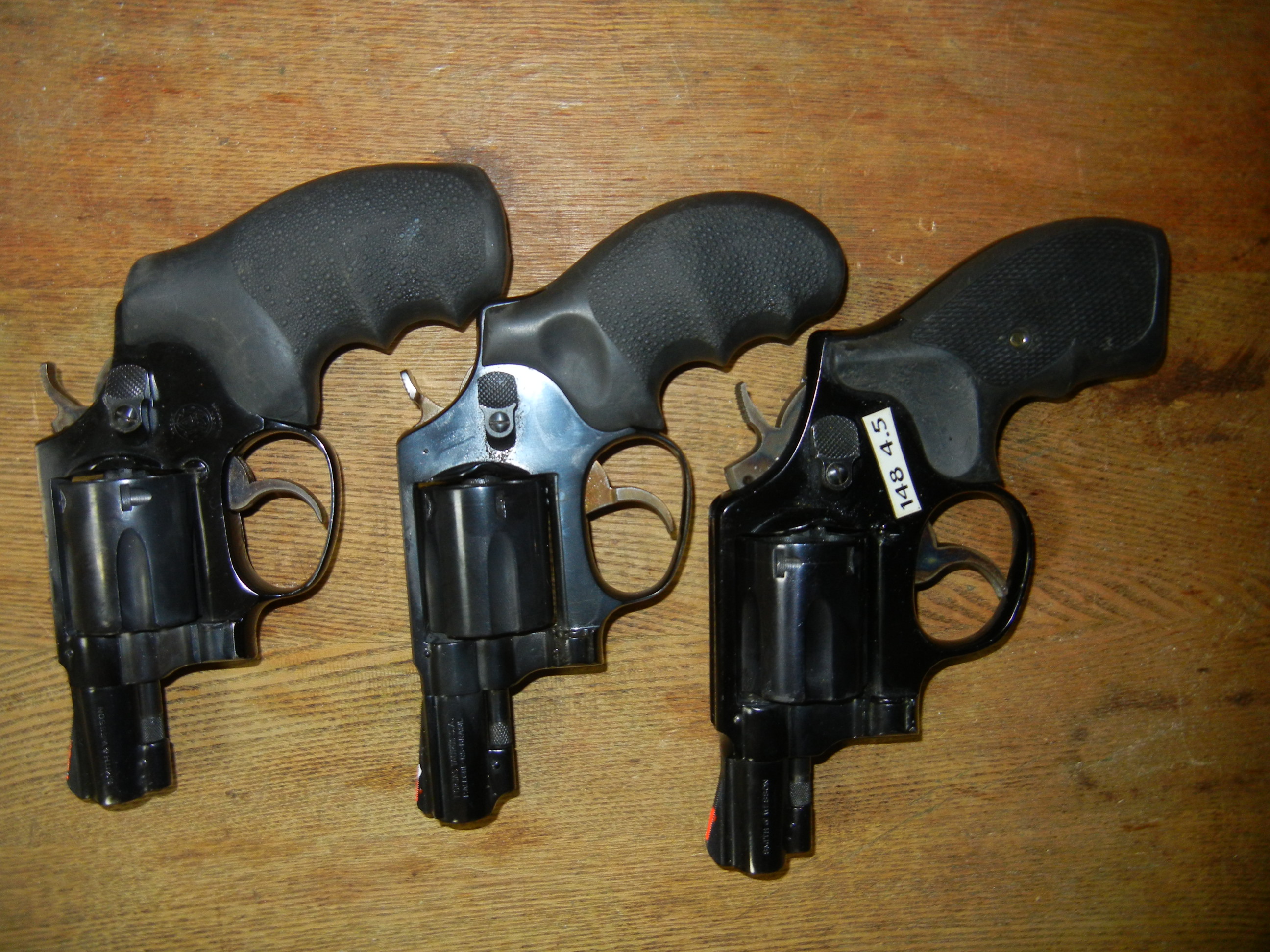
Some of my snubbies have a small rubber Hogue grip which feels great and in is not much bigger than the factory grip.
diia7Yr.jpg


The S&Ws all have a nice trigger. I did not really appreciate how good they are until shooting a bunch of different guns at the same time.
The Taurus M85 also had an excellent trigger and the little rubber grip on it felt good, too.

But “feel” does not translate to best results. The Smith M36 #1 felt great, but the group was very tall and probably the biggest group of the day. The Smith M12 also felt very nice, but also shot a big group.

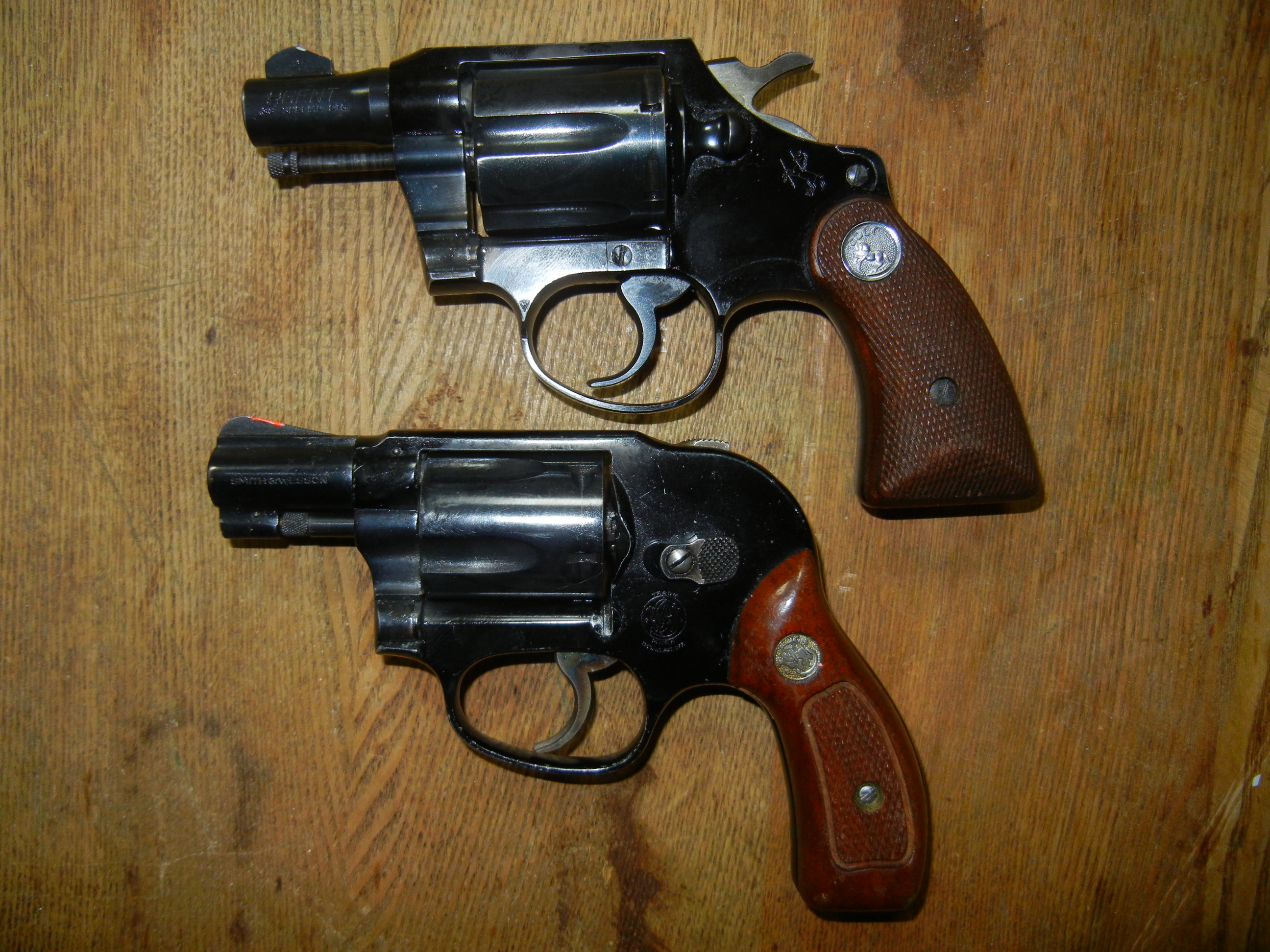
The Smith M38 Bodygurard felt terrible with the skinny little grip, but the group was good. A bit high, but now that I know that, I can aim lower and put all the shots on target.

In my log book for each revolver I have noted where the gun hits in both SA and DA.

The best "pocket pistol" is the Smith M38 Bodyguard. It is designed to be a pocket pistol.

The best belt gun, for me, would be either the Taurus M85, the Colt Agent, the M60 DAO or a Smith M37. All are light and compact and shoot well. The Taurus is a pleasant surprise, give that it is a cheaper gun than a Smith or Colt. The Agent and Cobras have 6 shots. Both have the same alloy frame and are very light.

The Rossi is a 3" clone of a M36. I bought 3 of them from Cenutry Arms for about $65 each. They shoot quite well.

PGYQZaR.jpg

qwp5ZNa.jpg

pPMfOe6.jpg

wJa87H1.jpg

GMOTNd6.jpg

2ywxCSI.jpg

sj6xN43.jpg

yiPyIQN.jpg

tczgaeB.jpg
 
Last edited:
Interesting thread.

I find on snubby in .38 Spl shooting, double action, especially with +P type loads, any trigger with a serrated surface really shreds the pad of my trigger finger. Much prefer revolver triggers with smooth faces for sure!

Based on experiences with the following: S&W Model 36 & 37, 2" brls; S&W Model 10, 2" barrel; S&W Model 19, 2 1/2" brl; Ruger Security Six, 2 3/4" brl; and Colt Cobra 2" brl.

------------
NAA.
 
Interesting thread.

I find on snubby in .38 Spl shooting, double action, especially with +P type loads, any trigger with a serrated surface really shreds the pad of my trigger finger. Much prefer revolver triggers with smooth faces for sure!

Based on experiences with the following: S&W Model 36 & 37, 2" brls; S&W Model 10, 2" barrel; S&W Model 19, 2 1/2" brl; Ruger Security Six, 2 3/4" brl; and Colt Cobra 2" brl.

------------
NAA.

You have two quite different classes of revolvers. The M10, M19 and the Sec 6 are full sized frames with 2" barrels. The M36-37 and Cobra are small frames. The feel and shoot quite differently.

If we were using these for their intended purposes, they would find different applications. A M10 and M10 would be ok on a belt, but never in a pocket.

I will test another bucket of 38s and will include some full frames (like the M12 I shot today). So far, I am surprised that the bigger guns don't shoot any better, although they feel better.
 
Your Model 38 is the lightweight equivilent of the Model 49 I have in Mexico. For the first few months I was carrying that gun, I lamented it was not a lightweight model. However, once I became accustomed to it, I reached a point I forgot it was there and I always found it more comfortable to shoot the heavier steel framed gun with the hot loads than a Model 38 with standard factory ammo -- both being fitted with stock grips and a Tyler grip adapter. I do believe that the Hogue Bantam grips are probably no larger or harder to conceal than the stock wooden grips with the adapter and may move to that in the future.

My plan when we move back in 3 years is to start my own "Armed Security Company" which I feel I can do because my wife's family is a Mexican Political Family with some clout, so I should be able to get the permits and authorizations. Although a foreigner cannot own such a company, I am immigrated and would put the Company in my wife's name anyway (Praetorian Guard Security S.A. de C.V.). As operations and training officer, I would be licensed the same as any of the employees. This would get me around the caliber restrictions and the need to be so totally concealed. Obviously if this is something I can work out, it will change things. If not: back to the Model 49 for normal interaction. I did it before, I can do it again I suppose.
 
You have two quite different classes of revolvers. The M10, M19 and the Sec 6 are full sized frames with 2" barrels. The M36-37 and Cobra are small frames. The feel and shoot quite differently.

If we were using these for their intended purposes, they would find different applications. A M10 and M10 would be ok on a belt, but never in a pocket.

Of all the one's I listed above that I had personal experience with, the only one I have left now is the S&W Model 37 'Airweight' which of them all makes the most sense for pocket carry. I agree the M10 snubbie is too heavy in a pocket unless a heavy coat.
I do admit I find some of the items listed in the EE 12(x) forum very tempting, especially in the snubbie .38 category!

OP, I see you have a Ruger SP101 3" in .38 Spl.... have you shot the same wheelgun in 9mm?

------------
NAA.
 
I've been enjoying this thread as I own several S&W snubs with 2-1/2" barrels; two blued M19s, one nickled and a M66. I bought them for IDPA. I call the nickled version my "Texas Barbecue Gun".

After our IDPA section folded, I use them in IPSC, much to the annoyance of one of our purists who states that I likely wouldn't make IPSC "minor" power factor with 158 gr bullets. I could, but I don't want to hang onto the little suckers even tho' they all wear after market Hogue wood grips. I'd like to chrono the load (3.2 grs Tite Group/158 RNFP/.38 Spl. brass) just to know in case I decide to use them in a sanctioned Qualifier.

I shot my S&W 66 4" with major loads for years in IPSC and it was bear to hang onto! Much to my surprise, I shoot the snubs (can't bear to call a .357 a snubby) better than I do my 4" Combat Masterpiece and M66s in IPSC practice.

I was challenged to see what they could do at 25m and 50m. It took a little sight adjustment but shooting off hand DA at 25m and SA prone at 50m, it is not difficult to keep all hits in the IDPA "down zero" zone.

The short sight radius gives a very clear sight picture and what has a better trigger SA trigger pull than a S&W revolver?
 
I've been enjoying this thread as I own several S&W snubs with 2-1/2" barrels; two blued M19s, one nickled and a M66. I bought them for IDPA. I call the nickled version my "Texas Barbecue Gun".

After our IDPA section folded, I use them in IPSC, much to the annoyance of one of our purists who states that I likely wouldn't make IPSC "minor" power factor with 158 gr bullets. I could, but I don't want to hang onto the little suckers even tho' they all wear after market Hogue wood grips. I'd like to chrono the load (3.2 grs Tite Group/158 RNFP/.38 Spl. brass) just to know in case I decide to use them in a sanctioned Qualifier.

I shot my S&W 66 4" with major loads for years in IPSC and it was bear to hang onto! Much to my surprise, I shoot the snubs (can't bear to call a .357 a snubby) better than I do my 4" Combat Masterpiece and M66s in IPSC practice.

I was challenged to see what they could do at 25m and 50m. It took a little sight adjustment but shooting off hand DA at 25m and SA prone at 50m, it is not difficult to keep all hits in the IDPA "down zero" zone.

The short sight radius gives a very clear sight picture and what has a better trigger SA trigger pull than a S&W revolver?

I find as my eyes got older shorter barreled guns were easier to shoot well. - dan
 
I find as my eyes got older shorter barreled guns were easier to shoot well. - dan

I am 75 and my eyes are not very good. It never occurred to me that the short sight radius might be an advantage.

I do get much better groups with the snubbies (shooting SA) than I thought appropriate. Maybe it is because of a better sight picture.

I shoot much, much better with an optic.
 
I've been enjoying this thread as I own several S&W snubs with 2-1/2" barrels; two blued M19s, one nickled and a M66. I bought them for IDPA. I call the nickled version my "Texas Barbecue Gun".

After our IDPA section folded, I use them in IPSC, much to the annoyance of one of our purists who states that I likely wouldn't make IPSC "minor" power factor with 158 gr bullets. I could, but I don't want to hang onto the little suckers even tho' they all wear after market Hogue wood grips. I'd like to chrono the load (3.2 grs Tite Group/158 RNFP/.38 Spl. brass) just to know in case I decide to use them in a sanctioned Qualifier.

I shot my S&W 66 4" with major loads for years in IPSC and it was bear to hang onto! Much to my surprise, I shoot the snubs (can't bear to call a .357 a snubby) better than I do my 4" Combat Masterpiece and M66s in IPSC practice.

I was challenged to see what they could do at 25m and 50m. It took a little sight adjustment but shooting off hand DA at 25m and SA prone at 50m, it is not difficult to keep all hits in the IDPA "down zero" zone.

The short sight radius gives a very clear sight picture and what has a better trigger SA trigger pull than a S&W revolver?


I never loaded a 158 that light, but according to my logbook, 3.6gr of TG is about 700 fps.
 
I am 75 and my eyes are not very good. It never occurred to me that the short sight radius might be an advantage.

I do get much better groups with the snubbies (shooting SA) than I thought appropriate. Maybe it is because of a better sight picture.

I shoot much, much better with an optic.

I've noticed the same thing with my .45 ACP Commanders. compared to my Gov't 5" models. You do get a sharper sight picture with a shorter sight radius. Using my Commanders at the IPSC matches I attended last summer, I wisely claimed "Minor" as my loads were just under "Major". A mere .2 grains more of Tite Group would have scored me "Major". They make "Major" just fine in a 5" gun.
 
I never loaded a 158 that light, but according to my logbook, 3.6gr of TG is about 700 fps.

In order to make IPSC "Minor" 125 Power factor I'd need to achieve 800 fps out of a 2-1/2" barrel - OUCH !!! Thinking of 10 stages, 32 rds per stage, no thanks.

I used to shoot Plus P loads from my M60 'cause Jeff Cooper said it was cool. Finally sold the gun as it was unsuited for IPSC and I couldn't legally carry it.
 
In order to make IPSC "Minor" 125 Power factor I'd need to achieve 800 fps out of a 2-1/2" barrel - OUCH !!! Thinking of 10 stages, 32 rds per stage, no thanks.

I used to shoot Plus P loads from my M60 'cause Jeff Cooper said it was cool. Finally sold the gun as it was unsuited for IPSC and I couldn't legally carry it.

When I was shooting double action yesterday, the loads were quite hot and I found I had to re-adjust the grip a bit after each shot. Ok for testing, but a non-starter in a timed match.
 
When I was shooting "Major" loads from my 4" 66, I used to train with a grip squeezer. I have small hands and they developed a strong tendon in the palm area.

Just got back from our weekly indoor IPSC practice. I shot one of my .45 ACP Commanders and again was aware of the sharp sight picture they offer.
 
In order to make IPSC "Minor" 125 Power factor I'd need to achieve 800 fps out of a 2-1/2" barrel - OUCH !!! Thinking of 10 stages, 32 rds per stage, no thanks.

A match shouldn't be all long stages, and usually has a total round count posted (plan to bring double that).

I've thought seriously about making Major in .357 Magnum out of a 4.2" barrel, back around the point that the 8-guns were chasing the 6-guns out of Minor, but that requires a warm .357 load and I really didn't think I'd be thanking myself after a match that way.
 
You said: "Two different individuals of whom I knew very well that worked in the S&W plant during the late '50's, and early to mid-60's told me that any model number marked .38 Special Steel framed S&W revolver was heat treated to the same specs as the .357's to avoid "accidents" in the factory. A Model 19 and a Model 15 frame are just so similar -- as is a Model 10 and a Model 13 (etc., etc.) that this just makes sense. Why have two different heat-treatment requirements when one will do it all? Although I have never SEEN this accepted in print, I personally don't think they were lying when they said it."

I can see that this would make sense for K frames, since they were made in both calibers. But what about J frames?

I was cleaning my guns tonight and checked to see which ones might be no dash models.

My M38, the M37s and the M36s are all no dash. The M36 are steel frame. I assume the Airweights are not suitable for hot loads. What about the M36s?
 
Well, I'm no expert on what S&W did, I only talked to people who probably were. This is a specific question I never asked, although (just thinking aloud here) it would make sense that the heat-treatment process instigated in 1957 would apply to all heat-treating. But I don't really know. I do know I was told that original "model marked" revolvers with no dash were hardest, and after that the hardness was "backed off", most specifically in the original Model 60.

In my own Model 49 no-dash, I got a Lee 160 grain LSWC tumble lube bullet up to a reliable 1,000 fps out of the slightly less than 2 inch barrel those guns have. I used a Winchester Small Pistol primer and 2400 powder. The EXACT charge is in my reloading chorograph book in the reloading room just outside San Miguel de Allende which I will not be sitting in for another 2 months and a bit. So I cannot tell you. I think it was 10.8 grains, but that is just an "I think", not an "I know". Experiment at your own risk. The bullet was crimped solidly into the first lube groove below the shoulder.

Recoil was unpleasant. Muzzle blast was unpleasant. Traces of unburned powder were visible. I shot about 20 or so of that load (all my "testers") and decided it was a bit too much poop for constant use. I did not have the Tyler T-grip in those days, and it just hurt too much to be able to double-action shoot three B-zones quickly at close range reliably. So, I dropped that load and went to the 4.5 grain load of Bullseye with the same bullet. Once the T-grip arrived, it made close-range double-action shots at least possible, if somewhat painful.

Having had much time to think upon it over the years, I actually now think backing off to 4.2 grains of Bullseye (about 860 to 880 fps from a snubby) is enough. You need to hit, and hit quickly. A little more "poop" might make each individual hit slightly more effective, but it also makes each individual shot much more painful and the ability to hang on and cycle without turning yourself into a flinch-factory becomes a problem.
 
My M38, the M37s and the M36s are all no dash. The M36 are steel frame. I assume the Airweights are not suitable for hot loads. What about the M36s?

The Airweights are not recommended with +P loads. I have shot a couple 110 gr JHP +P's in my M37 just to see how it was, though. The steel frame snubbies are more pleasant to shoot with those loads.

-------------
NAA.
 
A match shouldn't be all long stages, and usually has a total round count posted (plan to bring double that).

I've thought seriously about making Major in .357 Magnum out of a 4.2" barrel, back around the point that the 8-guns were chasing the 6-guns out of Minor, but that requires a warm .357 load and I really didn't think I'd be thanking myself after a match that way.

Making "Major" with a 4.2" L frame is no trick at all. The heavier frame and barrel lug make a noticeable recoil reduction. The same load in K frame M19 or a K frame M15 with slimmer barrel and no barrel lug will get your attention.

When I shoot revolver in IPSC, I'm up against 5-1/2" and 6" L frame 6 shot and 8 shot .357s and 9mms. It's still up to the shooter in the end, just as it is when you're shooting an 8 rd 1911 against a 10 shot 9mm.

IPSC stages cannot exceed more than 32 rds. That is why I enjoyed IDPA with a revolver as no stage can exceed 18 rds. I like a match with a mix of 20-25m and 'close & dirty' targets. Everyone is a Jerry Miculek when the targets are within spitting range.
 
Back
Top Bottom