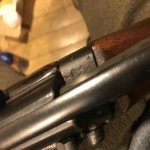
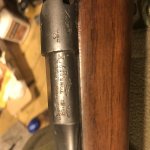
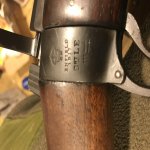
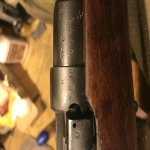
I must be getting old and half blind - I do not see a "DP" marking in your pictures ...
I had read that the original thought was that a British service rifle that failed various gauge inspections was "condemned" for use as a service rifle, was deemed to be beyond repairable - and relegated to "Drill Purpose" use only. History shows that unit armouries might have kept a stock of such "condemned" rifles.
However, if they had 11 on hand and a Requisition came in for 50, then people of the day would simply grab those condemned 11 plus 39 others from the "rack" - all got marked "DP" and requisition was filled - everyone appeared happy with that.
As a result, some marked "DP" have what was considered a "fatal flaw" for use as a battle rifle. Some others were perfectly fine. Up to us today to discover why was that particular rifle marked "DP" - is a challenge because not many have the correct gauges, any more, to tell the difference. It might be as subtle as a worn magazine catch in the receiver body, or as "obvious" as a crack in the receiver ring ... Or, perhaps, nothing wrong with it at all.
It might be significant that the rifle was BNP proof tested - that was only done, apparently, when that rifle was released from service and was to be sold to civilians. But passing "proof" may not indicate what was the issue that condemned the rifle to "DP" status - if there was any flaw to start with? I do not think the military could mark a rifle as "DP", after the BNP proof test, because rifle would no longer have "belonged" to the DND??
Is also possible that a part received the "DP" mark, to identify that rifle as DP - but then that part got swapped by a civilian owner?? For example, I have some front bands for P14's, that are stamped "DP" - I am not so sure how that particular part can "fail" any gauge test - that it could not have been easily replaced when in service - the "DP" mark might have been to identify the rifle that it used to be on, so swapping out that part makes the "DP" designation for that rifle go away??