Enfield markings help

Battleworn

Regular
Super GunNutz
Rating - 100%
58   0   1
Hey

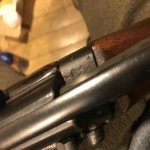
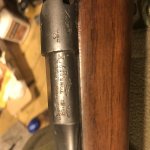
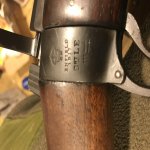
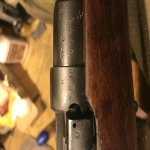
I recently got this enfield on a trade. Was just reading on d p marked enfields and how they’re not safe to shoot. Is that true? This rifle looks like it was made in 1917 recerviced in 1937 and went through bnp at some point and was proof tested. Before coming state side. Rifle is all matching accept for the mag. And is missing the mag cut off. Any info anyone could provide on this rifle would be greatly appreciated. 4D8B386A-2AE0-4E36-BC10-13C6A19D28D3.jpgD5ED0203-5499-4031-880B-84224D307DBF.jpgAA50FD56-D7E6-4F55-A86A-EA2CD787A708.jpg5AAC42EF-1166-4AE3-8605-2BCFABF42D48.jpgAA50FD56-D7E6-4F55-A86A-EA2CD787A708.jpg
 

Attachments

  • 4D8B386A-2AE0-4E36-BC10-13C6A19D28D3.jpg
    4D8B386A-2AE0-4E36-BC10-13C6A19D28D3.jpg
    54.4 KB · Views: 114
  • D5ED0203-5499-4031-880B-84224D307DBF.jpg
    D5ED0203-5499-4031-880B-84224D307DBF.jpg
    57.4 KB · Views: 114
  • AA50FD56-D7E6-4F55-A86A-EA2CD787A708.jpg
    AA50FD56-D7E6-4F55-A86A-EA2CD787A708.jpg
    64.7 KB · Views: 115
  • 5AAC42EF-1166-4AE3-8605-2BCFABF42D48.jpg
    5AAC42EF-1166-4AE3-8605-2BCFABF42D48.jpg
    57.7 KB · Views: 114
I must be getting old and half blind - I do not see a "DP" marking in your pictures ...

I had read that the original thought was that a British service rifle that failed various gauge inspections was "condemned" for use as a service rifle, was deemed to be beyond repairable - and relegated to "Drill Purpose" use only. History shows that unit armouries might have kept a stock of such "condemned" rifles.

However, if they had 11 on hand and a Requisition came in for 50, then people of the day would simply grab those condemned 11 plus 39 others from the "rack" - all got marked "DP" and requisition was filled - everyone appeared happy with that.

As a result, some marked "DP" have what was considered a "fatal flaw" for use as a battle rifle. Some others were perfectly fine. Up to us today to discover why was that particular rifle marked "DP" - is a challenge because not many have the correct gauges, any more, to tell the difference. It might be as subtle as a worn magazine catch in the receiver body, or as "obvious" as a crack in the receiver ring ... Or, perhaps, nothing wrong with it at all.

It might be significant that the rifle was BNP proof tested - that was only done, apparently, when that rifle was released from service and was to be sold to civilians. But passing "proof" may not indicate what was the issue that condemned the rifle to "DP" status - if there was any flaw to start with? I do not think the military could mark a rifle as "DP", after the BNP proof test, because rifle would no longer have "belonged" to the DND??

Is also possible that a part received the "DP" mark, to identify that rifle as DP - but then that part got swapped by a civilian owner?? For example, I have some front bands for P14's, that are stamped "DP" - I am not so sure how that particular part can "fail" any gauge test - that it could not have been easily replaced when in service - the "DP" mark might have been to identify the rifle that it used to be on, so swapping out that part makes the "DP" designation for that rifle go away??

 
Last edited:
Thank you for that info! The d p mark is in the second last photo “d” on the receiver and “p” on the barrel.

I have never seen done like that - most that I have seen are capital "DP" together. I presumed what was on the receiver ring was a poorly struck "P", like is shown on the barrel. Purely spitballing - but like "P" "block", No. 5870 - I am sure there were many 10's of thousands of those rifles made - much more than could be sequentially numbered with a 4 digit serial number?

 
Last edited:
Battleworn

The rifle is a Rifle, Number 1 Mark III, produced in 1917 as a Mark III* and refurbished post Great War to Mark III standard. Many rifles in good condition after the Great War were brought up to Mark III standard. Mark III* was a 'war expedient" production series with many corners cut for time and ease of production. The '37 stamp was added during an armourer's inspection while in service.

I do not see a "Drill Pattern" stamp anywhere on the rifle. I see a serial number (P 5870) and a stamp that says BNP (British Nitro Proof). The latter BNP stamp is as Potashminer said - safe for sale to the civilian market. No rifle marked DP would even be sent for proof tests by the MOD, let alone be sold to the civilian market. A DP rifle would never be authorized for live ammo - i.e. used for drill, dry fire training and then ultimately sent to the smelter.

Lastly, there is a PH stamp on the wrist, just forward of the stock on the right side. This is a "Parker Hale" stamp - back in the day, a popular and well respected distributor or Lee Enfield war surplus rifles. Parker Hale never sold junk.

This is no Drill Pattern Rifle. Check the bolt, make sure it matches, and if it does, it's likely an excellent rifle. Take it to a gunsmith for an inspection and then have fun with the old girl.

Jim
 
It is not a DP mark, it is part of the serial number: the P on the receiver is poorly stamped and should read as a P.

Tech 551 is bang on. P 5870 is the serial number. The P on the Knox Form is poorly done and just looks like a D. It is all all matching Number one - at least the receiver and barrel. Check the back of the bolt handle and the nose (where the bayonet attaches). If they also have P 5870, you have an all matching rifle.
 
The "all matching" would be a nice bonus - actually pretty necessary for a collector, I think? But as per an above post - still want to have it checked for function if you plan to shoot it. It could be "all matching" - with rusted out or rust filled bore, "wallowed" out rifling at the muzzle, damaged crown, excessive headspace from wear on bolt lugs or receiver seats, broken off or crushed "draws", chipped or mis-shaped firing pin tip and so on.

Is very conceivable that it has been 75 years or more since a military armourer inspected and serviced it - not really sure where it has been since then, or what "adventures" it may have had ...
 
Last edited:
Hey guys. Thanks for the reply’s and all the info. Much appreciated! I can confirm the bolt is matching. Though to clarify the rifle was sporterized. So the forstock is cut down. And missing all the military configured parts. I have since been collecting the necessary parts to restore it. Just missing the mag cut as far as I can tell. Barrel on the rifle is really nice. Sharp rifling. And lots of copper when I drop a bullet in it.
 
Not real certain what you mean by "drop a bullet in it" - it should not fit. The best way to determine your bore diameter at the muzzle might be to tap in a soft lead slug - then measure that slug? A commercially made 303 British bullet is usually .311" or .312" body diameter or thereabouts. Nominally, the rifling should be about .303" - face to face - and the grooves about .313" or so. A 303 bullet should not "go in" to the muzzle, if that is what you meant. I have an abused No. 4 - a .308" bullet would fully enter into the bore at the muzzle. I sawed it off to 20", thinking to make a "carbine" of sorts - no joy - that same .308" diameter bullet still fully enters that bore. I have condemned the barrel and am awaiting a replacement for it. Many, many years of no maintenance, no cleaning and being allowed to rust just did up that barrel bore to uselessness, I think.
 
I think he is saying there is lots of bullet showing between muzzle and case when he sticks the bullet in the bore. The way I test them. I have never slugged a 303 bore. I usually grab my lead loads 0.312 bullet and try shooting those first. Then if those don’t work I try 0.314. Two sizing dies I have, so if they don’t work I usually scrap the rifle.
 
Back
Top Bottom