Ever feel like you're chasing your tail?

I am interested in knowing more what's meant here. Can you help me out and elaborate a little more? Thanks!

Regards
Ronr

My method is to shoot ammo with successively larger powder charges, starting with 1-2 grains below max. Like CR5 says, I avoid increasing more than 0.2 gr per cartridge. I record velocities, and look for nodes where small increases in pressure result in little or no change in velocity. These can be visually identified as a "flat spot" when graphed in excel. This ammo should be more forgiving of variations in weather, neck tension etc. I'll usually load more rounds in small increments across the flat spot/node or play with neck tension and shoot for groups to refine the load. It saves you having to load 5-10 rounds per charge as you would with traditional OCW - cheaper in ammo and barrel life. It also has the benefit of being able to do load development at relatively short ranges. Make sense?


As with all hand loads, start below max and ALWAYS watch for pressure signs.
 
My method is to shoot ammo with successively larger powder charges, starting with 1-2 grains below max. Like CR5 says, I avoid increasing more than 0.2 gr per cartridge. I record velocities, and look for nodes where small increases in pressure result in little or no change in velocity. These can be visually identified as a "flat spot" when graphed in excel. This ammo should be more forgiving of variations in weather, neck tension etc. I'll usually load more rounds in small increments across the flat spot/node or play with neck tension and shoot for groups to refine the load. It saves you having to load 5-10 rounds per charge as you would with traditional OCW - cheaper in ammo and barrel life. It also has the benefit of being able to do load development at relatively short ranges. Make sense?


As with all hand loads, start below max and ALWAYS watch for pressure signs.

Yup makes sense. While shooting groups velocity is recorded. I use a magnetospeed which I found quite reliable but the other thread suggesting barrel harmonic effects, poi shifts etc. is why I am reluctant to capture velocity at the same time. My rifles don't have the sufficient barrel make up to attempt in my mind.

I graph on excel as well, and I use a modified OCW method between sessions/conditions to convince myself of the repeatability results of nodes. ES and SD values appear to have correlation but I haven't been in this game too long compared to the majority. Life has stepped in the way of spending time at the range and the reloading bench lately to continue testing of my own views/hypothesis regarding cause and effects such as neck tension and seating depth. I haven't spend any time understanding velocity/pressure relationships...yet. I'm just a hunter that's been bitten by the reloading bug and trying to get the most of what I have.


Much obliged on the response.

Regards
Ronr
 
6.5CMes-sd.jpg

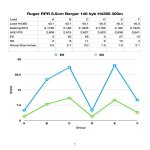
I'll leave this graphic here for shooter to review and understand. This was sent to me from a very good F open shooter with a very nice rifle. He is meticulous in his loading and data collection.

Compare the SD and ES numbers between the two load ranges. His loads are withing 0.02gr as he is loading on an excellent millligram scale

I know that velocity monitoring is all the rage but I have said many times, ES and SD can provide a false positive. The only way to know how a rifle shoots is on a target at distance and plot the shots.

Jerry
 

Attachments

  • 6.5CMes-sd.jpg
    6.5CMes-sd.jpg
    50.4 KB · Views: 194
had some fun playing with a savage in 243 a few years ago. bought 2 boxes of factory 100grn for initial sighting and break in. Then I started to work up loads with lighter bullets 55grn Nosler BT I think. all over the place tried a few other bullets and bullet weights but nothing was any better then the original groups with factory. So reluctantly I bought some cheap Hornady 100grn bullets and what do you know with a little work it started to group sub MOA. But then I sort of lost interest in it as I was thinking of using it as a lighter backup varmit gun, my 22-250 weighs in at just over 12 lbs
 
View attachment 183086

I'll leave this graphic here for shooter to review and understand. This was sent to me from a very good F open shooter with a very nice rifle. He is meticulous in his loading and data collection.

Compare the SD and ES numbers between the two load ranges. His loads are withing 0.02gr as he is loading on an excellent millligram scale

I know that velocity monitoring is all the rage but I have said many times, ES and SD can provide a false positive. The only way to know how a rifle shoots is on a target at distance and plot the shots.

Jerry

Thanks for the reminder Jerry. This would explain the "appears" to correlate statement I posted earlier. Magnetospeed results testing (post node finding) weren't great but the groups were. I have to train myself to treat chrony results as dope for the optics and nothing more for my own sanity.

Appreciate the information. That graph explains much for myself and it's good data to refer back to.

Regards
Ronr
 
Just finished loading up some rounds for the Ruger

I was pretty fussy about getting everything as accurate as possible. Length is 0.010" off the lands and it still fits in the mag.

Still debating whether to setup at 200 or 300 yards but I'm looking forward to it. I plan to shoot without the Magnetospeed and see which groups stand out then send some rounds over it at the end to get an idea of whats going on with the velocities
 
The RPR will be far faster and easier to get shooting so you can test various parameters and see what is happening on target. If using a 140gr class bullet, H4350 and a CCI200 primer in Hrn brass, start at 40.5gr and work up to 42.5gr... you will find a load somewhere here... DONE.

I would suggest a heavier bullet for the X95 as the long throats mean the lighter bullets are going to spray.... I would go right to the 75gr BTHP with a light/moderate load and see what happens.

Jerry

Is that load data something you've used Jerry? I ask as it goes beyond Hodgson`s upper limit (I'm using IMR 4350 which seems very similar and needs slightly more powder than H4350 like for like it seems):

Screen Shot 2018-06-15 at 22.14.46.jpg

Screen Shot 2018-06-15 at 22.20.28.jpg
 

Attachments

  • Screen Shot 2018-06-15 at 22.14.46.jpg
    Screen Shot 2018-06-15 at 22.14.46.jpg
    30.9 KB · Views: 125
  • Screen Shot 2018-06-15 at 22.20.28.jpg
    Screen Shot 2018-06-15 at 22.20.28.jpg
    21.5 KB · Views: 128
Is that load data something you've used Jerry? I ask as it goes beyond Hodgson`s upper limit (I'm using IMR 4350 which seems very similar and needs slightly more powder than H4350 like for like it seems).

Posted data is what they figure is safe in every rifle out there, as with any loads, what's safe in one guys rifle may not be safe in yours. Work up slowly and carefully.

I would switch to Hodgdon 4350, similar but not the same and between myself and my buddy who is loading for his 6.5CM as well we've both discovered that 6.5CM seems to have very small nodes so the most temp stable powder you can get is the best powder to use.
If H4350 is not available try IMR4451 which is their Enduron series and supposed to be more temp stable. I've done a little testing with it and groups were good but I didn't get enough time testing before I found H4350 and have put the 4451 aside for now.
 
Is that load data something you've used Jerry? I ask as it goes beyond Hodgson`s upper limit (I'm using IMR 4350 which seems very similar and needs slightly more powder than H4350 like for like it seems):

You bring up an excellent point, and a big reason I don't list my load data... if you look at various load data from component companies, you will quickly see that min/max powder charges vary ... and quite a bit.

https://load-data.nosler.com/load-data/65-creedmoor/

https://sierrabulletsblog.com/2017/01/09/sierra-bullets-6-5-creedmoor-load-data/

With all the possible options in brass, primers (size and type), bullets, barrels and of course, powder lots, how the heck do you know what to believe and where to start?

Follow the main rule in reloading... "start low and work up, looking for pressures signs".... and I will add one more very important thing... monitor the velocities and understand you are near max pressures when you approach the max listed velocities of several professional data sources.

Powder lots can and will vary.. sometimes quite a lot. So can case volumes and primer brissance, etc.

When the data was generated, THAT specific combo of stuff produced the results which they list. If you look at the other two links.. Nosler and Sierra offer quite different max loads. The data I am basing my loading on, had a slightly higher max charge again.... and yes, I do load within that range which I will get to in a moment.

But the one thing that is universal throughout ALL the data (and if you check, factory ammo) is the listed max velocity for that given bullet weight.

Look up the velocity from EVERY reloading manual and site (again, professional only), and you will see that the listed max velocity for a 6.5 Creedmoor in a 24" barrel using a 140gr bullet is right around 2700fps... a bit lower, a bit higher, but all in the same ball park.

And this is why owning a chronograph is so important.

When I worked up my loads with MY set of components, I hit 2700fps right in the middle of the range I suggested... other shooters I know were closer to the top end likely due to longer throats and/or looser barrels (all shoot factory rifles.. but that can also vary).

If you hit 2700fps but are say at 39.8gr of H4350 in YOUR set up, that's it.... in your rifle, using your specific batch of stuff, you are working in the max pressure ranges of this cartridge. Sure you can fudge a little higher as long as there are no obvious pressure signs but you aren't getting another 100fps or more with "no pressure".

I run two brands of brass... and the working loads vary almost 1 gr between. Same velocity, same drop chart out to 1000yds

now you run a small rifle primer brass and find that you actually need to add more powder, that would not be weird or unsafe. SR primers can have way less flash then a LR primer... but then some SR primer cases have smaller case volume... and on and on it goes.

So instead of trying to brain crunch all options to figure out THE load (which you never can by the way), just go to the range with ammo starting low and work up. Monitor the velocities and fired cases... and of course the target.

If you are new, or never seen this combo of chamber and rifle, I would make up 2rds using a min, mid and max printed load. Shoot them and see where the velocities lie.

I have had rifles that hit max using a start load (just like my suggested powder charge compares to your posted data)... I have had rifles that went a few grains beyond to hit the expected velocities. You just never know so don't guess... start low and work up.

Now a big giveaway on why your Hodgdon data is so different then the other two sources, note that both H4350 and IMR 4350 data show a compressed load. Compare that to the Nosler data which also uses HRN brass but only lists it as 93% full.

The brass that Hodgdon ran had way less case volume then the stuff Nosler ran. More case volume... more fuel to reach the same pressures/velocity. I love that Nosler shows the H2O capacity of the cases they tested... THAT is good data.

I am also using HRN brass, I am no where near a compressed load.

Components vary..... work up slowly... watch the max velocities and target.

Simple.

Jerry

 
I have noted others mentioning that RL16 is also a good temperature stable powder to use with the 6.5. Similar burn rates and characteristics to H4350. I too have noted the same small accurate velocity nodes with H4350 and the 6.5CM. I started out testing 130gr bullets, and have pretty much settled on Sierra 140 and 142gr MK. Powder charge with H4350 in the 40.3gr vicinity for the lower velocity node near 2625fps and 41.7 to 41.8gr for the upper velocity node near 2715fps. Currently working on 147 gr Hornady ELD-M with some very good success with an H4350 charge of 40.4gr give or take. These charges have been worked up from minimums and are for MY rifle. Please work up your own and take care.

I see Jerry replied as well while I was typing. As always, excellent advice!
 
Last edited:
Lots of good loading information here. Just want to add that, you will chase your tail for a long time unless you stop. Several years ago I realized I had at least one load for every rifle I have that is really quite good. So now I just replicate those loads and then shoot them. Sometimes I read about a new bullet or powder that might be able to better the performance of "my" load by a percent or even 3, but I no longer think that pursuit is worth it to me. If you find it fun, trying for "more perfect" can be lots of fun, but if you ever really start to feel like you are "chasing your tail" I suggest you pick a good load and live with it.

Perfection is the enemy of really good.
 
I cleaned the gun between sessions - is it possible that a clean gun can shoot worse than a dirty gun?

Didn't see it touched on yet, but YES, absolutely a clean gun can shoot worse. It's not uncommon at all to have a bore that takes a few fouling rounds to settle down. I have one rifle that puts the first round from a clean bore 3 MOA high, the second 1.5-2 MOA high and then rounds 3-20 are all sub .75 MOA right on
POA until groups start opening up again from fouling. So if I was going to start load work up with a clean bore on that rifle, I'd think the first three round group was terrible.
 
Lots of good loading information here. Just want to add that, you will chase your tail for a long time unless you stop. Several years ago I realized I had at least one load for every rifle I have that is really quite good. So now I just replicate those loads and then shoot them. Sometimes I read about a new bullet or powder that might be able to better the performance of "my" load by a percent or even 3, but I no longer think that pursuit is worth it to me. If you find it fun, trying for "more perfect" can be lots of fun, but if you ever really start to feel like you are "chasing your tail" I suggest you pick a good load and live with it.

Perfection is the enemy of really good.

A good friend of mine gave me similar advice a few years ago. I had 5 different bullets and 3 different powders to test in one of my rifles. He told me to pick one projectile and one powder and work through it till I found my load or realized that combination was not going to shoot.
There are too many options out there and since every barrel is different you could continue chasing the perfect load forever.
I've found many 0.5moa loads over the years and I'm sure they could be better but unless it's a rifle I plan to shoot 800 yards or more with 0.5 is plenty good enough.

Have realistic expectations of yourself and your rifle as well. If you're shooting a bone stock Rem 700 don't expect to be able to find a load that consistently shoots 0.25 moa. You may get lucky and get the best barrel they've ever made but chances are that 0.5-0.75 moa is the best you're going to get without a quality barrel, bedding, trigger, and quality optics.
Also remember that most of us are amateurs even if we've been shooting for years, so that load that worked great last time and isn't shooting well today could very well be our own inconsistent shooting techniques that is the problem and not the load. Even shooting from a lead sled or sandbags can be screwed up by the shooter so try not to get frustrated when you seem to be having a bad day.
 
Last edited:
You bring up an excellent point, and a big reason I don't list my load data... if you look at various load data from component companies, you will quickly see that min/max powder charges vary ... and quite a bit.

https://load-data.nosler.com/load-data/65-creedmoor/

https://sierrabulletsblog.com/2017/01/09/sierra-bullets-6-5-creedmoor-load-data/

With all the possible options in brass, primers (size and type), bullets, barrels and of course, powder lots, how the heck do you know what to believe and where to start?

Follow the main rule in reloading... "start low and work up, looking for pressures signs".... and I will add one more very important thing... monitor the velocities and understand you are near max pressures when you approach the max listed velocities of several professional data sources.

Powder lots can and will vary.. sometimes quite a lot. So can case volumes and primer brissance, etc.

When the data was generated, THAT specific combo of stuff produced the results which they list. If you look at the other two links.. Nosler and Sierra offer quite different max loads. The data I am basing my loading on, had a slightly higher max charge again.... and yes, I do load within that range which I will get to in a moment.

But the one thing that is universal throughout ALL the data (and if you check, factory ammo) is the listed max velocity for that given bullet weight.

Look up the velocity from EVERY reloading manual and site (again, professional only), and you will see that the listed max velocity for a 6.5 Creedmoor in a 24" barrel using a 140gr bullet is right around 2700fps... a bit lower, a bit higher, but all in the same ball park.

And this is why owning a chronograph is so important.

When I worked up my loads with MY set of components, I hit 2700fps right in the middle of the range I suggested... other shooters I know were closer to the top end likely due to longer throats and/or looser barrels (all shoot factory rifles.. but that can also vary).

If you hit 2700fps but are say at 39.8gr of H4350 in YOUR set up, that's it.... in your rifle, using your specific batch of stuff, you are working in the max pressure ranges of this cartridge. Sure you can fudge a little higher as long as there are no obvious pressure signs but you aren't getting another 100fps or more with "no pressure".

I run two brands of brass... and the working loads vary almost 1 gr between. Same velocity, same drop chart out to 1000yds

now you run a small rifle primer brass and find that you actually need to add more powder, that would not be weird or unsafe. SR primers can have way less flash then a LR primer... but then some SR primer cases have smaller case volume... and on and on it goes.

So instead of trying to brain crunch all options to figure out THE load (which you never can by the way), just go to the range with ammo starting low and work up. Monitor the velocities and fired cases... and of course the target.

If you are new, or never seen this combo of chamber and rifle, I would make up 2rds using a min, mid and max printed load. Shoot them and see where the velocities lie.

I have had rifles that hit max using a start load (just like my suggested powder charge compares to your posted data)... I have had rifles that went a few grains beyond to hit the expected velocities. You just never know so don't guess... start low and work up.

Now a big giveaway on why your Hodgdon data is so different then the other two sources, note that both H4350 and IMR 4350 data show a compressed load. Compare that to the Nosler data which also uses HRN brass but only lists it as 93% full.

The brass that Hodgdon ran had way less case volume then the stuff Nosler ran. More case volume... more fuel to reach the same pressures/velocity. I love that Nosler shows the H2O capacity of the cases they tested... THAT is good data.

I am also using HRN brass, I am no where near a compressed load.

Components vary..... work up slowly... watch the max velocities and target.

Simple.

Jerry

Excellent information and explanation Jerry - thanks again for your help

 
Didn't see it touched on yet, but YES, absolutely a clean gun can shoot worse. It's not uncommon at all to have a bore that takes a few fouling rounds to settle down. I have one rifle that puts the first round from a clean bore 3 MOA high, the second 1.5-2 MOA high and then rounds 3-20 are all sub .75 MOA right on
POA until groups start opening up again from fouling. So if I was going to start load work up with a clean bore on that rifle, I'd think the first three round group was terrible.

As I suspected. I have to sight this rifle in tomorrow and so I've made a few rounds with powders charges towards the lower end of the scale to help accomplish this. By the time its sighted I should be good to go.
 
Lots of good loading information here. Just want to add that, you will chase your tail for a long time unless you stop. Several years ago I realized I had at least one load for every rifle I have that is really quite good. So now I just replicate those loads and then shoot them. Sometimes I read about a new bullet or powder that might be able to better the performance of "my" load by a percent or even 3, but I no longer think that pursuit is worth it to me. If you find it fun, trying for "more perfect" can be lots of fun, but if you ever really start to feel like you are "chasing your tail" I suggest you pick a good load and live with it.


Perfection is the enemy of really good.


Yes, good point. I know for sure this hasn't been a factor with the X95 (I haven't found anything even remotely accurate so far) but I am conscious of it.

I have prepped up some cheap plinking rounds with different powder charges to test at some point and whichever comes out top on the day will be the basis for making up a bulk run on the progressive.
 
As I suspected. I have to sight this rifle in tomorrow and so I've made a few rounds with powders charges towards the lower end of the scale to help accomplish this. By the time its sighted I should be good to go.

Bingo. That's exactly what to do, and I should have mentioned it.
 
So when I next attempt some load testing for 223/556 whats everyones "go to" powder?

I've been using H335 and it meters nice but are their better options out there?

From what I can tell CFE223 & Varget seem popular across a wide range of applications, or should I just stick with H335?
 
So whats everyones opinion on what distance for my 6.5 Creed testing tomorrow? 200 or 300?

Does one have an advantage over the other?
 
Back
Top Bottom