Faster powders for shorter barrels - say 1680 for a 16 inch 308

Status
Not open for further replies.
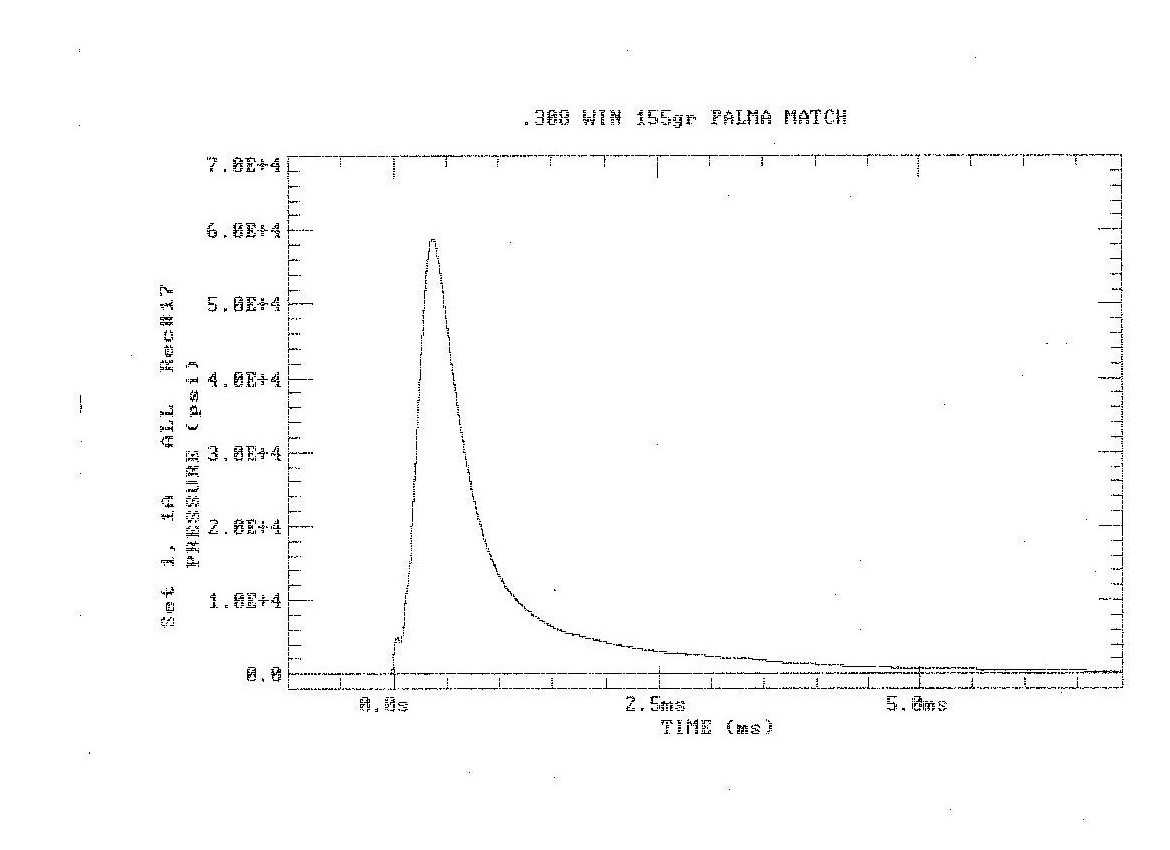
I know that Ganderite has otherwise suggested that, with a fast powder the peak pressure might come at 1". We also seem to know that, with most conventional loads, the majority of the powder is burned by the time that the bullet leaves a common length barrel - such as a 22 inch one. That bullet normally leaves such a barrel in about 1.2 Ms with conventional loads. However, the graph that he posted - of the pressure curve associated with a common 308 load - shows that pressure is still building up to 5 Ms after ignition - and that the peak of this pressure curve looks to me like comes at about .5 Ms (fairly close to the time when you'd expect the bullet to leave the bore).

hoLCpt9.jpg


Can anyone explain this apparent discrepancy?

Seems you don’t understand how to read the graph. Line up=pressure up, line down=pressure down. This whole thread seems to have been drawn out due to you not reading it properly, funny. How do you like your crow, medium rare or well done?
 
Last edited:
Seems you don’t understand how to read the graph. Line up=pressure up, line down=pressure down. This whole thread seems to have been drawn out due to you not reading it properly, funny. How do you like your crow, medium rare or well done?

That has been abundantly evident since he first commented on the graph.

As well, if instead of just theorizing he had actually chronographed only a few rounds of different powders, he might have grasped that.

Ted
 
That graph shows by 1.5ms there is very little pressure left. The peak is very near .5ms not 5ms. 5ms is so far right there is no pressure.

I was indeed unclear about the style of the graph - and that's specifically why I asked my questions.

I would say that my confusion originated from the fact that Ganderite described this as “my pressure curves for a 308 round I tested”. This led me to wrongly conclude this was a dynamic pressure curve, specific to a particular caliber and load.

To me that meant that it took into account the pressure characteristic of a loaded, fired cartridge and mapped the pressure as the bullet ran down the barrel – and that, as such, it account for such dynamics as the fact that the volume in which the gases are expanding is itself increasing (as the bullet runs down the bore) and the addition heat is factored-in associated with the friction of the bullet in the bore, etc.

Believing that this was a dynamic pressure graph caused me to believe that the area under the curve between say 2.0 and 2.5 Ms was supposed to represent the incremental pressure produced during this interval - over and above the pressure level reached at 2.0 Ms, etc.

With your explanation it is now clear that this is really just a very basic static pressure graph, created by just putting some powder in a closed pressure vessel, making it go bang and measuring the pressure as it goes up and down. This is just a representation of how powder X burns in a closed vessel and so the references to a “load” and a caliber (“308”) were really just an irrelevant red herrings – which did, indeed, confuse me.

Thank you for this clarification. Unfortunately, as far as I can tell, a static pressure graph like this doesn’t really provide useful insights into how much muzzle blast would be associated with a given load. IIRC QL is more useful for assessing the likely level of muzzle blast - since I believe it determines the dynamic (not static) pressures of the load at different burn times and at different muzzle lengths. I’ll look out for that feature when I get my new copy – hopeful soon.
 
I was indeed unclear about the style of the graph - and that's specifically why I asked my questions.

I would say that my confusion originated from the fact that Ganderite described this as “my pressure curves for a 308 round I tested”. This led me to wrongly conclude this was a dynamic pressure curve, specific to a particular caliber and load.

To me that meant that it took into account the pressure characteristic of a loaded, fired cartridge and mapped the pressure as the bullet ran down the barrel – and that, as such, it account for such dynamics as the fact that the volume in which the gases are expanding is itself increasing (as the bullet runs down the bore) and the addition heat is factored-in associated with the friction of the bullet in the bore, etc.

Believing that this was a dynamic pressure graph caused me to believe that the area under the curve between say 2.0 and 2.5 Ms was supposed to represent the incremental pressure produced during this interval - over and above the pressure level reached at 2.0 Ms, etc.

With your explanation it is now clear that this is really just a very basic static pressure graph, created by just putting some powder in a closed pressure vessel, making it go bang and measuring the pressure as it goes up and down. This is just a representation of how powder X burns in a closed vessel and so the references to a “load” and a caliber (“308”) were really just an irrelevant red herrings – which did, indeed, confuse me.

Thank you for this clarification. Unfortunately, as far as I can tell, a static pressure graph like this doesn’t really provide useful insights into how much muzzle blast would be associated with a given load. IIRC QL is more useful for assessing the likely level of muzzle blast - since I believe it determines the dynamic (not static) pressures of the load at different burn times and at different muzzle lengths. I’ll look out for that feature when I get my new copy – hopeful soon.

Uhhhh.... No?

The pressure drops BECAUSE of the fact that the volume is rapidly increasing. What you suggest ("static pressure graph" as you call it) would only show an increasing line, because if it was a closed pressure vessel the pressure wouldn't decrease at any point.

Now it seems like you're just making #### up to try and make yourself look less stupid...
 
The pressure gun (the receiver is a falling block, big enough for a 20mm canon shell) takes a variety of pressure barrels in the various calibers. A piezoelectric sensor is fitted to the barrel.

An ammo test is usually 20 rounds. The pressure curve is captured for each shot. A few years ago I purged my files of hundreds of pages of this stuff for which I have no use.

But I missed a few pages. The curve you see is an actual 308 round I tested. I don't have any data to go with it, so I don't know if it is Palma Match ammo I was making or if it is the ammo made by Jensen for the '92 Palma Match.

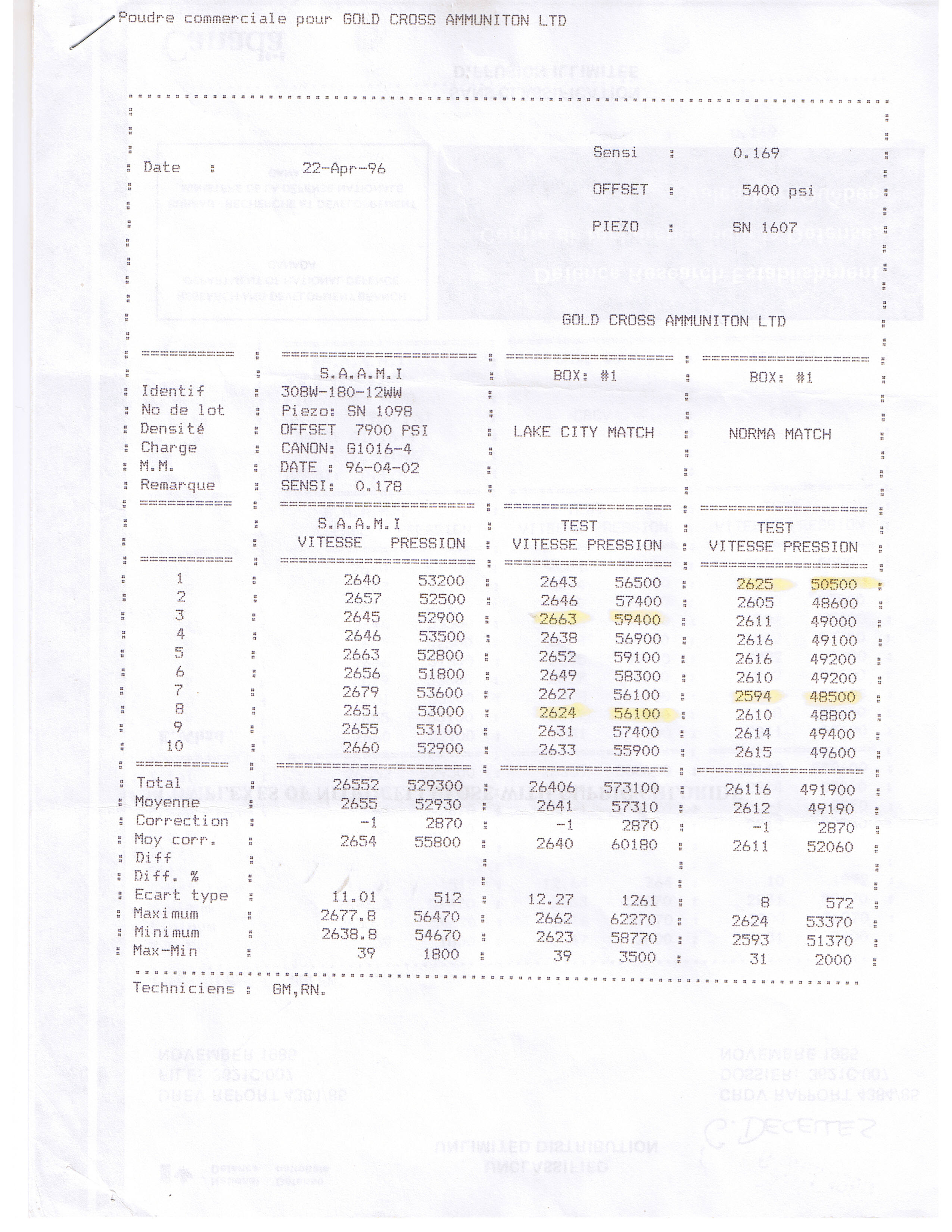
The test data is automatically captured and a print out looks like this:
uDmBPrX.jpg


In 308 there were two barrels used by the federal lab. The standard SAAMI test barrel and a longer, tighter Kreiger barrel with an Obermyer chamber. The latter increased pressures and velocities.

I don't know if the material printer here came from the EXPRO lab (IMR) or from the feds.
 
The pressure gun (the receiver is a falling block, big enough for a 20mm canon shell) takes a variety of pressure barrels in the various calibers. A piezoelectric sensor is fitted to the barrel.

An ammo test is usually 20 rounds. The pressure curve is captured for each shot. A few years ago I purged my files of hundreds of pages of this stuff for which I have no use.

But I missed a few pages. The curve you see is an actual 308 round I tested. I don't have any data to go with it, so I don't know if it is Palma Match ammo I was making or if it is the ammo made by Jensen for the '92 Palma Match.

The test data is automatically captured and a print out looks like this:
uDmBPrX.jpg


In 308 there were two barrels used by the federal lab. The standard SAAMI test barrel and a longer, tighter Kreiger barrel with an Obermyer chamber. The latter increased pressures and velocities.

I don't know if the material printer here came from the EXPRO lab (IMR) or from the feds.

Do you have pressure graphs for 9mm, 45acp(115 and 230 respectively)? 30-40Krag, 30-06, 300winmag(all 180gr)? shotguns? I'm curious as to how the curves compare for these rounds of different peak pressures, case capacity, velocity and the small differences in time at which these deliver their bullet/shot beyond the barrel and to their destinies with gravity and wind resistance. It's a curiosity... I understand what is going on in the pressure vs. time graphs, but am curious about the differences beyond max pressure.
 
Makes much more sense now how he blew up 3 guns...

I get a really get a chuckle out of Hitzy. There are definitely a few like him on CGN whose lives seem to revolve around finding lame excuses to put other posters down. Click on his name and view his profile and his last posts. Not a lot of nice things said there.

He has accused me of blowing up an Erma EP 22LR pistol as a result of my handloading error ?!!!!. Think about that. You actually can't make this stuff up.
 
Last edited:
Do you have pressure graphs for 9mm, 45acp(115 and 230 respectively)? 30-40Krag, 30-06, 300winmag(all 180gr)? shotguns? I'm curious as to how the curves compare for these rounds of different peak pressures, case capacity, velocity and the small differences in time at which these deliver their bullet/shot beyond the barrel and to their destinies with gravity and wind resistance. It's a curiosity... I understand what is going on in the pressure vs. time graphs, but am curious about the differences beyond max pressure.

All the testing I did in the 90s was for 223 and 308.

I don't think I ever tested those other calibers at any time.
 
I get a really get a chuckle out of Hitzy. There are definitely a few like him on CGN whose lives seem to revolve around finding lame excuses to put other posters down. Click on his name and view his profile and his last posts. Not a lot of nice things said there.

He has accused me of blowing up an Erma EP 22LR pistol as a result of my handloading error ?!!!!. Think about that. You actually can't make this stuff up.

Well you don't see too many people talk about needing a ladder if you use a 300winmag for deer, either.
 
I was indeed unclear about the style of the graph - and that's specifically why I asked my questions.

I would say that my confusion originated from the fact that Ganderite described this as “my pressure curves for a 308 round I tested”. This led me to wrongly conclude this was a dynamic pressure curve, specific to a particular caliber and load.

To me that meant that it took into account the pressure characteristic of a loaded, fired cartridge and mapped the pressure as the bullet ran down the barrel – and that, as such, it account for such dynamics as the fact that the volume in which the gases are expanding is itself increasing (as the bullet runs down the bore) and the addition heat is factored-in associated with the friction of the bullet in the bore, etc.

Believing that this was a dynamic pressure graph caused me to believe that the area under the curve between say 2.0 and 2.5 Ms was supposed to represent the incremental pressure produced during this interval - over and above the pressure level reached at 2.0 Ms, etc.

With your explanation it is now clear that this is really just a very basic static pressure graph, created by just putting some powder in a closed pressure vessel, making it go bang and measuring the pressure as it goes up and down. This is just a representation of how powder X burns in a closed vessel and so the references to a “load” and a caliber (“308”) were really just an irrelevant red herrings – which did, indeed, confuse me.

Thank you for this clarification. Unfortunately, as far as I can tell, a static pressure graph like this doesn’t really provide useful insights into how much muzzle blast would be associated with a given load. IIRC QL is more useful for assessing the likely level of muzzle blast - since I believe it determines the dynamic (not static) pressures of the load at different burn times and at different muzzle lengths. I’ll look out for that feature when I get my new copy – hopeful soon.


giphy.gif
 
It never ends.

steelgray said:
With your explanation it is now clear that this is really just a very basic static pressure graph, created by just putting some powder in a closed pressure vessel, making it go bang and measuring the pressure as it goes up and down. This is just a representation of how powder X burns in a closed vessel and so the references to a “load” and a caliber (“308”) were really just an irrelevant red herrings – which did, indeed, confuse me.

Thank you for this clarification. Unfortunately, as far as I can tell, a static pressure graph like this doesn’t really provide useful insights into how much muzzle blast would be associated with a given load. IIRC QL is more useful for assessing the likely level of muzzle blast - since I believe it determines the dynamic (not static) pressures of the load at different burn times and at different muzzle lengths. I’ll look out for that feature when I get my new copy – hopeful soon.

Amazing stuff, eh?

It would have been so simple to just say, "Thanks for the explanation. Appreciate that!"

Ted
 
What about the other 2 guns? And you can buy reloading kits for .22lr......

Why don't you read this whole thread.

See https://www.canadiangunnutz.com/forum/showthread.php/1924212-Guns-designed-without-out-of-battery-discharge-protection

I've been shooting for about 45 years and, as far as I can tell, I've had what I believe to be 3 different experiences with out of battery detonation "OOB"s. Considering the many 10s of thousands of rounds I've fired and the large number of guns I've owned, that's probably not out of the ordinary.

I did start a thread a while back to review the issue our of battery detonations. When you look at that thread, as I think you should, you'll see that quite a few other posters shared their experiences; so much so that this is was actually quite an informative thread.

The thread starts-off with me mentioning that I had had an experience where I had been firing reloaded ammo out of a Thureon Defense 10 millimeter carbine. Too bad for Hitzy, but nothing actually blew up. Instead, I found that among my fired brass was the case which had the head area totally swollen for about 6mms the up from the rim then the case diameter went down to normal. I knew enough, at that point, to immediately understand that this had been an out of battery detonation (OOB), where the swollen part of the case had obviously been protruding out of the chamber when the case had been fired.

I mentioned in the thread that I immediately, put this experience together with information that I had read, on CGN, about another guy who had had the same thing happen with his TD 10mm carbine. I was curious enough about this pattern that I tested my TD 10mm and my TD 9mm carbines and found that each could fire out of battery.

The test method is in the post. As an aside, I tested my Colt 9mm carbine and found that it could not fire OOB, These insight prompted me to start the thread.

As people added their experiences, in the thread these reminded me of two other experiences I had had - a lot further back - which became clear to me were also OOB situations. One was with a 22LR pistol - which suffered some damage firing factory 22 Aquilla ammo that Canadian Tire had been told not to sell.

The other was a case where I was firing a converted auto M14 in 243 using sub max reloads of H414 and 100 Gr soft points.

I don’t experiment with reloading as you guys do, but am a boring guy who just loads ammo for my two main shooting sports, hunting and IPSC. I usually load long batches on a Dillon 550B - hundreds of identical rounds at time. Once a run of identical rounds are produced, they go in a bag or box and are labelled.

I have my dies set adjusted and left for years in D550B individual tool heads (one per caliber). That tool head includes a flow through powder die with a powder measure mounted on that. The powder measure never comes of the tool head and don’t uses the same powder measure for pistol powder and rifle powder or whatever. Everything stays in one configuration.

On the day in question, I fired at least 20 rounds without issue, shooting offhand. After that round count (and I don’t know the actual no.) a round from that same well-marked batch grenaded - seriously damaging the gun.

That was many years ago and I didn’t know what OOBs were so I only thought maybe I’d made a reloading error – but I couldn't imagine what.

With that reloading set-up I have described you get a round every pull of the handle - and if you were try to do a double throw everything would be obviously wrong. You’d be trying to put a bullet on a completed round (in station four), you’d be trying to insert a new case in station one – where a case already was, etc. and the powder would over-flow.

One of the posters mentioned that he had lost an eye to his Springfield Armory M1A1 gun due to an OOB - and when he said that, things clicked. I now am convinced that my M14 experience was an OOB.

I’m leaving stuff out so read the whole thread.

https://www.canadiangunnutz.com/for...d-without-out-of-battery-discharge-protection

My experiences are posts 1, 5, and 14.

As recently as 6:20 this evening Hitzy was posting

“Makes much more sense now how he blew up 3 guns...”

Hitzy did that post this evening even though kodiakjack had already read the thread and 10 hours early and wrote

Not with his hand loads.” ... after someone else made the same false claim.

I don’t think Hitzy would like you to read post #18 of thread because it kind of dumps a load on his persistent efforts to claim that this event must have been as a result of my handloading error.

This is what I’m referring to.

https://www.canadiangunnutz.com/for...protection?p=16432460&viewfull=1#post16432460

The M14 was repaired and is still in my collection. No damage was suffered by the TD carbine and Canadian Tire acknowledged blame and paid for the repairs to my Erma EP 22 pistol.

The number of guns I have blown up as a result of handloading - or otherwise - is ZERO

 
Last edited:
Kindly explain. You seem to be going out of your way to be weirdly negative.

He’s talking about this:

I like this. However there are certainly folks who legally own original M14s in Canada. In fact, having shot these original M14s I can really say that the originals are really no better than the early Polytech that I own. As for the comparison between Norincos and Springfield Armory guns, the Norincos have more tool marks but use forged receivers - not castings like the Springfield Armory guns.

People make a HUGE deal about the fact that one early lot of Norinco had bolts that weren't properly heat treated but that is REALLY OLD NEWS and totally over blown.

Coincidentally, I personally blew the bolt and mag out of a real 12.3 Winchester M14 on a bad day. My fault on a reloading error. I'm still here and the gun has been fixed. Life is good and isn't black-and white. M14s aren't the paragon of perfection and M305s are terrible guns. It is all shades of gray


But can we get back on track here? Back to your assertion that Ganderite posted a graph for a pipe bomb?...
 
Status
Not open for further replies.
Back
Top Bottom