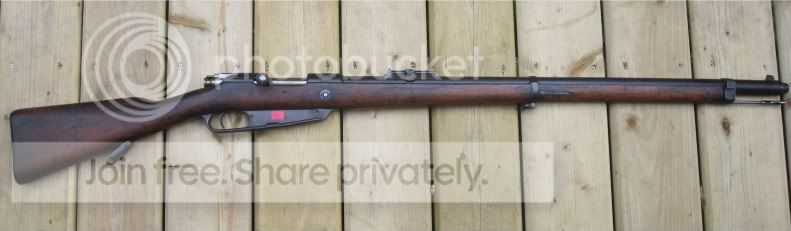
As to '88s, the Turks got a lot of them during the Great War and this is the source of the bulk of the rifles released here in the last 30 years or so. When they were running around right cheap, I picked up four of them, kept three, let a friend have one.
ONE was just like yours, 1891 Loewe, really nice shape. It had been "Turked" in part, has Arabic numbers of the rear sight, has been made up from all kinds of bit and reblued, a beautiful job. It shoots very nicely. I was actually silly enough to fire some RWS stuff that was headstamped only "RWS over E37": brass cases, FMJ bullets, .323" diameter. Recoil was awfully heavy. Turned out this particular ammo (sold mail-order by SIR) was Luftwaffe high-speed aircraft MG AP ammo with pressures 'WAY up at the limits for the MG-15! Sure made nice little quarter-inch holes straight through a chunk of B-25 belly armour. I toned the loads down more than a bit and it shoots really nice.
Second one I kept was made at the Konigliches Gewehrfabriken Amberg in 1898, right at the end of production. It has not been refinished although it has been FTR, more or less. Interesting thing about this rifle is the little "nm" stamp on the left side of the action: "Neues Muster" (New Issue). This rifle weighs nearly a pound more than the Loewe and the weight is ALL in the barrel and nearly all of that is right at the chamber: visibly thicker for about 4 inches ahead of the receiver. They had problems with the early rifles with the chambers "lifting out" and, of course, it was blamed on the Jews, hence the poor old rifle's nickname. The problem actually was that they didn't quite have a handle on smokeless powders yet and the Flake powder they were using was NOT progressive-burning: that was for Hudson Maxim to figure out, working in the USA for DuPont, although his brother Hiram (of aeronautical and machine-gun fame) had earlier worked this out in England. But chambers did lift out and it was the fault of the Jews, so the obvious thing was to make the chambers heavier.... which they proceeded to do. I still have these rifles so, if anyone doubts what I am saying, drop by for coffee and bring a screwdriver.
The third rifle came on the market a few months later and is what now is correctly called an 88/35: it uses the original 1888 action, completely rebuilt, a new 8x57 medium-weight barrel, 29 inches, stocked up in nice Turkish Walnut to look like a '95 Mauser. Only thing I don't like about it is the sloppy varnish finish, which is original on these.... and they could be SO nice.
All of these have the S, z and '14 mods: fat bullet, internal cartridge interruptor and do away with the clip-slot in the bottom of the mag well. You use regular '98 pattern chargers in all of these. I would think any rifle modded for the S would have had the sights graduated as well: new bullet was a 154 at 2880 ft/sec rather than a 227 at the original velocity.
They are beautiful old pieces of history, so very often unappreciated. And they are a LOT of fun at the range, too!
Congratulations on a FINE purchase!